](https://deep-paper.org/en/paper/10381_one_step_generalization_-1838/images/cover.png)
Introduction
Imagine training an AI to recognize a “cow.” You feed it thousands of images of cows in lush green pastures. It achieves 99% accuracy. Then, you show it a picture of a cow standing on a sandy beach. The model confidently predicts “sand” or fails to recognize the animal entirely.
This is the classic failure mode of Domain Generalization (DG). Deep learning models are notoriously lazy; they often latch onto the “spurious correlations”—like the green grass background—rather than the invariant features, like the shape of the cow itself. When the domain shifts (from pasture to beach), the model breaks.
Traditionally, researchers try to fix this by changing the model architecture or augmenting the data. But what if the problem lies in how the model learns? What if the optimization algorithm itself—the mathematical engine updating the weights—is biased toward these easy, spurious features?
In a compelling new paper, researchers propose GENIE (Generalization-ENhancing Iterative Equalizer). This novel optimizer fundamentally changes how neural networks update their parameters. Instead of just chasing the lowest training loss, GENIE ensures that all parameters contribute equitably to the model’s ability to generalize.
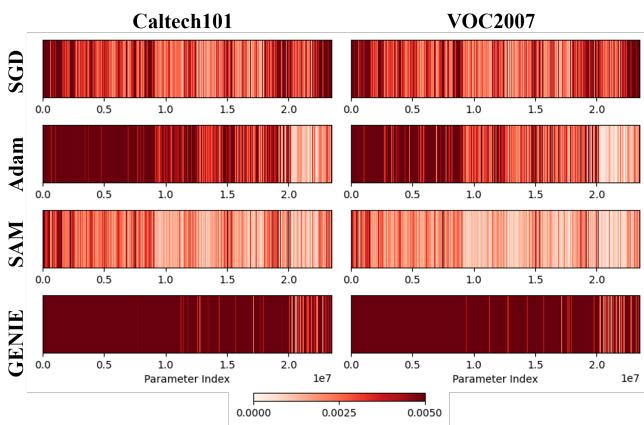
As shown in the heatmaps above, standard optimizers like SGD and Adam (on the left) allow a small subset of parameters to dominate the learning process (indicated by the red stripes). This imbalance often signifies overfitting to specific, easy features. GENIE (on the right) forces a more uniform distribution of parameter updates, mitigating overfitting and promoting robust feature learning.
In this post, we will dissect how GENIE works, the mathematics behind its “Generalization Ratio,” and why it might be the missing link for building truly robust AI.
Background: The Generalization Gap
To understand GENIE, we first need to understand why standard optimizers fail in Domain Generalization.
The Problem with “Greedy” Optimization
Standard algorithms like Stochastic Gradient Descent (SGD) or Adam are designed for convergence speed. They look for the steepest path down the “loss landscape” to minimize error on the training set.
However, in DG, minimizing training error isn’t enough. We need the model to perform well on unseen domains. The problem is that not all parameters in a neural network are created equal. Some parameters might latch onto “noisy” or domain-specific features (spurious correlations) that reduce training loss quickly but fail on test data. Standard optimizers inadvertently reinforce these parameters because they provide a strong, immediate signal.
The One-Step Generalization Ratio (OSGR)
How do we measure if a parameter update is actually helping the model learn general concepts rather than just memorizing data? The researchers utilize a metric called the One-Step Generalization Ratio (OSGR).
Conceptually, OSGR asks a simple question: “For every bit of progress we make on the training set, how much progress do we make on the test set?”
Mathematically, it is defined as the ratio of loss reduction on the test data (\(D'\)) to the loss reduction on the training data (\(D\)) after a single optimization step:
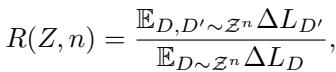
A higher OSGR means the model is learning features that apply broadly (generalization). A low OSGR means the model is overfitting—improving on training data without benefiting the test performance.
The researchers discovered that OSGR is heavily influenced by the Gradient Signal-to-Noise Ratio (GSNR). Parameters with high GSNR (strong signal, low noise) contribute more to generalization. The flaw in previous methods is that they don’t explicitly balance this ratio across the network, allowing noisy, over-confident parameters to dominate the OSGR.
Core Method: GENIE
The core philosophy of GENIE is to democratize the learning process. It prevents any single group of parameters from dominating the optimization, ensuring that the model relies on a broad set of features rather than a few spurious ones.
GENIE achieves this through three integrated mechanisms:
- Preconditioning: Balancing the OSGR.
- Noise Injection: Encouraging exploration.
- Random Masking: Preventing co-adaptation.
1. Preconditioning: The Mathematical Equalizer
This is the heart of the algorithm. Standard optimizers like Adam use preconditioning to normalize gradients based on their magnitude (to speed up convergence). GENIE, however, designs a preconditioner specifically to maximize and equalize the OSGR.
The researchers derived a theoretical breakdown of OSGR for standard SGD:

In this equation, \(r_j\) represents the GSNR of parameter \(j\). The key insight here is that SGD implicitly weights parameters based on their gradient magnitude. If a parameter has a massive gradient (even if it’s spurious), it dominates this sum, potentially lowering the overall generalization ratio.
To fix this, GENIE introduces a dynamic preconditioning factor, \(p_j\). The goal is to adjust the effective step size for each parameter so that their contributions to the generalization ratio are balanced.
The proposed preconditioner is calculated as:
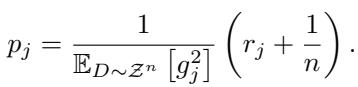
Here is what this equation is doing:
- \(\mathbb{E}[g_j^2]\) (Denominator): It normalizes by the squared gradient magnitude. This prevents parameters with naturally large gradients from taking over.
- \(r_j\) (Numerator): It scales the update by the Signal-to-Noise Ratio. Parameters with high signal (clean, reliable info) get a boost; parameters with high noise get suppressed.
By applying this specific preconditioner, the researchers theoretically prove that the new OSGR becomes:
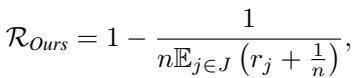
Crucially, they show that this resulting OSGR is theoretically superior to what SGD or Adam can achieve:

Comparing Optimizers
To visualize how GENIE differs from the industry standards, the authors provide a comparative table. While Adam focuses on convergence speed (using the square root of second moments), GENIE focuses on alignment—ensuring the update direction aligns with generalization.
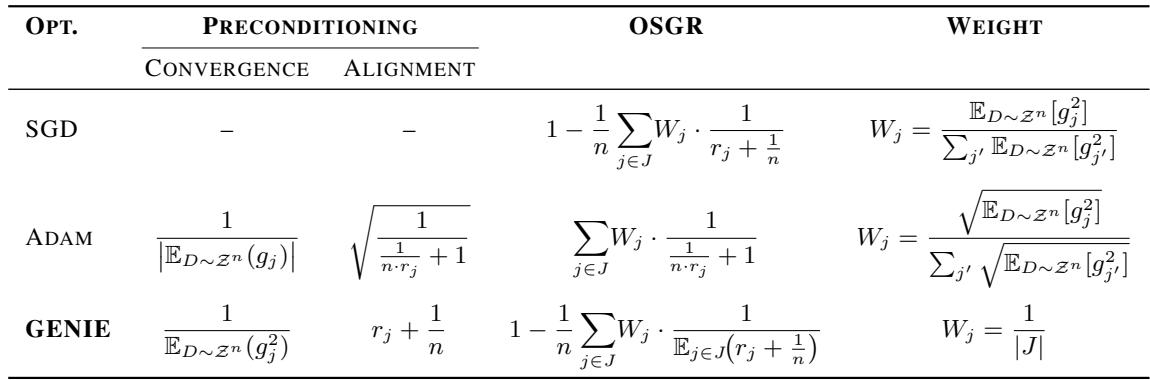
Notice the Alignment column. GENIE uses \((r_j + 1/n)\), explicitly factoring in the Signal-to-Noise ratio, whereas SGD has no alignment term, and Adam only partially addresses it through normalization.
2. Noise Injection: Escaping Sharp Minima
Balancing gradients is great, but optimization in deep learning is fraught with local minima. Sharp minima (deep, narrow valleys in the loss landscape) usually correspond to overfitting. Flat minima (wide valleys) correspond to robust generalization.
To encourage the model to find these flat regions, GENIE injects noise into the gradients. But it doesn’t just add random static; it scales the noise based on the variance of the gradients (\({\sigma_t}^2\)).

The term \(\tanh(1/\sigma^2)\) is clever.
- If the variance (\(\sigma^2\)) is high (noisy, uncertain parameter), the term \(\tanh(1/\sigma^2)\) becomes small. The noise added is large.
- If the variance is low (stable parameter), the noise added is small.
This “Variance-Adaptive Noise” ensures that the optimizer explores more aggressively in uncertain directions while remaining stable in confident directions.
3. Random Masking: Gradient Dropout
Finally, to further prevent the model from becoming overly reliant on any specific set of parameters, GENIE applies a Random Mask (similar to Dropout, but on gradients).

By randomly zeroing out gradient updates with probability \(p\), GENIE forces the network to distribute the “knowledge” across all parameters. This acts as a regularizer, ensuring that the optimization trajectory isn’t dictated by a “lucky” subset of neurons that happened to initialize well.
The Full Algorithm
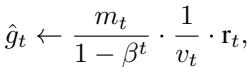
When we put it all together, the update step looks different from standard SGD. We compute the gradients, update moving averages (similar to Adam), calculate the dynamic preconditioner based on GSNR, inject adaptive noise, apply the mask, and then update the weights.
Theoretical Analysis: Convergence and Robustness
One common concern with novel optimizers is convergence. If we manipulate gradients too much to improve generalization, do we break the training process?
The authors provide a theoretical convergence analysis under non-convex settings (which deep learning requires). They prove that the average gradient norm of GENIE converges at a rate of \(O(1/\sqrt{T})\), which matches the standard convergence rate of SGD.

This is a critical result. It means we get the generalization benefits of GENIE without sacrificing the fundamental speed of convergence associated with stochastic gradient descent.
Furthermore, the authors link GENIE to PAC-Bayes Theory. The PAC-Bayes framework provides bounds on the generalization error. The authors show that GENIE’s preconditioning strategy naturally minimizes the Kullback-Leibler (KL) divergence term in the PAC-Bayes bound:
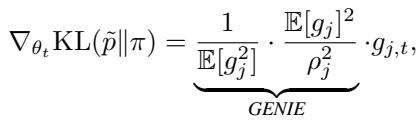
This theoretical link suggests that GENIE isn’t just a heuristic; it is minimizing a tighter bound on the true generalization error.
Experiments and Results
The theory is sound, but does it work in practice? The researchers tested GENIE against a suite of top-tier optimizers (Adam, AdamW, SAM, etc.) across five standard Domain Generalization benchmarks: PACS, VLCS, OfficeHome, TerraIncognita, and DomainNet.
Performance Comparison
The results are highly consistent. GENIE outperforms both standard optimizers (SGD, Adam) and specialized sharpness-aware optimizers (SAM).
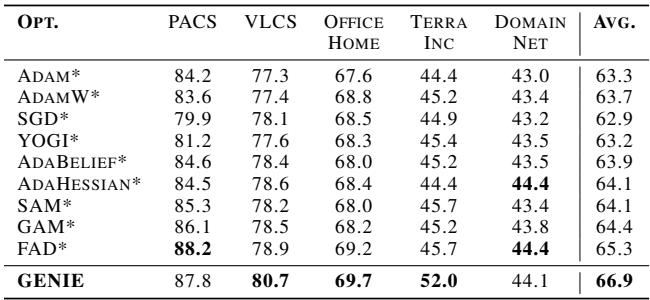
In the table above, GENIE achieves the highest average accuracy (66.9%), beating the popular Adam optimizer (63.3%) and the sharpness-aware SAM (64.1%).
- TerraIncognita: Look at the performance jump on this dataset (wildlife classification). GENIE scores 52.0%, significantly higher than the next best (SAM at 45.7%). This dataset involves extreme domain shifts (different camera traps, lighting, weather), indicating GENIE’s robustness in harsh conditions.
Efficiency
A major drawback of recent robust optimizers like SAM (Sharpness-Aware Minimization) is computational cost. SAM requires two forward/backward passes per step to estimate sharpness, effectively doubling training time.
GENIE, however, computes its statistics using moving averages during a single pass.
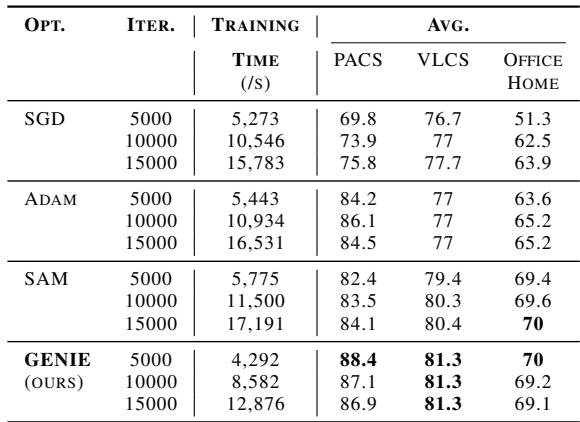
As shown in Table 3, GENIE is roughly 1.3x faster than SAM while achieving higher accuracy. It provides a “free lunch”—better performance without the massive computational overhead.
Sensitivity Analysis
Does GENIE require endless hyperparameter tuning? The authors conducted a grid search on the Dropout Probability (\(P\)) and the Moving Average Coefficient (\(\beta\)).
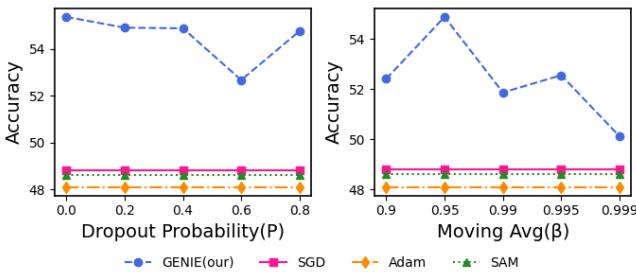
The charts show that GENIE (blue dashed line) consistently maintains higher accuracy than SGD, Adam, and SAM across a wide range of hyperparameter values. While there is a “sweet spot,” the method is stable and does not collapse if parameters aren’t perfectly tuned.
Visualizing the Learning Process
To verify that GENIE is actually learning better features, the authors used UMAP to visualize the latent space of the model.
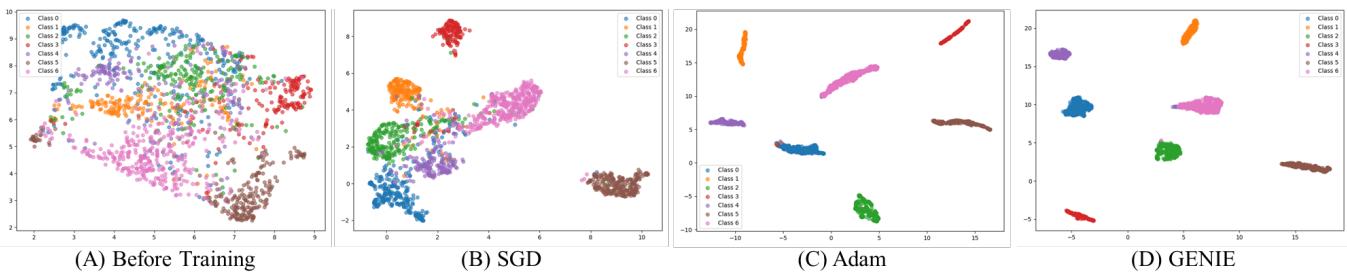
In the UMAP plots above:
- (B) SGD and (C) Adam show clusters that are somewhat distinct but still have significant overlap and “fuzziness” at the boundaries.
- (D) GENIE produces tight, well-separated clusters. This indicates that the model has learned representations that are distinct and robust, even on the unseen target domain (Sketch).
The Loss Landscape
Finally, understanding the path the optimizer takes through the loss landscape is illuminating.
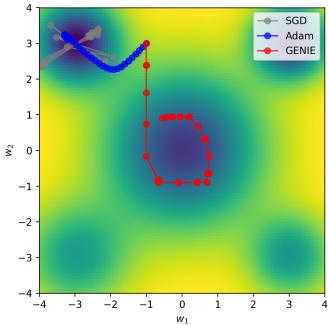
In this simulation, SGD (gray) and Adam (blue) rush toward the nearest minimum. GENIE (red dotted line), however, takes a different path. Driven by the OSGR guidance and noise injection, it avoids the sharpest descent and navigates toward a region that likely generalizes better. It doesn’t just memorize the training data; it explores the landscape to find a stable solution.
Conclusion
The quest for Domain Generalization often focuses on “what” the model sees (data augmentation) or “how” the model is built (architecture). The paper “One-Step Generalization Ratio Guided Optimization for Domain Generalization” compels us to look at “how” the model learns.
GENIE introduces a principled approach to optimization that prioritizes balance. By using the One-Step Generalization Ratio (OSGR) to guide gradients, it ensures that:
- No single parameter dominates: Preventing overfitting to spurious correlations.
- Signal outweighs noise: Using GSNR to trust reliable features.
- Exploration is maintained: Via adaptive noise and masking.
The results are clear: GENIE offers state-of-the-art performance on difficult DG benchmarks, is computationally efficient compared to SAM, and rests on a solid theoretical foundation connecting optimization to generalization bounds.
For students and practitioners in Deep Learning, GENIE represents a shift in thinking. It suggests that the “smartest” optimizer isn’t necessarily the fastest one, but the one that ensures every parameter pulls its weight in the right direction.