](https://deep-paper.org/en/paper/11469_causal_attribution_analy-1649/images/cover.png)
Introduction: The Detective Work of Data Science
Imagine a doctor treating a patient with dangerously high blood pressure. The patient has a history of poor diet, lack of exercise, and heart disease. The doctor needs to answer a specific, retrospective question: “Which of these factors actually caused the blood pressure to be this high for this specific patient?”
This is not a prediction task. We aren’t trying to guess what will happen next. We are trying to explain why something happened. In the field of Causal Inference, this is known as causal attribution.
Traditionally, this problem has been solved by simplifying the world into “Yes” or “No” questions. Did the patient have hypertension? Yes or No. Did the drug work? Yes or No. By binarizing outcomes, researchers could use established mathematical frameworks to find the “Probability of Necessity”—the likelihood that the outcome wouldn’t have occurred without the cause.
But the real world isn’t binary. Blood pressure is a continuous number. Body weight is continuous. Income is continuous. When we force these rich, continuous numbers into binary buckets (e.g., “High Blood Pressure” vs. “Normal”), we lose massive amounts of information. We might treat a patient with a reading of 141 the same as a patient with a reading of 200, simply because both are above the “140” threshold.
In a recent research paper titled “Causal Attribution Analysis for Continuous Outcomes,” researchers Shanshan Luo, Yixuan Yu, Chunchen Liu, Feng Xie, and Zhi Geng propose a groundbreaking framework to solve this problem. They have developed a way to perform retrospective causal analysis directly on continuous variables without losing precision.
This post will take you through their framework, explaining how we can mathematically pinpoint the causes of continuous effects, disentangle direct and indirect drivers, and apply this to real-world scenarios like medical diagnosis and toxicology.
Background: The Ladder of Causation
To understand the contribution of this paper, we must first locate where we are on Judea Pearl’s “Ladder of Causation.”
- Association (Seeing): Correlation between variables (e.g., “People who exercise tend to have lower blood pressure”).
- Intervention (Doing): Predicting the effect of an action (e.g., “If I force this group to exercise, what will their average blood pressure be?”).
- Counterfactuals (Imagining): Retrospective analysis (e.g., “My patient did not exercise and has high blood pressure. What would his blood pressure have been had he exercised?”).
Causal attribution lives at the very top of this ladder, in the realm of counterfactuals. We are looking at an event that has already occurred—observed evidence—and trying to simulate an alternative past.
The Problem with Binarization
Previous methods for attribution relied heavily on binary outcomes. For example, knowing the “Probability of Causation” allows us to say, “There is an 80% chance that the drug caused the recovery.”
However, when dealing with continuous metrics like blood pressure (BP), researchers often set an arbitrary threshold (like BP > 140). This creates bias. If a treatment lowers BP from 180 to 145, a binary check sees “Failure” (still > 140). A continuous analysis sees “Significant Improvement.” The authors of this paper argue that to truly understand risk factors, we must define posterior causal estimands that respect the continuity of the data.
Core Method: Defining the Estimands
The researchers introduce a suite of new metrics (estimands) tailored for continuous outcomes. These metrics are “posterior” because they are calculated after observing the specific evidence (the actual cause and the actual outcome) for an individual.
1. Posterior Total Causal Effect (PostTCE)
The first and most fundamental metric is the Posterior Total Causal Effect. It answers the question: Given that we observed a patient with specific risk factors (\(x\)) and a specific outcome (\(\mathcal{E}\)), how much did the presence of cause \(X_k\) contribute to the value of the outcome \(Y\)?
Mathematically, it is defined as the expected difference between the potential outcome if the cause were present (\(X_k=1\)) versus if it were absent (\(X_k=0\)), conditioned on the evidence we actually saw.
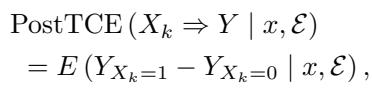
In this equation:
- \(\mathcal{E}\) represents the event defined by the observed continuous outcome (e.g., Blood Pressure = 160).
- \(Y_{X_k=1}\) is the potential outcome if the specific cause is turned on.
- \(Y_{X_k=0}\) is the potential outcome if the specific cause is turned off.
A larger PostTCE value indicates that \(X_k\) is a stronger driver of the observed effect.
2. Decomposing the Effect: Direct and Indirect
In complex systems, causes rarely act in isolation. A bad diet (Cause A) might cause high blood pressure (Outcome Y) directly, but it might also cause heart disease (Intermediate B), which then causes high blood pressure. To understand the mechanism, we need to split the total effect.
The authors define the Posterior Natural Direct Effect (PostNDE). This measures the effect of the cause \(X_k\) on \(Y\) that is not mediated through other variables. It simulates switching \(X_k\) from 0 to 1 while holding all other intermediate variables (\(D_k\)) at the levels they would have naturally taken if \(X_k\) were 0.
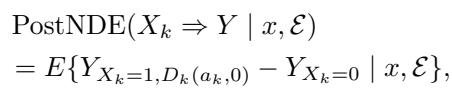
Conversely, the Posterior Natural Indirect Effect (PostNIE) measures the pathway through intermediate variables. It asks: How much would \(Y\) change if we held the main cause \(X_k\) constant at 1, but changed the intermediate variables from their “treated” state to their “untreated” state?

Crucially, the paper confirms that the total effect is simply the sum of the direct and indirect effects, just as it is in standard causal inference, but now conditioned on the specific observed evidence.

3. Posterior Intervention Causal Effect (PostICE)
Sometimes, we want to know what would have happened if we changed multiple causes simultaneously. For example, “What would my blood pressure be if I didn’t have heart disease AND I exercised?” This is captured by the PostICE.

This compares the potential outcome under a completely different set of conditions (\(x'\)) against the actually observed outcome (\(Y\)).
Identification: How Do We Solve the Equations?
Defining these metrics is the easy part. The hard part is identification: proving that these theoretical counterfactuals can actually be calculated from real-world data. We cannot observe parallel universes where a patient both did and did not take a drug.
To solve this, the authors rely on three key assumptions.
Assumption 1: Sequential Ignorability
This is a standard assumption in causal inference. It essentially states that there are no hidden, unmeasured confounders messing up the relationships between our variables in the causal chain.
Assumption 2: Monotonicity
The authors assume that causes have a “monotonic” relationship with each other. In epidemiology, this often translates to “no prevention.” For example, exposing someone to a risk factor (like smoking) should not prevent them from developing a subsequent risk factor (like lung damage) compared to if they hadn’t smoked.

Assumption 3: Perfect Positive Rank (The Secret Sauce)
This is the most critical assumption for handling continuous outcomes. It assumes that the individual outcome is a function of the causes plus some error term, and—crucially—that this function preserves the rank of the individual.
Think of it this way: If a student is in the 90th percentile of math scores in a classroom with poor textbooks, this assumption implies that if you moved that same student to a classroom with great textbooks, they would still be in the 90th percentile relative to that new group. Their relative “ability” (the error term \(\epsilon\)) stays constant across counterfactual worlds.
Mathematically, this allows the authors to construct a Counterfactual Mapping. If we know the cumulative distribution function (CDF) of the outcome under treatment (\(F_{x'}\)) and control (\(F_x\)), we can map a specific observed value \(y\) to its counterfactual counterpart.

This equation says: To find what outcome \(y\) would become under condition \(x'\), take the rank of \(y\) in the original distribution (\(F_x(y)\)), and find the value at that same rank in the new distribution (\(F^{-1}_{x'}\)).
Simplifying with Causal Graphs
When the variables form a Directed Acyclic Graph (DAG), the identification becomes even more elegant. The authors show that the counterfactual mapping depends only on the “parents” (direct causes) of the outcome variable.

This simplification is powerful because it reduces the dimensionality of the problem. You don’t need to worry about the entire history of the universe—just the direct parents of the variable you care about.
With the mapping \(\phi\) established, the authors prove that all the complex estimands (PostTCE, PostNDE, etc.) are identifiable. For example, the PostICE can be calculated using an inverse probability weighting approach:

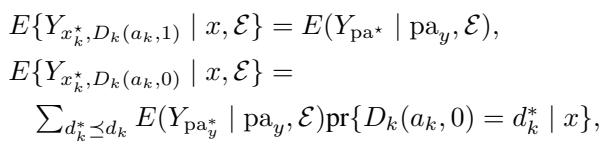
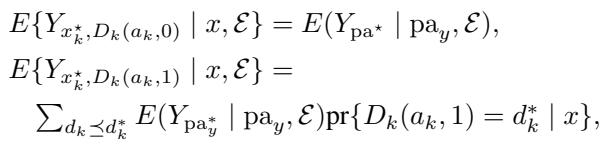
Furthermore, the authors derive explicit identification formulas for the nested counterfactuals required for direct and indirect effects. These involve complex probability summations over the possible states of intermediate variables (\(D_k\)), but the paper proves they are solvable using observed data.
Estimation: The Two-Step Procedure
So, we know the math works. How do we actually crunch the numbers? The authors propose a two-step estimation procedure.
Step 1: Recover the Counterfactual Mapping First, for every observation in the dataset, the algorithm estimates what that individual’s outcome would be under different conditions. They achieve this by minimizing a specific objective function, inspired by quantile regression.
The objective function essentially tries to find a value \(t\) that aligns the quantiles of the two distributions.
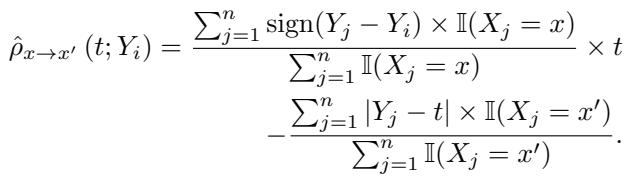
By minimizing this function for a specific individual unit \(i\), we obtain the estimated counterfactual outcome \(\hat{\phi}\).

Step 2: Estimate the Estimands Once the counterfactual outcomes are generated for every individual in the sample, calculating the PostTCE or PostNDE becomes a matter of simple averaging. We just take the sample mean of the differences between the observed values and the estimated counterfactuals.
Experiments and Results
To demonstrate the power of this method, the authors applied it to both synthetic and real-world datasets.
The Hypertension Example
They created a synthetic dataset modeling the causes of high blood pressure (BP). The causal network included Exercise (\(X_1\)), Diet (\(X_2\)), Heartburn (\(X_3\)), Heart Disease (\(X_4\)), and Chest Pain (\(X_5\)).
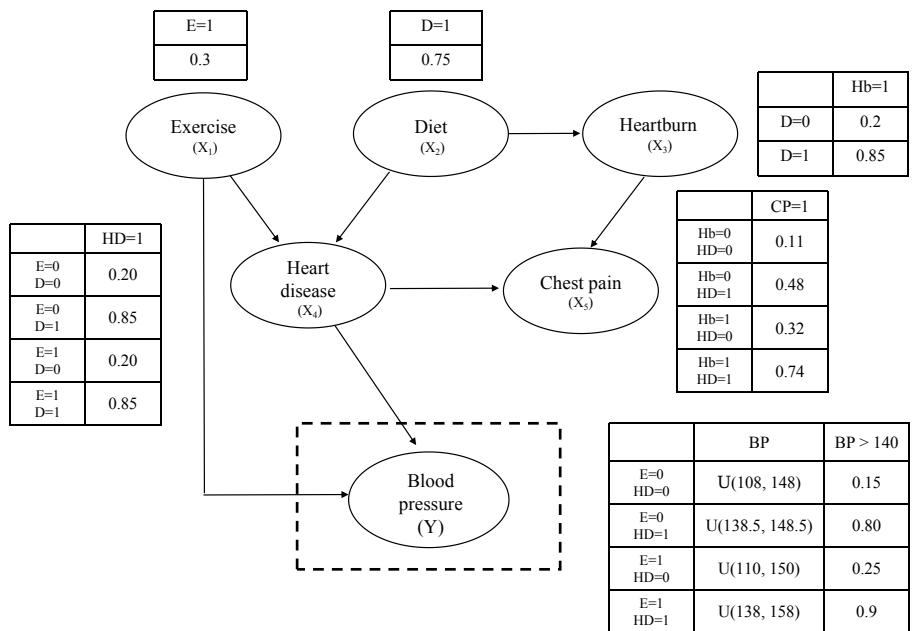
The goal was to attribute the cause of high BP for specific patient profiles.
Result 1: The Power of Continuous Analysis The authors compared their method against the “binary” approach (binarizing BP at 140). For a patient with all risk factors present (\(X = (1,1,1,1,1)\)) and high BP, the binary method identified Heart Disease (\(X_4\)) as a risk factor, but assigned zero impact to Chest Pain (\(X_5\)) and Heartburn (\(X_3\)).
The continuous method (PostTCE) agreed on the major drivers but provided significantly more nuance. It showed that Heart Disease (\(X_4\)) was indeed the dominant driver (PostTCE \(\approx 17.0\)), but it also quantified the direct and indirect contributions of Exercise (\(X_1\)).
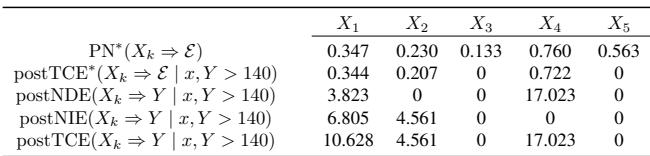
In this table, notice the split for \(X_1\) (Exercise). It has a PostNDE of 3.8 and a PostNIE of 6.8. This tells a clinical story: Lack of exercise raises blood pressure directly, but it raises it twice as much indirectly (likely by causing heart disease). This is an insight you simply cannot get from a binary “Yes/No” analysis.
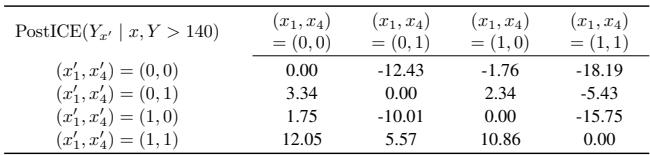
Result 2: Interaction Effects (PostICE) The authors also looked at the interaction of causes using PostICE. They found that for individuals who do not exercise and have heart disease, fixing both problems simultaneously (\(x'=(0,0)\)) resulted in a massive drop in blood pressure (-18.19 units).
Real-World Application: Developmental Toxicity
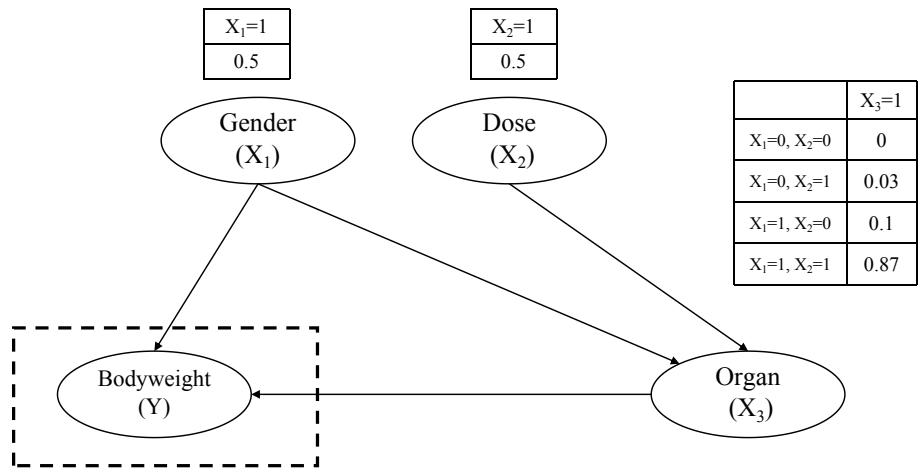
The authors also applied their method to a dataset from the National Toxicology Program (NTP). The goal: determine if a chemical called TCPP causes abnormal weight loss in mice.
The causal graph here was simpler:
- Gender (\(X_1\)) -> Body Weight (\(Y\))
- Dose (\(X_2\)) -> Organ Disease (\(X_3\)) -> Body Weight (\(Y\))
The analysis revealed fascinating insights about the pathways of toxicity.
- Gender (\(X_1\)): Had a large direct effect. Males are heavier than females, so gender is a strong “cause” of weight difference.
- Dose (\(X_2\)): The PostNDE for Dose was 0. This means the toxin does not directly cause weight loss.
- Organ Disease (\(X_3\)): The PostTCE for organ disease was significant.
- Indirect Effect (\(X_2\)): However, the PostNIE (Indirect Effect) for the Dose was significant.
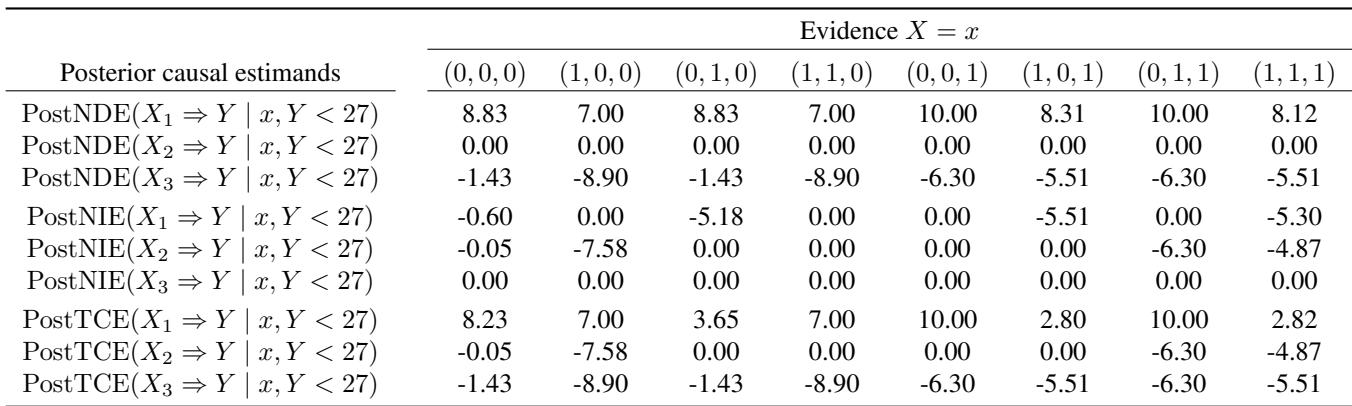
Interpretation: The toxin (\(X_2\)) does cause weight loss, but entirely indirectly. The toxin causes organ disease (\(X_3\)), and the organ disease causes the weight loss. This level of mechanistic detail helps researchers understand exactly how a toxin poses a risk, rather than just knowing that it poses a risk.
Also, looking at the PostICE (Intervention effects) for the mice:

Table S14 shows that changing a mouse’s status from “Male without organ disease” (\(1,0\)) to “Female with organ disease” (\(0,1\)) results in the largest positive change (meaning the original weight was much higher).
Conclusion and Implications
The paper “Causal Attribution Analysis for Continuous Outcomes” bridges a major gap in causal inference. By moving away from crude binarization, we can now perform retrospective analysis that respects the complexity of the real world.
Key Takeaways:
- Don’t Binarize: Continuous outcomes contain vital information about magnitude and rank that binary methods discard.
- Rank Preservation: The “Perfect Positive Rank” assumption is the key that unlocks counterfactuals for continuous data, allowing us to map individuals between treated and untreated worlds.
- Nuanced Explanations: We can now separate how much of an outcome is caused directly by a factor versus how much is caused by the factor’s downstream effects (Direct vs. Indirect).
This framework has massive potential. In medicine, it can help doctors tell a patient exactly how much their specific lifestyle choices contributed to their specific blood pressure reading. In law, it could help quantify exactly how much financial damage a specific bad act caused. In AI, it provides a robust mathematical foundation for explaining the decisions of black-box models regression outputs.
By enabling us to ask “Why?” with greater precision, this research brings us one step closer to truly understanding the causes of effects in a complex, continuous world.