](https://deep-paper.org/en/paper/181_estimating_value_of_assist-2654/images/cover.png)
Introduction
Imagine a collaborative robotic scenario in a warehouse. One robot, equipped with a robotic arm, is trying to pick up a specific can of soda from a cluttered shelf. However, its sensors are noisy, and a large box is blocking its line of sight. It knows the can is there, but it can’t pinpoint the location with enough certainty to act safely. Nearby, a second robot with a vacuum gripper is idle. This second robot could move the box, revealing the can and making the first robot’s job significantly easier.
This seems like an intuitive decision for a human: “Move the box so your teammate can see.” But for an autonomous system, this decision is mathematically paralyzed by uncertainty. The helping robot needs to ask: Is moving this box actually worth the time and energy? Will it really help, or is the first robot already confident enough?
This is the problem of estimating the Value of Assistance (VOA).
In a new paper titled “Estimating Value of Assistance for Online POMDP Robotic Agents,” researchers Yuval Goshen and Sarah Keren tackle this complex challenge. They explore how a “helper” agent can calculate the benefit of intervening in another agent’s task without getting bogged down in computationally impossible calculations.
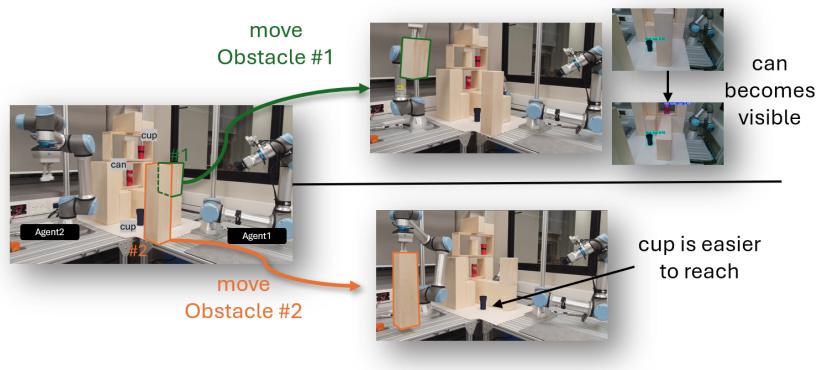
As shown in Figure 1, the scenario involves high-level decision-making. Agent 2 can move Obstacle #1 to reveal a hidden can, or move Obstacle #2 to clear a path. To make the right choice, Agent 2 needs to simulate Agent 1’s future performance under different conditions.
The core contribution of this work is a set of efficient heuristics that allow robots to estimate this value in real-time, effectively balancing the trade-off between calculation speed and decision accuracy.
Background: The Complexity of Robot Thought
To understand why calculating “helpfulness” is so hard, we first need to understand how advanced robots think. In simple environments, a robot knows exactly where it is and where the objects are. But in the real world, sensors are noisy. A robot doesn’t know the state of the world (\(s\)); it maintains a Belief (\(\beta\))—a probability distribution over all possible states.
POMDPs and Online Planning
This problem is modeled as a Partially Observable Markov Decision Process (POMDP). A POMDP is defined by the tuple \(\langle S, A, T, R, \Omega, O, \gamma \rangle\):
- S: States (e.g., exact object coordinates).
- A: Actions (e.g., move left, pick up).
- T: Transition probabilities (if I move left, how likely am I to actually arrive there?).
- R: Reward function (points for completing the task).
- \(\Omega\) & O: Observations and their probabilities (if I look at the shelf, what are the odds I see the can?).
Solving a POMDP exactly is often impossible (PSPACE-complete) because the belief space is continuous and vast. Therefore, modern robots use Online Planning. Instead of memorizing a policy for every possible situation before they start (Offline), they plan in real-time for the current situation only.
POMCP: Thinking in Trees
A popular algorithm for this is POMCP (Partially Observable Monte Carlo Planning). It uses a particle filter to represent the belief state (a cloud of thousands of “hypothetical” states). To decide on a move, the robot builds a search tree.

As illustrated in Figure 2, the tree alternates between taking an action and receiving an observation.
- Simulate: The robot simulates a history of actions and observations.
- Rollout: When it reaches a new, unexplored leaf node, it runs a quick, random (or heuristic-based) simulation to guess the future value.
- Backpropagate: It updates the values up the tree to decide the best immediate move.
This process allows robots to act intelligently under uncertainty. However, it is computationally expensive. A robot might spend 1 to 3 seconds just to decide its next move.
The Core Method: Defining Value of Assistance
Now, introduce the Helper Agent. The helper wants to perform an action \(\alpha\) (like moving a box) that changes the environment or provides information. To know if \(\alpha\) is a good idea, the helper calculates the Value of Assistance (VOA).
VOA is defined as the difference between the expected value the actor (the robot doing the work) will achieve after the help, minus the value it would achieve without the help.
The mathematical formulation looks like this:

Here is what this equation tells us:
- We average over the current belief state (\(s \sim \beta\)).
- We look at the expected future value \(V^{\pi}\) after the helping action \(\alpha\) changes the state to \(s'\) and generates a new observation \(\omega\).
- We subtract the value \(V^{\pi}(\beta)\) the agent would have gotten if we did nothing.
If the result is positive and high, the help is valuable. If it’s near zero, the help is useless.
The Computational Bottleneck
Here lies the problem. To compute the terms in that equation exactly, the helper has to simulate the actor. But remember, the actor uses Online Planning (POMCP).
To evaluate one potential helping action, the helper must:
- Sample thousands of possible states.
- For each state, simulate the helping action.
- Then, simulate the actor’s future trajectory (e.g., 50 steps).
- Crucially: At every single step of that 50-step trajectory, the simulated actor must run its own POMCP tree search to decide what to do.
This is a simulation within a simulation. If the actor takes 1 second to think per step, and we want to simulate a 20-step trajectory for 100 different starting particles, estimating the VOA for just one helping action could take over 30 minutes. That is useless for real-time robotics.
We can visualize this baseline “brute force” approach in Algorithm 1:
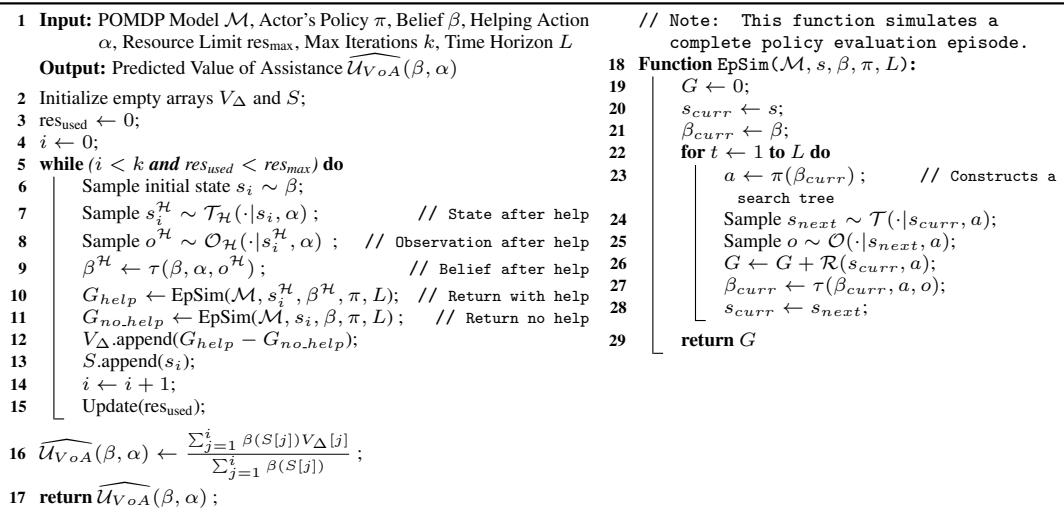
The complexity is roughly \(O(k \cdot L \cdot (N_{s}N_{D} + N_{P}))\), where \(k\) is the samples, \(L\) is the trajectory length, and the term in the parenthesis is the cost of the actor’s planning. This is too slow.
Heuristics: Shortcuts to Estimation
The researchers propose three distinct heuristics to approximate VOA. These heuristics trade varying degrees of accuracy for massive speed gains.
1. First-Action Value Heuristic (\(h_{FA}\))
The most expensive part of the baseline is simulating the full trajectory (\(L\) steps). What if we only look at the first step?
In POMCP, the root of the search tree contains an estimated value of the current state (\(V_{root}\)). The First-Action Heuristic assumes that the value at the root of the actor’s planning tree is a “good enough” proxy for the long-term value.

Instead of running a full simulation of the actor moving through the world, the helper:
- Simulates the help.
- Runs the actor’s planner once to generate a search tree.
- Reads the value at the root of that tree.
Pros: Reduces complexity by a factor of \(L\) (trajectory length). Cons: Still requires building a POMCP tree, which is heavy. Also, POMCP root values can be noisy.
2. Rollout-Policy Heuristic (\(h_{\pi_{Rollout}}\))
POMCP uses a “Rollout Policy” to evaluate leaf nodes. This is usually a very fast, lightweight policy (sometimes random, sometimes a simple greedy rule). The Rollout-Policy Heuristic asks: What if we skip the tree search entirely and just assume the actor acts according to this simple rollout policy?

Here, \(V^{\pi_{Rollout}}\) replaces the expensive planning value.
Pros: Extremely fast. No tree construction required. Cons: The rollout policy is usually “dumb.” It underestimates the actor’s intelligence. If the actor is smart enough to find a path the rollout misses, this heuristic will report a VOA of zero (incorrectly).
3. Full-Information Heuristic (\(h_{FO}\))
This is the most innovative approach. It tackles the root of the complexity: Partial Observability.
Planning in belief space (POMDP) is hard. Planning in a known state (MDP) is much easier. The Full-Information Heuristic relaxes the problem by assuming all-outcome determinization.
For the purpose of estimation, the helper pretends that after the help is given, the actor will effectively know the true state of the world and the outcome of its actions. This turns a probabilistic puzzle into a standard pathfinding search (like A* search or Dijkstra).

Here, \(U(s)\) represents the value of the optimal plan in a fully observable, deterministic version of the world.
Pros: Solving a deterministic MDP is exponentially faster than solving a POMDP. Cons: It’s an optimistic upper bound. It assumes the actor is omniscient. However, since VOA is a difference between two values, the bias often cancels out, leaving a reliable ranking of actions.
Visualizing the Approaches
The researchers provide a side-by-side comparison of how these methods look computationally:

- Left (Baseline): Deep trees at every step.
- Mid-Left (\(h_{FA}\)): One deep tree at the start.
- Mid-Right (\(h_{\pi_{Rollout}}\)): Fast, shallow execution.
- Right (\(h_{FO}\)): Deterministic planning (no branching probability clouds).
Experiments & Results
To test these heuristics, the authors used two domains:
- RockSample: A standard benchmark where a rover must sample rocks in a grid.
- POMAN (Partially Observable MANipulation): A realistic robotic arm simulation using YOLO-world object detection.
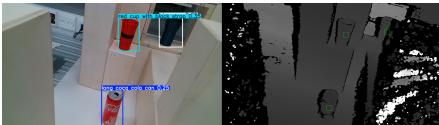
In the POMAN task (Figure 4), a helper robot can move large obstacles to help the arm see a can (improve observability) or reach a cup (improve accessibility).
The researchers compared the heuristics against a “Ground Truth” VOA (calculated by running the expensive baseline for hours offline). They looked at:
- Accuracy: Did the heuristic pick the best helping action?
- Regret: How much value was lost if we followed the heuristic?
- Time: How long did it take?
Key Findings
The results were striking, particularly regarding the trade-off between speed and quality.
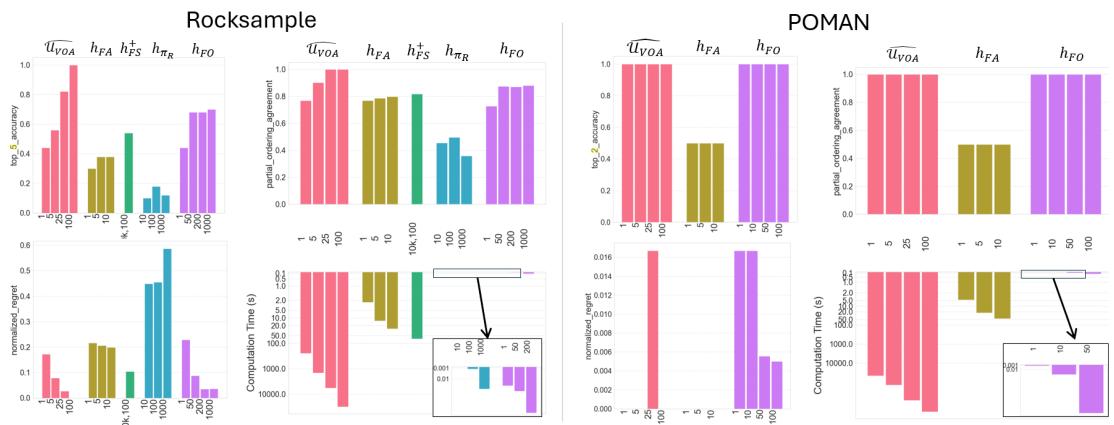
Looking at Figure 5:
- The Baseline (Red) is impractical: The computation time (Bottom Right) is orders of magnitude higher than the others.
- Rollout Policy (Blue) fails: In the robotic manipulation task (POMAN), the rollout heuristic often returned zero value. It was too simple to understand the complex sequence of moving an obstacle to grasp a cup.
- Full-Information (\(h_{FO}\) - Purple) dominates:
- Speed: It runs in less than 0.1 seconds (Bottom Right).
- Accuracy: It has high agreement with the ground truth (Top Right) and extremely low regret (Bottom Left).
- Consistency: Even with fewer samples (lighter bars), it performs reliably.
The Full-Information Heuristic shines because, in robotics, the geometry of the problem usually dictates the value. Even if we ignore sensor noise for a moment (the relaxation), the physical fact that “moving this box makes the path 2 meters shorter” captures the majority of the assistance value.
Supplementary Metrics
The appendix provides further insight into “Top-k Selection Rate”—how often the heuristic’s top choice was at least in the top few best actions.
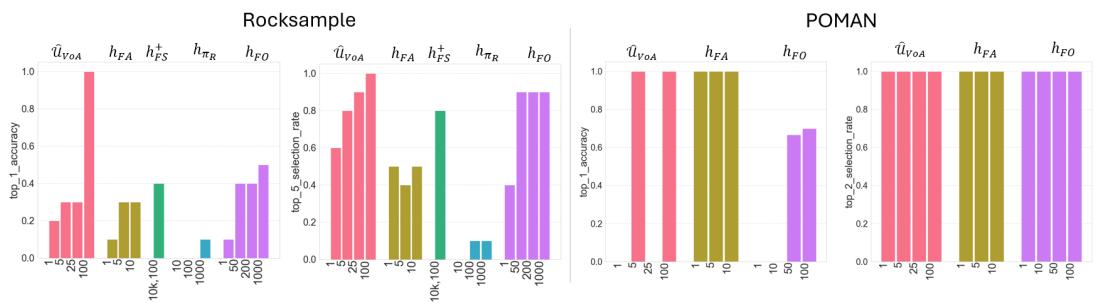
As seen in Figure 6, the Full-Information heuristic (Purple) achieves near-perfect selection rates in the manipulation task, proving it can reliably identify beneficial actions even if the exact numerical value isn’t perfect.
Conclusion and Implications
This research provides a crucial piece of the puzzle for multi-robot collaboration. We often assume that for a robot to be helpful, it must fully understand the complexities and uncertainties of its teammate’s mind.
However, Goshen and Keren demonstrate that simplification is powerful. By relaxing the problem—pretending the world is deterministic and fully observable just for the sake of evaluation—a helping robot can make highly accurate assistance decisions in milliseconds rather than hours.
Key Takeaways
- VOA is the metric: Calculating the difference in expected future rewards is the principled way to decide on helping actions.
- Exact is too slow: You cannot simulate an online planner inside another online planner in real-time.
- Determinization wins: The Full-Information heuristic (\(h_{FO}\)), which calculates value based on a deterministic “best-case” plan, offers the best balance of speed and accuracy.
This work paves the way for smarter warehouses and construction sites where robots can intuitively “see” when a teammate is struggling and step in to help, fluidly and efficiently. Future work aims to tackle sequential assistance (planning a series of helping moves) and scenarios where the robots might not share the exact same beliefs about the world.