](https://deep-paper.org/en/paper/1904.05862/images/cover.png)
The field of Automatic Speech Recognition (ASR) has long struggled with a “data hunger” problem. To build a system that understands human speech effectively—like Siri or Alexa—you historically needed thousands of hours of audio that had been painstakingly transcribed by humans. This labeled data is expensive, slow to produce, and often unavailable for low-resource languages.
Meanwhile, in the world of Natural Language Processing (NLP), models like BERT were shattering records by reading massive amounts of unlabeled text to learn the structure of language before ever seeing a specific task.
In 2019, researchers at Facebook AI Research asked a pivotal question: Can we do for speech what BERT did for text?
The result was wav2vec, a groundbreaking paper that proposed a method for unsupervised pre-training on raw audio. By teaching a neural network to understand the structure of audio before asking it to transcribe words, they achieved state-of-the-art results with significantly less labeled data.
In this post, we will tear down the wav2vec paper. We’ll look at how it abandons traditional audio features, the architecture of its convolutional networks, and the clever “game” it plays to learn from silence and sound.
The Core Problem: Learning from Raw Audio
Before wav2vec, most speech recognition pipelines didn’t actually look at raw audio waves. Raw audio is high-frequency and continuous—a messy stream of numbers changing 16,000 times a second (16 kHz).
Instead, engineers usually converted audio into log-mel filterbanks or spectrograms. These are visual representations of sound frequencies over time. While effective, this process is “lossy”—it throws away data that a machine might find useful, based on assumptions about human hearing.
The authors of wav2vec argued that we should stop hand-crafting features. Instead, we should let a neural network learn its own features directly from the raw waveform. Furthermore, we should do this using unsupervised learning. We have practically infinite amounts of unlabelled audio (podcasts, YouTube, radio). If a model could learn the statistical structure of speech from that data, it would require far fewer human transcripts later on.
The wav2vec Architecture
The wav2vec model is built entirely on Convolutional Neural Networks (CNNs). Unlike Recurrent Neural Networks (RNNs) or LSTMs, which process data sequentially and are hard to parallelize, CNNs can be computed efficiently on modern GPUs.
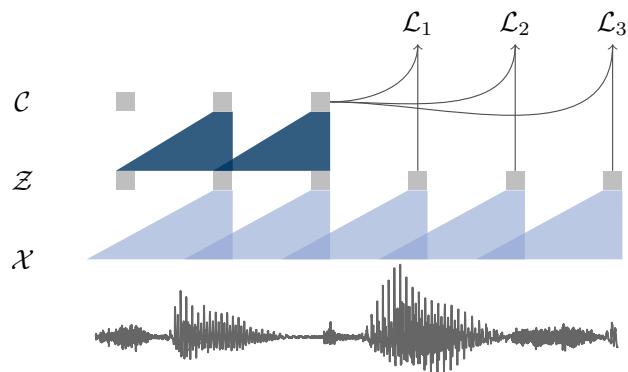
The architecture consists of two distinct stacked networks: the Encoder Network and the Context Network.
1. The Encoder Network (\(f\))
The process begins with the raw audio, denoted as \(\mathcal{X}\). The encoder network takes this raw waveform and compresses it.
- Input: Raw audio samples.
- Operation: A 5-layer convolutional network.
- Output: A low-frequency feature representation, denoted as \(\mathcal{Z}\).
Think of the Encoder as a feature extractor. It takes the high-frequency raw audio (16,000 samples per second) and downsamples it into a “latent space.” In this paper, the encoder outputs a vector representation every 10 milliseconds. This essentially converts the continuous wave into a sequence of discrete steps, similar to how an image CNN converts pixels into feature maps.
2. The Context Network (\(g\))
The output of the encoder (\(\mathbf{z}_i\)) only knows about a tiny slice of time (about 30ms). However, to understand speech, you need context. You can’t distinguish a “p” from a “b” without knowing the silence that came before it or the vowel that comes after.
The Context Network sits on top of the Encoder.
- Input: The sequence of feature representations \(\mathcal{Z}\) from the encoder.
- Operation: A 9-layer convolutional network.
- Output: A contextualized representation, denoted as \(\mathcal{C}\).
This network mixes multiple time steps together. By the time the data passes through the Context layers, a single vector \(\mathbf{c}_i\) contains information covering a receptive field of about 210 milliseconds (or up to 810ms in the larger version of the model).
The “Game”: Contrastive Predictive Coding
So we have a network that turns audio into vectors. But how do we train it without labels? If we don’t have a transcript saying “this audio says ‘hello’”, what is the error signal?
The authors utilize a technique called Contrastive Predictive Coding (CPC).
Instead of trying to predict the exact numerical value of the next audio sample (which is incredibly difficult because audio is noisy and complex), the model tries to solve a classification task.
The logic is as follows:
- Take the current context representation \(\mathbf{c}_i\) (what we know about the audio so far).
- Look at the future steps in the audio \(\mathbf{z}_{i+k}\) (what actually happened next).
- Gather a bunch of “negative” samples (random audio clips taken from other parts of the recording).
- The Task: Can the model identify the true future sample hidden among the negatives?
The Objective Function
To mathematically enforce this, wav2vec minimizes a contrastive loss function. This looks intimidating, but let’s break it down using the equation provided in the paper:

Here is what these symbols mean:
- \(\mathcal{L}_k\): The loss for predicting \(k\) steps into the future.
- \(\sigma\): The sigmoid function. This squashes numbers between 0 and 1, turning them into probabilities.
- \(\mathbf{z}_{i+k}^{\top} h_k(\mathbf{c}_i)\): This is the “score” the model gives to the true future sample. We want this score to be high.
- \(\tilde{\mathbf{z}}\): These are the negative samples (distractors).
- \(\mathbb{E}[\dots]\): This part calculates the average score given to the distractors. We want these scores to be low (close to 0).
In simple terms: The model is trained to maximize the probability of the real future audio chunk while minimizing the probability of random audio chunks.
By solving this “game” millions of times over thousands of hours of audio, the Encoder and Context networks learn extremely robust representations of how speech sounds. They learn phonemes, silence patterns, and speaker characteristics—all without a single human-written word.
Experiments and Results
Once the wav2vec model is pre-trained on unlabeled data, the researchers tested it on actual Speech Recognition tasks. They fed the output of the Context network (\(\mathbf{c}\)) into a standard acoustic model and fine-tuned it on labeled data.
They tested primarily on the Wall Street Journal (WSJ) benchmark and the Librispeech dataset.
Beating the Baseline
The primary comparison was against a baseline model that used traditional log-mel filterbanks (the industry standard). They also compared it against Deep Speech 2, a famous character-based system.
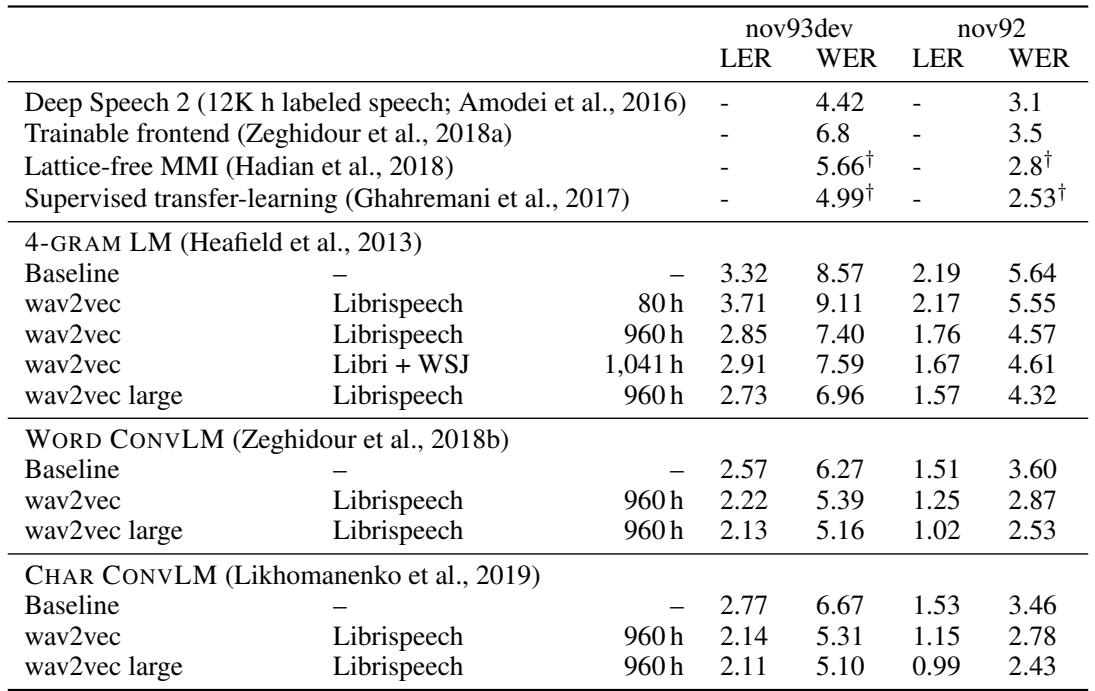
The results in Table 1 are significant.
- LER (Letter Error Rate): The percentage of characters the model got wrong.
- WER (Word Error Rate): The percentage of words the model got wrong.
You can see that the wav2vec large model (trained on Librispeech 960h) achieves a 2.43% WER on the nov92 test set. This outperforms Deep Speech 2 (3.1%) and drastically outperforms the baseline (3.46%), despite Deep Speech 2 utilizing significantly more labeled data in its original training.
The Power of Low-Resource Settings
The most impressive claim of wav2vec is its efficiency. Pre-training should allow the model to “understand” speech so well that it needs very few examples to learn how to transcribe it.
To test this, the researchers simulated a low-resource environment where they had only a few hours of transcribed data available.
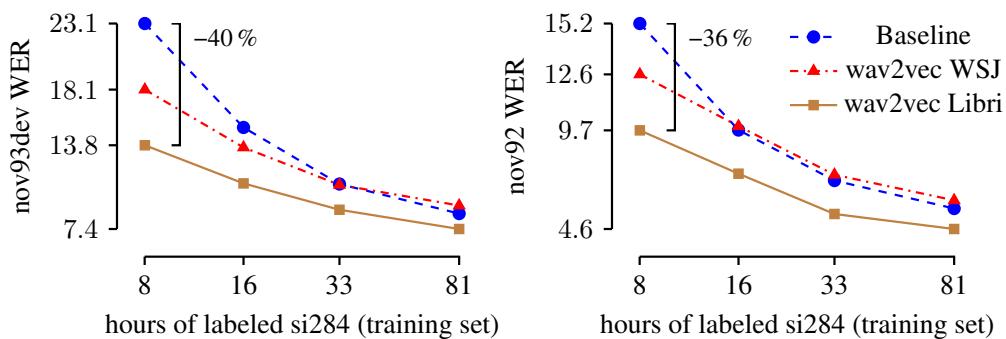
Figure 2 visualizes this dramatic improvement.
- The X-axis: The amount of labeled training data used (in hours).
- The Y-axis: The Word Error Rate (lower is better).
Look at the left side of the charts. When only 8 hours of labeled data is available, the standard Baseline (blue line) has a very high error rate. However, the pre-trained wav2vec models (red and brown lines) perform significantly better.
Specifically, wav2vec reduced the Word Error Rate by up to 36% compared to the baseline when transcribed data was scarce. This is a game-changer for languages that don’t have thousands of hours of transcribed speech available.
Decoding the Output
It is worth noting that the output of the acoustic model isn’t just plain text; it’s a stream of probabilities. To turn this into a readable sentence, the researchers use a Beam Search Decoder.

This equation represents the final step of the pipeline. The decoder looks for the word sequence \(\mathbf{y}\) that maximizes a combination of:
- \(f_{AM}\): What the acoustic model (wav2vec) heard.
- \(p_{LM}\): What the Language Model thinks makes grammatical sense.
- Penalty terms (\(\beta, \gamma\)) to control word length and silence.
By combining the acoustic understanding of wav2vec with a standard Language Model, the system ensures that the output is not only acoustically accurate but also grammatically coherent.
Ablation Studies: What matters?
The researchers performed “ablation studies”—experiments where they tweaked parts of the model to see what was actually driving the performance.
Number of Negative Samples
In the contrastive loss function, the model compares the true future sample against “distractors.” Does adding more distractors make the model smarter?
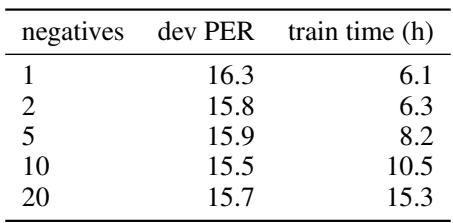
Table 3 suggests that there is a “sweet spot.” Increasing the number of negative samples helps performance up to about 10 negatives. After that, performance plateaus (stays around 15.5 PER), but the training time increases. The researchers stuck with 10 negatives for their main models to balance speed and accuracy.
Predicting the Future
The model is trained to predict \(K\) steps into the future. Does predicting further ahead help?
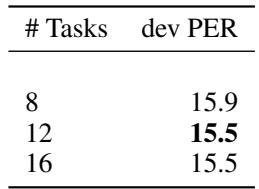
Interestingly, Table 5 shows that predicting more than 12 steps into the future does not yield better performance. It seems that the immediate future contains the most relevant signal for learning speech representations, and trying to guess too far ahead becomes noise that doesn’t help the encoder learn useful features.
Conclusion and Implications
The wav2vec paper marked a turning point in speech processing. It successfully demonstrated that:
- Raw audio is sufficient: We don’t need to manually process audio into spectrograms. Convolutional networks can learn better features directly from the waveform.
- Unsupervised learning works for speech: Just as NLP models learn from reading Wikipedia, speech models can learn from listening to unlabeled audio.
- Efficiency: This approach allows us to build high-quality speech recognizers with orders of magnitude less labeled data.
By moving away from supervised-only learning, wav2vec opened the door for more inclusive technology. It paved the way for future iterations (like wav2vec 2.0) that would eventually bring high-quality speech recognition to low-resource languages and specialized domains where labeled data is impossible to find.
For students of machine learning, wav2vec is a perfect example of how architectural choices (CNNs vs RNNs) and objective functions (Contrastive Loss) can be combined to solve fundamental bottlenecks in AI development.