](https://deep-paper.org/en/paper/2006.11477/images/cover.png)
Introduction: The Data Bottleneck
In the world of deep learning, data is fuel. For years, the engine of Automatic Speech Recognition (ASR) has been fueled by thousands of hours of transcribed audio—humans painstakingly listening to recordings and typing out every word. While this supervised approach has yielded systems like Siri and Alexa, it has a fundamental flaw: it doesn’t scale.
There are approximately 7,000 languages spoken worldwide. For the vast majority of them, collecting thousands of hours of transcribed audio is impossible. Even for major languages, the reliance on labeled data is inefficient. Consider how a human infant learns language. They don’t start by reading transcripts; they start by listening. They learn the structure of speech—the rhythm, the phonemes, the intonation—long before they attach meaning to words.
This blog post explores wav2vec 2.0, a seminal paper by researchers at Facebook AI that mimics this human learning process. By using Self-Supervised Learning (SSL), the authors created a model that learns powerful speech representations from raw audio alone.
The results are staggering. By pre-training on unlabeled audio, wav2vec 2.0 can outperform previous state-of-the-art methods while using 100 times less labeled data. In one experiment, the model achieves respectable accuracy using only 10 minutes of transcribed speech.
Background: From BERT to Audio
To understand wav2vec 2.0, we must look briefly at Natural Language Processing (NLP). The revolution in NLP was driven by models like BERT, which use “Masked Language Modeling.” In BERT, you take a sentence, hide (mask) some of the words, and ask the neural network to guess the missing words based on the context. This forces the model to understand grammar, syntax, and semantics without needing explicit labels.
Applying this to speech is difficult. In text, words are discrete units (a “cat” is always “cat”). In speech, audio is continuous. There are no clear boundaries between phonemes or words, and the same word sounds different every time it is spoken.
wav2vec 2.0 solves this by bridging the gap between continuous audio and discrete units. It learns to discretize audio data itself, creating a learned “codebook” of speech units, and then solves a masked task similar to BERT.
The wav2vec 2.0 Architecture
The model operates in two distinct phases: Pre-training (learning from unlabeled audio) and Fine-tuning (learning to recognize words from labeled audio). The architecture is designed to transform raw waveforms into rich, contextualized representations.
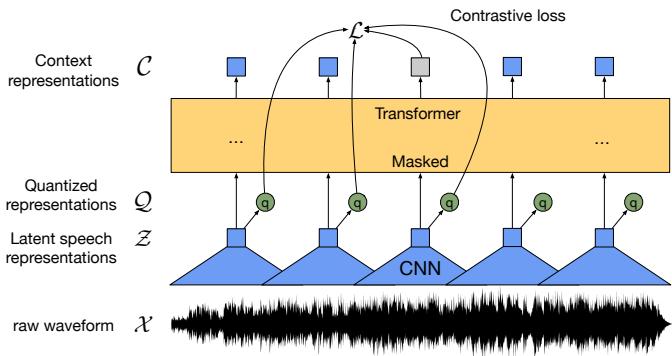
As shown in Figure 1, the architecture consists of three main components working in tandem:
Feature Encoder (CNN): The process begins with the raw audio waveform, denoted as \(\mathcal{X}\). This is fed into a multi-layer Convolutional Neural Network (CNN). This encoder, \(f(x)\), turns the raw sound into a sequence of latent speech representations, denoted as \(\mathbf{z}_1, \ldots, \mathbf{z}_T\). You can think of these \(Z\) vectors as a compressed, mathematical summary of the sound at each time step (every 20ms).
Context Network (Transformer): The latent representations (\(Z\)) are masked (more on this later) and fed into a Transformer network, \(g(z)\). Just like in NLP, the Transformer uses self-attention to look at the entire sequence at once. It produces contextualized representations, \(\mathbf{c}_1, \ldots, \mathbf{c}_T\). While \(Z\) represents local sound features, \(C\) captures the global context—understanding that a specific sound is likely a “p” because it was preceded by “a” and “p”.
Quantization Module: This is the novel contribution that allows BERT-style training on continuous audio. The model takes the continuous output of the feature encoder (\(Z\)) and discretizes it into quantized representations (\(Q\)). This effectively turns continuous sound waves into a finite vocabulary of “speech tokens.”
The Quantization Process
How do we turn infinite variations of sound into a finite set of discrete units? The authors use Product Quantization.
Imagine a codebook (a dictionary) containing various sound patterns. Instead of matching a sound vector to a single entry, product quantization splits the vector into \(G\) groups (sub-vectors). It then finds the best match for each sub-vector in specific codebooks and concatenates them.
For example, if the model uses \(G=2\) codebooks with \(V=320\) entries each, it can represent \(320 \times 320 = 102,400\) unique theoretical sound units.
The Gumbel Softmax
Choosing a discrete entry from a codebook is typically a non-differentiable operation (you can’t calculate gradients through a hard “choice” like an argmax). To train this end-to-end, the researchers use the Gumbel Softmax trick. This allows the model to make a “soft” choice during training that becomes a “hard” choice during inference, while still allowing gradients to flow backward to update the encoder.
The probability of choosing the \(v\)-th entry in the \(g\)-th codebook is calculated as:

Here, \(\tau\) is a temperature parameter. When \(\tau\) is large, the distribution is uniform. As \(\tau\) approaches 0, the distribution becomes a “one-hot” vector, effectively selecting a single entry. The authors anneal (lower) this temperature over the course of training.
The Training Objective
The core magic of wav2vec 2.0 lies in how it learns. The model is not trained to transcribe speech (yet). It is trained to solve a Contrastive Task.
1. Masking
First, the model obscures part of the input. It randomly samples starting time steps and masks the subsequent \(M\) time steps in the latent space (\(Z\)).
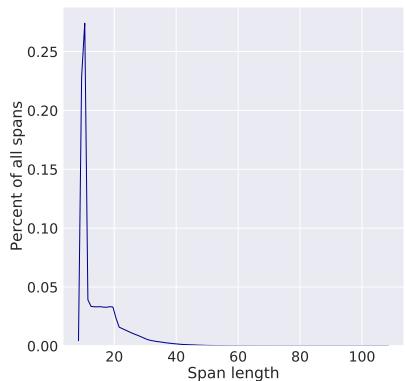
Figure 2 shows the distribution of mask lengths. Roughly 49% of the total time steps are masked. The Transformer sees the context around the mask but not the masked segment itself. Its job is to figure out what sound was hidden.
2. Contrastive Loss (\(\mathcal{L}_m\))
Unlike standard reconstruction (where a model tries to recreate the exact input values), wav2vec 2.0 simply has to identify the correct discrete unit (\(q_t\)) from a set of options.
For a masked time step, the model looks at the context vector \(c_t\) and compares it to the true quantized vector \(q_t\). However, to make it difficult, the model also compares \(c_t\) to \(K\) distractors—quantized vectors sampled from other masked parts of the same audio file.
The objective is to maximize the similarity between the context vector and the true quantized vector, while minimizing similarity with the distractors.

This equation represents the negative log-likelihood of identifying the true latent representation. \(\text{sim}\) denotes cosine similarity.
3. Diversity Loss (\(\mathcal{L}_d\))
There is a risk in this setup: “Codebook Collapse.” The model might get lazy and use only a tiny fraction of its available codebook entries to represent all speech, ignoring the rest. To prevent this, the researchers add a diversity loss.

This loss maximizes the entropy of the averaged softmax distribution over the codebook entries. In simple terms, it forces the model to use all the “words” in its dictionary equally often across a batch of data.
Total Objective
The final loss function combines the contrastive loss and the diversity loss:

Experimental Setup
The researchers tested two model sizes:
- BASE: 12 Transformer blocks (95 million parameters).
- LARGE: 24 Transformer blocks (317 million parameters).
Data Sources:
- Unlabeled Pre-training: They used the Librispeech corpus (960 hours) and the massive LibriVox dataset (53,200 hours).
- Labeled Fine-tuning: They fine-tuned on subsets of Librispeech ranging from the full 960 hours down to just 10 minutes of labeled data.
During fine-tuning, the quantization module is discarded. A simple linear projection layer is added on top of the Transformer to predict the actual character classes (vocabulary), and the model is trained using Connectionist Temporal Classification (CTC) loss.
Results: Redefining State-of-the-Art
The results of wav2vec 2.0 demonstrate a massive leap forward in data efficiency.
The Power of 10 Minutes
Perhaps the most striking result is the performance in ultra-low-resource settings.
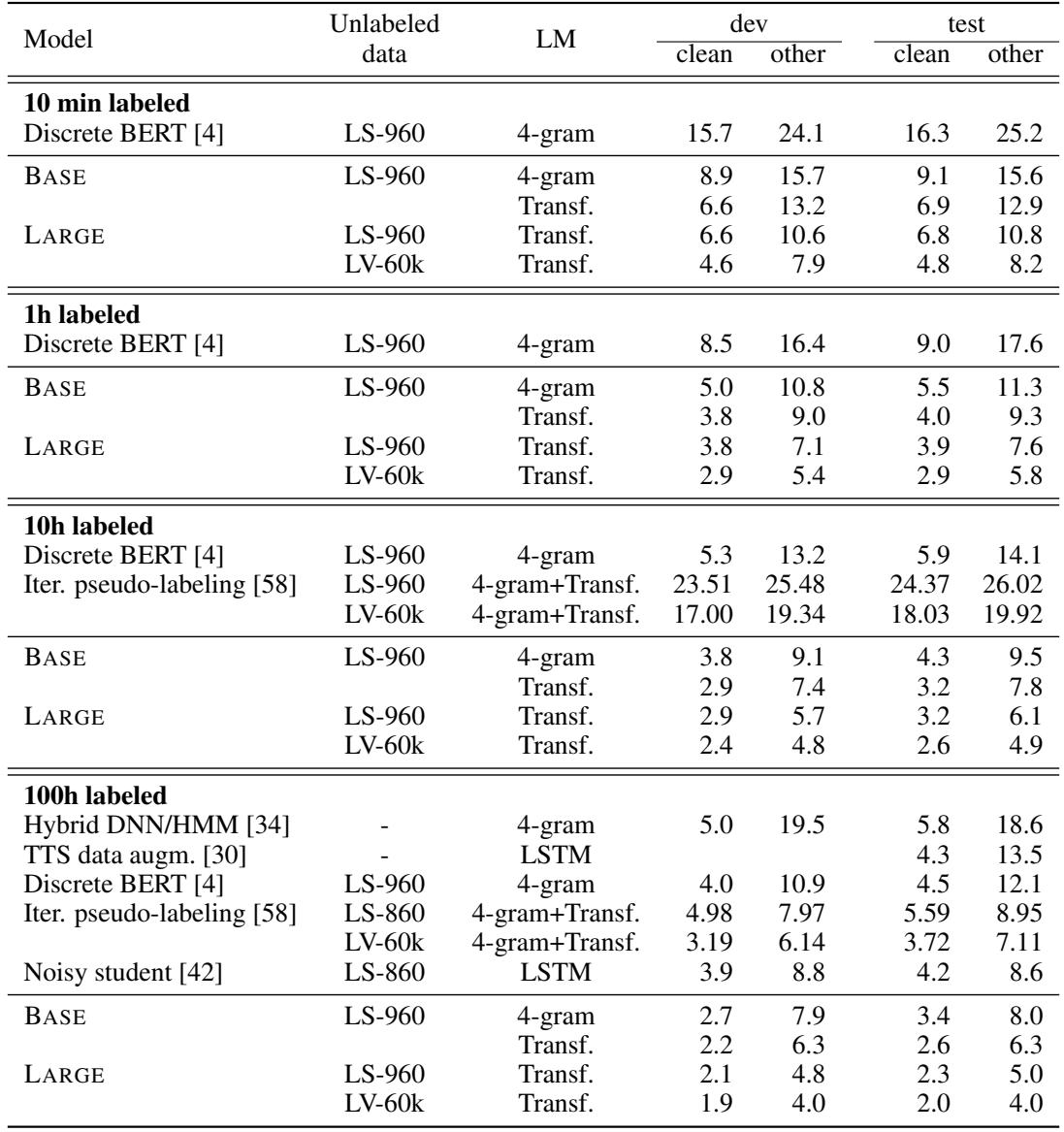
As seen in Table 1, when fine-tuned on only 10 minutes of labeled data (roughly 48 sentences), the LARGE model pre-trained on LibriVox achieves a Word Error Rate (WER) of 4.8% on clean test data.
Compare this to Discrete BERT (a previous method), which achieved a 16.3% error rate using the same amount of data. The wav2vec 2.0 model effectively learns the structure of the language so well during pre-training that it barely needs any teacher to learn the mapping to text.
Beating the 100-Hour Benchmark
On the standard 100-hour labeled subset, wav2vec 2.0 outperforms the previous state-of-the-art, Noisy Student, while using significantly fewer resources.
- Noisy Student: WER 4.2% (Test Clean)
- wav2vec 2.0 (Large): WER 2.3% (Test Clean)
This is a 45% relative reduction in errors. Even with only 10 hours of labels (one-tenth of the data), wav2vec 2.0 (3.2% WER) still outperforms the Noisy Student model trained on 100 hours.
High-Resource Performance
Does the method scale when we have plenty of data? Yes.

Table 10 shows that when fine-tuned on the full 960 hours of Librispeech, the model achieves a WER of 1.8% on the clean test set. It outperforms the supervised baseline (2.1%) and other semi-supervised methods like ContextNet.
Phoneme Recognition (TIMIT)
To prove that the model learns fine-grained speech details, the authors tested it on the TIMIT dataset, which requires recognizing phonemes (the distinct units of sound that distinguish one word from another).

As shown in Table 3, wav2vec 2.0 sets a new state-of-the-art with a Phoneme Error Rate (PER) of 8.3%, a significant improvement over previous bests (11.6%).
Analysis: What did the model learn?
One of the fascinating aspects of self-supervised learning is inspecting the “black box” to see what representations emerged.
Discrete Units \(\approx\) Phonemes
The authors analyzed the alignment between the learned quantized units and human-annotated phonemes.
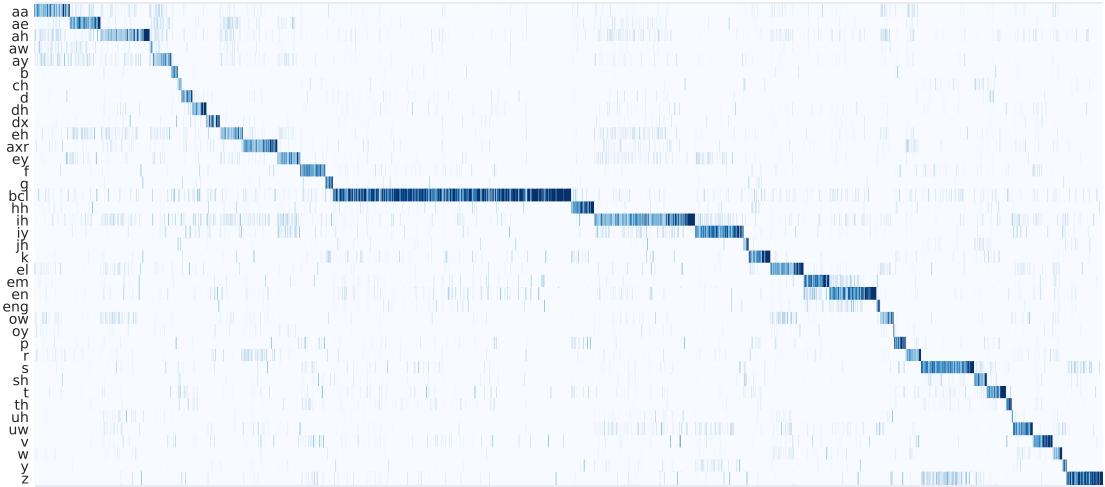
Figure 3 visualizes the conditional probability of a phoneme given a specific discrete latent code (\(q_t\)). The distinct horizontal bars indicate that specific quantized units have specialized to represent specific phonemes. For example, specific codes strongly correlate with the silence phoneme (“bcl”) or specific vowels. The model essentially re-discovered the concept of phonemes on its own, without being told they exist.
Error Analysis
Despite the impressive performance, the model is not perfect. Table 11 and Table 12 in the paper highlight common errors, particularly when the model is used without a language model (LM).
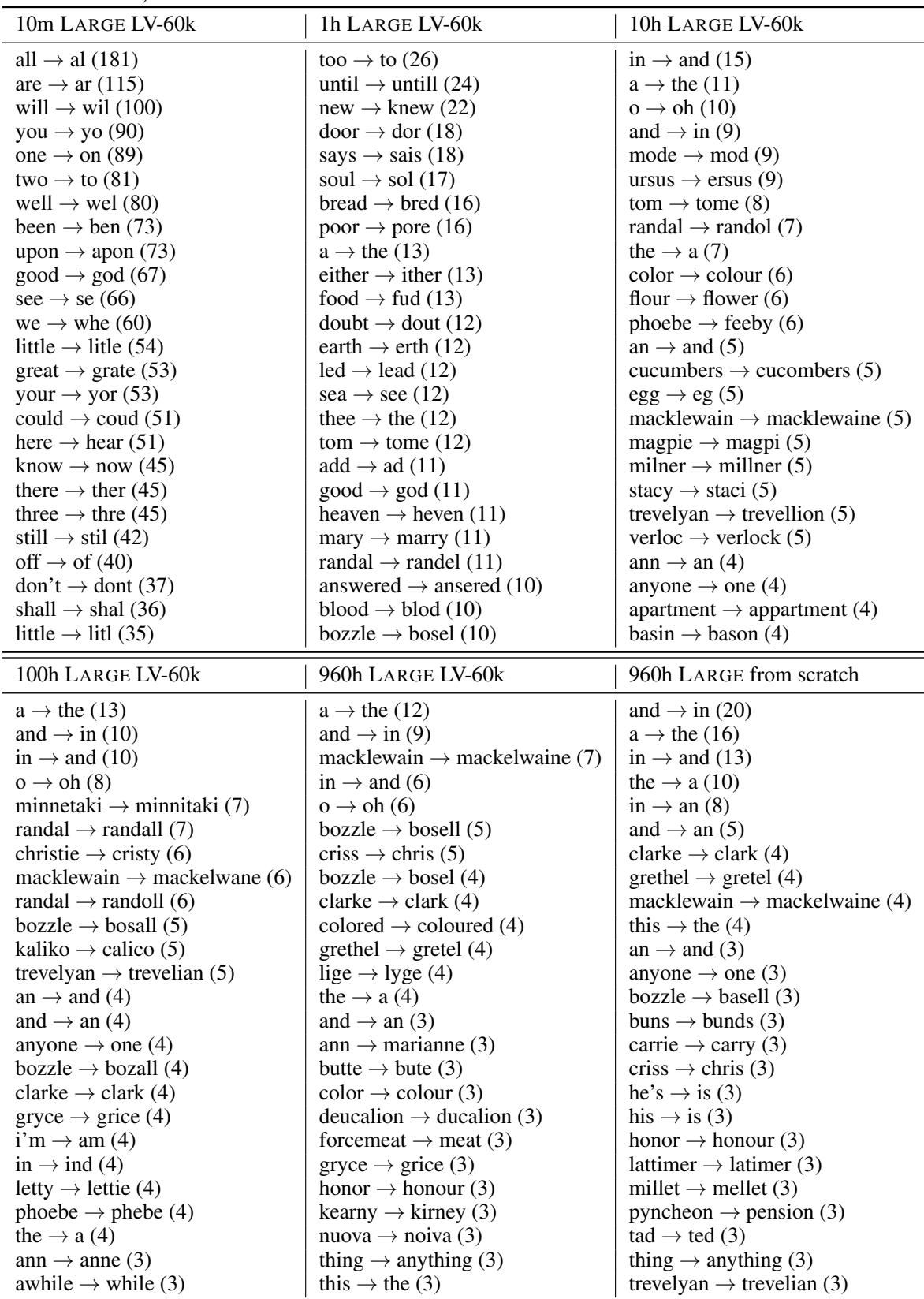
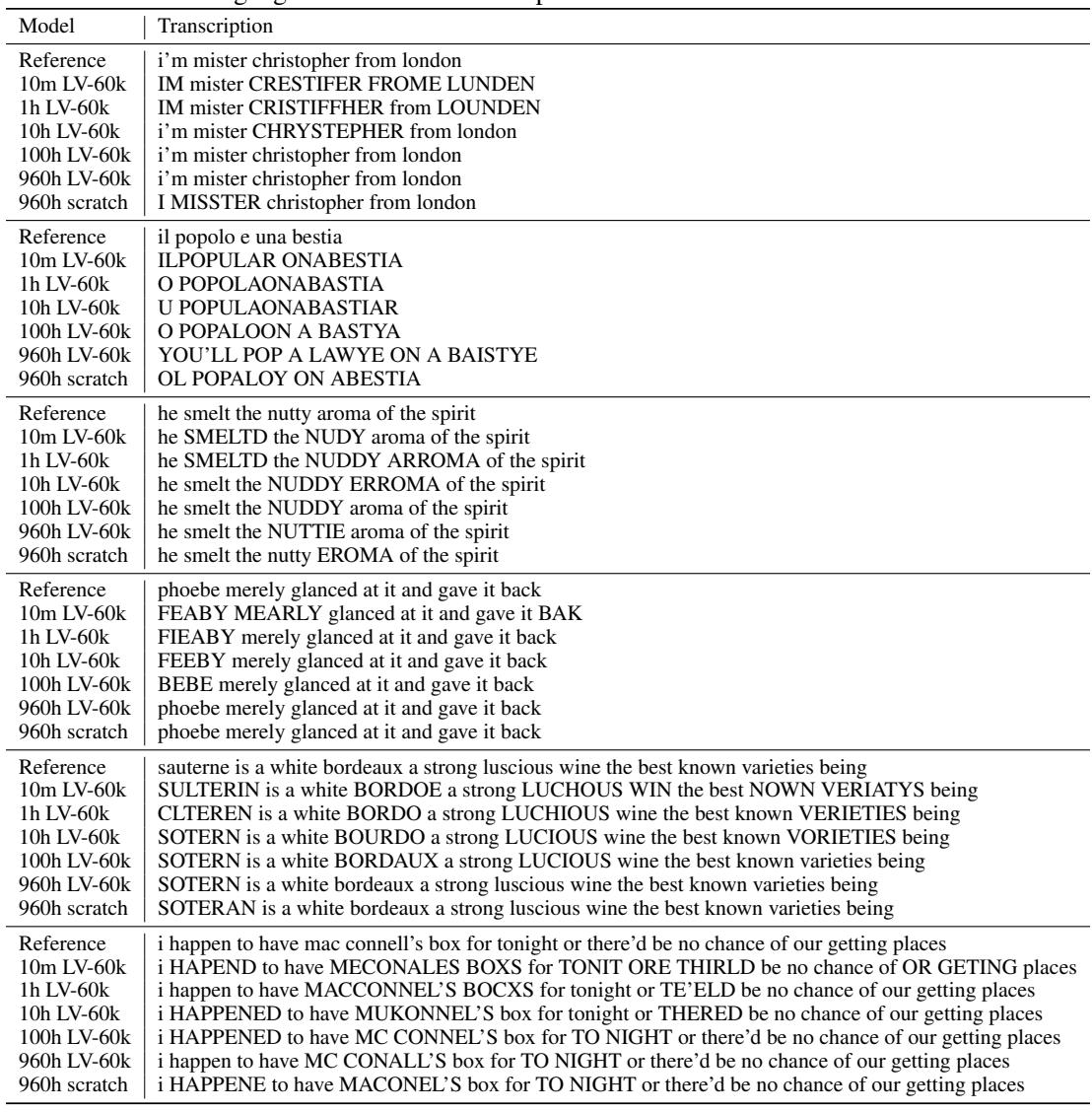
In Table 12, we see that in the 10-minute setup, the model produces phonetically correct but orthographically wrong transcriptions (e.g., “CRESTIFER” instead of “CHRISTOPHER”). This confirms the acoustic model is strong—it hears the sounds correctly—but without a language model or sufficient labeled data, it doesn’t know the correct spelling conventions of English. As more labeled data is added (1h, 10h), these spelling errors diminish.
Ablation Studies: Continuous vs. Quantized
Finally, the researchers asked: Is it better to feed the Transformer quantized data or continuous data?
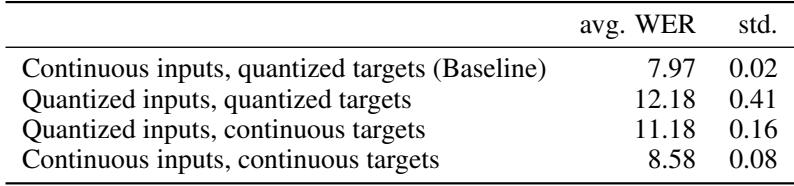
Table 4 reveals a crucial design choice. The best performance comes from using continuous inputs (feeding \(Z\) to the Transformer) but using quantized targets (using \(Q\) for the loss function).
- If you quantize the input, you lose information and performance drops (WER rises to 12.18).
- If you leave the targets continuous, the task becomes too focused on detailed artifacts (like background noise), and the model fails to learn general speech representations (WER 8.58).
- The hybrid approach (Continuous Input, Quantized Target) strikes the perfect balance (WER 7.97).
Conclusion and Implications
wav2vec 2.0 represents a watershed moment for speech processing. By successfully adapting the “mask-and-predict” paradigm from NLP to audio via quantization, the authors unlocked the potential of vast amounts of unlabeled data.
The implications are profound, particularly for the “long tail” of languages.
- Democratization: High-quality speech recognition is no longer the exclusive domain of English, Mandarin, or Spanish.
- Efficiency: We can build effective models with minutes, not months, of transcription effort.
- Simplicity: The framework is end-to-end differentiable and conceptually simpler than previous multi-stage pipelines.
As we move forward, techniques like wav2vec 2.0 pave the way for a world where technology understands every voice, regardless of the language spoken or the resources available to document it. The model didn’t just learn to recognize speech; it learned how to listen.