](https://deep-paper.org/en/paper/203_fomo_3d_using_vision_found-2445/images/cover.png)
In the world of autonomous driving, recognizing a car or a pedestrian is a solved problem. Modern perception systems can spot a sedan from a hundred meters away with high accuracy. But what happens when the vehicle encounters something rare? A construction worker carrying a sheet of glass, a child in a stroller, or debris scattered on a highway?
These “long-tailed” objects—classes that appear infrequently in training data—pose a massive safety risk. Standard AI models struggle to learn them because they simply don’t see enough examples during training.
In this post, we dive into FOMO-3D, a novel research paper that proposes a clever solution: instead of spending years collecting more driving data, why not leverage the “knowledge” of massive Vision Foundation Models (VFMs) that have already seen billions of images from the internet?
The Problem: The Long Tail of Driving
Self-driving cars rely heavily on supervised learning. You show the model thousands of examples of a car, and it learns to detect cars. But for rare objects, the data is scarce. This is known as the long-tailed class imbalance.
Traditional methods try to fix this by re-sampling data (showing the rare examples more often) or re-weighting loss functions (punishing the model more for missing rare items). However, these methods are limited by the information present in the original dataset. If your LiDAR sensor barely picked up a few points on a distant stroller, re-weighting the loss won’t magically create more detail.
The researchers behind FOMO-3D realized that while driving datasets are limited, the internet is not. Vision Foundation Models (like CLIP or OWLv2) have been trained on billions of image-text pairs. They know what a “stroller” or “debris” looks like, even if a self-driving dataset doesn’t.
The Solution: Foundation Models as Priors
FOMO-3D stands for “Foundation Model 3D detection.” It is a multi-modal detector that fuses data from active sensors (LiDAR) with the rich semantic knowledge of passive sensors (Cameras processed by Foundation Models).
The core idea is illustrated below:

As shown in Figure 1:
- OWL (Left): An open-vocabulary 2D detector. You can give it a text prompt like “construction worker,” and it finds them in the image with high accuracy, zero-shot (without specific training).
- Metric3D (Middle): A depth estimation model that can predict the geometry of a scene from a single image.
- FOMO-3D (Right): The proposed method that combines these 2D priors with LiDAR to create accurate 3D bounding boxes.
The Architecture: How FOMO-3D Works
Fusing 2D foundation model outputs with 3D LiDAR data is notoriously difficult. Cameras give you dense semantics (colors, textures, labels) but poor geometry (depth). LiDAR gives you perfect geometry but poor semantics (it just sees 3D points).
FOMO-3D tackles this with a two-stage architecture, summarized in the figure below.
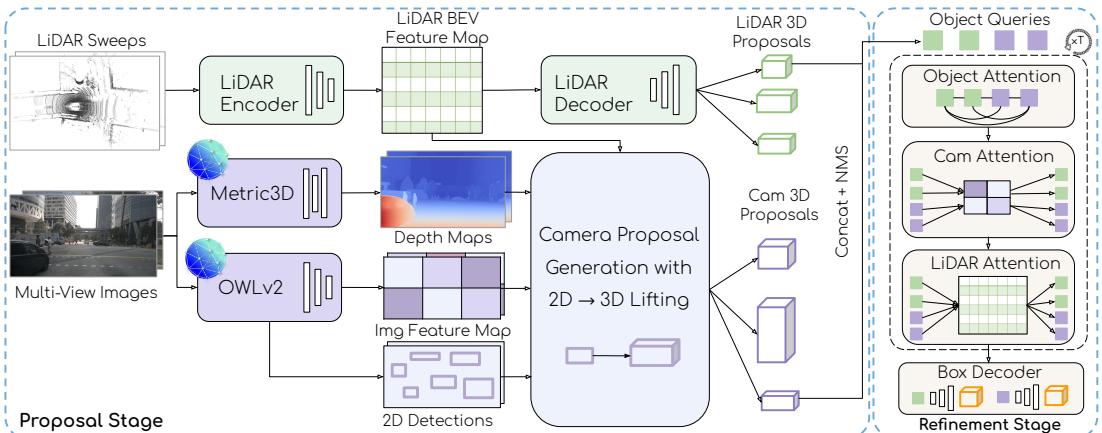
Let’s break down the two main stages shown in Figure 2.
Stage 1: The Multi-Modal Proposal
In this stage, the system generates initial guesses (proposals) about where objects might be. FOMO-3D runs two parallel branches:
- LiDAR Branch: Uses a standard detector (CenterPoint) to find objects based on 3D point clouds. This is great for common objects like cars.
- Camera Branch: This is the novel contribution. It uses OWLv2 to find objects in 2D images and Metric3D to guess their depth.
The Challenge of Lifting 2D to 3D
The camera branch has to “lift” a 2D box from an image into 3D space. The math for this relies on unprojecting pixels using the estimated depth (\(d_i\)) and camera intrinsics (\(\mathbf{K}\)):

However, monocular depth estimation (estimating distance from a single picture) is often noisy. If the depth is off by even a few meters, the 3D box will be in the wrong place.
To solve this, the researchers introduced Frustum-Based Attention.
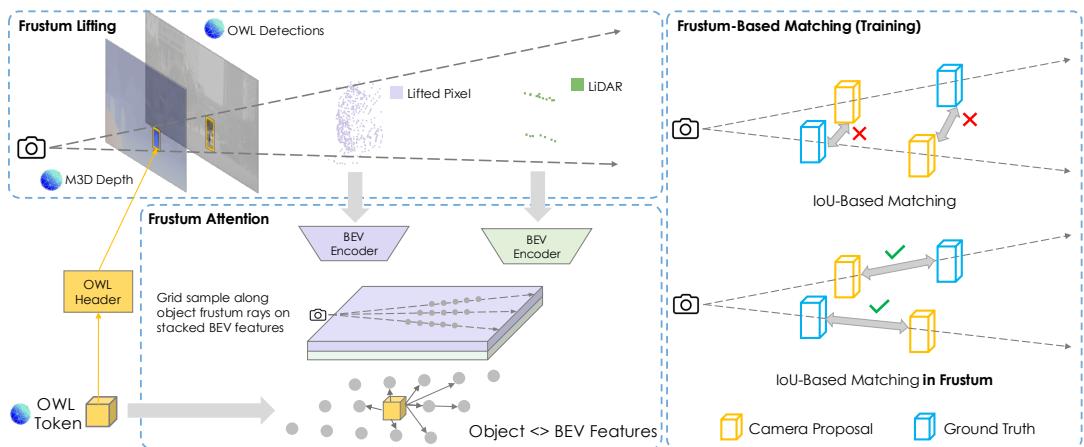
As visualized in Figure 3:
- Frustum Lifting: The model takes the 2D detection and projects it out into 3D space, creating a frustum (a pyramid shape extending from the camera).
- Virtual Point Cloud: It creates a “virtual” point cloud inside this frustum using the Metric3D depth, painting each point with semantic features from OWL.
- Frustum Attention: The model knows the depth might be wrong. So, instead of trusting a single point, it samples features along the entire frustum ray. It looks at the LiDAR features and image features within that cone of vision to refine the object’s position.
Stage 2: Attention-Based Refinement
Once the proposals are generated (from both LiDAR and Camera branches), they are merged. But we aren’t done yet. The proposals might still be slightly misaligned or misclassified.
The Refinement Stage uses a Transformer architecture. Each proposal becomes a “query” that attends to the rest of the scene.
- LiDAR Attention: The query looks at the LiDAR point cloud to verify the geometry.
- Camera Attention: The query looks back at the OWL image features. This is crucial for long-tail classification. The LiDAR might just see a “blob,” but OWL knows that blob has the texture of a “construction worker.”
Experiments and Results
The researchers tested FOMO-3D on two challenging datasets: nuScenes (complex urban driving) and an in-house Highway dataset (long-range detection at high speeds).
Urban Driving (nuScenes)
The results on nuScenes were significant. The table below compares FOMO-3D against state-of-the-art methods.
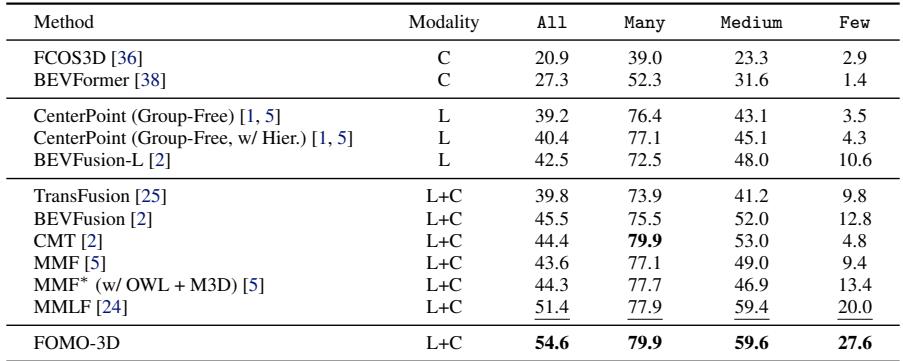
Key Takeaways from the Data:
- Look at the “Few” column (rare objects). FOMO-3D achieves 27.6 mAP, nearly doubling the performance of some baselines and significantly beating the previous best (MMLF at 20.0).
- It improves performance on “Many” (common objects) as well, proving that adding rare object capability doesn’t hurt overall performance.
Long-Range Detection (Highway)
Detecting small objects at high speeds is difficult because LiDAR points become very sparse at long range.
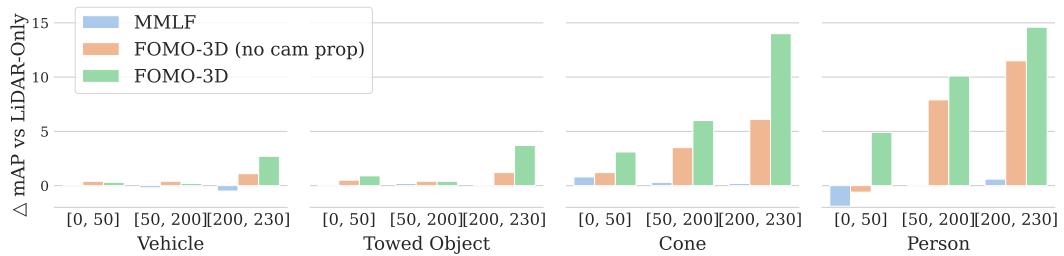
Figure 5 shows the performance gain over a LiDAR-only baseline.
- Green Bars (FOMO-3D): Show consistent improvements across all distances.
- Person Detection: Notice the massive spike in the “Person” category (far right). At long ranges (200m+), LiDAR barely sees pedestrians. The camera (OWL), however, can still spot them, and FOMO-3D successfully leverages that prior.
Qualitative Analysis: Seeing is Believing
Numbers are great, but visual examples demonstrate the real impact.
Example 1: The Child and the Cone
In this scenario, a LiDAR-only model confuses a child for an adult and hallucinates a traffic cone.
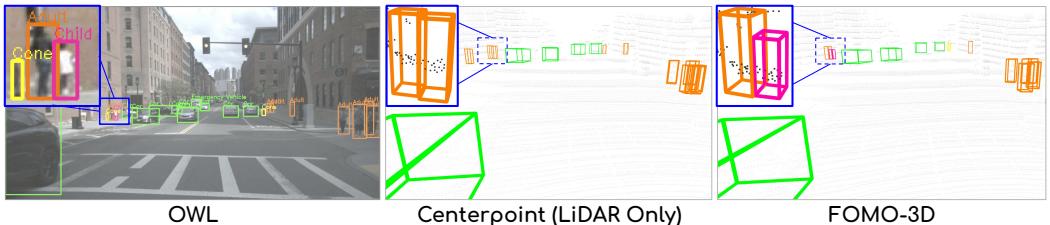
As seen in Figure 6, OWL (left) correctly identifies the child but creates a False Positive (FP) cone. The LiDAR-only model (middle) misclassifies the child. FOMO-3D (right) fuses the data: it uses the LiDAR geometry to realize the “cone” isn’t real, but uses the OWL semantics to correctly classify the “Child.”
Example 2: Cleaning up False Positives
One risk of using sensitive 2D detectors is that they often hallucinate objects.
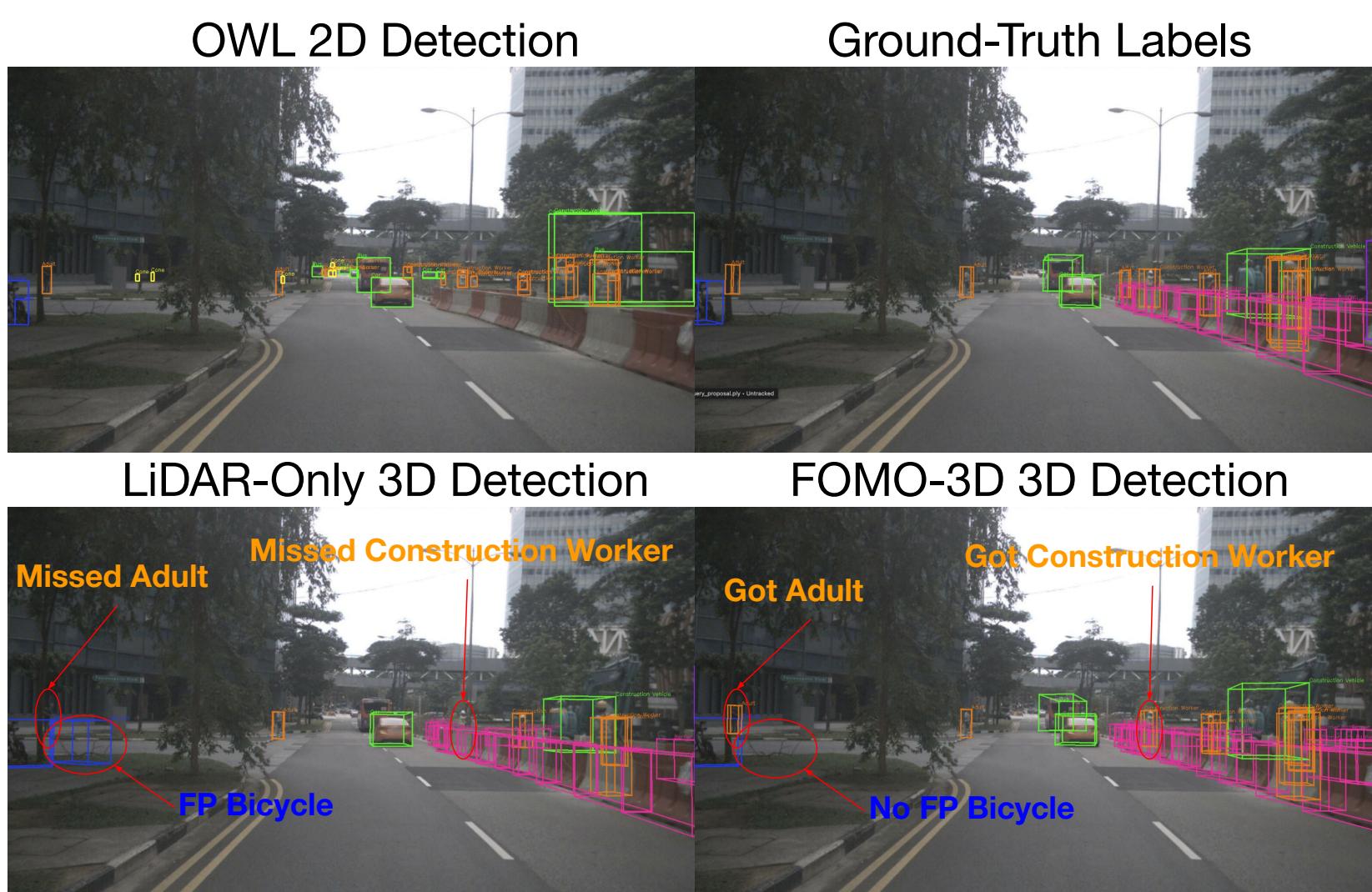
In Figure 10, the LiDAR-only model misses the construction worker entirely and hallucinates a bicycle. FOMO-3D successfully detects the worker (thanks to the camera) and suppresses the ghost bicycle (thanks to the LiDAR).
Conclusion and Future Outlook
FOMO-3D represents a shift in how we approach perception in robotics. Rather than treating object detection as a closed-loop supervised learning problem, it treats it as an open-world problem assisted by the vast knowledge embedded in Foundation Models.
Why this matters:
- Safety: It detects the “long-tail” objects that actually cause accidents.
- Efficiency: It improves performance without requiring millions of new labeled driving logs.
- Flexibility: Because it uses open-vocabulary models, you could theoretically ask it to detect “deer” or “skateboard” without retraining the whole network, just by changing the text prompt to OWLv2.
Limitations: currently, the heavy foundation models (OWL and Metric3D) are computationally expensive, making real-time onboard inference a challenge. However, as hardware improves and techniques like model distillation advance, methods like FOMO-3D pave the way for safer, smarter autonomous vehicles that understand the world as well as we do.