](https://deep-paper.org/en/paper/2164_catch_your_emotion_sharpe-1642/images/cover.png)
Introduction
In the rapidly evolving world of Artificial Intelligence, Multimodal Large Language Models (MLLMs) like LLaVA and GPT-4V have become incredibly adept at describing the world. Show them a picture of a crowded street, and they can list the objects, read the signs, and even deduce the time of day. However, there is a frontier where these powerful models still stumble: Emotional Intelligence.
While an MLLM can identify a person smiling, it often struggles to distinguish the nuance between “amusement” and “excitement,” or between “sadness” and “fear.” Why? Because unlike object detection, emotion is abstract, subjective, and often hidden in subtle cues rather than obvious shapes.
The standard approach to fixing this has been brute force: fine-tuning models on massive datasets of emotional images. But this is expensive, resource-intensive, and hard to scale.
Enter a new, elegant solution proposed by researchers from Wuhan University: Sharpening Emotion Perception in MLLMs (SEPM). In their recent paper, they introduce a training-free method that helps models “focus” on emotional cues during inference, effectively sharpening their emotional IQ without a single step of back-propagation training.
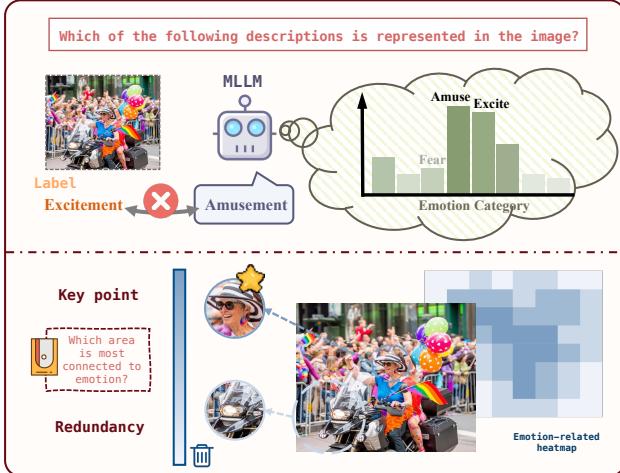
As shown in Figure 1, models face two main hurdles:
- Semantic Confusion: Differentiating between similar positive emotions (like Amusement vs. Excitement) is much harder than distinguishing positive from negative.
- Visual Redundancy: An image contains a lot of “noise.” A motorcycle in a parade might be visually dominant, but the rider’s facial expression is what defines the emotion.
In this post, we will break down how SEPM solves these problems using a clever “Coarse-to-Fine” inference strategy and a mechanism to filter out visual noise.
Background: The Emotional Gap in MLLMs
To understand why this paper is significant, we first need to look at how MLLMs process images. Typically, an image is encoded into “visual tokens” (similar to words in a sentence) by a vision encoder (like ViT). These tokens are then fed into a Large Language Model (LLM) alongside a text prompt.
The problem arises in the inference stage:
- Text Dominance: LLMs often prioritize text over visual cues. If the text prompt is generic, the model might hallucinate or stick to safe, broad descriptions.
- Visual Overload: MLLMs process hundreds of visual tokens. For emotion recognition, maybe only 10% of those tokens (the eyes, the mouth, a gesture) actually matter. The rest (the sky, the floor, the background crowd) are distractors.
Previous attempts to fix this involved fine-tuning (training the model specifically on emotion datasets) or visual prompting (manually drawing bounding boxes around faces). The former is computationally expensive; the latter requires human labor. SEPM offers a third way: optimizing the inference process itself.
The Core Method: SEPM
The proposed method, SEPM, is built on the philosophy that if you want a model to answer a hard question, you should first ask it an easy question to orient its focus. It consists of two main pillars:
- Confidence-Guided Coarse-to-Fine Inference (CCI): Breaking the task into two steps.
- Focus-on-Emotion Visual Augmentation (VTA): Automatically removing irrelevant parts of the image.
Let’s visualize the entire architecture before diving into the details.
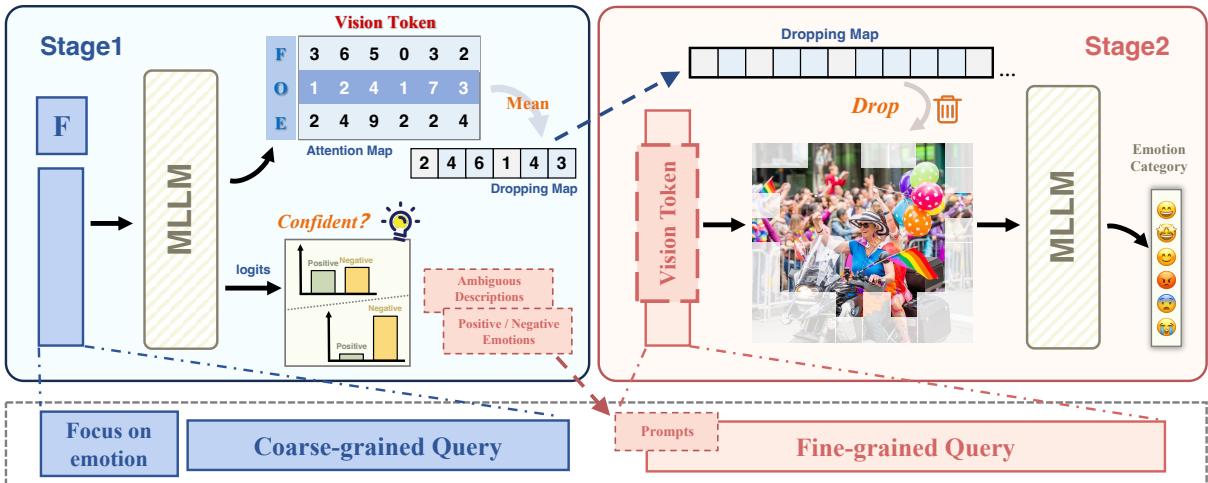
Component 1: Confidence-Guided Coarse-to-Fine Inference (CCI)
Imagine you are looking at a blurry photo. It’s hard to tell if the person is “ecstatic” or “content.” However, it is usually easy to tell if they are feeling something “Positive” or “Negative.”
SEPM leverages this by splitting the inference into two stages.
Stage 1: Coarse-Grained Inference
First, the model is asked a broad question: Is this image Positive or Negative?
\[ \hat { \mathcal { E } } = \mathcal { M } ( \mathcal { Q } _ { c } , D ) , \]Here, \(\mathcal{Q}_c\) is the coarse query (e.g., “Positive or Negative?”). This is a much simpler task for the model. But the researchers don’t just take the answer; they measure how confident the model is.
The Confidence Check
How do we know if the model is confident? We look at the “logits” (the raw scores before the final decision) for the answers “Positive” and “Negative.”
\[ \begin{array} { l } { z = \mathcal { M } _ { l o g i t s } ( \mathcal { Q } _ { c } , D ) , } \\ { p = s o f t m a x ( z ) , } \end{array} \]If the probability (\(p\)) for Positive is 0.51 and Negative is 0.49, the model is guessing. If it’s 0.99 vs 0.01, it’s certain. The paper formalizes this variance calculation as:
\[ \mathcal { C } = \frac { ( p _ { A } - \mu ) ^ { 2 } + ( p _ { B } - \mu ) ^ { 2 } } { 2 } , \]If this confidence score \(\mathcal{C}\) is high (above a certain threshold), the model proceeds to Stage 2 with a narrowed scope. If the model determines the image is “Positive” with high confidence, it will only consider positive emotions (like Awe, Amusement, Excitement) in the next step, ignoring negative ones. This drastically reduces the “search space” for the model, preventing it from getting confused by irrelevant categories.
If the confidence is low (ambiguous), the model keeps all options open but adds a prompt indicating the ambiguity.
Component 2: Focus-on-Emotion Visual Augmentation
Now for the visual part. As mentioned earlier, images are noisy. To sharpen perception, SEPM attempts to remove visual tokens that don’t contribute to the emotion.
Step 1: Prompting Attention
The researchers use a specific prompt: “Please focus on emotion.” When the MLLM processes this text alongside the image in Stage 1, it generates an Attention Map. This map reveals which parts of the image the model is “looking at” when it thinks about the word “emotion.”
The attention map \(\mathcal{A}\) is derived from the model’s internal layers:
\[ \mathcal { A } = \mathcal { M } _ { a t t n } ( \mathcal { Q } _ { c } , D ) , \]Step 2: Estimating Token Importance
The system looks at the interaction between the text tokens (Focus on Emotion) and the visual tokens. It builds a matrix that scores every patch of the image based on how relevant it is to the concept of emotion.
\[ \hat { P } [ j ] = \frac { 1 } { L _ { t } } \sum _ { i = 1 } ^ { L _ { t } } P [ i , j ] , \quad j \in \{ 1 , 2 , \ldots , N _ { v } \} , \]In simple terms, \(\hat{P}[j]\) is the “Emotion Score” for the \(j\)-th part of the image.
Step 3: Dropping the Noise
This is where the “Augmentation” happens. The method identifies the visual tokens with the lowest scores—the background, the inanimate objects, the empty space—and physically removes them from the input for Stage 2.
\[ \begin{array} { r } { \mathcal { R } = \mathrm { a r g m i n } _ { k } ( \bar { P } ) , \quad k = \lfloor \beta N _ { v } \rfloor , } \end{array} \]Here, \(\beta\) is the drop rate (e.g., dropping the bottom 20% of tokens). The refined set of visual tokens \(\mathcal{V}'\) consists only of the important bits:
\[ \mathcal { V } ^ { \prime } = \{ v _ { j } \ | \ j \notin \mathcal { R } , j \in \{ 1 , 2 , \ldots , N _ { v } \} \} , \]Visualizing the Result
Does this actually work visually? Look at the figure below.
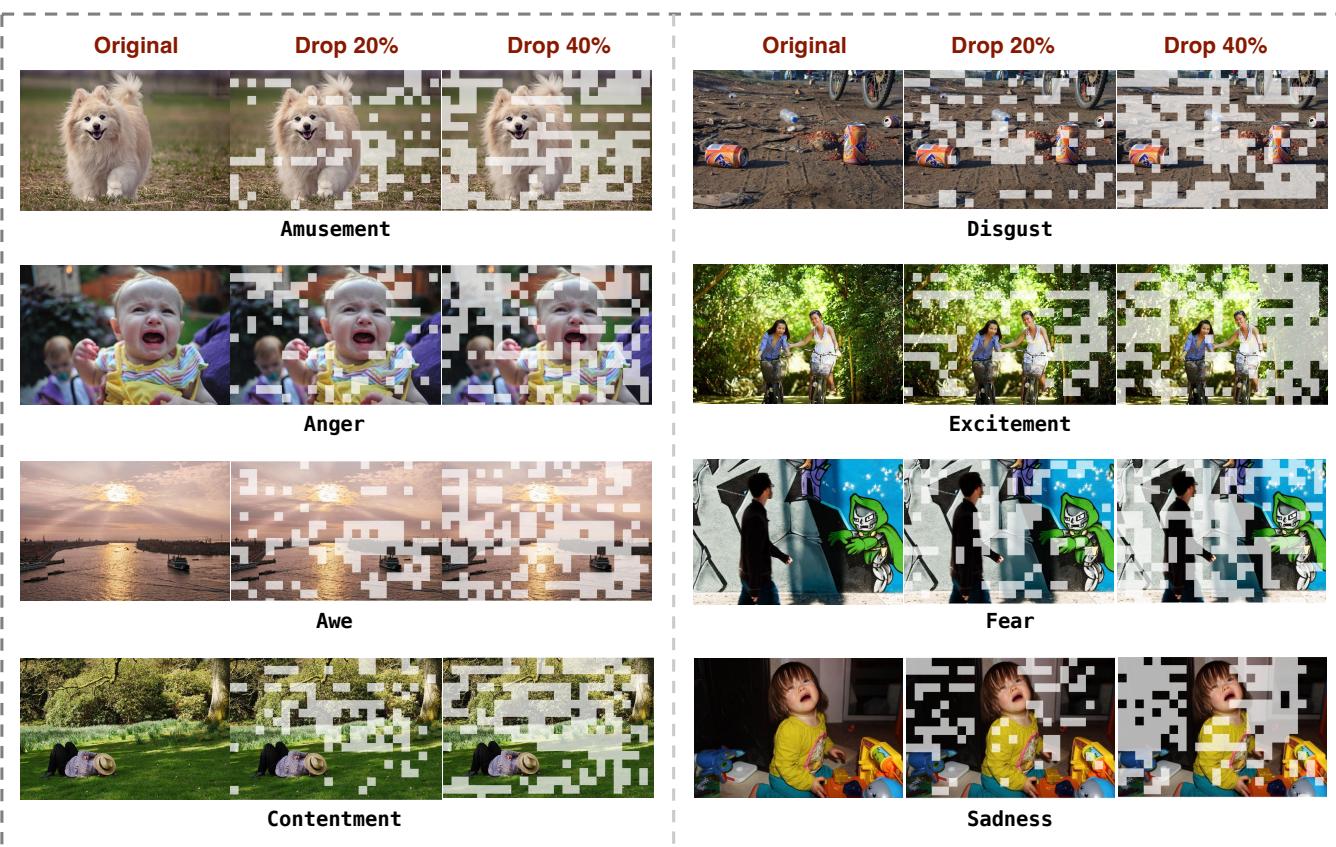
In Figure 4, you can see the original images on the left. As we move to the right (20% drop and 40% drop), the irrelevant parts of the image (like the wall behind the cat or the sky behind the rollercoaster) are “mosaic-ed” out, effectively removed from the model’s view. The model is forced to stare directly at the facial expressions and key actions.
Experiments & Results
The researchers tested SEPM on several standard datasets, including Emotion6, EmoSet, and WebEmo. They used LLaVA-7b and VILA-8b as their base models.
Comparison with State-of-the-Art
The results were compelling. Without any training, SEPM significantly outperformed the standard Zero-shot baseline and even beat “Zero-shot-CoT” (Chain of Thought prompting).
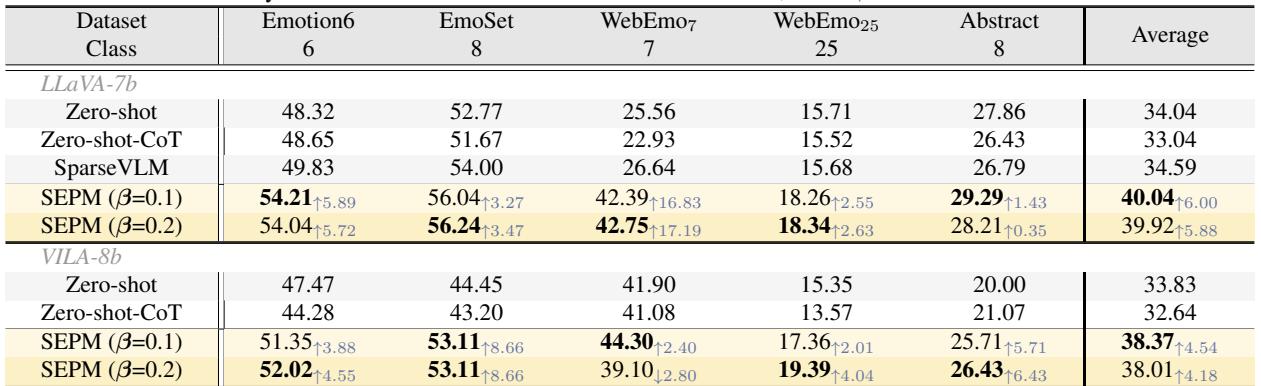
As seen in Table 1, on the WebEmo7 dataset, SEPM improved the LLaVA-7b model’s accuracy from 25.56% to 42.75%. That is a massive jump for an inference-only optimization. It demonstrates that the raw knowledge to recognize emotions was already in the model; it just needed the right focus.
Does the “Dropping” Strategy Matter?
You might ask: “Maybe dropping tokens just works because it processes less data?” The authors tested this by comparing their method against Random Dropping (just removing random parts of the image) and Query-related Dropping (dropping based on the general query, not specific to “emotion”).
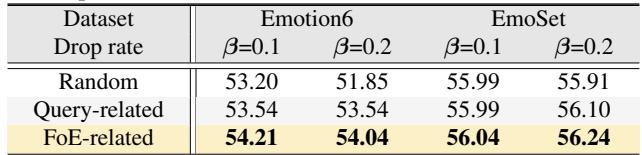
Table 2 confirms that context matters. Random dropping actually hurts performance (accuracy drops to 51.85% with higher drop rates). “FoE-related” (Focus-on-Emotion) dropping is the only strategy that consistently improves results, proving that the attention map is correctly identifying the emotional centers of the image.
Diagnostic Analysis: Is the Confidence Score Real?
The method relies heavily on the “Confidence Score” from Stage 1 to decide whether to narrow down the choices. The researchers validated this by plotting accuracy against the variance (their proxy for confidence).
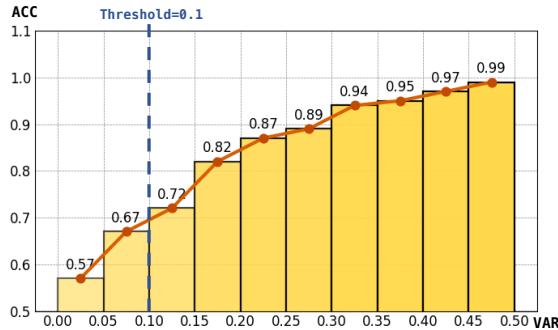
Figure 5 shows a clear trend: as the variance (confidence) increases, the accuracy of the prediction skyrockets toward 1.0. This validates the hypothesis that when the model “feels” sure about the Positive/Negative distinction, it is almost always right, making the two-stage pipeline reliable.
Conclusion & Implications
The SEPM framework presents a shift in how we approach Multimodal Large Language Models. Instead of constantly retraining models—which consumes vast amounts of electricity and data—we can unlock better performance by simply guiding the inference process.
By combining Confidence-Guided Coarse-to-Fine Inference with Focus-on-Emotion Visual Augmentation, the authors successfully:
- Reduced confusion between semantically similar emotions.
- Filtered out visual noise that distracts the model.
- Achieved state-of-the-art results in a completely training-free manner.
Why does this matter? For students and researchers, this highlights the power of Prompt Engineering combined with Architectural Awareness. We often treat models as black boxes, but by peeking inside at the attention maps and logits, we can engineer systems that are far more robust and emotionally intelligent.
As MLLMs become more integrated into our daily lives—serving as companions, tutors, or customer service agents—their ability to accurately perceive human emotion will be critical. SEPM offers a scalable, efficient path toward that future.