](https://deep-paper.org/en/paper/2302.12563/images/cover.png)
The field of protein representation learning is currently witnessing a massive paradigm shift. For years, the “gold standard” for understanding a protein’s structure and function has been to look at its evolutionary history. By aligning a protein sequence with thousands of its evolutionary cousins—a process called Multiple Sequence Alignment (MSA)—models could infer which parts of a protein are essential and which parts interact with one another.
However, MSA comes with a heavy price tag: it is computationally expensive, slow, and relies on rigid, pre-computed databases.
In this deep dive, we are exploring a paper that challenges the necessity of this rigid process: “Retrieved Sequence Augmentation for Protein Representation Learning.” The researchers propose a novel framework, RSA, that borrows a concept from Natural Language Processing (NLP)—Retrieval Augmented Generation—to replace MSAs. The result? A model that is not only mathematically elegant but also up to 373 times faster than current state-of-the-art methods while achieving superior performance.
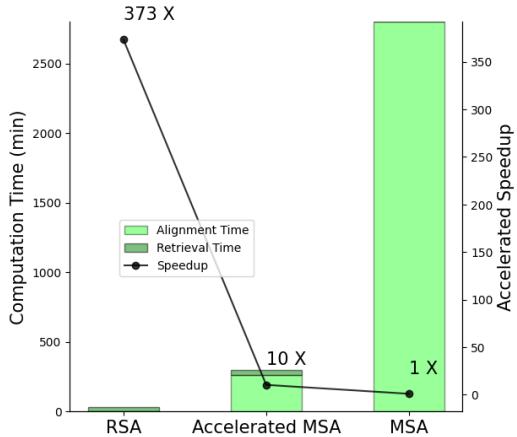
The Bottleneck: Why Evolution is Expensive
To understand why RSA is such a breakthrough, we first need to understand the problem it solves. Proteins are the workhorses of biology. Predicting their 3D structure and function from a 1D string of amino acids is one of the grand challenges of biology.
State-of-the-art models like AlphaFold and MSA Transformer rely heavily on Multiple Sequence Alignments (MSAs). Here is the basic intuition: if you want to understand a specific protein (let’s call it the query), you search a massive database for other proteins that share a common ancestor. You then align them in a grid. If a mutation in position 10 of the sequence is always accompanied by a mutation in position 50, the model learns that these two residues likely touch each other in 3D space (co-evolution).
While effective, this approach has three major flaws:
- Computational Complexity: Building an MSA requires comparing the query against millions of sequences. The complexity is roughly \(O(LD)\), where \(L\) is the protein length and \(D\) is the database size. This is slow.
- Rigidity: It requires an explicit “alignment” step. If a protein is “orphan” (has no known relatives) or “de novo” (engineered by humans), MSA methods fail.
- Storage: It requires storing massive Hidden Markov Model (HMM) profiles.
The researchers behind RSA asked a provocative question: Do we actually need the alignment? Or can we just retrieve similar sequences and let a deep neural network figure out the rest?
The Theoretical Shift: MSA as Retrieval
One of the most insightful contributions of this paper is a theoretical re-framing of the problem. The authors argue that MSA-based models are essentially just a specific, rigid type of Retrieval-Augmented Language Model.
In NLP, models like REALM or RAG improve their predictions by “reading” relevant documents from Wikipedia before answering a question. This paper proves that MSA Transformer does the same thing, just with biological constraints.
We can view the probability of predicting a protein property \(y\) given a sequence \(x\) as a two-step process:
- Retrieve: Find a related sequence \(r\) from a database.
- Predict: Make a prediction based on both \(x\) and \(r\).
Mathematically, this looks like this:

The authors broke down existing methods to show how they fit this framework. The traditional MSA Transformer selects sequences based on alignment scores and aggregates them using column-wise attention.
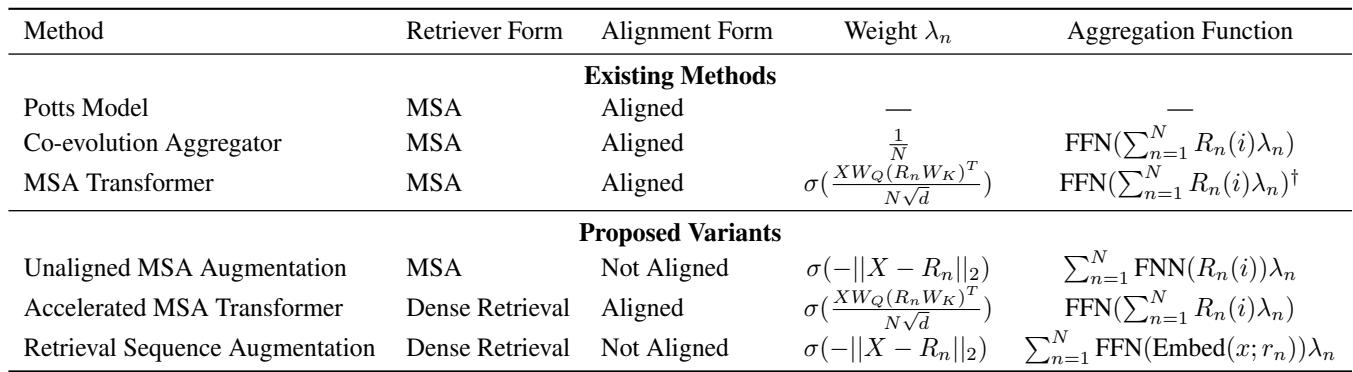
As shown in the table above, the proposed RSA method shifts two key design pillars:
- Retriever Form: Instead of discrete MSA search, it uses Dense Retrieval (vector similarity).
- Alignment Form: Instead of forcing sequences to align, it uses No Alignment.
The Core Method: Retrieved Sequence Augmentation (RSA)
So, how does RSA actually work? The workflow is surprisingly elegant and mimics modern search engines.
1. The Architecture
The process operates in a “retrieve-then-predict” manner.
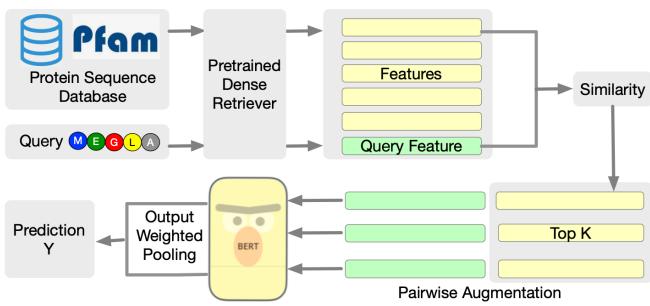
Step A: The Dense Retriever Instead of slowly scanning gene databases for matches, RSA pre-indexes the database. It uses a pre-trained protein language model (specifically ESM-1b) to convert every protein in the database into a dense vector. To find related proteins for a new query, the model simply encodes the query into a vector and performs a fast Nearest Neighbor search (using Faiss).
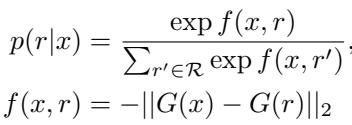
The similarity metric is straightforward—the negative L2 distance between the embeddings:
Step B: The Augmented Encoder Once the top \(K\) related sequences are retrieved, the model does not try to align them. Instead, it concatenates the query sequence \(x\) and the retrieved sequence \(r\) into a single long input.
It then feeds this combined sequence into a Transformer. This is where the magic of Self-Attention comes in. The attention mechanism naturally allows the model to “look” at the retrieved sequence to gather context for the query sequence.
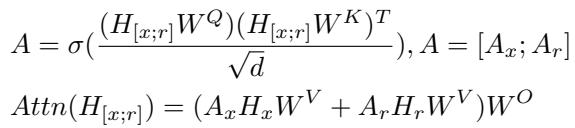
By allowing the model to attend to the retrieved sequence (\(H_r\)) while processing the query (\(H_x\)), the network learns to perform a “soft alignment” automatically. It figures out which parts of the retrieved protein correspond to the query without human-designed algorithms.
Why This Matters: Interpretability
You might wonder: “If we aren’t using evolutionary alignment, what exactly is the model finding?” The authors analyzed the retrieved sequences and found that the dense retriever captures two distinct types of biological knowledge: Homology and Structure.
Retrieving Homology
Even though the model uses vector similarity, it successfully retrieves homologous sequences (sequences with shared ancestry), much like traditional BLAST or MSA tools.
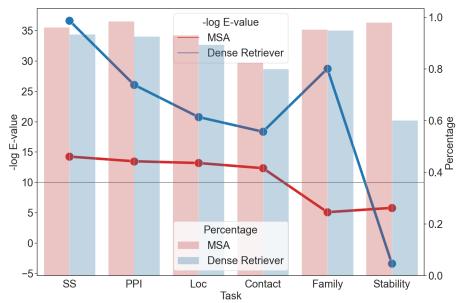
The graph above shows that for most tasks, the dense retriever finds sequences with very low E-values (indicating high statistical significance of homology), comparable to the slow, traditional MSA methods.
Retrieving Structure
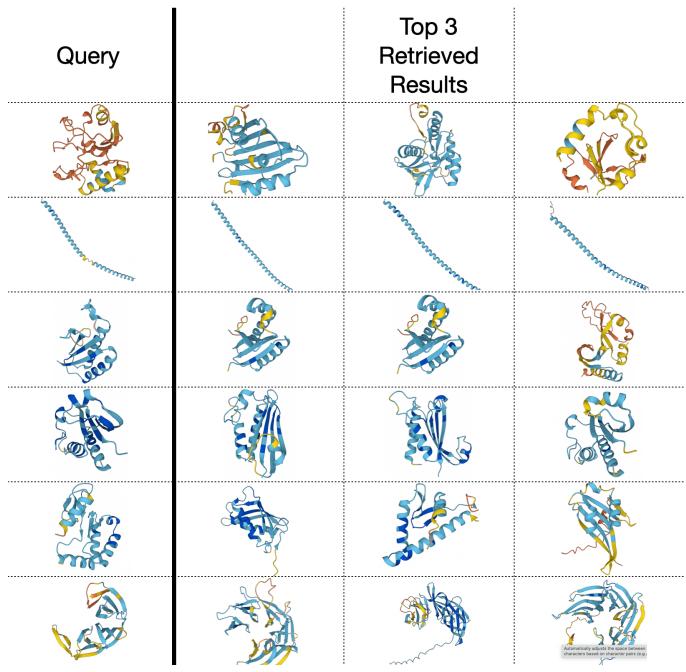
This is where RSA shines. Sometimes, proteins look different in terms of sequence (low homology) but fold into the exact same 3D shape. Traditional MSA tools often miss these “structural neighbors.” RSA, however, finds them.
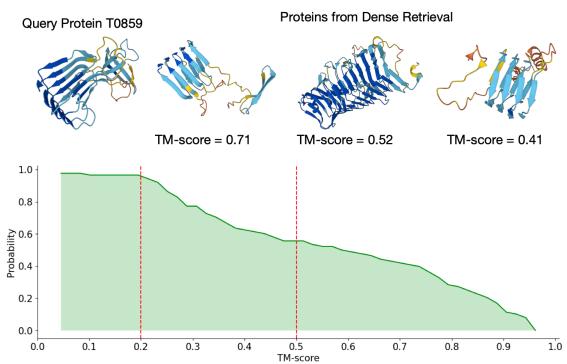
Visualizing the search results makes this clear. In the image below, you can see the query protein on the left and the retrieved results on the right. Even when the sequences differ, the 3D folds are remarkably similar.
Experimental Results
The researchers tested RSA on a suite of standard protein tasks, including Secondary Structure Prediction (SSP), Contact Prediction, and Homology Prediction. They compared RSA against vanilla Transformers (like ProtBERT) and the state-of-the-art MSA Transformer.
1. Performance vs. SOTA
The results were impressive. RSA didn’t just match the baselines; it often exceeded them.

A key highlight from Table 3 is that RSA (ProtBERT backbone) achieved an average score of 0.723 across all tasks, significantly higher than the MSA Transformer’s 0.672. It achieves this without the expensive pre-training step that models like MSA Transformer and PMLM require.
2. Generalization to “De Novo” Proteins
The biggest weakness of evolutionary models is that they fail when a protein has no history. Scientists are increasingly designing de novo proteins—synthetic proteins that don’t exist in nature. MSA tools return empty results for these.
Because RSA relies on vector embedding space rather than strict sequence matching, it can find “structural analogs” even for synthetic proteins.
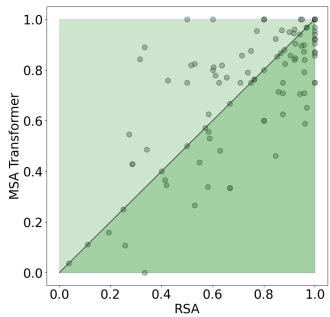
The scatter plot above compares RSA against MSA Transformer on de novo proteins. Points below the diagonal line indicate proteins where RSA performed better. As you can see, RSA wins in the majority of cases.
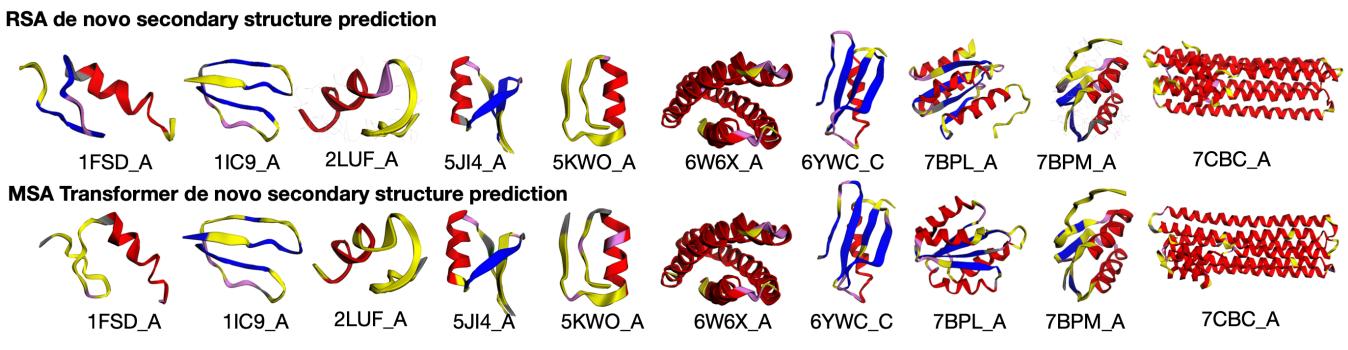
We can also visualize this improvement. In the figure below, look at the Secondary Structure predictions. RSA (top row) produces predictions that are much cleaner and more consistent with the ground truth compared to the MSA Transformer (bottom row).
3. Ablation: Is Alignment Necessary?
To settle the theoretical debate, the authors ran an ablation study. They took the standard MSA sequences but fed them into the model without aligning them first (Unaligned MSA Augmentation).
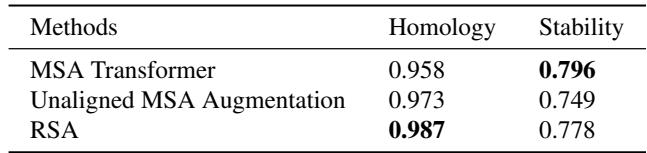
The results (Table 5) show that removing the alignment causes only a minor drop in performance. This confirms the paper’s hypothesis: Deep Learning models are smart enough to learn alignment on their own. We don’t need to hand-feed it to them.
Conclusion and Future Implications
The “Retrieved Sequence Augmentation” paper makes a compelling case for a shift in how we model proteins. By viewing protein analysis through the lens of Retrieval Augmented Generation, the authors have developed a method that is:
- Faster: Bypassing the \(O(LD)\) alignment bottleneck allows for high-throughput analysis.
- Simpler: No need for complex HMM profiles or alignment algorithms.
- More Robust: It works on orphan and synthetic proteins where evolution-based methods fail.
The implication is that the future of protein language models might not lie in larger models or deeper evolutionary mining, but in better retrieval. Just as search engines changed how humans access information, retrieval-augmented models are changing how AI understands the language of life. We are moving away from rigid, pre-computed alignments toward a flexible, dynamic look-up of biological knowledge.