](https://deep-paper.org/en/paper/2305.13214/images/cover.png)
In the rapidly evolving world of Natural Language Processing (NLP), we face a recurring “black box” dilemma. We have models that can read a complex paragraph and accurately answer questions about it, but we rarely know why they chose a specific answer.
Imagine a model denying a loan application or flagging a news article as fake. If the model cannot explain its reasoning faithfully, how can we trust it?
Today, we are diving into a research paper that tackles this problem head-on. The paper, “Atomic Inference for NLI with Generated Facts as Atoms,” introduces a novel framework called FGLR (Fact-Generated Logical Reasoning). This approach doesn’t just ask an AI to guess an answer; it forces the AI to break the problem down into atomic facts, evaluate each one individually, and build a logical conclusion.
For students of NLP, this is a fascinating look at how we can marry the generative power of Large Language Models (LLMs) with the interpretability of structured logical rules.
The Problem: Accuracy vs. Interpretability
The paper focuses on Natural Language Inference (NLI). NLI is a fundamental task where a model is given two pieces of text:
- Premise: A statement of fact (e.g., “The cat sat on the mat.”).
- Hypothesis: A statement to verify (e.g., “The cat is sleeping.”).
The goal is to classify the relationship as:
- Entailment: The hypothesis must be true if the premise is true.
- Contradiction: The hypothesis must be false if the premise is true.
- Neutral: The truth of the hypothesis cannot be determined from the premise.
State-of-the-art models like DeBERTa are excellent at this. However, they provide a single label as output. Even if we use “explainability” techniques (like highlighting important words), we can’t guarantee that those highlighted words are the actual reason the model made its decision. This is a lack of faithfulness.
The Solution: Atomic Inference
The researchers propose a solution called Atomic Inference. The core idea is simple but powerful: instead of feeding the whole text into a classifier, we break the input down into smaller, indivisible units called atoms.
The model makes a “hard” decision (Yes/No) on each atom. Then, a deterministic set of logical rules combines these small decisions to form the final answer. Because the rules are deterministic, we know exactly which atom caused the final prediction.
Why Facts?
Previous attempts at atomic inference chopped texts into sentences or arbitrary word spans. But these have flaws:
- Sentences often contain multiple pieces of information (e.g., “The red car, which was fast, hit the wall”). If the model flags this sentence, is it flagging “red,” “fast,” or “hit the wall”?
- Word Spans can be too fragmented and lack context.
The authors of this paper argue that the perfect atom is a Fact. By using an LLM to rewrite a complex premise into a list of distinct, simple facts, we get the perfect granularity for reasoning.
The Core Method: Fact-Generated Logical Reasoning (FGLR)
The FGLR system operates in a pipeline that transforms a messy paragraph into a clean, logical decision. Let’s break down the architecture.
Step 1: Fact Generation
First, the system uses GPT-3 to decompose the Premise into a list of atomic facts.
For example, if the premise is:
The Ottawa Sun is a daily tabloid newspaper in Ottawa, Ontario, Canada. It is published by Sun Media.
The LLM generates a list:
- The Ottawa Sun is a daily tabloid newspaper.
- The Ottawa Sun is located in Ottawa, Ontario, Canada.
- The Ottawa Sun is published by Sun Media.
The “Hypothesis-Conditioned” Twist: The researchers found that sometimes the general list of facts misses a subtle detail required to prove or disprove the hypothesis. To fix this, during the inference phase, they ask the LLM a targeted question: “List a fact explicitly known from the premise that allows us to verify the hypothesis.” This generates a hypothesis-conditioned fact, ensuring no critical information is left out.
Step 2: The Attention-Based Architecture
Once we have our list of facts, how do we classify them? The researchers use a modified DeBERTa model.
Each fact (\(f_i\)) is paired with the Hypothesis and encoded into a vector representation (\(R_{f_i}\)). The model then needs to decide if this specific fact supports (entails) or refutes (contradicts) the hypothesis.
The model calculates “attention weights” for contradiction (\(\tilde{a}_{c,i}\)) and entailment (\(\tilde{a}_{e,i}\)). These weights represent how strongly the model believes a specific fact triggers a specific label.
The calculation for the contradiction weight, for example, looks like this:

Here, the sigmoid function (\(\sigma\)) squashes the output between 0 and 1. If \(\tilde{a}_{c,i}\) is high (close to 1), the model believes Fact \(i\) contradicts the hypothesis.
Step 3: Training with Atoms “In-the-Loop”
This is the clever part. The standard datasets (like ANLI) only provide labels for the whole pair (Entailment/Contradiction/Neutral). They do not tell us which specific fact is responsible.
To solve this, the researchers use a training method that treats the facts as a group. They calculate a weighted sum of the scores for all facts to create an “instance-level” prediction.
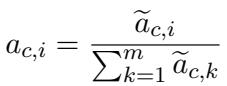

Simultaneously, they apply a Fact-Level Loss. This pushes the model to ensure that if the overall label is “Contradiction,” the fact with the highest contradiction score is pushed as close to 1 as possible.

The total loss function combines these objectives, forcing the model to get the right answer for the whole instance by finding the right evidence in the individual facts.

Step 4: Logical Rules for Inference
Once the model is trained, it doesn’t output probabilities for the final answer. Instead, it looks at the scores for the atoms.
The researchers devised a specific logic for decomposing the Premise (which differs from previous work that decomposed the Hypothesis).
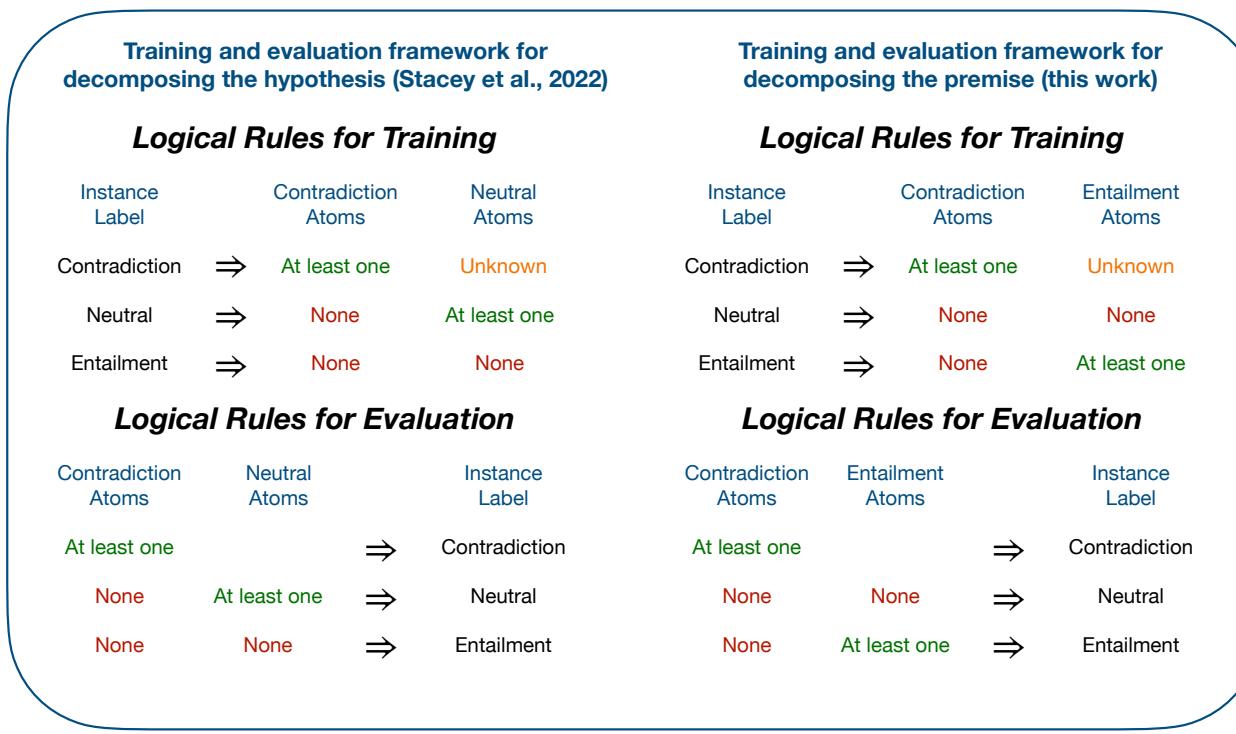
As shown in Figure 2, the rules are intuitive:
- Contradiction: If at least one fact contradicts the hypothesis, the whole instance is a Contradiction.
- Entailment: If at least one fact fully entails the hypothesis, the instance is Entailment.
- Neutral: If no facts contradict or entail the hypothesis, the answer is Neutral.
This highlights the interpretability: if the model predicts “Contradiction,” you can point to Fact #3 and say, “It’s because of this.”
Experiments and Results
The team tested FGLR on the ANLI (Adversarial NLI) dataset, which is known for being difficult because it was designed to trick AI models. They compared their fact-based approach against sentence-based approaches (SenAI) and span-based approaches (SLR-NLI).
Does Granularity Matter?
The results show that using facts (FGLR) significantly outperforms using sentences or spans.
Below is the ablation study (Table 4) which breaks down why FGLR works well.
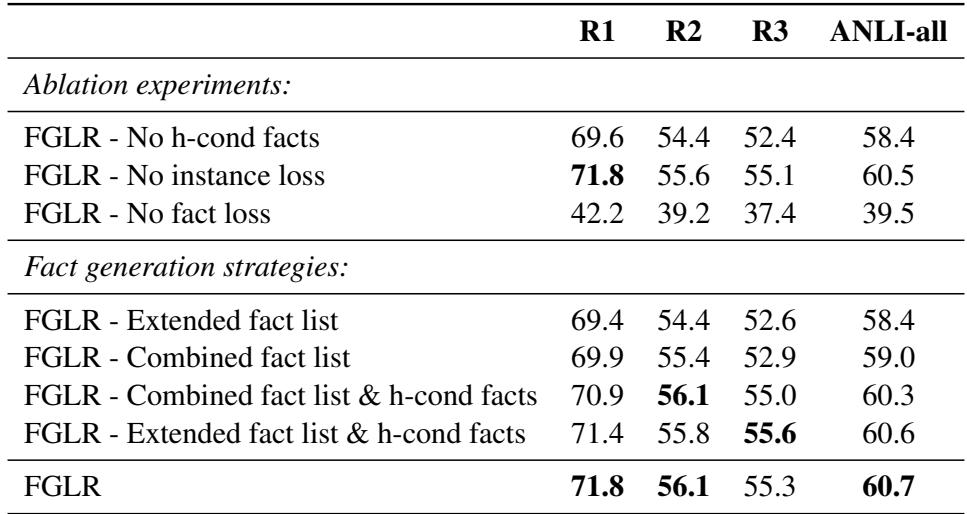
Notice the row “FGLR - No h-cond facts”. Without the “hypothesis-conditioned facts” (the targeted facts generated by the LLM during inference), the accuracy drops from 60.7% to 58.4%. This proves that the quality of the “atoms” is just as important as the reasoning model itself.
Scaling Up
Does this method work with larger models? The researchers applied FGLR to DeBERTa-large.
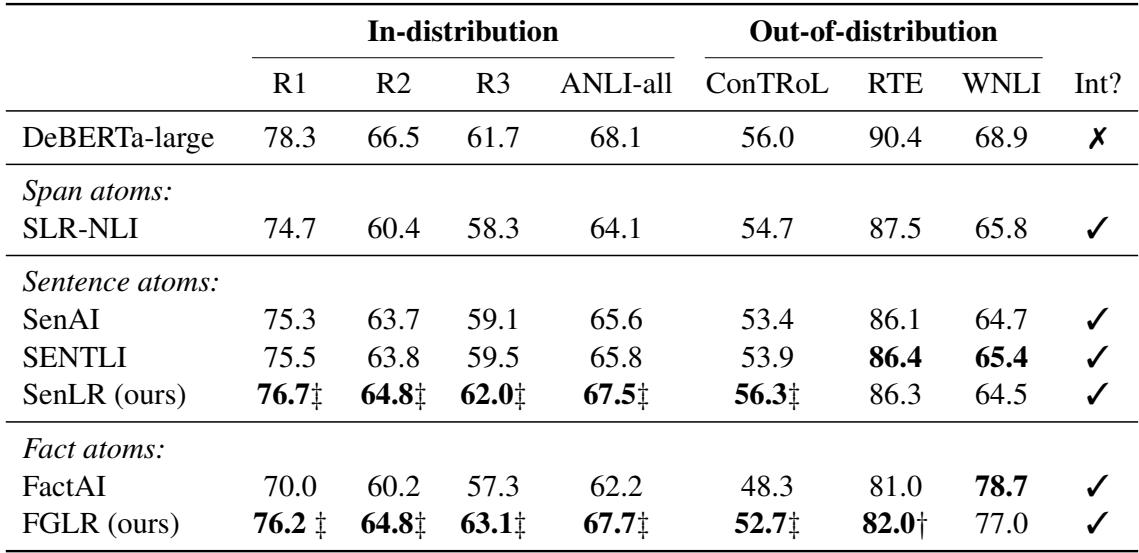
As shown in Table 2, FGLR (bottom row) achieves 67.7% on the full ANLI dataset, beating the sentence-based baselines (SenAI at 65.6%). This confirms that the method scales effectively with model size.
Why This Matters
The “Fact-Generated Logical Reasoning” approach offers a “best of both worlds” solution:
- Interpretability: Unlike a standard “black box” classifier, FGLR provides a breadcrumb trail. You can see exactly which generated fact triggered the decision.
- Faithfulness: Because the final decision is a hard logical sum of the atomic decisions, the explanation is guaranteed to be the actual cause of the prediction.
- Performance: It doesn’t sacrifice accuracy for interpretability. In fact, by focusing the model on cleaner, simpler facts, it often outperforms standard models on complex reasoning tasks.
Conclusion
The research presented in “Atomic Inference for NLI with Generated Facts as Atoms” suggests a shift in how we build reliable AI. Instead of hoping our massive neural networks implicitly learn logic, we can explicitly structure their inputs and outputs to mirror human reasoning.
By using LLMs to act as “translators”—converting dense text into clear, atomic facts—and using discriminators to judge those facts, we create systems that are not just smart, but also transparent and accountable. For students looking into the future of NLP, this intersection of neuro-symbolic AI (combining neural networks with logic) is a thrilling frontier.