](https://deep-paper.org/en/paper/2307.16375/images/cover.png)
If you have ever tried to train a massive Large Language Model (LLM) like Llama or a vision giant like ViT, you know the struggle: a single GPU simply doesn’t cut it. To train these behemoths, we need distributed learning across clusters of GPUs.
But here is the catch: simply having a cluster isn’t enough. You have to decide how to split the model. Do you split the data? Do you split the layers? Do you split the tensors inside the layers?
Historically, this has been a choice between two evils:
- Manual Parallelism (MP): Requires you to be a hardware genius, manually tuning how every tensor moves across wires.
- Automatic Parallelism (AP): Software that tries to do it for you, but often results in sub-optimal performance because it solves the problem in pieces rather than as a whole.
Enter UniAP.
In this post, we will deep dive into a fascinating paper that proposes a novel method to unify Inter-layer and Intra-layer parallelism using Mixed Integer Quadratic Programming (MIQP). The result? A system that finds the optimal parallel strategy significantly faster than current state-of-the-art methods and improves training throughput by up to \(3.80\times\).
The Problem: The Fragmentation of Parallel Strategies
Before we get into the solution, we need to understand the landscape of distributed training. Parallel strategies generally fall into two buckets:
1. Inter-Layer Parallelism
This involves partitioning the model effectively “between” layers.
- Pipeline Parallelism (PP): Imagine an assembly line. Device A computes Layer 1, passes the result to Device B, which computes Layer 2. While B is working, A starts on the next batch.
2. Intra-Layer Parallelism
This involves splitting the work “inside” a layer.
- Data Parallelism (DP): Every GPU has a copy of the model but works on different data slices. They sync gradients at the end.
- Tensor Parallelism (TP): A single huge matrix multiplication is split across multiple GPUs.
- Fully Sharded Data Parallelism (FSDP): A memory-efficient version of DP where parameters, gradients, and optimizer states are sharded across workers.
The Limitation of Current Auto-Parallelism
Existing automatic tools (like Alpa or Galvatron) typically take a hierarchical approach. They might first decide how to pipeline the model (Inter-layer) and then figure out how to split the tensors (Intra-layer) for each stage.
This is like deciding which city to live in before checking if you can afford the rent in any of the neighborhoods. By solving these problems sequentially, you lock yourself into a suboptimal solution early on.
UniAP (Unified Automatic Parallelism) takes a different approach. It considers all strategies—PP, DP, TP, and FSDP—simultaneously.
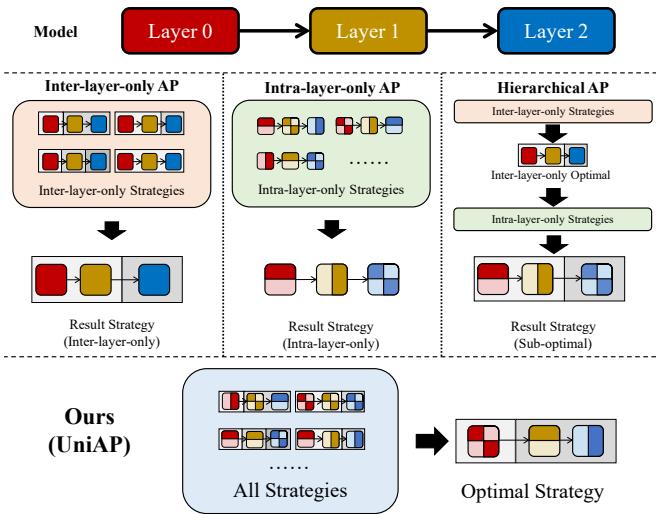
As shown in Figure 1, UniAP looks at the global picture to find the true optimal strategy, whereas hierarchical methods often settle for a “local optimum.”
The UniAP Architecture
So, how does UniAP achieve this joint optimization without taking years to compute? The researchers treat the strategy search as a mathematical optimization problem.
The workflow, illustrated in Figure 2, consists of three main phases:
- Profiling: Gathering hard data on the model and hardware.
- Unified Optimization Process (UOP): The core engine that uses MIQP.
- Execution: Translating the math into a runnable plan.
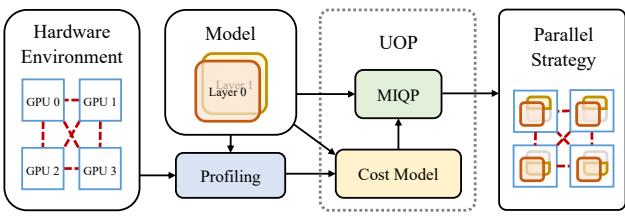
Let’s break down the magic happening inside the “UOP” box.
1. Profiling & Cost Modeling
First, UniAP needs to know the cost of doing business. It profiles the hardware environment to measure communication bandwidth (P2P and All-Reduce speeds) and computation power. It also profiles the model to understand the memory footprint and computation time of each layer.
It uses two cost models:
- Time Cost Model: Estimates forward/backward pass times and communication latency.
- Memory Cost Model: Estimates memory usage.
For memory, specifically model states (parameters + gradients + optimizer), UniAP uses the following formulation:
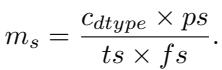
Here, \(m_s\) is the memory cost, \(ps\) is parameter size, and \(ts\) and \(fs\) represent Tensor and FSDP sizes. This equation allows the system to predict exactly how much VRAM a specific strategy will consume.
2. Mixed Integer Quadratic Programming (MIQP)
This is the heart of the paper. The researchers translate the problem of “how to train this model fast” into a mathematical format called Mixed Integer Quadratic Programming.
- Mixed Integer: Some decisions are binary (0 or 1). For example, “Is Layer 5 on GPU 2?” (Yes/No).
- Quadratic: The cost functions involve multiplying variables (e.g., placing two connected layers on the same stage reduces cost, involving quadratic terms).
The Objective: Minimize TPI
The goal is to minimize the Time Per Iteration (TPI). In a pipeline system (like GPipe), the speed is determined by the total latency of the pipeline plus the time taken by the slowest stage (the bottleneck).
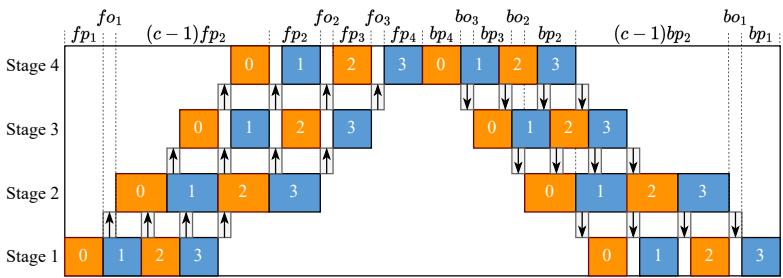
Based on the decomposition in Figure 3, the objective function looks like this:
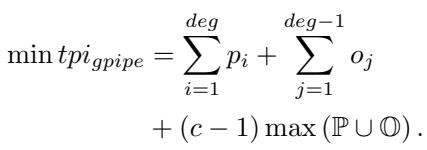
This equation seeks to minimize the sum of processing times (\(p_i\)) and communication times (\(o_j\)), weighted by the number of micro-batches (\(c\)).
The Constraints
Optimization is nothing without rules. UniAP imposes several critical constraints to ensure the solution is valid.
A. Computation & Communication Constraints The solver calculates the cost for each stage. If you assign specific layers to a stage, their computation costs sum up. If layers communicate across devices, that adds communication cost.
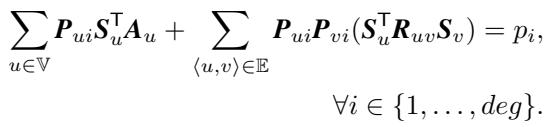
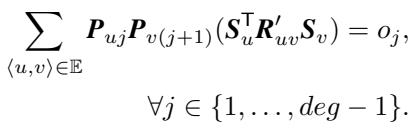
B. Memory Constraint This is crucial. The selected strategy must not cause an Out-Of-Memory (OOM) error. The total memory of activations and model states on any device must be less than the device limit \(m\).

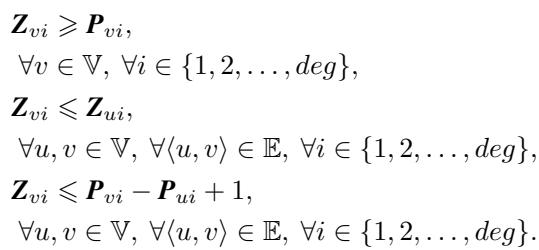
C. Order-Preserving (Contiguous) Constraint Pipeline parallelism isn’t random. If you put layers 1, 2, and 3 on GPU A, you generally can’t put Layer 4 on GPU B and then put Layer 5 back on GPU A. The pipeline stages need to be contiguous sets of layers.
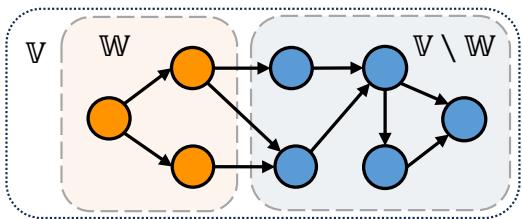
To enforce this mathematically, the paper uses an auxiliary variable \(Z\) to ensure that if a node is in a stage, its dependencies are respected.
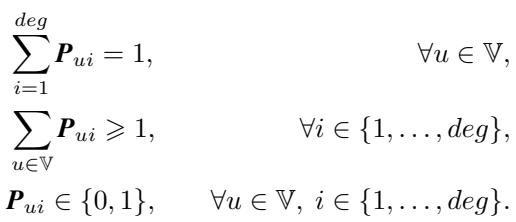
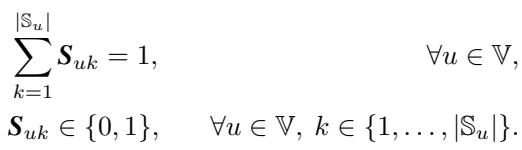
D. Placement & Selection Constraints Finally, every layer must be placed somewhere, and every layer must pick exactly one strategy.
The Unified Optimization Process (UOP)
With the math defined, UniAP runs an algorithm (Algorithm 1 in the paper) that:
- Enumerates possible pipeline sizes (\(deg\)) and micro-batch counts (\(c\)).
- Feeds the cost matrices and constraints into a solver (like Gurobi).
- The solver finds the global minimum for TPI.
Visualizing the Solution
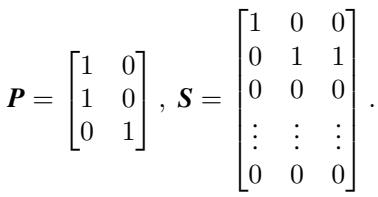
The output of this process is a set of matrices indicating exactly where each layer goes and what strategy it uses.
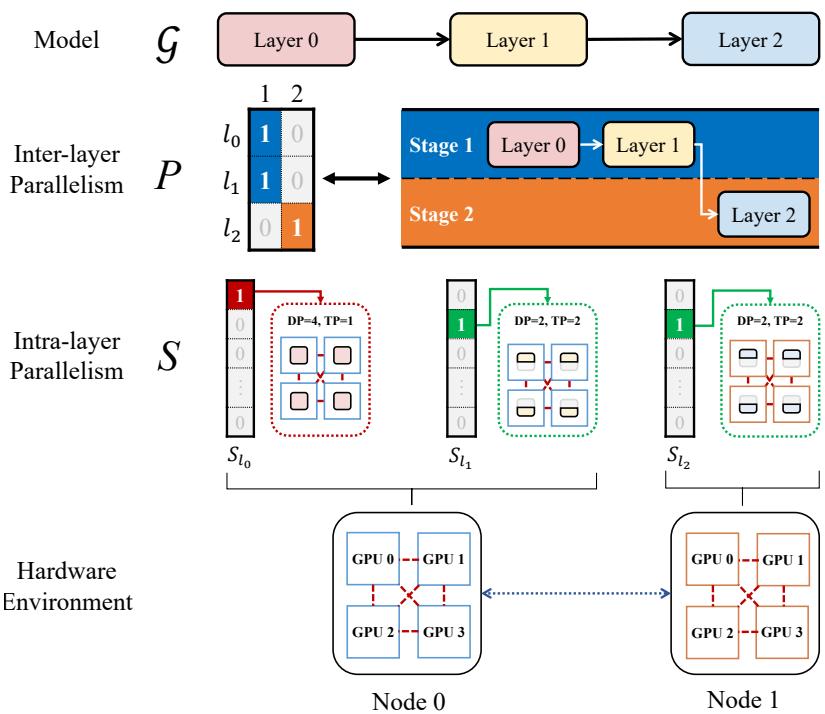
As seen in Figure 7, the matrices \(\mathbf{P}\) (Placement) and \(\mathbf{S}\) (Strategy) give a deterministic blueprint for execution. For example, Layer 0 might use Data Parallelism on Stage 1, while Layer 1 uses a mix of Data and Tensor Parallelism.
Here is what the matrix representation looks like mathematically:
Experiments and Results
The researchers tested UniAP against top-tier baselines like Galvatron and Alpa, as well as manual methods like Megatron-LM and DeepSpeed. They used a variety of models (BERT, T5, ViT, Swin, Llama) across different hardware environments (NVIDIA V100s, A100s, and even DCUs).
1. Throughput and Optimization Speed
The results were impressive. UniAP not only found faster execution strategies (Higher Throughput) but also found them much faster (Lower Optimization Time).

In Table 1, notice Llama-7B on EnvC. UniAP achieved 4.63 samples/s compared to Galvatron’s 1.22. That is a 3.80x speedup. Why? UniAP realized that on PCIe-based GPU clusters, communication is the bottleneck. It chose an 8-stage pipeline with minimal tensor parallelism to reduce cross-device talk. Galvatron, limited by its search space, chose a communication-heavy strategy that choked the bandwidth.
Furthermore, look at the Optimization Time for BERT-Huge. UniAP found the solution in 0.37 minutes, while Alpa took over 80 minutes. This is the efficiency of MIQP solvers versus complex dynamic programming.
2. Scalability
Does UniAP hold up as the cluster grows?
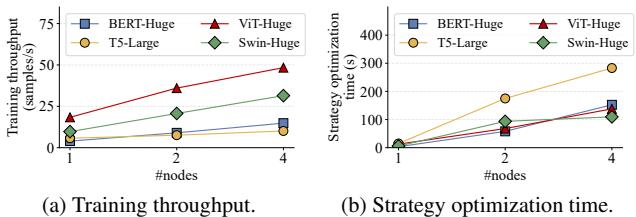
Figure 5(a) shows that throughput scales linearly with the number of nodes. More importantly, Figure 5(b) shows that the time it takes UniAP to find the strategy doesn’t explode exponentially, making it viable for large-scale clusters.
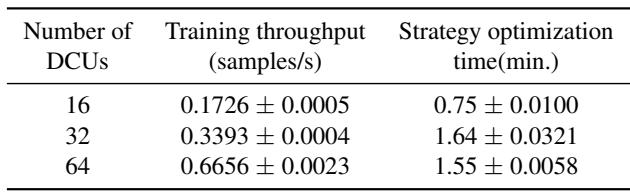
This scalability holds true even on non-NVIDIA hardware (DCUs), as shown in Table 4:
3. Why Joint Optimization Matters
The researchers performed an ablation study to prove that combining Inter- and Intra-layer parallelism is actually necessary. They compared full UniAP against versions restricted to only Inter-layer or only Intra-layer strategies.
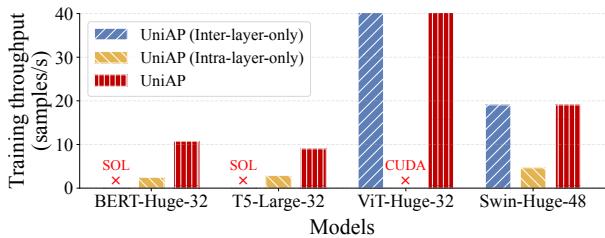
The results in Figure 6 are stark. For many models, restricting the search space resulted in either terrible performance or total failure (SOL \(\times\) means no solution found, often due to OOM). This validates the core premise of the paper: you must optimize jointly.
Case Study: BERT-Huge on “EnvB”
To make this concrete, let’s look at the optimal strategy UniAP found for BERT-Huge on a specific cluster (“EnvB” - 2 nodes, slower inter-node bandwidth).
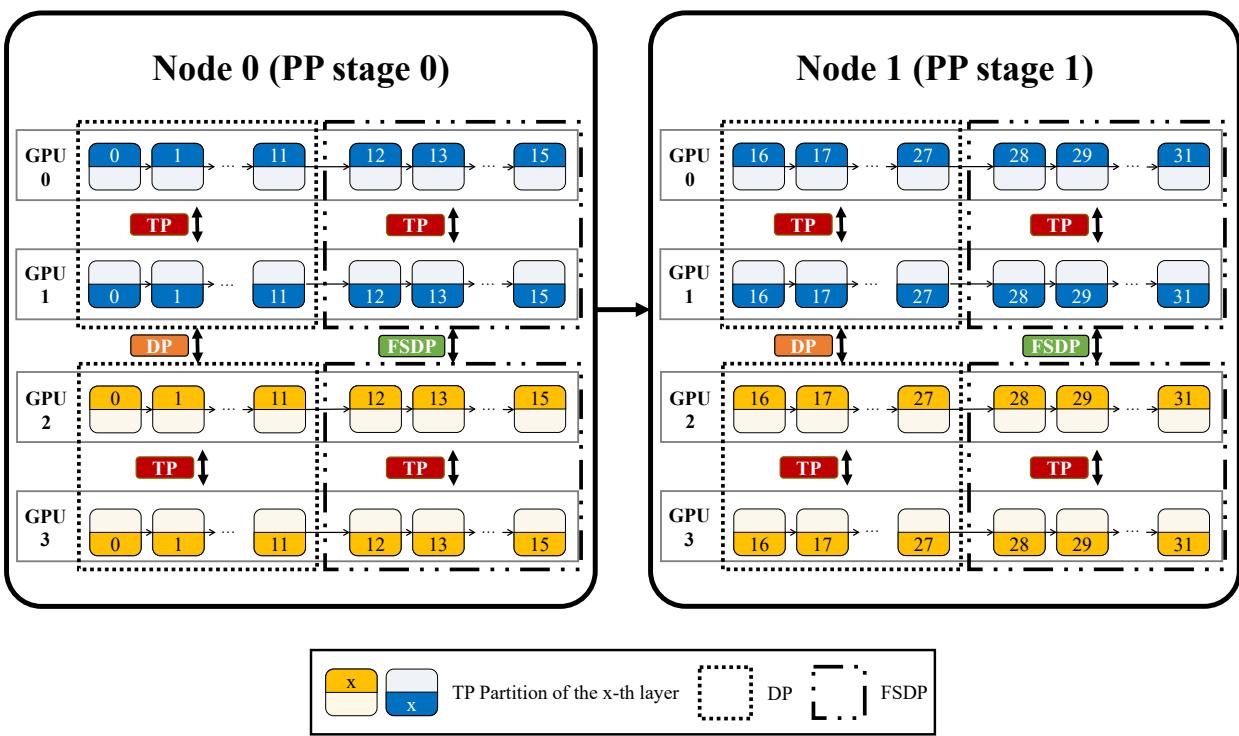
As shown in Figure 9, UniAP did something clever:
- It used a 2-stage Pipeline (one stage per node) to minimize slow inter-node communication.
- Inside the nodes, it used Tensor Parallelism (TP) because the intra-node bandwidth (PCIe) was fast.
- It selectively applied FSDP (green boxes) to specific layers to fit everything into memory.
A manual engineer might struggle to balance all these factors, but the math solved it automatically.
Conclusion
Distributed training is becoming a requirement, not a luxury. However, the complexity of configuring these systems has been a major barrier.
UniAP represents a significant step forward. By formulating the parallel strategy problem as a Mixed Integer Quadratic Programming (MIQP) task, it unifies the search for inter- and intra-layer strategies. The key takeaways are:
- Unified > Hierarchical: Jointly optimizing PP, DP, TP, and FSDP yields better results than optimizing them in steps.
- MIQP is Fast: Mathematical solvers are incredibly efficient at navigating these massive search spaces compared to traditional search algorithms.
- Hardware Awareness: UniAP adapts to the specific bandwidth and memory constraints of the hardware, whether it’s an NVLink-equipped A100 cluster or a PCIe-based setup.
For students and researchers working with Large Language Models, tools like UniAP pave the way for more accessible, efficient, and automated model training. The days of manually calculating tensor splits on a whiteboard might finally be coming to an end.