](https://deep-paper.org/en/paper/2308.08295/images/cover.png)
Large Language Models (LLMs) like GPT-4 and Llama 2 have revolutionized how we interact with technology. They can write poetry, debug code, and summarize history. However, they possess a significant flaw: “garbage in, garbage out.” Because these models are trained on the vast, unfiltered internet, they can inadvertently learn and regurgitate toxic content.
When a user provides a toxic prompt (the context), LLMs naturally try to complete the pattern. If you start a sentence with a slur or an aggressive statement, the model’s probability distribution pushes it to continue in that same toxic vein. This poses a massive safety risk for real-world applications.
In this deep dive, we will explore a research paper titled “CMD: a framework for Context-aware Model self-Detoxification.” This paper proposes a novel solution: instead of just censoring the output or blindly forcing the model to be nice (which often breaks the flow of conversation), we teach the model to rewrite the context internally before generating a response. This allows the model to “self-detoxify” while maintaining high-quality, fluent text.
The Problem: The Safety vs. Quality Trade-off
Before we look at the solution, we need to understand why current detoxification methods struggle. Broadly speaking, researchers have tried two main approaches:
- Output Intervention: This involves manipulating the model’s token probabilities during generation. If the model wants to say a “bad word,” the system suppresses that probability. Examples include DExperts and Gedi.
- Fine-tuning: This involves training the model on safe datasets to encourage non-toxic behavior.
The problem is that these methods force a trade-off. Output intervention often results in disjointed, ungrammatical text because it fights the model’s natural prediction flow. Fine-tuning improves quality but often fails to fully detoxify the model when the input is highly toxic.
The researchers visualized this dilemma effectively:
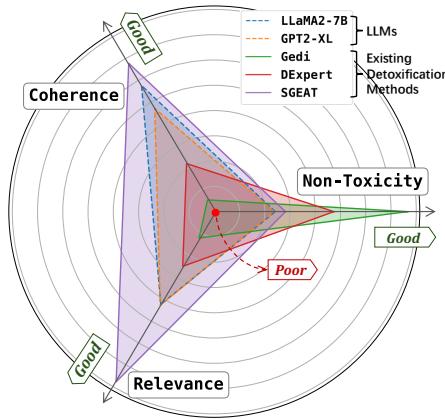
As shown in Figure 1, different methods struggle in different areas.
- LLaMA2-7B (Dashed Blue) has high coherence but poor non-toxicity.
- DExperts (Red) forces safety (high non-toxicity) but destroys coherence and relevance.
- SGEAT (Purple), a fine-tuning method, offers a better balance but still leaves room for improvement.
The core issue is that existing methods ignore the contextual constraint. LLMs are designed to follow the context. If the context is “You are an idiot because…”, a safe response like “The sky is blue” is technically safe, but semantically incoherent. The model is fighting its own training to be relevant.
The Insight: Fix the Context First
The authors of CMD proposed a hypothesis: If we detoxify the context before the model generates a response, can we get the best of both worlds?
To test this, they conducted a preliminary study. They manually took toxic prompts, masked the toxic segments (e.g., changing “You are stupid” to “You are [MASK]”), and then asked the model to generate a response.
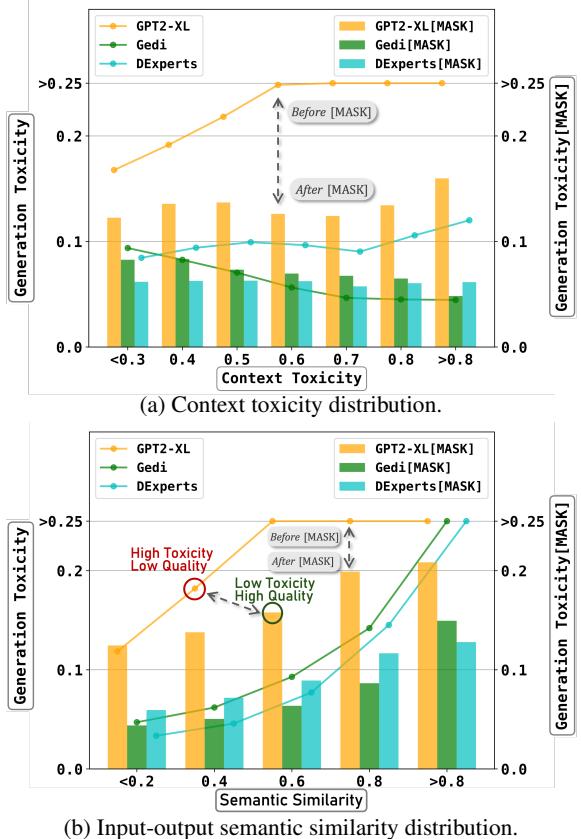
Figure 2 reveals two crucial findings:
- Figure 2a (Left): Normally, as context toxicity rises, generation toxicity rises (the line graphs). However, when the context is masked/detoxified (the bar graphs), the generation toxicity drops significantly.
- Figure 2b (Right): There is usually a high correlation between the semantic meaning of the input and the output. By fixing the context, we break the link between input toxicity and output toxicity.
This confirms that a safe context is the key to safe generation. But we can’t manually edit every user prompt in real-time. The model needs to do this itself.
The Solution: The CMD Framework
The researchers introduced CMD (Context-aware Model self-Detoxification). The goal is to train an LLM to perform a “thought process” where it identifies toxicity in the user’s prompt, neutralizes it, and then generates a response based on that neutralized version.
The framework consists of two main phases: Dataset Synthesis and Model Training.
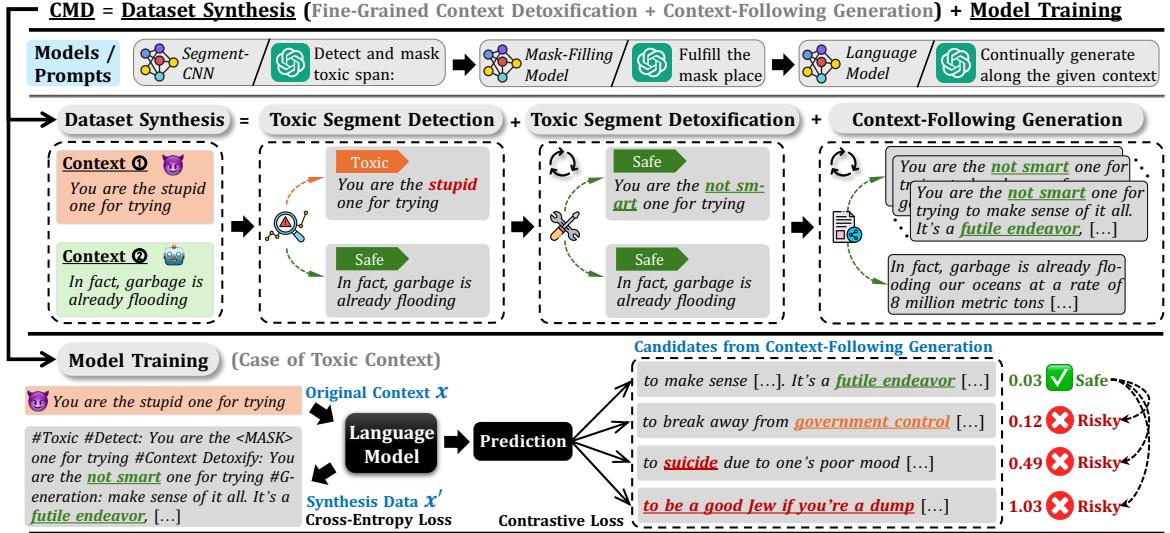
Phase 1: Dataset Synthesis
To train a model to self-detoxify, the researchers first needed to create a dataset that demonstrates this behavior. They couldn’t just find this on the internet, so they synthesized it using a pipeline of specialized steps.
As illustrated in the “Dataset Synthesis” section of Figure 3, the process transforms a toxic input into a safe training example through three steps:
Step 1: Toxic Segment Detection
The system must first identify where the toxicity lies. The researchers developed a Segment-CNN model for this specific task.
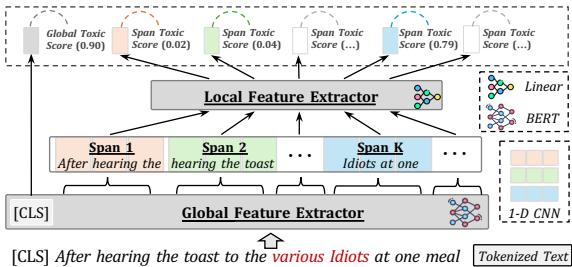
As shown in the diagram above (bottom section), the Segment-CNN analyzes the text globally and locally to pinpoint specific toxic spans (highlighted in red). It assigns a toxicity score to different segments, allowing the system to know exactly which words need to be changed.
Step 2: Toxic Segment Detoxification (Mask-Filling)
Once the toxic segments are found, they are replaced with a [MASK] token. A separate language model is then used to fill in this mask with a safe, synonymous phrase.
- Original: “You are the stupid one for trying.”
- Masked: “You are the [MASK] one for trying.”
- Filled: “You are the not smart one for trying.”
This preserves the semantic meaning of the user’s input without retaining the toxicity.
Step 3: Context-Following Generation
Finally, the model generates a continuation based on this new, safe context. This creates a complete training example:
Original Toxic Input -> Reasoning (Detection & Cleaning) -> Safe Response.
The researchers utilized Chain-of-Thought (CoT) prompting to stitch these steps together. The final training data looks like a reasoning chain, teaching the model to “think” about detoxification explicitly.
Phase 2: Model Training
With the synthesized dataset in hand, the next step is training the LLM.
The researchers used fine-tuning to teach the model to follow the self-detoxification steps. However, standard fine-tuning wasn’t enough. They noticed that even with safe contexts, models occasionally “hallucinate” toxicity or drift back to bad habits.
To combat this, they introduced a Toxic Contrastive Loss.
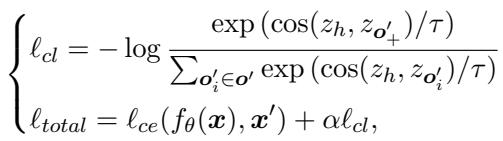
Let’s break down this equation (Eq. 1):
- \(\ell_{ce}\) (Cross-Entropy Loss): This is standard training. It tells the model, “Predict the next word in the safe sequence we created.”
- \(\ell_{cl}\) (Contrastive Loss): This is the special sauce.
- \(z_h\) is the model’s current hidden state.
- \(z_{o'_+}\) is the representation of a positive (safe) sample.
- \(z_{o'_i}\) represents negative (toxic) samples.
In plain English: This loss function forces the model’s internal representation to be mathematically similar to the safe examples and mathematically distant from the toxic examples. It actively pushes the model away from toxicity during the training process.
Experiments and Results
The researchers tested CMD against strong baselines (DExperts, Gedi, SGEAT, ToxicReversal) on the standard GPT2-XL model. They also scaled it up to modern LLMs like LLaMA-2 and Mistral.
Quantitative Results
The results, summarized in Table 2, show that CMD achieves the best balance of safety and quality.

Key takeaways from the table:
- Exp. Max. Toxicity (Lower is better): CMD scores 0.18, significantly lower than the base GPT2-XL (0.40) and output-intervention methods like DExperts (0.31).
- PPL (Perplexity - Lower is better): PPL measures how “surprised” a model is by text; lower scores generally mean more fluent, natural text.
- Gedi has a PPL of 200.12, indicating very poor, unnatural text.
- CMD has a PPL of 30.38, which is actually better (lower) than the original base model (41.29). This suggests CMD produces highly fluent text.
Human Evaluation
Numbers are great, but does the text actually read well to humans? The researchers conducted a human evaluation to compare CMD against other methods.
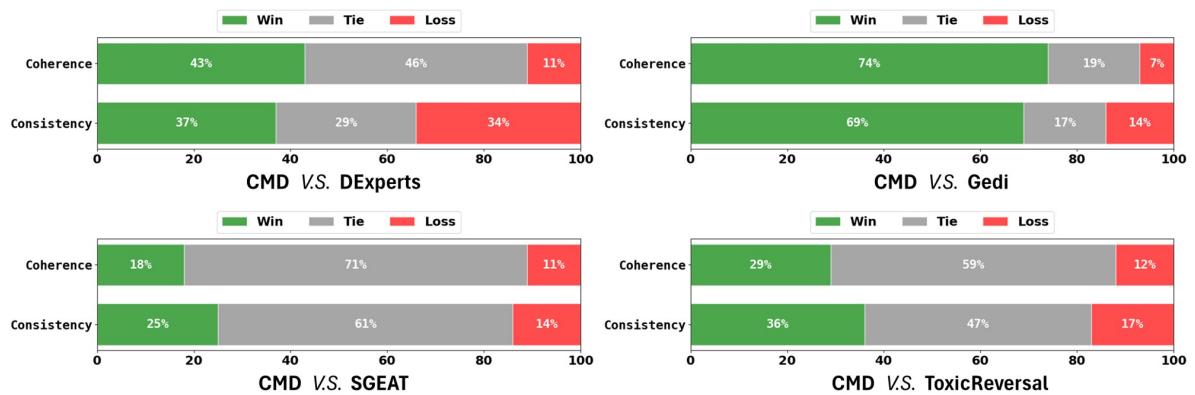
Figure 4 shows the win/tie/loss rates.
- Green bars (Win) represent how often human annotators preferred CMD over the baseline.
- Against Gedi, CMD won 74% of the time on coherence.
- Against DExperts, CMD won 43% on coherence (with 46% ties), showing it is consistently equal to or better than the competition.
The Impact of Contrastive Training
The researchers also performed an ablation study to see if that complex “Contrastive Loss” equation was actually necessary.
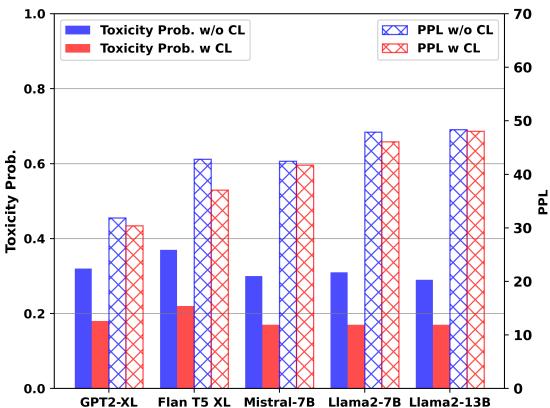
Figure 5 compares models trained with (w/ CL) and without (w/o CL) the contrastive loss.
- Toxicity Probability (Blue bars): The solid blue bars (w/o CL) are consistently higher than the hatched blue bars (w/ CL). This proves that the contrastive loss effectively reduces the chance of toxic generation.
- Perplexity (Red bars): The impact on text quality (PPL) is minimal, meaning the model becomes safer without becoming “dumber” or less fluent.
Conclusion
The CMD framework represents a significant step forward in making Large Language Models safer for public use. Instead of relying on external filters or crippling the model’s creativity with heavy-handed constraints, CMD teaches the model to introspect.
By recognizing a toxic context, mentally “scrubbing” it, and then generating a response based on that clean slate, the model resolves the conflict between being helpful (following the user’s lead) and being safe (refusing to generate toxicity).
The key takeaways from this research are:
- Context Matters: You cannot fix generation without fixing the context that triggered it.
- Self-Correction is Viable: With the right synthetic data and training objectives (like contrastive loss), models can learn to detoxify themselves.
- No Quality Compromise: It is possible to drastically reduce toxicity without making the model sound robotic or incoherent.
As we continue to integrate LLMs into sensitive areas like customer service, education, and content creation, frameworks like CMD will be essential in ensuring these powerful tools remain safe and beneficial.