](https://deep-paper.org/en/paper/2309.16289/images/cover.png)
Introduction
In the past few years, the headline “AI Passes the Bar Exam” has appeared in nearly every major tech publication. It is a compelling narrative: Large Language Models (LLMs) like GPT-4 have ingested so much information that they can technically qualify to practice law. But any practicing attorney will tell you that passing a standardized test and navigating the nuanced, high-stakes reality of the legal system are two very different things.
While general benchmarks evaluate an AI’s ability to write code, solve math problems, or chat casually, the legal domain presents a unique “safe-critical” challenge. A hallucination in a creative writing prompt is a quirk; a hallucination in a legal contract is a liability. Furthermore, most existing legal benchmarks focus heavily on the United States and Europe, which operate primarily under Common Law systems.
But what about the Chinese legal system? Rooted in Civil Law, it prioritizes the application of statutory articles over judicial precedents. This structural difference means that an AI trained to reason like an American lawyer might fail miserably in a Chinese court.
To address this gap, a team of researchers from Nanjing University, Amazon Alexa AI, and Shanghai AI Laboratory introduced LawBench. This is not just another dataset; it is a meticulously crafted evaluation framework designed to probe the depths of an LLM’s legal cognition. By testing 51 different models across 20 distinct tasks, LawBench offers a sobering and detailed look at where AI currently stands in the pursuit of “computational justice.”
In this deep dive, we will explore how LawBench is constructed, the cognitive hierarchy it uses to test intelligence, and the surprising results that reveal why we are still a long way from an AI attorney.
Background: The Need for Specialized Benchmarks
To understand the significance of LawBench, we first need to look at how LLMs are evaluated today. The standard development pipeline for models like LLaMA or ChatGPT involves pre-training on massive text corpora, followed by Supervised Fine-Tuning (SFT) and Reinforcement Learning from Human Feedback (RLHF). To test these models, researchers use benchmarks like MMLU (Massive Multitask Language Understanding) or HELM (Holistic Evaluation of Language Models).
However, “general capability” does not equal “domain expertise.”
Legal tasks require a specific type of logic. In the Chinese Civil Law system, judges must remain neutral and strictly ground their decisions in established statutory law articles. Unlike Common Law, where studying previous case precedents is paramount, the Chinese system demands a rigorous understanding and application of existing codes.
Previous attempts to benchmark legal AI, such as LexGLUE or LegalBench, have focused on English and American law. While valuable, they do not translate to the Chinese context. LawBench was created to provide a standardized, comprehensive test suite for Chinese legal tasks, moving beyond simple “bar exam” questions to simulate the actual workflow of legal professionals.
The Core Method: Structuring Legal Cognition
The most innovative aspect of LawBench is its organization. The researchers did not simply throw a bag of random legal questions at the models. Instead, they structured the benchmark based on Bloom’s Taxonomy, a hierarchical model of cognitive skills often used in education.
In LawBench, legal capability is broken down into three ascending levels of difficulty: Memorization, Understanding, and Applying.
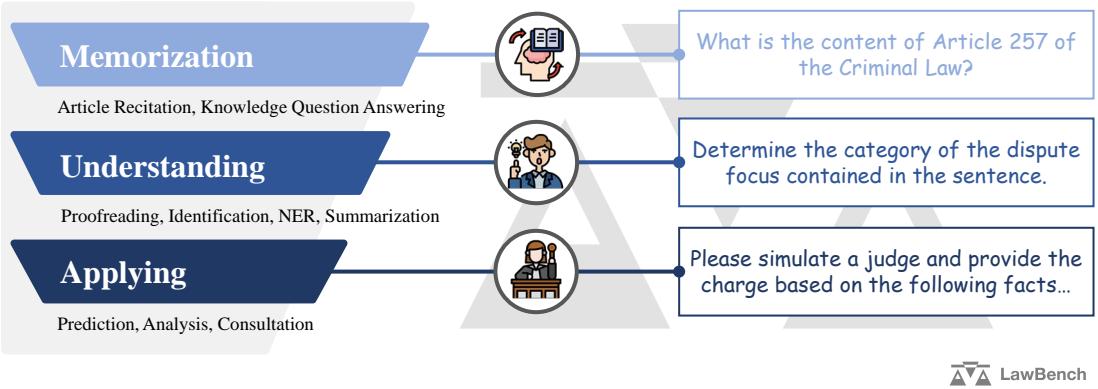
As illustrated in the figure above, the hierarchy suggests that an LLM must first “Remember” the law before it can “Understand” the nuances of a case, and only then can it “Apply” that knowledge to solve complex problems. Let’s break down these levels and the specific tasks involved.
Level 1: Legal Knowledge Memorization
This is the foundational layer. If a model cannot recall the content of a specific law, it cannot possibly apply it correctly. In the era of Retrieval-Augmented Generation (RAG), one might argue that models don’t need to memorize laws—they can just look them up. However, the researchers argue that parametric memory (knowledge stored in the model’s weights) is crucial for reducing latency and connecting concepts efficiently.
Tasks in this level include:
- Article Recitation: Given a specific article number (e.g., “Article 257 of the Criminal Law”), the model must recite the text.
- Knowledge Question Answering: Multiple-choice questions regarding basic legal facts.
Below is an example of what these tasks look like:
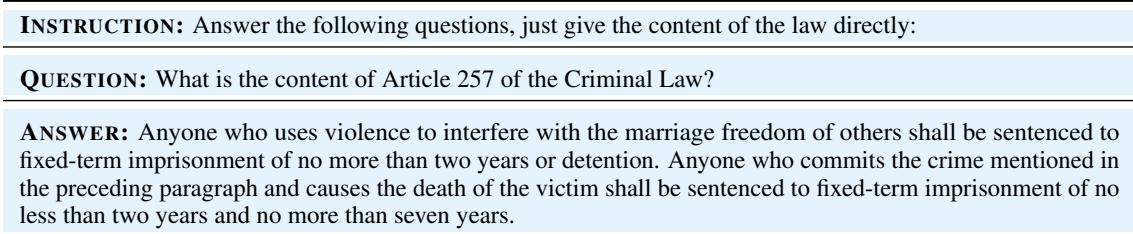
This tests the model’s “encyclopedic” knowledge. It is the digital equivalent of a law student making flashcards.
Level 2: Legal Knowledge Understanding
Once the model “knows” the law, can it comprehend legal text? Legal documents are notoriously dense, filled with jargon, complex entity relationships, and specific formatting rules.
The “Understanding” level tests whether an LLM can parse this information. This category includes 10 different tasks, such as:
- Document Proofreading: Correcting grammar and spelling in formal legal documents.
- Dispute Focus Identification: Reading a plaintiff’s claim and a defendant’s response to identify exactly what they are arguing about (e.g., contract validity vs. property division).
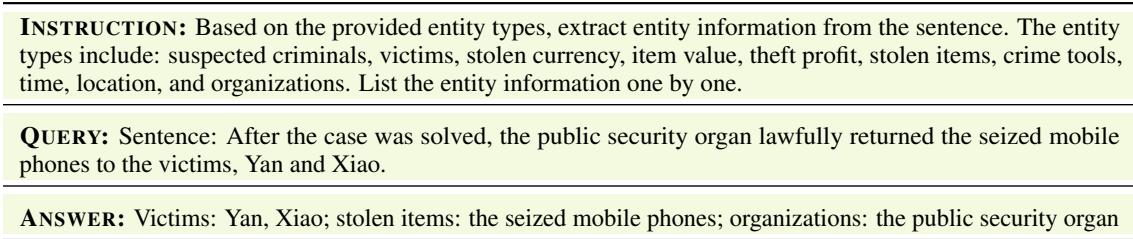
- Named-Entity Recognition (NER): Extracting specific entities like “suspect,” “victim,” or “stolen item” from a judgment.
- Opinion Summarization: Creating concise summaries of legal news reports.
Here is an example of the Named-Entity Recognition task, which is vital for automated case processing:
And here is an example of Opinion Summarization, requiring the model to condense a complex report into a single sentence:
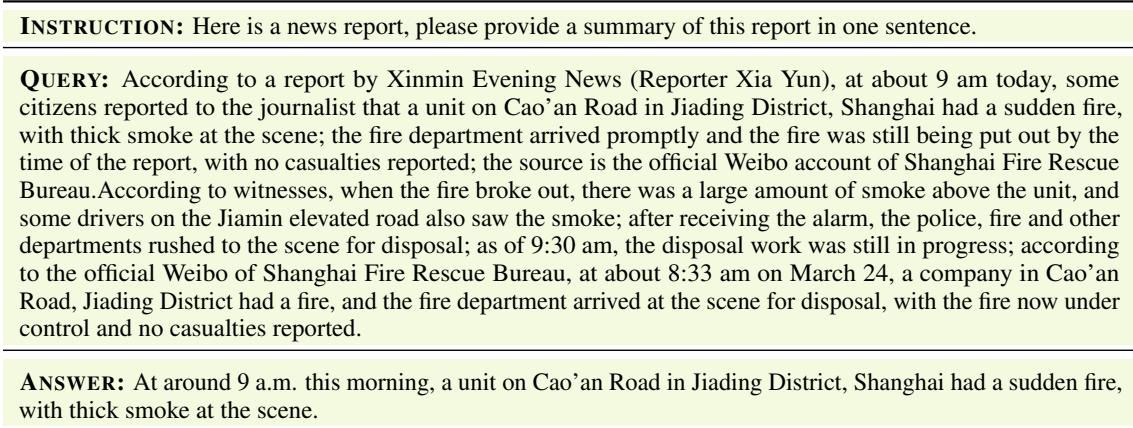
These tasks move beyond rote memorization. They require the model to possess a degree of reading comprehension that aligns with legal standards.
Level 3: Legal Knowledge Applying
This is the summit of the hierarchy. At this level, the LLM is asked to simulate a legal professional. It must synthesize its memorized knowledge and its understanding of the text to reason through a realistic scenario.
The tasks here are complex and high-stakes:
- Charge Prediction: Given a set of facts, what crime was committed?
- Prison Term Prediction: Based on the facts and the charge, how many months should the defendant serve?
- Criminal Damages Calculation: A regression task requiring the model to calculate the financial amount involved in a crime (e.g., total value of stolen goods).
- Consultation: Acting as a lawyer to answer a user’s legal inquiry.
One of the most fascinating tasks is Prison Term Prediction. The benchmark evaluates this in two modes: one where the model must rely on its internal knowledge, and one where the relevant legal article is provided in the prompt.
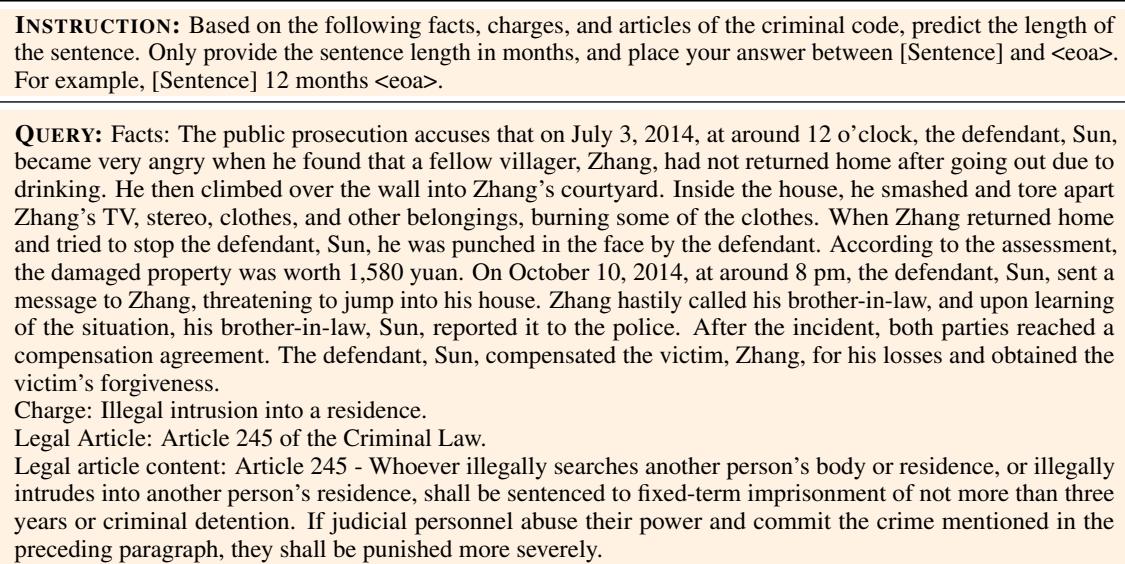
As you can see in the example above, the model must parse the facts (Sun smashed Zhang’s TV, punched him, etc.), consider the charge (Illegal intrusion), and output a specific number of months for the sentence. This requires high-level logical and numerical reasoning.
The Full Task Landscape
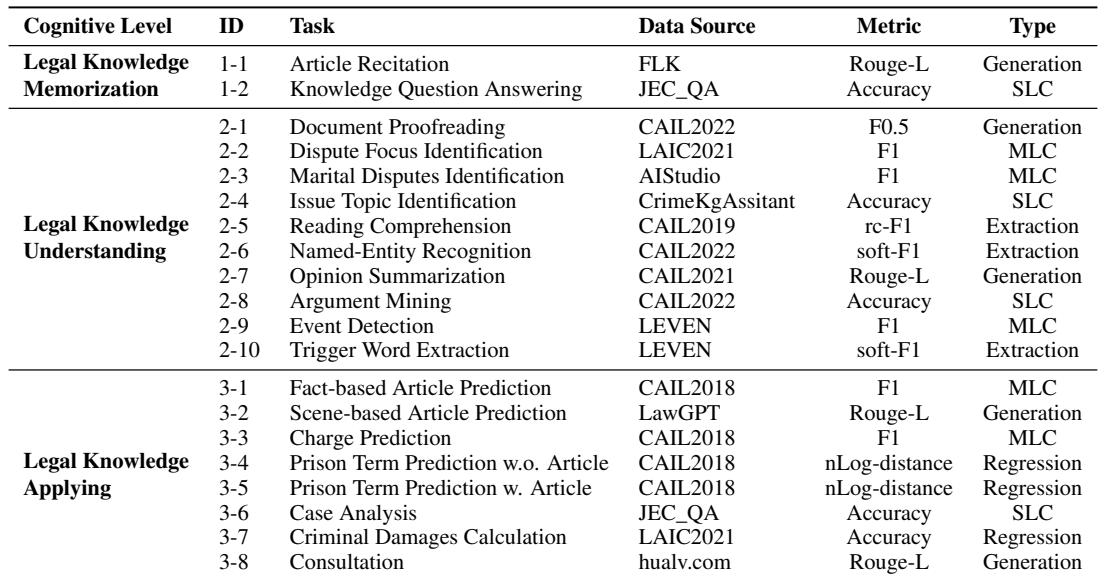
The researchers compiled a total of 20 tasks across these three levels. They also categorized them by the type of output required: Single-Label Classification (SLC), Multi-Label Classification (MLC), Regression, Extraction, and Generation.
Experimental Setup: The Contestants
To run this massive evaluation, the authors tested 51 different LLMs. These models were categorized into three groups based on their training background:
- Multilingual LLMs: General-purpose models trained largely on English but with multilingual capabilities (e.g., GPT-4, ChatGPT, LLaMA, Claude).
- Chinese-Oriented LLMs: Models specifically pre-trained or fine-tuned on massive Chinese corpora to enhance local language understanding (e.g., Baichuan, ChatGLM, Qwen).
- Legal-Specific LLMs: Models that started as general LLMs but were further fine-tuned on legal datasets (e.g., ChatLaw, Lawyer-LLaMA).
The evaluation used two settings: Zero-shot (just the question) and One-shot (the question plus one example). This allows us to see how well models perform “out of the box” versus how well they adapt when shown a single example of the desired output.
Results and Analysis
The results of LawBench provide a reality check for the field of Legal AI. While there is promise, there is also a significant gap between the best models and true reliability.
1. The Dominance of GPT-4
The most immediate takeaway is the sheer dominance of OpenAI’s GPT-4. Despite not being explicitly trained as a “Chinese Legal Model,” it outperformed every other model, including those specifically fine-tuned for Chinese law.
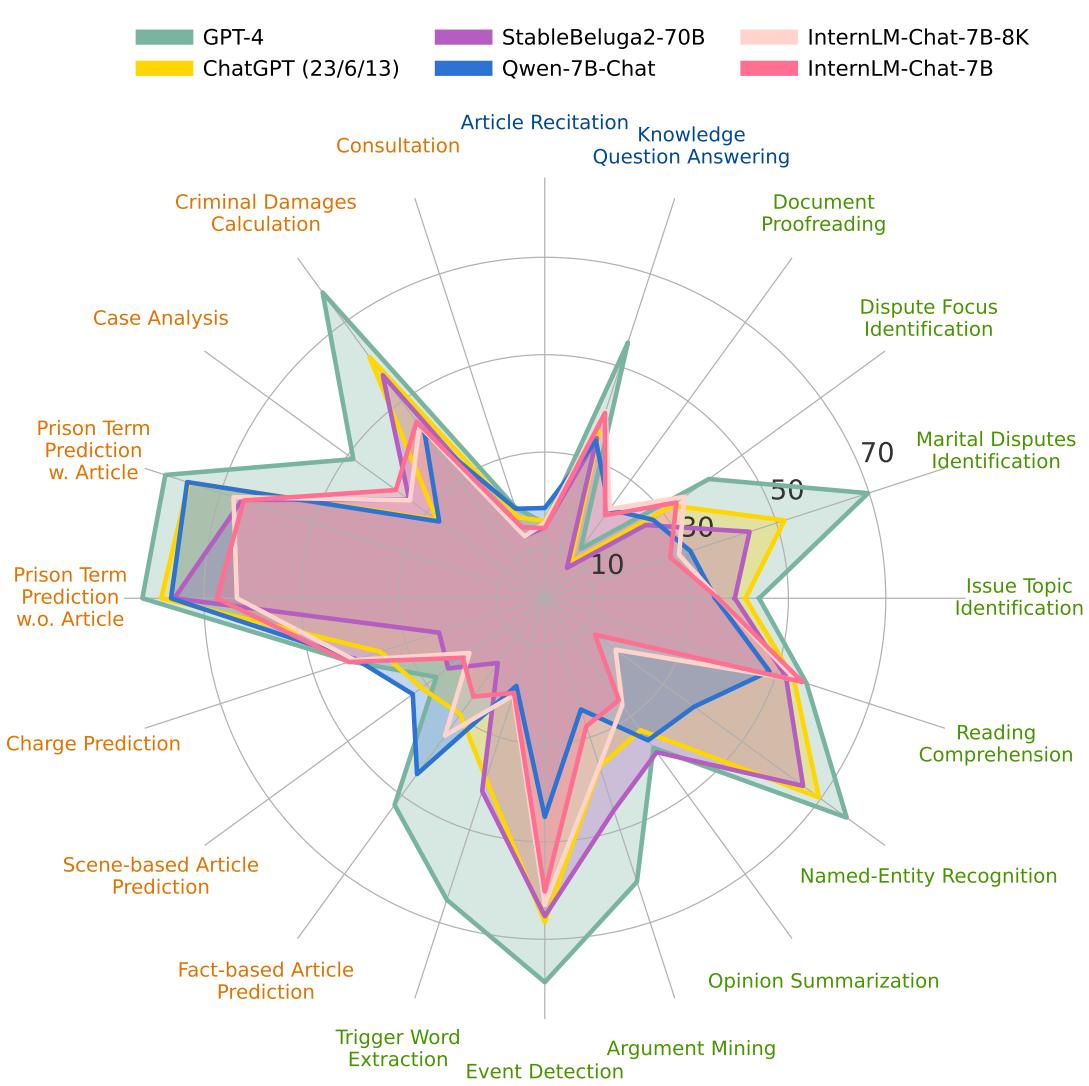
In the radar chart above, the teal line represents GPT-4. It encompasses almost every other model, reaching the outer edges (higher scores) on nearly all tasks. It is particularly strong in complex application tasks like Case Analysis.
When we look at the average zero-shot performance across all tasks, the gap becomes even clearer:
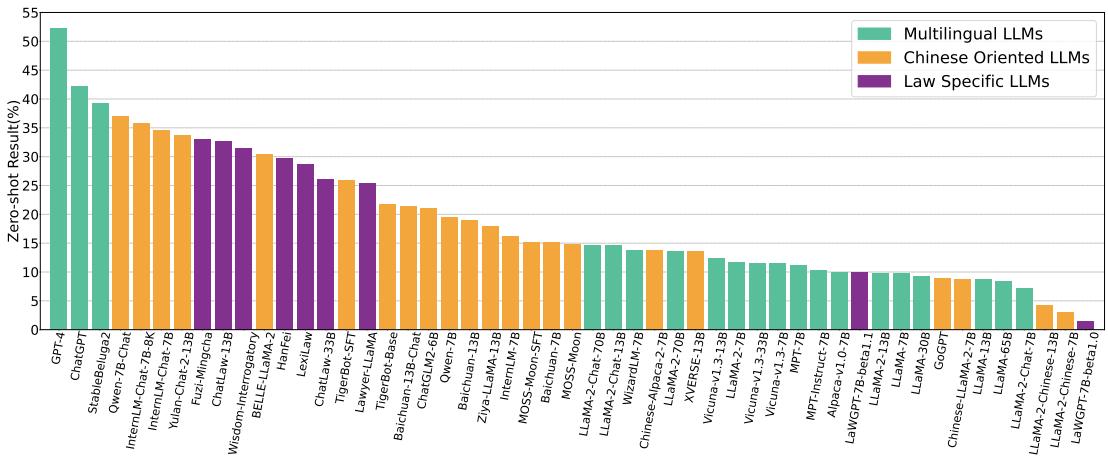
GPT-4 and ChatGPT (the top two bars) stand alone. Interestingly, the top-performing open-source models are generally Chinese-oriented generalist models (like Qwen-Chat and InternLM) rather than the legal-specific models.
2. The Paradox of Legal Fine-Tuning
One would assume that a model fine-tuned on legal data (Legal-Specific LLMs) would beat a general-purpose model. The data tells a nuanced story.
The researchers found that legal-specific LLMs (purple bars in the chart above) often lagged behind strong generalist models. Why?
The issue lies in the base model. Most current legal-specific models are built upon weaker foundation models (e.g., smaller versions of LLaMA or older architectures). While fine-tuning helps them improve over their own base version, it isn’t enough to overcome the raw intelligence gap of a massive model like GPT-4 or a highly optimized 70B parameter model.
However, fine-tuning is effective. As shown below, legal fine-tuning consistently improves performance and reduces the “abstention rate” (how often a model refuses to answer) compared to the base model.
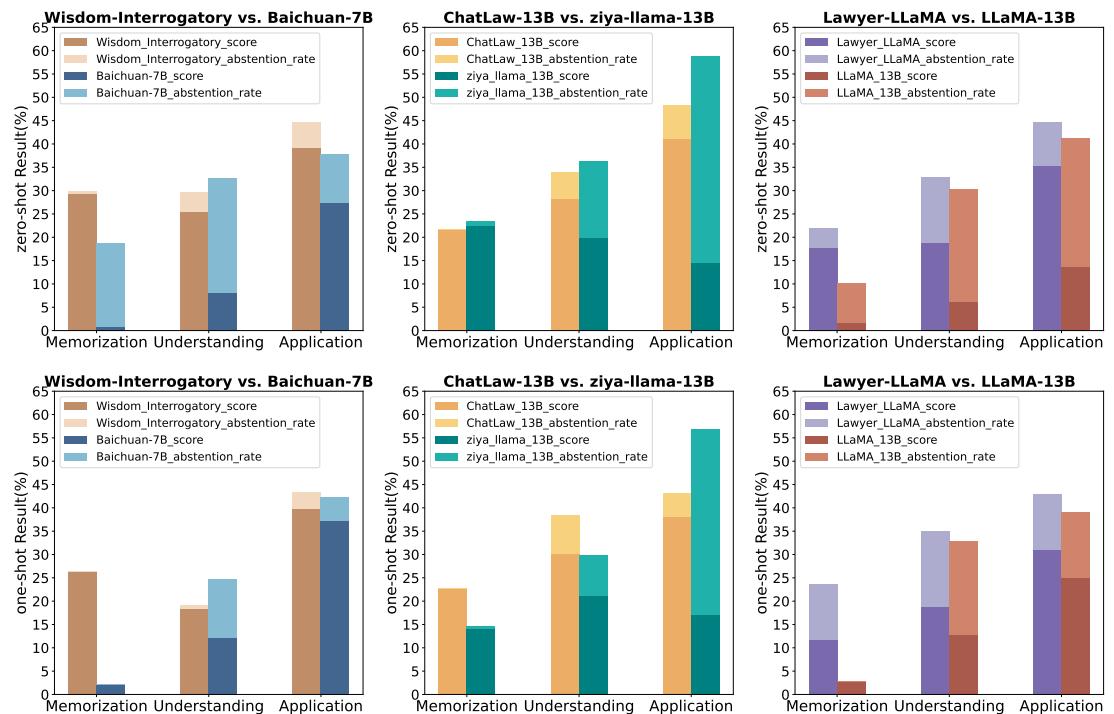
The takeaway: To build a great legal AI, you need to start with a great generalist AI. You cannot fine-tune your way out of a weak foundation.
3. The “Retrieval” Problem
A common strategy in AI development is Retrieval-Augmented Generation (RAG). The idea is that if you give the model the relevant text (e.g., the specific law article), it should answer better.
LawBench tested this hypothesis by comparing Task 3-4 (Prison Term Prediction without Article) and Task 3-5 (Prison Term Prediction with Article).
The results were shocking.

For most models, including the article content actually degraded performance. Even GPT-4 saw a drop in accuracy when the specific legal text was added to the prompt.
This suggests that current LLMs struggle to effectively utilize long, complex legal texts provided in the context window. Instead of using the article to refine their reasoning, the extra text may act as noise, confusing the model’s internal “gut feeling” which was established during pre-training. This is a critical finding for legal tech companies building RAG systems: simply retrieving the law isn’t a silver bullet.
4. One-Shot vs. Zero-Shot & Model Size
Consistent with other NLP benchmarks, LawBench found that bigger models generally do better, and providing a single example (one-shot) helps significantly.
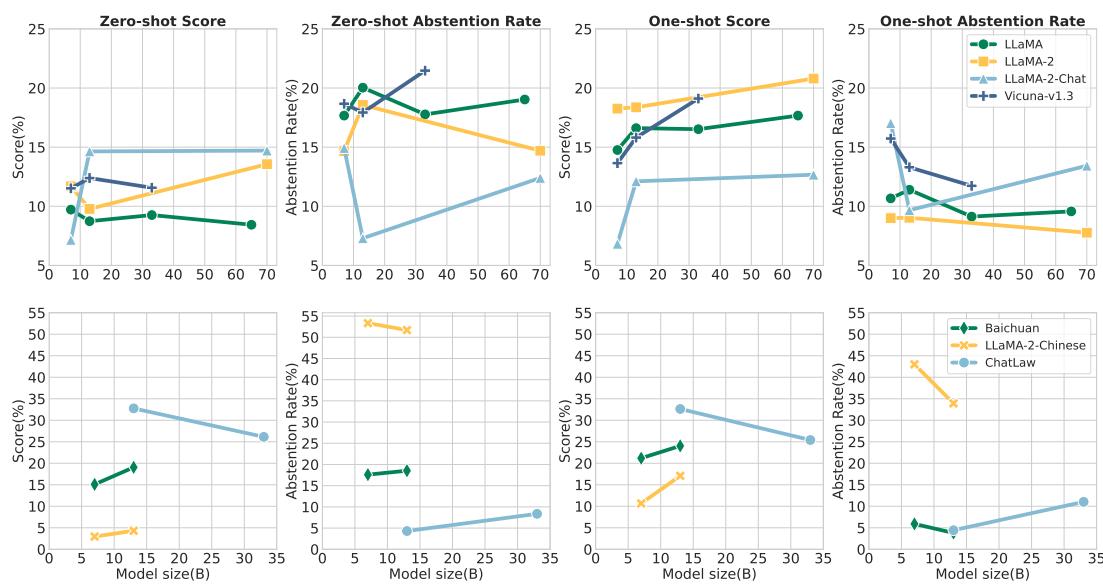
As model parameters increase (moving right on the x-axes), performance generally trends upward. This is even more pronounced in the one-shot setting (green lines), indicating that larger models are better at “in-context learning”—adapting their behavior based on the example provided in the prompt.
5. The RLHF Trap
Reinforcement Learning from Human Feedback (RLHF) is the secret sauce that makes models like ChatGPT polite and conversational. However, LawBench suggests it might be detrimental to legal accuracy.
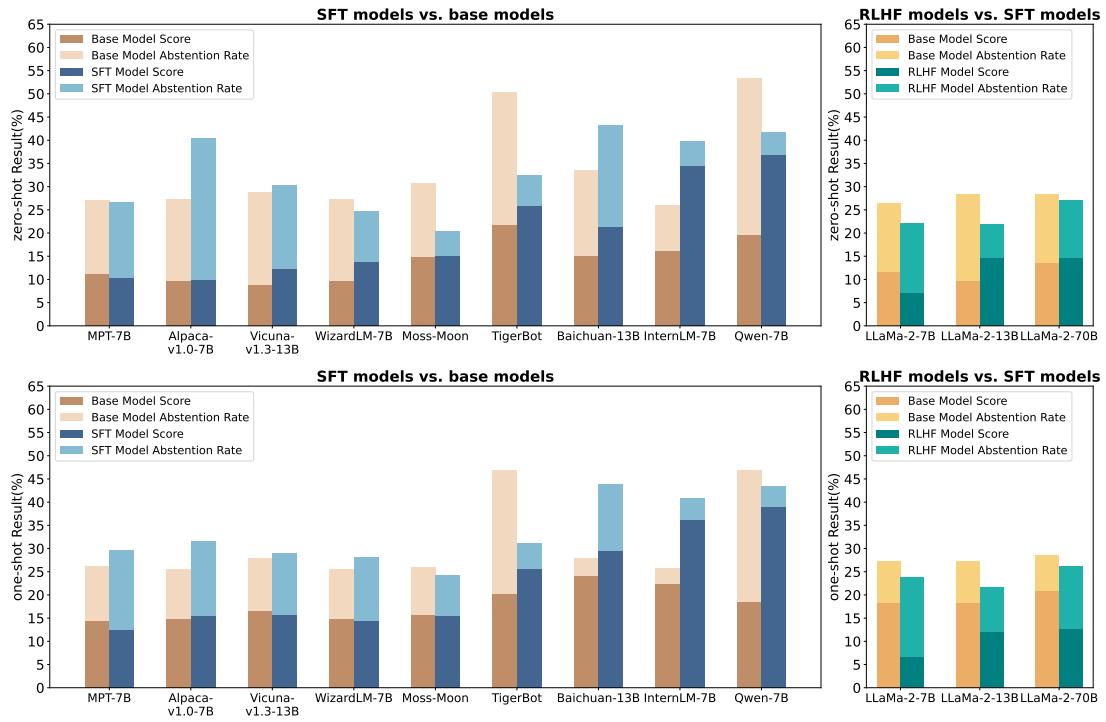
In the chart above, look at the LLaMA-2 series. The RLHF versions (green bars) often have higher abstention rates (the light top portion of the bar) compared to the SFT versions. In a bid to be “safe” and helpful, RLHF-trained models often refuse to answer legal questions, treating them as providing professional advice which violates their safety guidelines. This “alignment tax” severely hampers their utility in professional legal applications.
Conclusion: The Verdict
LawBench represents a significant step forward in our understanding of how AI handles specialized, high-stakes domains. The comprehensive evaluation of 51 models yields a clear verdict:
AI is not ready to replace lawyers.
Even the best model, GPT-4, achieves an average score of only roughly 50-53% across these tasks. While it excels at memorization and basic understanding, the “Applying” layer—reasoning through a case to determine a prison sentence or damages—remains a significant hurdle.
Furthermore, the study highlights critical flaws in current development strategies:
- Safety vs. Utility: RLHF makes models too cautious for legal work.
- Context Utilization: Models struggle to effectively use retrieved legal articles.
- Foundation Matters: Building a “Legal GPT” requires a state-of-the-art foundation model, not just fine-tuning a smaller, open-source model.
For students and researchers, LawBench serves as both a roadmap and a challenge. It maps out the cognitive skills required for legal intelligence and exposes the specific areas where current technology falls short. The future of Legal AI isn’t just about training on more contracts; it’s about solving fundamental reasoning and context-utilization problems that persist even in the largest models.
The gavel hasn’t fallen on AI yet, but the trial is just beginning.