](https://deep-paper.org/en/paper/2310.07059/images/cover.png)
In the world of medical Artificial Intelligence (AI), there is a persistent tension between “what the model sees” and “what the model knows.”
Imagine a newly trained resident doctor in an emergency room. When a patient arrives with common flu symptoms, the resident diagnoses it immediately based on experience—they have seen it a hundred times. But what happens when a patient arrives with a rare set of symptoms indicating a specific, obscure crush syndrome? If the resident hasn’t seen that specific case during their rotation, they might miss it.
However, a good doctor doesn’t rely solely on memory; they consult medical guidelines, textbooks, and protocols. They augment their experience (data) with external knowledge.
Most current AI models for diagnosis prediction rely heavily on experience—training on massive datasets of Electronic Health Records (EHR). They struggle with the “Long Tail” problem: they are excellent at diagnosing common conditions (the “head” of the distribution) but perform poorly on rare diseases (the “tail”) simply because they haven’t seen enough examples during training.
This post dives into DKEC (Domain Knowledge Enhanced Classification), a research paper that proposes a clever solution: teaching AI models to consult an external “medical textbook” (a Knowledge Graph) while they read patient notes.
The Problem: The Long Tail of Medicine
Automated diagnosis prediction involves Multi-Label Text Classification (MLTC). Given a free-text narrative from a doctor or paramedic (e.g., “Patient found unresponsive, shallow breathing, pinpoint pupils…”), the goal is to assign the correct set of diagnosis codes.
This is difficult for two main reasons:
- Combinatorial Explosion: Patients rarely have just one issue. The number of possible combinations of diseases grows exponentially.
- Imbalanced Data: Medical datasets follow a power-law distribution. You might have 10,000 examples of “Chest Pain” but only 5 examples of a specific chemical poisoning.
Standard Deep Learning models, including large transformers like BERT, tend to bias toward the majority classes. They learn to predict the common diseases well but often ignore the rare ones. While Large Language Models (LLMs) like GPT-4 have vast internal knowledge, they are expensive to run, hard to deploy on hospital devices, and can still hallucinate or miss specific clinical protocol nuances.
The Solution: DKEC
The researchers introduce DKEC, a framework that integrates Domain Knowledge directly into the classification process. Instead of hoping the model implicitly learns that “wheezing” is related to “asthma” through millions of training examples, DKEC explicitly feeds the model a graph where “wheezing” and “asthma” are connected.
The Architecture at a Glance
The beauty of DKEC is that it creates a dual-pathway for understanding a patient.
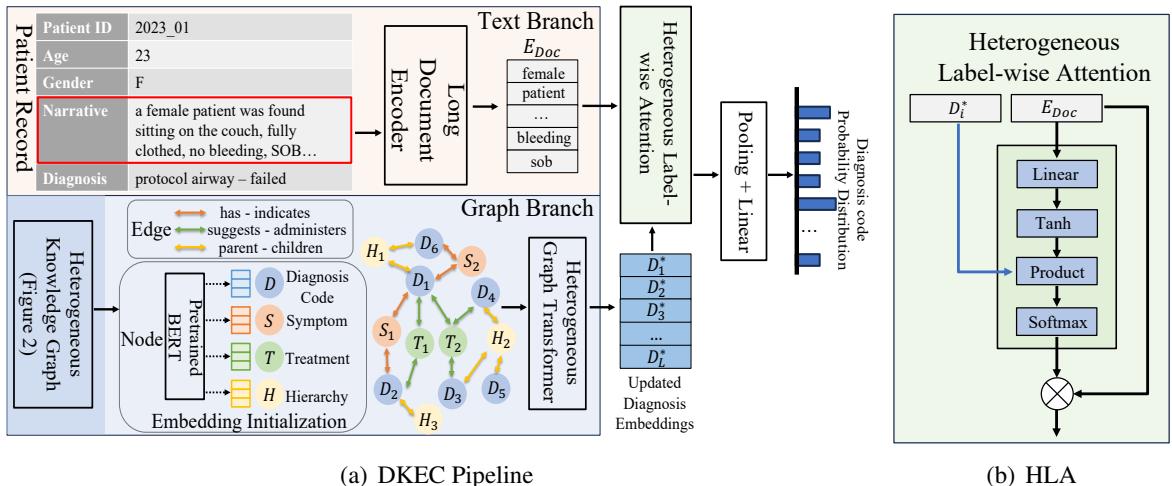
As shown in Figure 1 above, the architecture consists of two main branches:
- The Text Branch (Left): This processes the actual patient record (the narrative text) using a document encoder (like a CNN or BERT) to understand the specific case at hand.
- The Graph Branch (Right): This processes a “Heterogeneous Knowledge Graph.” This graph contains general medical truths—relationships between diagnoses, symptoms, and treatments.
These two branches meet at the Heterogeneous Label-wise Attention (HLA) module, which we will explore in detail. But first, where does the graph come from?
Building the Brain: Automated Knowledge Graph Construction
One of the paper’s significant contributions is a method for automatically building medical knowledge graphs (KGs) from online sources like Wikipedia, Mayo Clinic, and EMS protocols.
Manually building a KG is slow and expensive. The researchers automated this using LLMs (specifically GPT-4) with Chain-of-Thought prompting.
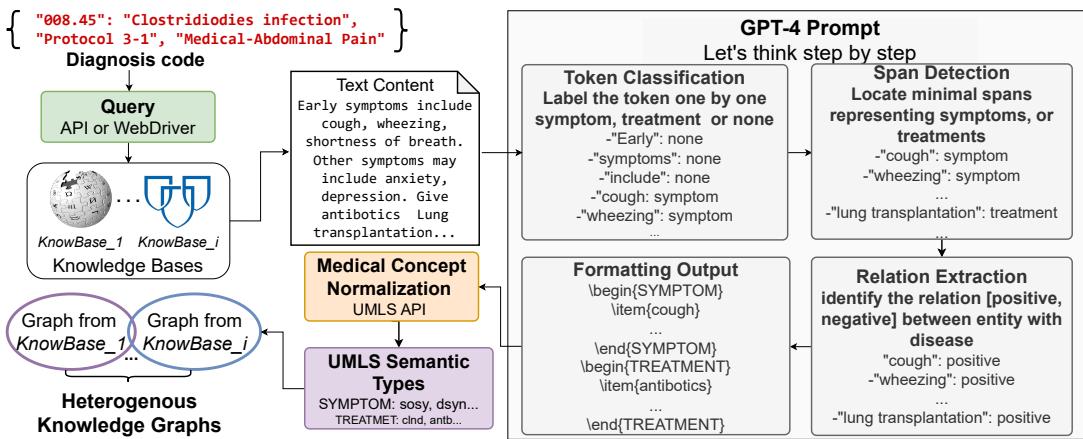
Figure 2 illustrates this construction pipeline. It isn’t as simple as asking ChatGPT “What are the symptoms of Asthma?” because LLMs can be chatty, inconsistent, or hallucinate. The authors devised a rigorous process:
- Prompting: They used a “One-shot Chain-of-Thought” prompt. This asks the LLM to “think step-by-step”—first labeling tokens in the text, then detecting spans (phrases), and finally validating relationships (ensuring a symptom is actually caused by the disease and not just mentioned in a “not present” context).
- Extraction: The system extracts triplets:
<Disease, Relation, Symptom>or<Disease, Relation, Treatment>. - Normalization: Medical text is messy. “High temp,” “fever,” and “burning up” are the same thing. The system uses the UMLS (Unified Medical Language System) API to map these varied terms to a single, normalized medical concept ID.
The result is a Heterogeneous Knowledge Graph containing four types of nodes: Diagnosis Codes, Symptoms, Treatments, and Hierarchy (parent/child relationships between diseases).
The Core Method: How It Works
Once the graph is built, how does the neural network use it?
1. Graph Encoding with HGT
The model needs to turn the static Knowledge Graph into mathematical vectors (embeddings) that represent the diseases. It uses a Heterogeneous Graph Transformer (HGT).
Unlike a standard graph neural network, an HGT understands that a relationship between a Disease and a Symptom is semantically different from a relationship between a Disease and a Treatment.
The HGT updates the representation of every Diagnosis node by aggregating information from its neighbors. So, the vector for “Asthma” is mathematically adjusted to include information from “Wheezing” (symptom) and “Inhaler” (treatment).
The final representation of the diagnosis labels (\(D^*\)) is obtained via a linear transformation of the HGT output:

Here, \(D^*\) is a matrix where every row is a rich, knowledge-infused vector representing a specific disease.
2. Heterogeneous Label-wise Attention (HLA)
This is the heart of the classification engine. We have our patient document representation (\(E_{Doc}\)) from the text encoder, and our knowledge-rich disease representations (\(D^*\)).
Standard multi-label classification might just pool the document text and run a classifier. DKEC, however, asks: For this specific disease label, which parts of the patient note are relevant?
It calculates an attention score for every word in the document regarding every possible disease.

In this equation:
- \(\mathbf{a}_{Doc,k}\) is the attention weight for the \(k\)-th disease label.
- It looks at the compatibility between the document features (\(E_{Doc}\)) and the specific disease embedding (\(D_k^*\)).
If the disease label is “Cardiac Arrest” and the document contains the word “CPR,” the graph embedding for “Cardiac Arrest” (which “knows” about CPR) will react strongly to that word, assigning it a high attention weight.
These attention vectors are stacked for all \(L\) labels:

The model then creates a Label-wise Text Representation (\(E_{Doc}^{attn}\)). This is a unique view of the patient document custom-tailored for each possible diagnosis.

3. Final Prediction
Finally, the model decides the probability of each diagnosis. It takes the tailored document representation, pools it (simplifies it), and passes it through a linear classifier.

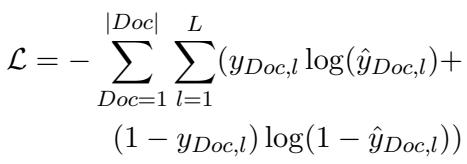
The model is trained using Binary Cross-Entropy loss, comparing the predicted probabilities (\(\hat{y}\)) against the ground truth labels (\(y\)).
Experiments and Key Results
The researchers tested DKEC on two distinct datasets:
- MIMIC-III: A massive dataset of ICU electronic health records (complex, many labels).
- EMS: A real-world dataset of ambulance patient care reports (messy, time-critical).
They compared DKEC against State-of-the-Art (SOTA) baselines, including specialized Convolutional Neural Networks (like CAML) and large Pre-trained Transformers (like BioMedLM and GatorTron).
Finding 1: Dominating the “Tail”
The primary goal was to improve performance on rare diseases (the “Tail” classes). The results were compelling. DKEC outperformed baseline methods significantly on tail labels—achieving a 10.5% improvement on the EMS dataset and 6% on MIMIC-III for few-shot classes.
By giving the model “textbook knowledge,” it didn’t need thousands of examples to recognize a rare disease; it just needed to see the symptoms in the text that matched the graph.
Finding 2: Small Models Can Punch Above Their Weight
Perhaps the most exciting finding for engineers and hospital IT departments is regarding model size. Running a massive 2.7 Billion parameter model (like BioMedLM) is expensive and slow.
The researchers applied the DKEC framework to a smaller model (GatorTron, 325M parameters) and compared it to the giant BioMedLM.
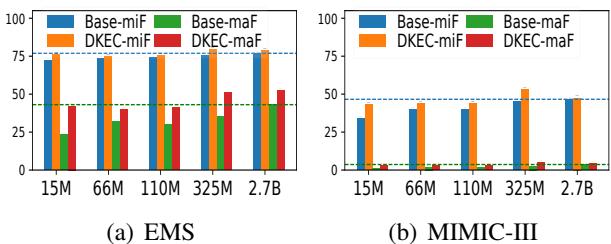
Figure 3 shows the comparison on both EMS (a) and MIMIC-III (b) datasets.
- The Orange/Red bars (DKEC models) consistently reach higher scores than the Blue/Green bars (Base models).
- Crucially, look at the 325M column vs. the 2.7B column. The DKEC-enhanced GatorTron (325M) often outperforms the Base BioMedLM (2.7B).
This implies that injecting structured domain knowledge allows us to use models that are nearly 10x smaller while achieving equal or better performance.
Finding 3: Scalability
Does the model break if we add thousands of diseases? The team tested performance on subsets of MIMIC-III with 1,000, 3,700, and 6,700 labels.
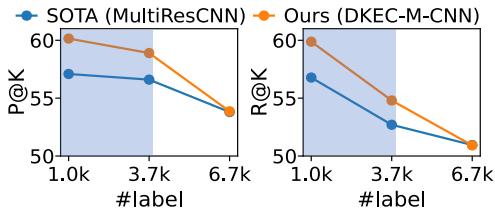
Figure 4 illustrates that while performance naturally drops as the task gets harder (more labels), the DKEC model (Orange line) consistently stays above the SOTA baseline (Blue line). The gap is widest when “full knowledge” is available (the 1.0k and 3.7k subsets), proving that the quality of the Knowledge Graph directly correlates to performance gains.
Conclusion and Implications
The DKEC paper highlights a pivotal shift in how we approach AI in specialized domains like medicine. We cannot rely solely on “Big Data” because, for many critical conditions, big data simply doesn’t exist.
By combining the statistical power of Deep Learning (reading the text) with the structured reasoning of Knowledge Graphs (understanding the medicine), DKEC offers a robust solution to the long-tail problem.
Key Takeaways:
- Knowledge over Size: A smaller model equipped with an external knowledge graph can beat a larger model that relies on memorization.
- LLMs as Tools: Large Language Models are excellent at constructing the knowledge base (data processing) even if they are too unwieldy to be the classifier itself.
- Attention is All You Need (plus Knowledge): The Label-wise Attention mechanism allows the model to “read” a patient note differently depending on which disease it is investigating, mimicking human clinical reasoning.
This approach paves the way for more reliable, explainable, and efficient diagnostic assistants that can operate effectively even on the rarest of cases.