](https://deep-paper.org/en/paper/2310.09505/images/cover.png)
Introduction
Imagine you have trained a state-of-the-art speech recognition model. In the quiet confines of your laboratory, it performs flawlessly. It transcribes every word with near-perfect accuracy. Then, you deploy it into the real world. Suddenly, the model faces the hum of an air conditioner, the unique cadence of a non-native speaker, or perhaps someone humming a tune while they speak. Performance plummets.
This phenomenon is known as domain shift—the mismatch between the clean data the model was trained on and the messy, “wild” data it encounters during deployment.
Traditionally, fixing this required collecting massive amounts of new data and retraining the model. But what if the model could adapt itself on the fly, using only the specific audio clip it is currently processing? This is the promise of Test-Time Adaptation (TTA).
In this post, we will deep-dive into a fascinating research paper titled “Advancing Test-Time Adaptation in Wild Acoustic Test Settings.” This work addresses a critical gap in current AI research: while visual models have decent adaptation techniques, acoustic models (like those powering Siri or Alexa) struggle when applied to “wild” audio.
We will explore how the authors challenge the conventional wisdom of “filtering out noise,” why high-entropy speech frames are actually valuable, and how a new method called Confidence-Enhanced Adaptation (CEA) combined with Short-Term Consistency Regularization is setting a new standard for robust speech recognition.
The Problem with “Wild” Audio
Deep learning-based acoustic models, such as Wav2vec2, are powerful. However, they rely on the assumption that the test data looks (or sounds) statistically similar to the training data. In the real world, this assumption breaks down immediately due to:
- Environmental Noise: Background sounds like traffic, machinery, or typing.
- Speaker Variations: Different accents, timbres, or pronunciations (L2 learners).
- Style Changes: Sung speech (singing), which alters pitch and duration significantly.
As shown in the figure below, the performance of standard models (Wav2vec2 Base and Large) degrades significantly as the acoustic conditions worsen (from In-Domain to Noise, Accents, and Singing).
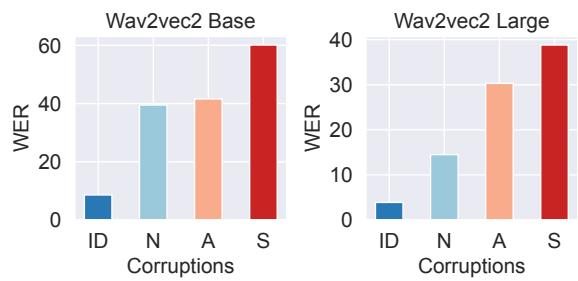
In Figure 1, notice the drastic jump in Word Error Rate (WER)—where lower is better—when moving from “ID” (In-Domain) to “S” (Singing). The error rate creates a massive barrier for deploying these models in real-world applications.
Background: The TTA Landscape
Before dissecting the solution, we must understand the setup. The researchers focus on a fully Test-Time Adaptation framework. This means:
- We do not have access to the original training data.
- We adapt the model episodically: for every new utterance, the model tweaks itself, processes the audio, and then resets for the next file.
- It must happen quickly (online).
The Foundation Model Architecture
The paper focuses on acoustic foundation models like Wav2vec2 or HuBERT. These models generally process audio in two stages:
- Feature Extractor (\(g_\phi\)): Takes the raw waveform (\(x\)) and converts it into latent features (\(z\)).
- Transformer Encoder (\(h_\theta\)): Takes those features and processes them into context-rich representations (\(y\)) used for prediction.
This relationship is formalized mathematically as:

Here, \(\Theta\) represents the model parameters. In TTA, our goal is to adjust these parameters slightly to better fit the incoming audio \(x\), without seeing the ground truth text.
The “Vision” Trap
Previous TTA methods were largely developed for computer vision (images). A popular technique in vision, called SAR, works by identifying “noisy” or “high-entropy” pixels/images and filtering them out. The logic is that if the model is very uncertain about an image, that image is likely garbage and will hurt the adaptation process.
The authors of this paper realized that this logic fails for speech. In audio, the “noisy” or “uncertain” frames are often the ones containing the most complex and important phonetic information (non-silent segments). If you throw away the uncertain frames in speech, you might be throwing away the content itself.
The Core Method: Confidence-Enhanced Adaptation
The researchers propose a two-pronged approach to solve this: Confidence-Enhanced Adaptation (CEA) and Short-Term Consistency Regularization. Let’s break down the architecture.
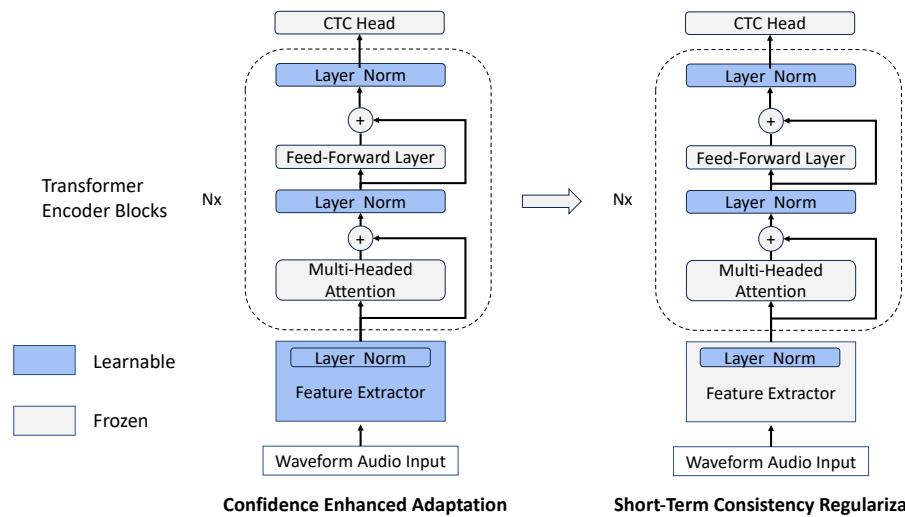
As illustrated in Figure 2, the framework adapts the model in two steps. First, it uses CEA to boost the reliability of noisy frames. Second, it uses consistency regularization to ensure that the adaptation makes sense over time.
1. Rethinking Entropy in Speech
To understand why traditional filtering fails, the authors analyzed the entropy (uncertainty) of speech frames.
In the figure below, red dots represent high-entropy (uncertain) frames, while blue dots are low-entropy (confident) frames. The triangles represent silence, and circles represent speech (non-silent).
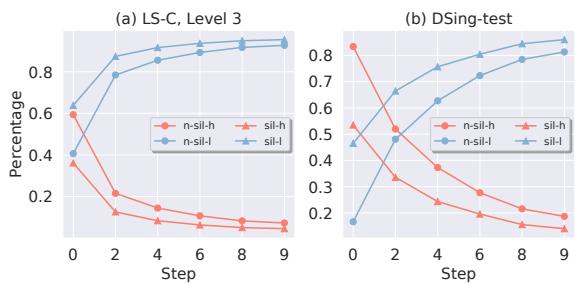
Look at the “Step 0” (initial) graphs. In the non-silent segments (circles), there is a massive cluster of red dots. This proves that the model is naturally uncertain about the actual speech content in wild settings. If we followed the Computer Vision approach and filtered out high-entropy frames, we would delete the vast majority of the actual speech data we need to recognize!
2. The Weighting Scheme
Instead of discarding these high-entropy frames, the authors propose Confidence-Enhanced Adaptation (CEA). The intuition is counter-intuitive but brilliant: If the model is uncertain about a frame, we should force it to learn more from that frame, not less.
First, they calculate the entropy \(E(x_i)\) for a frame, which measures how “confused” the model is about its prediction \(\hat{y}\):
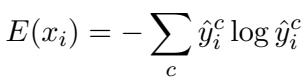
Then, they define a confidence-aware weight, \(S(x_i)\).

Let’s decode this equation:
- \(\frac{1}{1 + \exp(-E(x_i))}\): This is a sigmoid function applied to the entropy. If entropy \(E\) is high (uncertainty is high), the weight \(S\) becomes larger. If the model is confident (low entropy), the weight is smaller.
- \(\mathbb{I}_{\hat{y}_i \neq c_0}\): This is an indicator function. It ensures we only apply this logic to non-silent frames (where the predicted class is not the blank/silence token \(c_0\)). We generally trust the model’s ability to identify silence; we only want to aggressively adapt the speech parts.
Finally, the adaptation minimizes the weighted entropy:
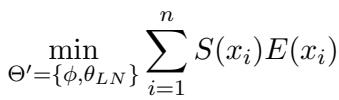
By minimizing this weighted objective, the model updates its parameters (specifically the Feature Extractor and Layer Normalization parameters) to become more confident about the confusing parts of the speech.
3. Short-Term Consistency Regularization
Speech is not a random sequence of sounds; it is continuous. If you are pronouncing the “a” in “cat,” that sound spans multiple milliseconds—meaning several consecutive frames should have similar representations.
The authors leverage this inductive bias. They force the model to ensure that the feature representation of a frame \(z_i\) is mathematically close to its neighbors.

This equation adds a penalty term (weighted by \(\alpha\)). It looks at a window of size \(k\) and minimizes the distance (\(|| \dots ||_2\)) between the current frame and its neighbors. This smooths out the predictions and prevents the model from making erratic jumps in adaptation.
Experiments and Results
Does this theory hold up in practice? The authors tested the model on several challenging datasets:
- LS-C: LibriSpeech corrupted with Gaussian noise.
- LS-P: LibriSpeech corrupted with environmental sounds (typing, AC, etc.).
- L2-Arctic: Non-native speakers with strong accents.
- DSing: A dataset of sung speech (singing).
Performance on Noise (Gaussian)
First, let’s look at standard noise corruption across different severity levels. The table below compares the Source (un-adapted) model against various TTA methods like Tent and the proposed method (“Ours”).
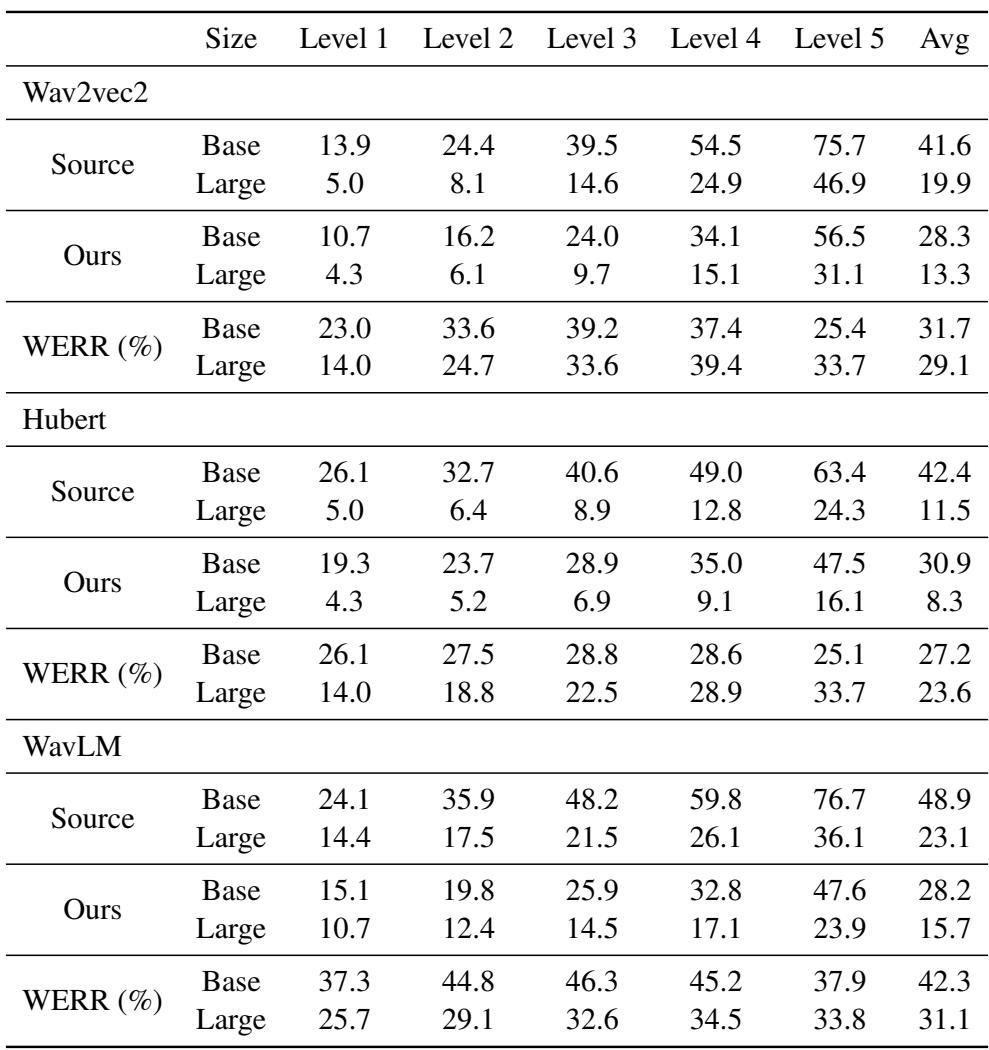
Analysis:
- Look at the “Wav2vec2 Base” section. The Source model has an average WER of 41.6%.
- Ours reduces this to 28.3%.
- This represents a Relative Word Error Rate Reduction (WERR) of over 30%.
- The method consistently outperforms the un-adapted model across all severity levels (1 through 5) and across different model architectures (Hubert, WavLM).
Performance on Environmental Sounds
Real-world noise isn’t just static; it’s specific sounds like an air conditioner humming or someone typing.
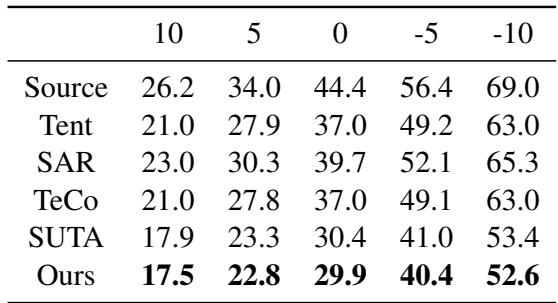
In these tables, we see the results for Air Conditioner and Typing noises at different Signal-to-Noise Ratios (SNR). A lower SNR (e.g., -5 dB) is much noisier.
- At -5 dB SNR for Air Conditioner noise, the Source model has a massive 83.4% error rate.
- The proposed method drops this to 61.6%, significantly outperforming the “Tent” and “SAR” baselines.
Performance on Singing
Singing is arguably the hardest “wild” setting because the fundamental frequency and duration of phonemes change drastically.
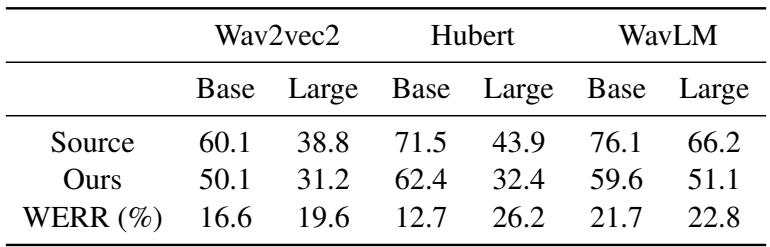
For the Wav2vec2 Base model, the error rate drops from 60.1% (Source) to 50.1% (Ours). While 50% is still high (singing recognition is notoriously difficult), a 10% absolute improvement is a massive leap forward in this domain, outperforming other baselines significantly.
Ablation Study: Do we need both components?
You might wonder: is the improvement coming from the weighting scheme (CEA) or the consistency regularization?
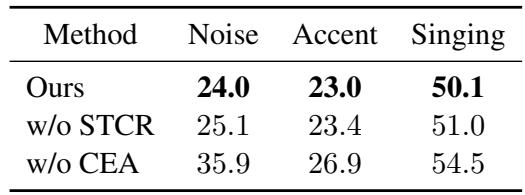
This table breaks it down:
- “Ours” (Both components): Best performance (e.g., 24.0% on Noise).
- w/o STCR (Removing consistency): Performance drops slightly to 25.1%.
- w/o CEA (Removing confidence adaptation): Performance drops significantly to 35.9%.
Takeaway: The Confidence-Enhanced Adaptation (CEA) is the heavy lifter here. It prevents the model from ignoring the difficult, high-entropy frames. However, adding the consistency regularization (STCR) provides that final boost of stability needed to beat the state-of-the-art.
Conclusion
The transition of AI from the lab to the real world is rarely smooth. In the domain of speech recognition, “wild” acoustic settings—filled with noise, accents, and singing—pose a unique challenge that traditional adaptation methods failed to address.
This research paper makes a pivotal contribution by identifying that uncertainty in speech does not equal irrelevance. Unlike computer vision, where noisy pixels can be discarded, noisy speech frames carry the message.
By introducing Confidence-Enhanced Adaptation, the authors successfully taught models to “lean in” to their uncertainty rather than shy away from it. By coupling this with Short-Term Consistency Regularization, they ensured that these adaptations respected the natural temporal flow of speech.
The results are compelling: significant reductions in error rates across synthetic noise, real-world environmental sounds, accents, and even singing. For students and practitioners in ASR (Automatic Speech Recognition), this work highlights the importance of designing adaptation algorithms that respect the specific properties of the data modality (audio vs. vision) rather than blindly applying techniques from one field to another.
As we move toward always-on, ubiquitous voice assistants, techniques like this will be the engine that keeps them understanding us—whether we are in a library, a construction site, or singing in the shower.