](https://deep-paper.org/en/paper/2311.07237/images/cover.png)
Large Language Models (LLMs) like GPT-4 and Llama 2 have dazzled the world with their ability to write code, compose poetry, and answer complex questions. But there is a catch: these models perform best when they are on “familiar ground.” When you ask an LLM about popular topics—like the iPhone or major historical events—it shines. But what happens when you push the model into the obscure corners of knowledge, known as the long-tail distribution?
A recent research paper, “In Search of the Long-Tail,” tackles this exact question. The authors reveal a significant weakness in state-of-the-art models: their reasoning capabilities crumble when dealing with rare or low-confidence examples, even if the underlying logic is simple.
In this post, we will unpack why this happens, how the researchers developed a clever system called LINK to generate rare test data, and what the results tell us about the future of AI generalization.
The Problem: The Comfort Zone of AI
To understand the problem, we first need to define the “long-tail.” In the context of LLMs, knowledge isn’t just about what is true or false; it’s about frequency and likelihood.
LLMs are trained on vast amounts of internet data. Consequently, they are biased toward the “Head” of the distribution—concepts that appear frequently. They are very confident when discussing high-frequency entities (like “Sherman Tanks” or “iPhone 13”). However, as we move to less common examples (the “Long-tail”), the model’s confidence drops.
The researchers posed a critical question: Does an LLM’s ability to reason depend on how famous the subject is?
Ideally, logic should be universal. If Person A is allergic to dairy, they cannot eat Dish B (assuming it contains dairy). This logic holds true whether Dish B is “Ice Cream” (common/Head) or “Saag Chicken” (less common/Long-tail).
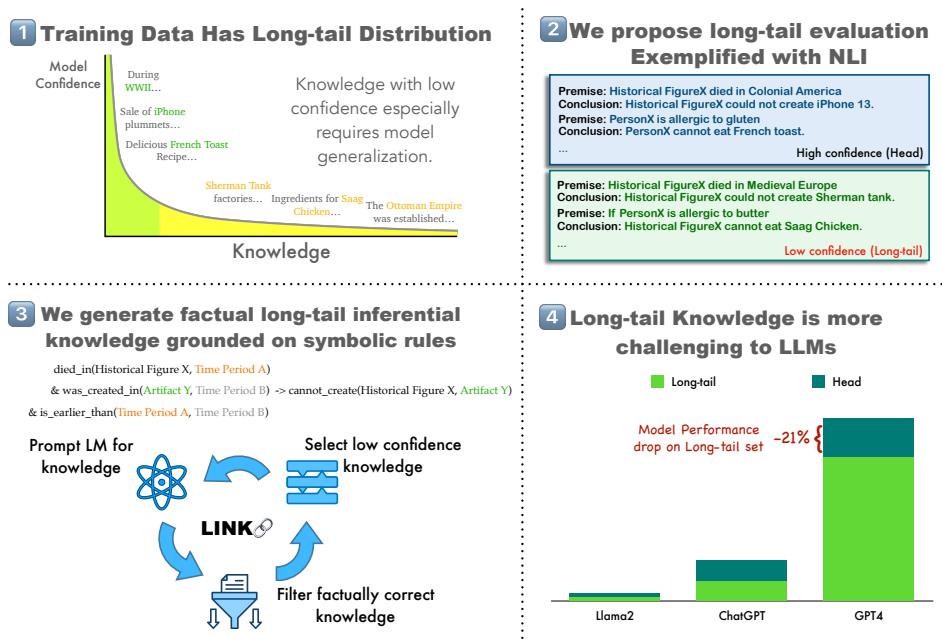
As shown in Figure 1 above, the researchers set out to evaluate this by contrasting “Head” knowledge against “Long-tail” knowledge using a Natural Language Inference (NLI) task. The goal was to see if models could maintain their accuracy when the examples shifted from high-confidence (common) to low-confidence (rare).
The Challenge of Finding the Long-Tail
Testing this hypothesis is harder than it sounds. You can’t simply ask an LLM, “Give me a rare fact.” Because models are trained to predict the most likely next word, they struggle to generate low-probability text that is still factually correct. If you force them to be creative, they often hallucinate.
Crowdsourcing is also difficult because humans suffer from cognitive bias—we tend to recall familiar examples (the “availability heuristic”) rather than obscure ones.
To solve this, the authors introduced a new framework: Logic-Induced-Knowledge-Search (LINK).
The Solution: Logic-Induced-Knowledge-Search (LINK)
LINK is a systematic framework designed to generate inferential knowledge statements that are factually correct yet fall into the long-tail distribution (unfamiliar to the model).
The core innovation of LINK is that it doesn’t ask the model to generate a whole sentence at once. Instead, it breaks the generation process down into steps governed by Symbolic Rules.
1. Symbolic Rules
First, the researchers define a logical template. For example:
If Person X is allergic to Ingredient Z, and Ingredient Z is in Dish B, then Person X cannot eat Dish B.
This rule is universally true. The challenge is filling in the variables (\(X\), \(Z\), \(B\)) with values that are rare but real.
2. Knowledge Beam Search
This is the engine of the framework. Instead of asking the model to fill in the blanks all at once, LINK performs a “variable-wise search.”
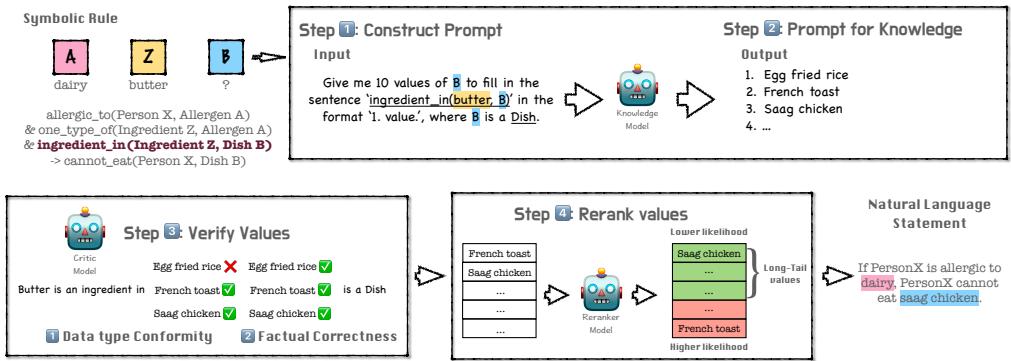
As illustrated in Figure 2, the process works like a decision tree:
- Prompt for Knowledge: The system asks the model for a list of values for one variable (e.g., “List dishes that contain butter”).
- The Critic (Verification): This is a crucial step. A separate “Critic” model verifies two things:
- Data Type: Is “Saag Chicken” actually a dish?
- Factuality: Does “Saag Chicken” actually contain butter?
- Reranking (The Long-Tail Push): This is where the magic happens. The system checks the likelihood of the valid answers. It specifically selects values that the model finds less probable (low confidence).
By prioritizing valid but “unlikely” answers, LINK forces the generation of valid long-tail data. For example, while the model might shout “French Toast!” (high probability), LINK digs deeper to find “Saag Chicken” (lower probability but still correct).
Does LINK Actually Work?
The researchers compared LINK against standard prompting methods. They took powerful models like ChatGPT and GPT-4 and simply instructed them: “Generate rare/less frequent examples.”
The results were telling.
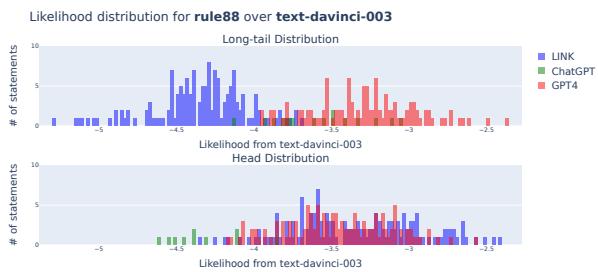
Figure 4 demonstrates the distribution of generated statements.
- Red Area (GPT-4): Even when asked for rare examples, GPT-4 tended to generate high-likelihood (Head) statements. It struggled to escape its training bias.
- Blue Area (LINK): The LINK framework successfully pushed the generated statements into the lower probability zones (the left side of the graph) while maintaining factual correctness.
This proves that we cannot rely on LLMs to self-report their own long-tail knowledge; we need external frameworks like LINK to excavate it.
Using this method, the authors created LINT (Logic-Induced-Long-Tail), a massive dataset containing 108,000 knowledge statements across four domains:
- Temporal: Relationships involving time (e.g., historical eras).
- Locational: Geography and places.
- Outcome & Effect: Medical or causal relationships.
- Natural Properties: Physical attributes of objects.
The Experiment: Do Models Crash in the Long-Tail?
With the LINT dataset in hand, the researchers performed the ultimate test. They evaluated three popular LLMs (Llama-2-70B, ChatGPT, and GPT-4) on an entailment task.
The task was simple: Given a premise (e.g., “Person X has Hepatitis”), does the conclusion follow (e.g., “Person X should take Sofosbuvir”)?
They compared the models’ accuracy on Head (common) data versus Long-tail (rare) data.
The Results
The performance drop was stark.
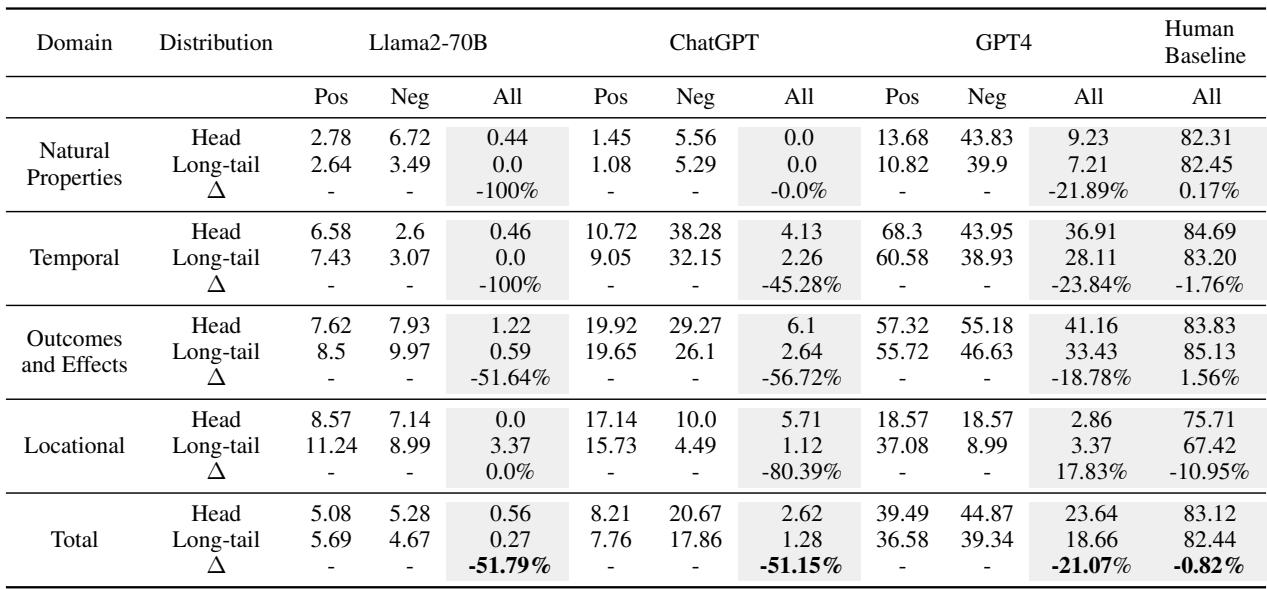
Table 4 summarizes the findings:
- GPT-4: The most advanced model tested showed a ~21% relative drop in performance when moving from Head to Long-tail data.
- Llama-2 & ChatGPT: These models suffered even worse declines, with Llama-2 dropping nearly 52%.
- Human Baseline: Perhaps most interestingly, human performance remained stable. The last column shows that humans were roughly as accurate on rare data as they were on common data.
Why the Human-AI Discrepancy?
Why did humans succeed where AI failed? The study notes that for the human baseline, annotators were allowed to use search engines. When a human encounters a rare fact they don’t know (e.g., “Does Saag Chicken contain dairy?”), they look it up and apply logic. Their reasoning process is robust regardless of the data’s obscurity.
LLMs, however, rely on their internal parametric memory. When that memory is weak (as it is for long-tail data), their reasoning capabilities seem to collapse, leading to hallucinations or incorrect inferences.
Why This Matters
This research highlights a critical bottleneck in current AI development. We often evaluate models on “general” benchmarks that may inadvertently favor head-distribution knowledge. A model might score 90% on a medical benchmark because it memorized common diseases, but fail catastrophically when presented with a rare condition, even if the diagnostic logic is identical.
The LINK framework provides a blueprint for how we can rigorously stress-test these models. By systematically generating valid, low-confidence data, we can better measure true generalization—the ability to apply rules correctly regardless of familiarity.
Conclusion
The “In Search of the Long-Tail” paper serves as a wake-up call. While LLMs are impressive, their brilliance is often limited to their “comfort zone” of high-frequency data.
- Generalization is not solved: High performance on standard benchmarks does not guarantee reliability on rare real-world scenarios.
- Evaluation needs an upgrade: We need to move beyond standard datasets and specifically target the long-tail to ensure safety and robustness.
- Logic + Search is powerful: The LINK method shows that combining symbolic logic with modern LLMs is a potent way to generate high-quality, difficult test data that would be impossible to curate manually.
As we deploy AI into increasingly complex fields—like law, medicine, and engineering—understanding and fixing this long-tail weakness will be essential. We need models that act less like students reciting memorized textbooks and more like researchers capable of reasoning through the unknown.