](https://deep-paper.org/en/paper/2311.08662/images/cover.png)
Introduction
Imagine you are using a large language model (LLM) to summarize a financial report. The model works perfectly. Then, you fix a small typo in the input data—changing “5000” to “5,000” or correcting a misspelled company name. Suddenly, the model’s output flips completely. It contradicts its previous summary.
This scenario highlights a critical vulnerability in modern NLP: brittleness. While Language Models (LMs) display impressive capabilities, they are often “black boxes” that are highly sensitive to minor input perturbations. A model might understand a sentence perfectly, but if you add a double negative or swap a word for a synonym, the model crashes.
For students and researchers entering the field of NLP, understanding how to make models “robust”—resilient to these changes—is one of the most important frontiers.
In this post, we are doing a deep dive into the research paper “Evaluating Concurrent Robustness of Language Models Across Diverse Challenge Sets.” We will explore how researchers evaluate this fragility and, more importantly, the new methodologies they propose to “inoculate” models against multiple types of errors simultaneously.
The Problem: Sensitivity to Perturbations
Before fixing the problem, we must define it. In the context of this research, the authors focus on the task of Tabular Natural Language Inference (Tabular-NLI). This task involves looking at a structured table (the premise) and determining if a sentence (the hypothesis) is True (Entailment), False (Contradiction), or Neutral.
What are Perturbations?
A “perturbation” is a slight modification to the input that usually preserves the original meaning (or changes it in a predictable way) but often confuses the model. The researchers categorized these into five distinct types:
- Character (char): Typos or misspellings (e.g., “wotte” instead of “wrote”).
- Negation (neg): Adding or removing negatives (e.g., “is not” vs “is”).
- Paraphrasing (stan): Rewording the sentence without changing meaning.
- Numeric (num): Changing numbers or units.
- Location (loc): Changing geographical entities.
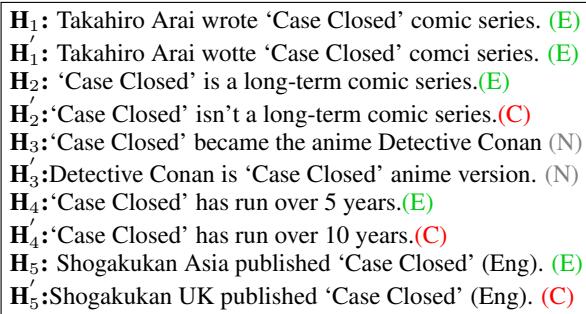 Figure 1: Examples of perturbations in the INFOTABS dataset. Notice how minor changes, like a typo in H'1 or a negation in H'2, create new “challenge” sentences.
As shown in Figure 1, a human reading these perturbed sentences can easily still understand the relationship between the table and the text. However, Language Models often struggle.
The Fragility of Fine-Tuning
You might think, “If the model is bad at typos, let’s just train it on typos.” This is called Single-Set Inoculation. The problem is that while the model might get better at handling typos, it often forgets how to handle paraphrasing or numbers. Worse, it might degrade on the original, clean dataset.
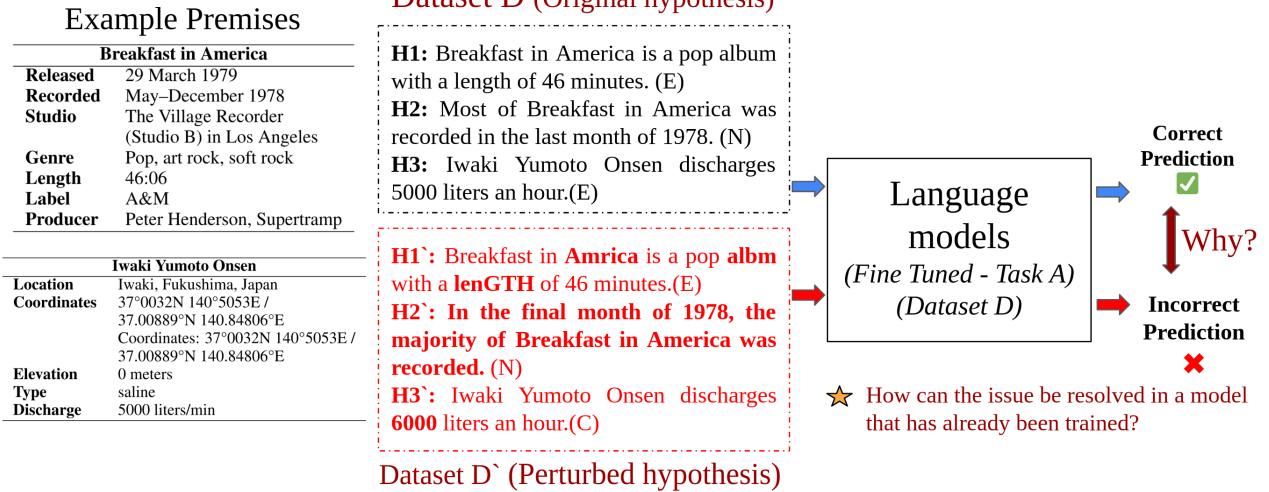 Figure 2: The Core Issue. A model fine-tuned on the original dataset (D) works well for standard hypotheses (H1, H2, H3). However, when exposed to perturbed data (D’), such as slight numeric changes or paraphrasing, the model fails (red crosses).
Figure 2 visualizes this failure mode. The central question of this research is: How can we create a single model that is robust to ALL these perturbations at the same time?
The Solution: Multi-Set Inoculation Framework
The authors introduce a framework called Multi-Set Inoculation. The goal is to fine-tune or prompt a model so that it becomes immune to multiple types of attacks (perturbations) simultaneously, without losing its original capabilities.
The approach differs depending on whether you are using a Pre-trained Language Model (PLM) like BERT/RoBERTa (which you can fine-tune easily) or a Large Language Model (LLM) like GPT-4 or LLaMA (which are often accessed via prompting).
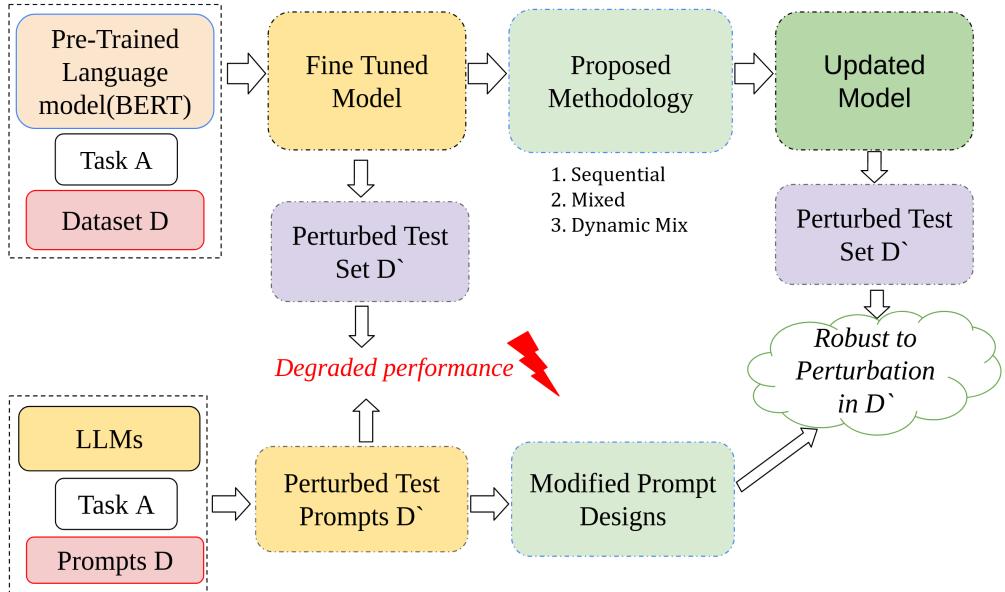 Figure 3: The high-level workflow. The top path shows fine-tuning strategies for PLMs. The bottom path shows prompt-engineering strategies for LLMs.
Part 1: Strategies for Fine-Tuning PLMs
For models like RoBERTa, where we have access to weights and can run gradients, the authors propose three training strategies to handle multiple challenge sets (P_j):
1. Sequential Training (SEQ)
This is the intuitive approach: Train the model on Typos, then train it on Negation, then on Numbers, and so on.
- The Risk: This often leads to Catastrophic Forgetting. By the time the model finishes learning about Numbers, it may have overwritten the weights that helped it understand Typos.
2. Mixed Training (MIX)
In this strategy, samples from all different challenge sets (Typos, Negation, Numbers, etc.) are tossed into a single “salad bowl” combined dataset. The model is fine-tuned on this aggregate mix.
- The Theory: By seeing all perturbations effectively at once, the model learns a generalized robustness without overwriting previous knowledge.
3. Dynamic Mix-Training (DYNMIX)
This is a smarter version of MIX. Instead of taking an equal number of examples from each set, the authors sample inversely proportional to the model’s baseline performance.
- How it works: If the baseline model is terrible at Negation but okay at Typos, DYNMIX will include more Negation examples and fewer Typo examples in the training set. It forces the model to focus on its weak points.
Part 2: Strategies for LLMs (Prompting)
Fine-tuning massive models like GPT-4 or LLaMA-70B is computationally expensive and sometimes impossible via API. Therefore, the authors devised prompting strategies to achieve similar robustness.
Zero-Shot vs. Few-Shot
- Zero-Shot (\(OP_{ZS}\)): You simply give the model the instructions and the table.
- Few-Shot with CoT (\(OP_{COT}\)): You give the model instructions plus a few examples (exemplars) that include a “Chain of Thought”—a reasoning step explaining why the answer is true or false.
Advanced Prompting Strategies
To handle perturbations, the authors introduced two specific prompt structures:
- Single Exemplar Multiple Prompts (SEMP): You create a specific prompt for each perturbation type. If you are testing for typos, you give the model examples of typos.
- Multiple Exemplars Single Prompt (MESP): This is the “robust” approach. The prompt includes instructions and examples for all perturbation types at once.
- MESP-MPI (Instructional): Focuses on detailed descriptions of what the perturbations are (e.g., explaining to the model what a “numeric typo” looks like).
- MESP-MPE (Exemplar): Focuses on showing more examples of different perturbations rather than lengthy descriptions.
Experiments and Results
The researchers tested these strategies on the InfoTabs dataset. Let’s look at what they found.
1. Fine-Tuning Results (RoBERTa)
The experiments on RoBERTa revealed a clear winner. Mixed Training (MIX) significantly outperformed the Sequential method.
- Sequential Failure: As predicted, sequentially training on different sets caused the model to forget previous ones. If the model learned “Negation” last, its performance on “Typos” dropped.
- The Power of Mixing: The MIX strategy provided concurrent robustness. It improved performance across almost all challenge sets.
- Dynamic vs. Static: Interestingly, while DYNMIX (weighted sampling) was effective, it performed roughly on par with standard MIX. This suggests that simply exposing the model to a diverse “diet” of errors is the most critical factor, more so than the exact ratio of that diet.
2. LLM Results (GPT-3.5, LLaMA-2)
The results for Large Language Models highlighted the importance of Context and Chain of Thought (CoT).
- Vulnerability: Even massive models like GPT-3.5 and LLaMA-2 are sensitive to perturbations in Zero-Shot settings. They are not inherently robust.
- The “Priming” Effect: One of the most fascinating findings was that explaining one type of perturbation (e.g., “Watch out for typos”) actually helped the model handle other types of perturbations (e.g., Negation). It seems that warning the model about errors puts it into a more “vigilant” mode of processing.
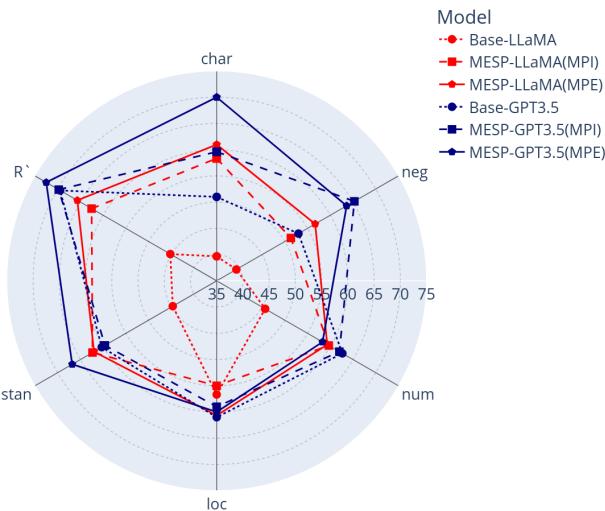 Figure 4: Radar chart comparing robustness of base models vs. MESP prompting. The colored lines represent different models (LLaMA vs. GPT-3.5) and strategies. Notice how the MESP strategies (the wider polygons) generally encompass a larger area, indicating better performance across the five axes (char, neg, num, loc, stan).
As shown in Figure 4, the MESP (Multiple Exemplars Single Prompt) strategy yields the most robust performance. Specifically, MESP-MPE (showing more examples) tended to outperform MESP-MPI (giving detailed instructions).
Key Takeaway for Prompt Engineering: It is better to show the LLM many different ways data can be messy (exemplars) than to just tell it to be careful (instructions).
Conclusion & Implications
This paper makes a compelling case for Multi-Set Inoculation. In the real world, data is rarely clean. Users make typos, they use slang, and they phrase questions in unexpected ways. A model that is only robust to one type of noise is not truly robust.
Here are the major takeaways for students and practitioners:
- Don’t rely on standard training: Standard fine-tuning does not guarantee robustness against noise.
- Mix your training data: If you are fine-tuning a BERT/RoBERTa model, do not train on edge cases sequentially. Mix your edge cases into a diverse training set.
- Prompt with variety: If you are using LLMs, your system prompt should include diverse examples of potential input errors. “Few-shot” prompting with noisy examples acts as a vaccine, preparing the model for the messiness of real-world deployment.
By understanding and applying these inoculation strategies, we can build NLP systems that are not just intelligent, but resilient.