](https://deep-paper.org/en/paper/2311.09210/images/cover.png)
Introduction
We are currently living in the “Golden Age” of Retrieval-Augmented Generation (RAG). If you have worked with Large Language Models (LLMs) recently, you know the drill: LLMs are incredibly smart, but they can be forgetful, outdated, or prone to confident lies—a phenomenon known as hallucination.
The industry standard solution has been RAG. The idea is simple: before the model answers a question, we let it “cheat” by looking up the answer in a digital library (like Wikipedia). We retrieve relevant documents, feed them to the model, and ask it to generate an answer based on that evidence.
But there is a flaw in this perfect plan.
What happens when the “library” hands the model the wrong book? What if the retrieved documents are irrelevant, outdated, or actively misleading? Standard RAG models are often too trusting. They are designed to squeeze an answer out of the provided context, even if that context is garbage. The result? The model hallucinates an answer based on bad information, or it ignores its own internal knowledge because it was distracted by the noisy retrieval.
In this post, we are doing a deep dive into a paper titled “Chain-of-Note: Enhancing Robustness in Retrieval-Augmented Language Models.” The researchers introduce a clever, human-like mechanism to solve this problem. Instead of blindly reading and answering, the model is taught to take notes first—critically evaluating the data before committing to an answer.

As shown in Figure 1 above, a standard model (left) sees a snippet about a song and blindly assumes it’s the answer, getting it wrong. The Chain-of-Note (CoN) model (right) reads the snippet, notes that it refers to a different song with a similar name, and correctly identifies the right answer.
Background: The Risks of “Retrieve-then-Read”
To understand why Chain-of-Note is necessary, we first need to look at how standard Retrieval-Augmented Language Models (RALMs) work.
The standard pipeline consists of two main players:
- The Retriever: A system that hunts through a massive database (like Wikipedia) to find documents related to your query.
- The Reader (Generator): The LLM that takes your query and the retrieved documents to formulate an answer.
Mathematically, the model tries to maximize the probability of the correct answer \(y\), given the input \(x\) and the retrieved documents \(d\). It looks something like this:
\[ p(y|x) = \sum p(y|d, x)p(d|x) \]In plain English: “The answer depends on what the question is, and what the documents say.”
The Problem: The “Gullible” Reader
The issue arises when the Retriever fails. Search engines aren’t perfect. If you ask a complex question, the retriever might return 5 documents that look relevant because they share keywords, but actually contain nothing useful.
Standard models suffer from Surface-Level Processing. They see keywords and immediately try to stitch them into a sentence. They lack a “filtering” step. If you give a standard RAG model a document about “Apple (the fruit)” when asking about “Apple (the tech company),” it might try to explain how the iPhone is harvested in autumn.
This leads to two major failures:
- Noise Sensitivity: The model gets distracted by irrelevant info.
- Inability to say “Unknown”: If the answer isn’t in the documents, and the model doesn’t know it, it often makes something up rather than admitting ignorance.
The Core Method: Chain-of-Note (CoN)
The researchers propose a method that mimics how a careful human student would answer a test using an open textbook. You don’t just copy the first sentence you see. You read the passage, think about whether it actually answers the question, take a mental note, and then write your answer.
Chain-of-Note (CoN) introduces an intermediate step. The model generates sequential “reading notes” for each retrieved document. This allows it to:
- Assess relevance.
- Resolve conflicts between documents.
- Identify when the information is missing.
The Three Types of Notes
The core innovation here is not just “taking notes,” but the type of reasoning the model performs during this step. As illustrated in the architecture below, the framework handles three distinct scenarios.

Let’s break down the three paths shown in Figure 2:
1. Relevant Information (Direct Answer)
- Scenario: The retriever did its job perfectly. The document contains the exact answer.
- The Note: The model writes a note confirming the document addresses the specific question.
- The Outcome: The model extracts the answer directly.
- Example (Left Panel): Question: “When was Deadpool 2 released?” The note confirms the document gives the exact date.
2. Contextual Information (Inference)
- Scenario: The document doesn’t have the exact answer, but it provides clues that, combined with the model’s internal knowledge, solve the puzzle.
- The Note: The model notes the context and connects the dots.
- The Outcome: The model infers the answer.
- Example (Middle Panel): Question: “Who wrote the song ‘When I was 17’?” The document mentions the song “It Was a Very Good Year.” The model realizes they are related and uses its internal training data to identify the songwriter, Ervin Drake, even though his name wasn’t explicitly in the snippet.
3. Irrelevant Information (Robustness)
- Scenario: The retriever failed. The documents are about the wrong topic entirely.
- The Note: This is the game-changer. The model explicitly writes, “This document discusses X, but the question asks about Y. This is not relevant.”
- The Outcome: The model rejects the noise. If its internal knowledge also fails, it outputs “Unknown.”
- Example (Right Panel): Question: “When is the fourth Divergent movie coming out?” The documents discuss budget cuts and the first movie. The model notes this lack of info and correctly concludes the answer is unknown.
Training the Model
How do you teach a model to take notes like this? You can’t exactly find a dataset of “notes on Wikipedia articles” lying around.
The researchers used a clever synthetic data pipeline:
- Data Collection: They took 10,000 questions from the Natural Questions (NQ) dataset.
- Teacher Model: They used GPT-4 to generate the “gold standard” reading notes for these questions. They prompted GPT-4 to act as the ideal student, creating notes that categorize documents as relevant, contextual, or irrelevant.
- Student Model: They then fine-tuned a smaller model, LLaMA-2 7B, on this synthesized dataset.
This process essentially distilled the reasoning capabilities of the massive GPT-4 into the smaller, faster LLaMA-2 model.
Hybrid Training for Efficiency
One valid criticism of “Chain-of-X” methods (like Chain-of-Thought) is that they slow things down. Generating a paragraph of notes before every answer increases latency and compute costs.
To solve this, the authors introduced a Hybrid Training Strategy.
They trained the model on a 50/50 mix of data:
- 50% of the time, the model was forced to use the Chain-of-Note format (generate notes -> answer).
- 50% of the time, the model was forced to use the Standard RALM format (generate answer directly).
Why do this? The hypothesis was that by forcing the model to explain its reasoning half the time, it would “internalize” that critical thinking process. During inference (actual use), you can just ask for the answer directly. The model, having learned the patterns of relevance detection during training, retains the robustness of CoN without the extra token generation cost.
Experiments & Results
The researchers evaluated their method against standard RALM (Retrieve-and-Read) and purely internal generation (no retrieval). They used major benchmarks like Natural Questions (NQ), TriviaQA, and WebQ.
They focused on three main metrics:
- Overall QA Performance: Does it get more questions right?
- Noise Robustness: Can it handle bad documents?
- Unknown Robustness: Can it admit when it doesn’t know?
1. Noise Robustness: The “Garbage In” Test
This was the most impressive result of the paper. To test robustness, the researchers intentionally corrupted the retrieval results. They fed the model irrelevant documents to see if it would get confused.
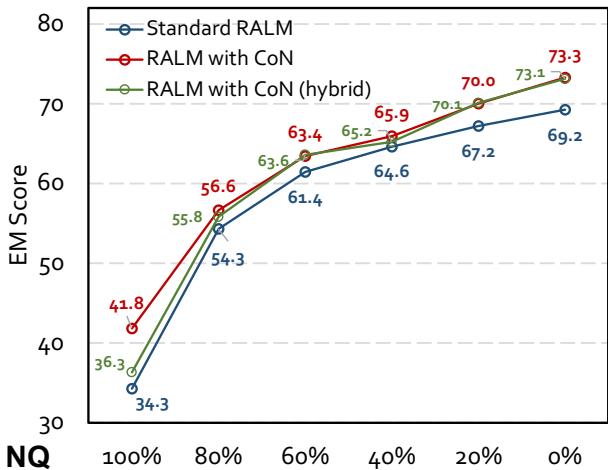
Figure 3 tells the whole story:
- The Blue Line (Standard RALM): As the noise ratio increases (moving left to right, or specifically looking at the drop when documents become irrelevant), the standard model’s performance plummets. It is easily distracted by garbage data.
- The Red Line (CoN): The performance remains remarkably stable. Even when provided with 100% noisy documents, the CoN model performs significantly better—essentially falling back on its internal knowledge rather than hallucinating based on the bad docs.
In numeric terms, on the Natural Questions dataset with 100% noisy documents, the Chain-of-Note approach improved accuracy by +7.9 points over the standard method.
2. Unknown Robustness: The “RealTimeQA” Test
The researchers also tested the model on RealTimeQA, a dataset containing questions about events that happened after the model was trained.
- Standard RALM: Often tried to force an answer based on outdated pre-training data or irrelevant retrieved snippets.
- Chain-of-Note: Achieved a +10.5 point improvement in rejection rate.
This means the CoN model was much better at saying, “I have read the documents, and I have checked my memory, and I simply do not have the answer.” For user trust, this “rejection” capability is just as important as answering correctly.
3. Comparison with Chain-of-Thought (CoT)
You might be wondering: “Isn’t this just Chain-of-Thought?”
Yes and no. Chain-of-Thought (CoT) generally asks the model to “think step-by-step.” The researchers compared CoN against standard CoT. They found that while CoT helps with logical reasoning (math, puzzles), CoN is superior for retrieval tasks.
Why? Because CoT prompts often focus on the answer generation logic. CoN focuses specifically on the document evaluation logic. It forces the model to engage with the retrieval specifically, rather than just thinking about the query.
Conclusion & Implications
The “Chain-of-Note” paper highlights a crucial evolution in how we build AI systems. We are moving away from treating LLMs as simple input-output machines and towards treating them as active reasoners that must evaluate their inputs.
Key Takeaways:
- Skepticism is a Skill: Models need to be explicitly taught to doubt their sources. Standard training assumes context is always relevant; CoN challenges that assumption.
- Notes Bridge the Gap: Writing out an intermediate evaluation (the note) allows the model to “think” before it speaks, filtering out noise and connecting disparate clues.
- Efficiency Matters: Through hybrid training, we can bake this critical thinking into the model’s weights, allowing for fast inference without sacrificing robustness.
For students and engineers building RAG systems, this paper suggests that the quality of your retrieval is only half the battle. The other half is ensuring your generator knows what to do when that retrieval inevitably fails. By implementing a Chain-of-Note architecture, we can build AI that is not just smarter, but more honest and reliable.