](https://deep-paper.org/en/paper/2311.09630/images/cover.png)
Introduction
We live in an era of information overload, but perhaps more dangerously, an era of information disorder. False claims, conspiracy theories, and pseudo-scientific advice—particularly regarding COVID-19—spread through social media networks like wildfire. While we often focus on the content of misinformation or the algorithms that amplify it, there is a third, critical component to this ecosystem: the human element.
Why does one person scroll past a conspiracy theory while another pauses, believes it, and hits the “Retweet” button? This tendency to believe in unverifiable or false claims is known as susceptibility.
Traditionally, understanding susceptibility has been the domain of psychologists using small-scale surveys. Researchers would ask participants to rate the accuracy of headlines, a process that is slow, expensive, and prone to “self-reporting bias” (where people lie to look better). But what if we could measure this hidden psychological trait computationally, on a massive scale, just by looking at how people behave online?
That is the core contribution of the paper “Decoding Susceptibility: Modeling Misbelief to Misinformation Through a Computational Approach” by researchers from Harvard, Stanford, UCLA, and Georgia Tech. They propose a novel framework to model this unobservable mental process using observable social media data. By doing so, they not only predict who might share misinformation but also uncover fascinating correlations between susceptibility and our profession, political leanings, and emotional states.
In this deep dive, we will unpack how they built this model, the mathematics behind it, and the sociopolitical insights it revealed about the United States.
Background: The Problem with Measuring Belief
Before we look at the neural networks, we have to understand the social science problem. Susceptibility is a latent variable. In statistics and social science, a latent variable is something that exists but cannot be directly observed. You can observe a fever (body temperature), but you cannot observe “sickness” directly; you infer it from the symptoms.
Similarly, you cannot open someone’s skull to read their “Susceptibility Score.” In the past, researchers relied on:
- Surveys: Asking 500 people, “Do you believe this fake headline?” (Hard to scale to millions).
- Proxies: Assuming anyone who shares a link believes it. (Flawed, because people sometimes share things to debunk them or ironically).
The authors of this paper argue that while we cannot see the belief process, we can see the results of it combined with context. People generally share information they perceive as true. Therefore, by analyzing a user’s historical behavior (what they usually talk about and how) and seeing if they share a specific piece of misinformation, we can train a model to infer that hidden susceptibility score.
The Core Method: Computational Susceptibility Modeling
The researchers developed a framework that treats susceptibility not as a static label, but as a dynamic interaction between a user and a specific piece of misinformation.
This is a crucial distinction. You might be highly susceptible to political conspiracy theories but very skeptical of medical pseudoscience. Therefore, susceptibility (\(s\)) is defined for a user (\(u\)) regarding a specific post (\(p\)).
Let’s break down the architecture they built to solve this.
1. The High-Level Architecture
The model is designed to take two inputs and produce one hidden score, which then predicts a visible behavior.
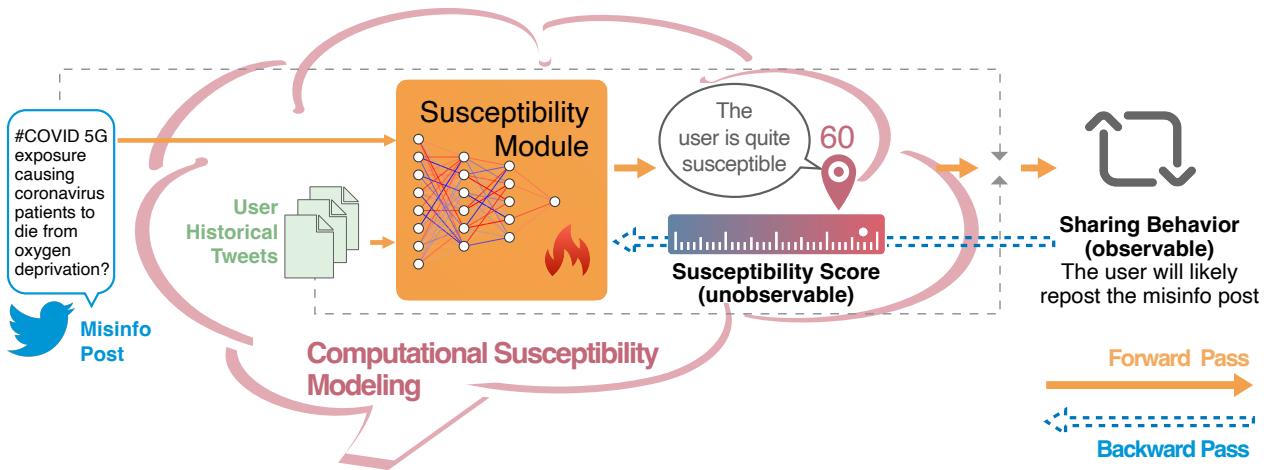
As shown in Figure 1, the process flows as follows:
- Inputs: The model ingests a “Misinfo Post” and the “User Historical Tweets” (to establish a baseline of who the user is).
- Susceptibility Module: This is the core neural network (the orange box). It processes the inputs to generate a Susceptibility Score.
- Output & Supervision: The model predicts whether the user will repost the content. It learns by comparing this prediction to what actually happened (the “Sharing Behavior”).
2. Representing Users and Content (Embeddings)
Computers cannot understand raw text like “COVID-19 is caused by 5G.” They need numbers. The researchers used SBERT (Sentence-BERT), a variation of the famous RoBERTa language model, to create “embeddings.”
- Post Embedding (\(E(p)\)): The misinformation tweet is converted into a vector (a long list of numbers) representing its semantic meaning.
- User Embedding (\(E(u)\)): This is trickier. A user is more than one sentence. The model aggregates the user’s posts from the last 10 days, converting each to a vector, and averaging them. This creates a mathematical representation of the user’s recent online persona.
3. Calculating the Latent Score
How do we get the actual number? The user and post embeddings are fed into a multi-layer neural network (the function suscep).

Here, \(s_{u,p}\) is the raw susceptibility score. To make this score interpretable for humans, the output is normalized to a range of -100 to 100.
- -100: Highly resistant to misinformation.
- +100: Highly susceptible (likely to believe and share).
4. From Belief to Behavior (The Training Signal)
This is the most innovative part of the methodology. Since the researchers didn’t have a dataset of millions of people self-reporting their beliefs, they had to use reposting behavior as a proxy for training.
However, they were careful not to equate reposting directly with susceptibility. Many factors influence a repost (e.g., social pressure, emotion, time of day). The model calculates the probability of a repost (\(p_{rp}\)) by combining the user/post compatibility with the susceptibility score.

In this equation:
- \(\sigma\) is the sigmoid function (squashing the result between 0 and 1).
- \(E(u) \cdot E(p)\) represents the general affinity between the user and the content (dot product).
- \(s_{u,p}\) acts as a weighting factor.
This structure tells the model: “Find a susceptibility score that, when combined with the content match, best explains why this user retweeted this post.”
5. Multi-Task Learning: The Loss Functions
To train the model effectively, the researchers used Multi-Task Learning. They didn’t just ask the model to predict “Yes/No” on reposting; they also asked it to learn relative rankings between users. This makes the model much more robust.
They employed a combined loss function consisting of two parts:
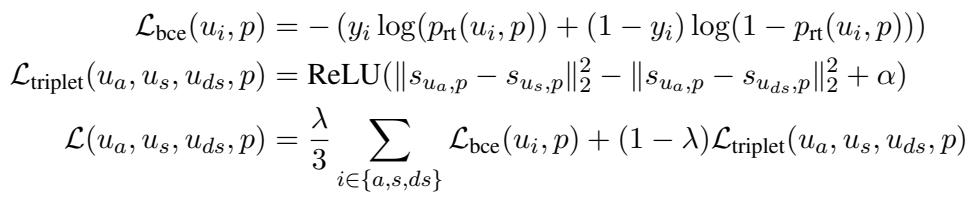
Let’s break down the two components of this equation:
Binary Classification Entropy (\(\mathcal{L}_{bce}\)): This is the standard classification loss. It asks: Did the model correctly predict that User A would repost and User B would not? It pushes the probability \(p_{rt}\) closer to 1 for reposters and 0 for non-reposters.
Triplet Loss (\(\mathcal{L}_{triplet}\)): This is often used in facial recognition, but here it is adapted for psychology. The model looks at three users at once:
- Anchor (\(u_a\)): A user who reposted the misinformation.
- Similar (\(u_s\)): Another user who also reposted it.
- Dissimilar (\(u_{ds}\)): A user who saw it but did not repost it.
The Triplet Loss forces the model to ensure that the susceptibility scores of the two reposters (\(s_{u_a}\) and \(s_{u_s}\)) are mathematically closer to each other than to the non-reposter (\(s_{u_{ds}}\)). This teaches the model to cluster susceptible users together in the numerical space.
Experiments and Results
The researchers utilized Twitter data centered on COVID-19, specifically the ANTi-Vax and CoAID datasets. They filtered for misinformation tweets and identified users who retweeted them (positive samples) and constructed “negative samples” (users who follow the poster and were active, but chose not to retweet).
1. Validation: Better than ChatGPT?
Since there is no “ground truth” (we don’t know for sure what these users truly believed), how do we know the model works?
The researchers ran a Human Judgment test. They presented human annotators with pairs of users and their timelines and asked, “Which user is more likely to believe fake news?” They then compared the human consensus against their model, a baseline cosine-similarity method, and ChatGPT (GPT-3.5).

As shown in Table 2, the proposed model achieved 72.90% agreement with human annotators.
- It significantly outperformed the baseline (63.55%).
- Notably, it outperformed ChatGPT (62.62%) in a zero-shot setting.
This suggests that the specialized embeddings and triplet-loss training allowed this smaller model to capture nuances in user history that general-purpose Large Language Models (LLMs) missed.
2. Distinguishing Susceptibility
Does the model actually assign different scores to different groups? The histogram below shows the distribution of susceptibility scores for users who retweeted misinformation (Red) versus those who did not (Blue).
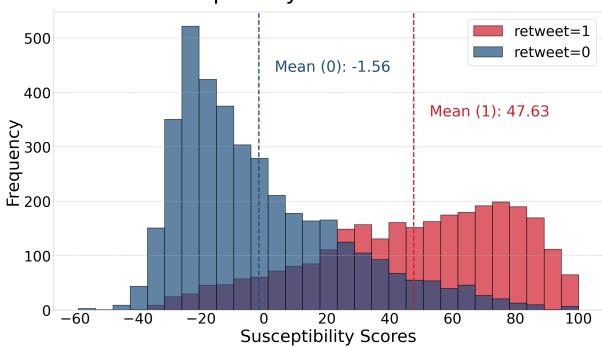
The separation in Figure 2 is stark.
- Negative Group (Blue): The mean score is -1.56. Most users who didn’t retweet are clustered around the resistant (negative) side of the scale.
- Positive Group (Red): The mean score is 47.63. Users who spread misinformation have consistently higher positive scores.
This validates the core hypothesis: the latent “susceptibility score” is a strong predictor of real-world sharing behavior.
Implications: What Drives Susceptibility?
Once the model was validated, the researchers applied it to a massive dataset of 100,000 users. This is where the computational approach shines—it allows for sociological analysis at a scale impossible for traditional surveys.
They analyzed correlations between the calculated susceptibility scores and three key areas: Psychological factors, Professional fields, and Geography.
1. Psychological Factors
Using LIWC (Linguistic Inquiry and Word Count), a text analysis program, they extracted psychological traits from users’ tweets and correlated them with their susceptibility scores.
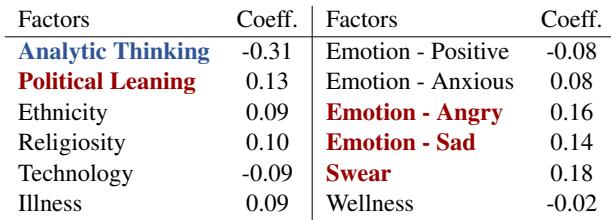
Table 3 confirms several theories from psychology literature:
- Analytic Thinking (-0.31): This is the strongest negative correlation. Users who use precise, analytical language are much less likely to be susceptible.
- Anger (+0.16) & Swearing (+0.18): High emotional arousal, specifically negative emotion and aggression, correlates with higher susceptibility.
- Anxiety (+0.08): Fear plays a role, albeit a smaller one than anger.
This paints a profile of the susceptible user: someone who engages less in analytical processing and more in emotionally charged, reactive communication.
2. Professional Backgrounds
Do our jobs protect us from misinformation? The model classified users into professional categories based on their bios.
Looking at the table in Figure 3 (Top):
- Health and Medicine (H&M): As expected, this group had very low susceptibility (-5.47). Their domain knowledge protects them.
- Education: This group was the most resistant (-7.80).
- Arts and Media: Interestingly, this group showed higher susceptibility (-0.15) compared to other professions. The authors speculate this might be due to higher emotional expressiveness or exposure to sensationalized content.
An unexpected finding was in Science and Technology (S&T). While resistant (-2.20), they were more susceptible than the Finance or Health sectors. The authors suggest a “disruptive innovation” culture might make some tech-focused individuals more open to contrarian or “alternative” narratives.
3. Geography and Politics
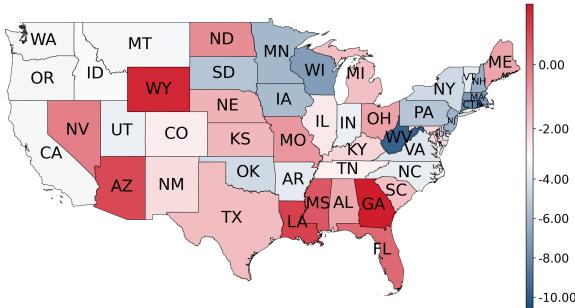
Finally, the researchers mapped the average susceptibility scores across the United States.
The map in Figure 3 (Bottom) reveals a geographic divide that mirrors the political landscape.
- Blue States: States with lower (more resistant) susceptibility scores often align with Democratic-leaning populations (e.g., Massachusetts, New York).
- Red States: States with higher (more susceptible) scores often align with Republican-leaning populations (e.g., Wyoming, West Virginia).
The average susceptibility score for users in “Blue” states was -3.66, compared to -2.82 in “Red” states. This provides large-scale empirical evidence supporting previous survey-based findings that political ideology is a significant factor in how people process scientific information, particularly regarding COVID-19.
Conclusion
The paper “Decoding Susceptibility” represents a significant leap forward in computational social science. By moving away from small surveys and toward deep learning models that infer latent traits from behavior, the researchers have given us a new lens through which to view the misinformation crisis.
Key Takeaways:
- It is possible to model the invisible: We can accurately infer a user’s susceptibility to misinformation just from their posting history.
- Context matters: The triplet loss training method shows that susceptibility is best understood as a relative ranking between users.
- Psychology scales up: The computational findings align perfectly with psychological theory—analytical thinkers are safe; angry, reactive users are at risk.
The Future & Ethics While this technology is promising for identifying vulnerable communities and designing interventions (like “pre-bunking”), the authors rightly note the ethical risks. A model that can identify gullible users could be weaponized by bad actors to target misinformation more effectively.
As we move forward, tools like this must be used responsibly—not to label or stigmatize individuals, but to understand the systemic flaws in our information ecosystem and help build a more resilient digital society.