](https://deep-paper.org/en/paper/2311.09756/images/cover.png)
Imagine sitting down to read a storybook to a four-year-old. You open “The Little Mermaid.” You read a sentence about the Sea King commanding a flood. If you want to check if the child is listening, you might ask, “Who commanded the flood?” The answer is right there in the text: The Sea King.
But if you are a teacher or an engaged parent, you know that interactive story reading is about much more than just memory recall. You want to expand the child’s understanding of the world. You might pause and ask, “Do you know what a ‘flood’ actually is?” or “What happens when too much water covers the land?”
The answer to that question isn’t in the book. It requires external, real-world knowledge.
While humans do this naturally, Artificial Intelligence struggles with it. Most existing datasets used to train AI storytellers focus on “extractive” questions—where the answer is highlighted directly in the text. This limits the AI’s ability to act as a true educational companion.
In this post, we are diving into StorySparkQA, a fascinating research paper that tackles this problem head-on. The researchers developed a novel framework to capture how education experts think, resulting in a massive dataset of over 5,000 expert-annotated Question-Answer (QA) pairs designed to teach children about the real world, not just the story world.
The Problem: The Knowledge Gap in AI Storytelling
Interactive story reading is a gold standard in early childhood education. It improves reading comprehension, vocabulary, and cultural awareness. However, it is difficult to execute well. Teachers have to identify a teachable moment, formulate a concept in their head, and ask an engaging question—all in real-time.
Recent years have seen a boom in AI-assisted storytelling systems (like StoryBuddy or TaleMate). However, these systems are built on datasets like FairytaleQA, where the answers are found strictly within the narrative.
If we want AI to help children learn about the world, we need data that bridges the gap between the story narrative and structured real-world knowledge. This is where StorySparkQA comes in.
The Solution: A Concept-Driven Annotation Framework
The researchers didn’t just ask people to “write some questions.” They recognized that recalling systematic external knowledge is hard even for experts. To solve this, they designed a structured annotation framework empowered by ConceptNet.
ConceptNet is a large-scale Knowledge Graph (KG). Think of it as a giant web of concepts connected by relationships. For example, it knows that (“apple”, “is used for”, “eating”) or (“flood”, “is a”, “natural disaster”).
The researchers used this graph to guide education experts through a three-step process to create high-quality data.

As illustrated in the figure above, the workflow is designed to mimic a teacher’s thought process but supports it with structured data. Let’s break down the three steps:
Step 1: Concept Selection
First, the system presents a section of a story to the expert. The expert identifies a “concept word” from the text that is educationally valuable for a child aged 3 to 6. The system uses Natural Language Processing (NLP) tools to highlight candidate words—usually concrete nouns, verbs, or adjectives that are appropriate for young learners.
Step 2: Knowledge Matching
This is the clever part. Once a word (like “Pickles” or “Flood”) is selected, the system queries ConceptNet. It retrieves “triples”—structured links between the concept and the outside world.
For example, if the word is Pickles, ConceptNet might suggest:
- (Pickles, is a, relish)
- (Pickles, has context of, cooking)
- (Pickles, is at location of, jar)
The system ranks these triples to find the ones most relevant and credible, then presents them to the expert. The expert selects the specific piece of real-world knowledge they want to teach.
Step 3: QA Pair Annotation
Finally, the expert writes a Question and Answer pair based on the chosen triple. The constraint is that the QA pair must incorporate the relationship from the triple. This ensures the question is grounded in facts but conversational in tone.
For instance:
- Story Text: “…The nanjiu is also called the Jewel of the Flood Tide…”
- Concept: Flood
- Triple: (flood, has subevent, fill)
- Question: What is a flood?
- Answer: A flood is when an area is filled with too much water.
What Makes StorySparkQA Unique?
The result of this process is a dataset of 5,868 QA pairs across 278 children’s books. But how does this compare to what was already available?
Most existing datasets rely on crowd-sourced workers (non-experts) and focus on reading comprehension. StorySparkQA relies on education experts and focuses on knowledge expansion.
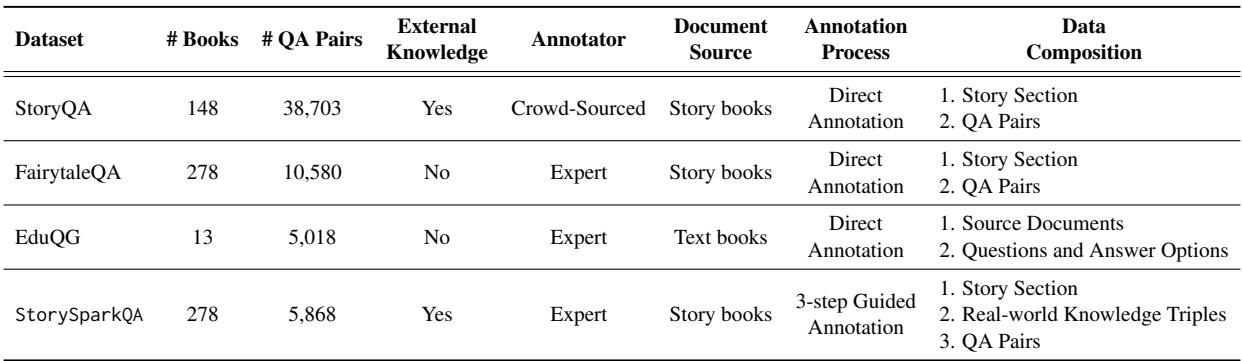
As shown in the table above, StorySparkQA is unique because it includes external knowledge explicitly in the loop. It doesn’t just give you the question and answer; it provides the triple (the structured logic) behind the question. This helps models understand why a question was asked.
What Kind of Knowledge is Included?
The researchers analyzed the types of relationships the experts selected.
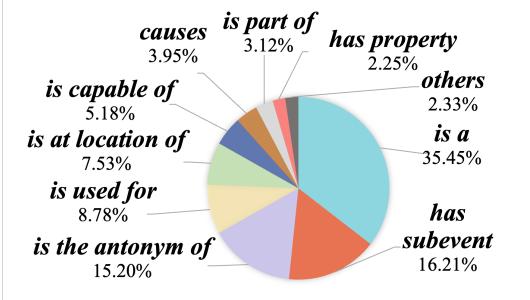
The dominance of the “is a” relation (e.g., a dog is an animal) aligns perfectly with developmental psychology. Children aged 3-6 are in a stage of rapid vocabulary acquisition and categorization. They are constantly asking “What is that?” questions. The dataset reflects this genuine educational need.
Experiments: Can AI Learn to Teach?
The researchers wanted to validate their dataset. They set up a task called Question Answer Generation (QAG). The goal: Give an AI model a section of a story and ask it to generate an educational QA pair that uses external knowledge.
They compared several models:
- Large Language Models (LLMs): GPT-3.5, GPT-4, Llama 2, Mistral, and Alpaca. These were tested in “Zero-shot” (no examples) and “Few-shot” (given a few examples) modes.
- Fine-Tuned Model: A T5-Large model (which is much smaller than GPT-4) was fine-tuned specifically on the StorySparkQA training data.
Automated Evaluation Results
The models were evaluated on how closely their generated questions matched the expert-written ones (using metrics like Rouge-L and SBERT).
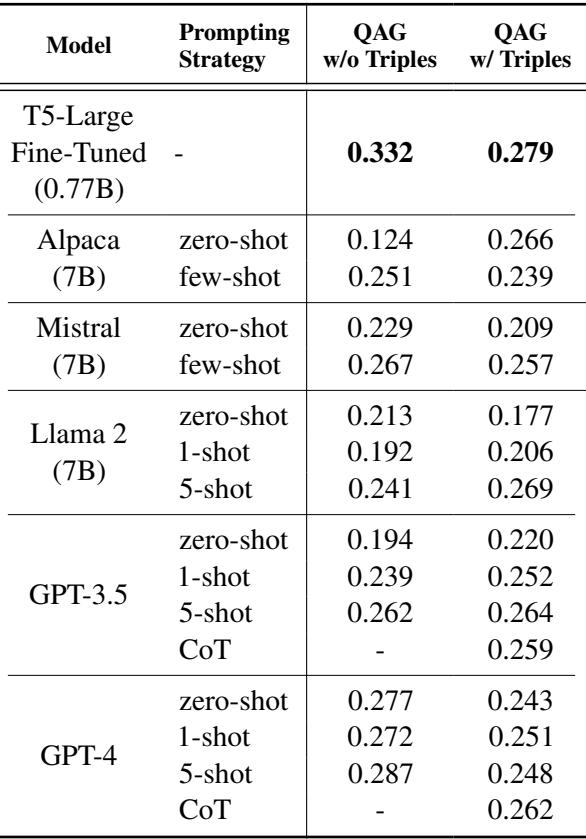
The results were revealing. The Fine-Tuned T5-Large model often outperformed significantly larger models like Llama 2 and matched or beat GPT-3.5/4 in semantic similarity metrics (Rouge-L).
Notice in the table that GPT-4 performed well with “Few-Shot” prompting, but the much smaller, specialized T5 model held its own. This highlights a critical lesson in AI: Domain-specific data often trumps raw model size. A small model trained on high-quality, expert-annotated data can be more effective for a specific task than a general-purpose giant.
Human Evaluation: The True Test
Automated metrics like “Rouge” only check text overlap. They can’t tell you if a question is actually good for a child. So, the researchers hired education experts to blindly review the AI-generated questions.
They rated questions on four criteria:
- Grammar Correctness
- Answer Relevancy
- Contextual Consistency (Does it fit the story context?)
- Educational Appropriateness (Is it good for a 3-6 year old?)
The Verdict: While GPT-4 scored slightly higher on grammar (it speaks very smoothly), the Fine-Tuned T5-Large model won on Educational Appropriateness.
Experts found that GPT-4 sometimes used vocabulary that was too advanced or created sentence structures too complex for preschoolers. The T5 model, having “studied” the expert annotations in StorySparkQA, mimicked the simpler, more pedagogically sound style of the human teachers.
Broader Implications and Conclusion
The StorySparkQA paper makes a compelling contribution to the field of AI in education. It demonstrates that we cannot simply rely on generic Large Language Models to teach our children. To be effective, AI needs:
- Structured Knowledge: Integrating resources like ConceptNet ensures the AI isn’t just hallucinating facts but is grounded in real-world relationships.
- Expert Guidance: Datasets annotated by domain experts (teachers) are superior to general crowd-sourced data for specialized tasks.
- The Right Data: A smaller model trained on the right data can outperform a massive model on the wrong data.
By releasing this dataset, the researchers have opened the door for new educational tools—digital reading companions that can pause, look a child “in the eye,” and ask, “Do you know what a flood is?” just like a teacher would.
This brings us one step closer to AI that doesn’t just read to children, but helps them read the world.