](https://deep-paper.org/en/paper/2312.02971/images/cover.png)
Solving the Ghosting Problem: How to Reconstruct Images from Multiplexed Single-Photon Detectors
Imagine trying to take a picture in near-total darkness, where light is so scarce that you are counting individual particles—photons—as they hit the sensor. This is the realm of single-photon detectors. These devices are revolutionizing fields ranging from biological imaging and Lidar to quantum optics.
Among these, Superconducting Nanowire Single-Photon Detectors (SNSPDs) are the gold standard. They offer incredible efficiency and precision. However, they have a major scaling problem: they need to be cooled to cryogenic temperatures. If you want a megapixel camera, you can’t easily run a million wires out of a deep-freeze cryostat without introducing too much heat.
To solve this, engineers use readout multiplexing, a clever wiring scheme that reduces the number of required cables. But this hardware fix introduces a new software problem: ambiguity. When multiple photons hit the sensor at once, the wiring creates “ghost” signals, making it impossible to know exactly where the photons landed.
In a fascinating paper titled Image Reconstruction from Readout-Multiplexed Single-Photon Detector Arrays, researchers from Boston University propose a sophisticated computational method to solve this puzzle. By treating image formation as a probabilistic inverse problem, they have developed a “Multiphoton Estimator” that can untangle these ghostly signals, producing sharper images faster than conventional methods.
In this post, we will break down the problem of readout multiplexing, explain the mathematics behind the new estimator, and explore how this approach pushes the boundaries of low-light imaging.
The Hardware Bottleneck: Why Multiplex?
To understand the solution, we first need to understand the hardware constraint. In a standard digital camera, every pixel can be read out individually. In a superconducting array, running a dedicated wire to every pixel is thermally impossible for large arrays.
A common solution is Row-Column Multiplexing. Instead of reading every pixel (\(n^2\) wires), you only read the rows and the columns (\(2n\) wires).
- If a photon hits pixel \((2, 3)\), the readout says “Row 2 fired” and “Column 3 fired.”
- By crossing these lines, we know the photon hit \((2, 3)\).
This works perfectly—as long as photons arrive one by one.
The Ambiguity Problem
The trouble starts when the light gets brighter. If two photons arrive simultaneously at different locations, the readouts become ambiguous.
Consider a simple \(2 \times 2\) pixel array.
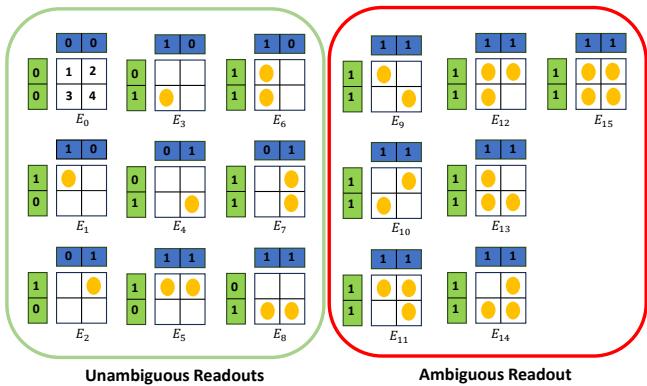
As shown in Figure 2 above, look at the events in the red box (Events \(E_9\) through \(E_15\)). If the readout says Row 1 & 2 fired and Column 1 & 2 fired, we have a problem. This readout could be caused by:
- Photons at \((1,1)\) and \((2,2)\).
- Photons at \((1,2)\) and \((2,1)\).
- Photons at three of the corners.
- Photons at all four corners.
The hardware gives us the same signal for all these distinct physical events. This is the ill-posed inverse problem.
Conventional Solutions and Their Flaws
Historically, researchers have used two main strategies to deal with this, both of which are suboptimal:
- The Naive Estimator: This method assumes that every intersection of a fired row and column contains a photon. If Rows 1/2 and Columns 1/2 fire, it assumes 4 photons hit. This creates “ghost images”—phantom photons that never existed—resulting in high bias.
- The Single-Photon Estimator (SPE): This method is conservative. It simply throws away any frame where more than one row or column fires. It only trusts unambiguous data. While this removes the ghosting (bias), it discards a massive amount of data, leading to high noise (variance), especially when the light source is bright.
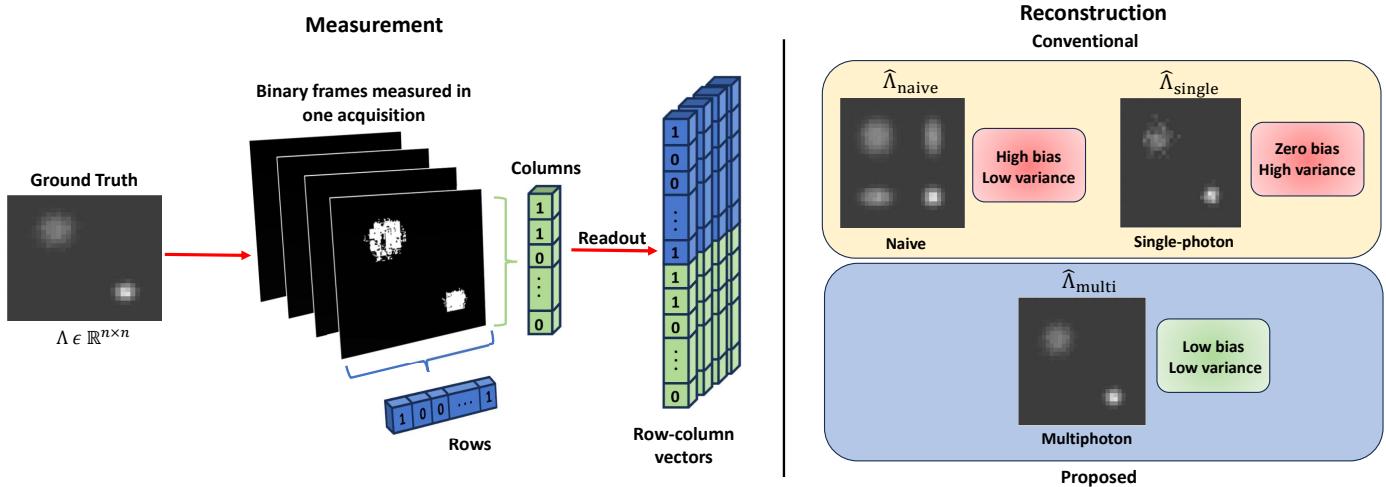
Figure 1 illustrates this trade-off. The “Naive” image is smooth but has artifacts (ghosts). The “Single” image is accurate but incredibly grainy because it threw away most of the light. The “Proposed” method aims for the best of both worlds.
The Core Method: The Multiphoton Estimator
The researchers’ contribution is the Multiphoton Estimator (ME). Instead of discarding ambiguous frames or guessing blindly, the ME uses a probabilistic framework to resolve the spatial locations of photon incidences.
1. Modeling the Flux
First, the system is modeled mathematically. The number of photons arriving at a pixel \((i,j)\) follows a Poisson distribution based on the light intensity (flux) \(\Lambda_{ij}\):

However, single-photon detectors effectively saturate with one photon (they are binary). So, we look at the probability \(q_{ij}\) that a pixel detects at least one photon:
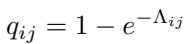
Our goal is to estimate this \(q_{ij}\) for every pixel to reconstruct the image \(\Lambda\).
2. The Readout Logic
The row (\(R\)) and column (\(C\)) readouts are binary vectors. A row \(R_i\) returns 1 if any pixel in that row detects a photon.

3. Solving the Inverse Problem
The researchers formulated the likelihood of observing a specific set of readouts. For unambiguous frames, this is easy. For ambiguous frames, the likelihood involves a sum of probabilities of all possible events that could have caused that readout.
The naive estimator calculates probability by averaging the intersection of rows and columns:
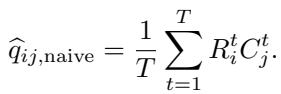
This math confirms why the naive method fails: it blindly correlates rows and columns.
The proposed Multiphoton Estimator takes a smarter approach. It uses an approximate maximum likelihood method. It works in two stages:
- Initial Guess: It calculates the Single-Photon Estimator (SPE) first. Since the SPE is unbiased (it never lies, it just doesn’t talk much), it provides a rough, noisy map of where the image structure actually is.
- Redistribution: It uses that initial map to assign probabilities to the ambiguous frames.
If an ambiguous frame says “Corners fired,” and the initial map says “The top-left and bottom-right are bright, but the others are dark,” the algorithm attributes the ambiguous photons to the bright pixels.
The likelihood of the observations is split into two parts: \(U(q)\) for unambiguous frames and \(A(q)\) for ambiguous ones.

The term \(A(q)\) is complex because it lumps together many possible events (like \(E_9\) through \(E_{15}\) in Figure 2).

To solve this, the researchers calculate conditional probabilities (\(g\)) for each event. For example, \(g_9\) is the probability that event \(E_9\) occurred, given we saw an ambiguous readout. They estimate these \(g\) values using the “safe” single-photon data (\(\hat{q}^s\)).

Finally, they combine these weighted probabilities to update the count for every pixel. The formula for the estimated probability (\(\hat{q}^a\)) involves taking the unambiguous counts (\(M_1, M_5...\)) and adding a weighted fraction of the ambiguous counts (\(M_9\)).
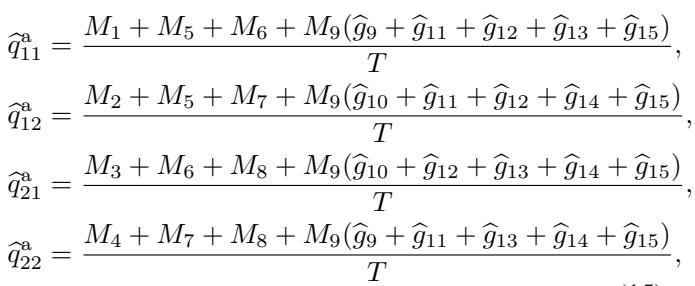
In simple terms: The algorithm doesn’t throw away the ambiguous data. It looks at the “clean” data to learn the scene’s shape, then statistically distributes the “messy” data into that shape to improve the signal-to-noise ratio.
While the math above is for a \(2 \times 2\) case, the paper extends this logic to handle coincidences of up to 4 photons simultaneously.
Experiments and Results
The researchers validated their method using Monte Carlo simulations on \(32 \times 32\) images (matching the size of current prototype SNSPD arrays).
1. Visual Reconstruction Quality
The visual improvements are striking.
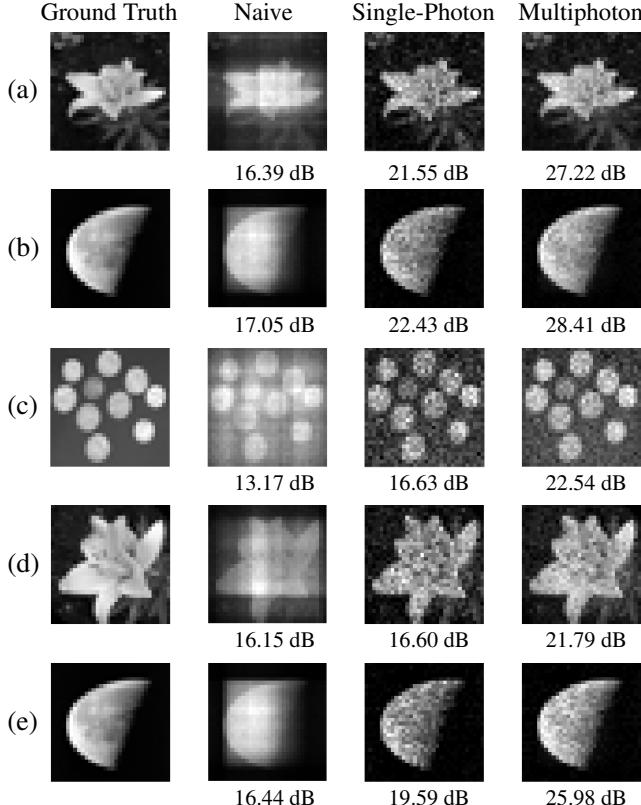
In Figure 3, compare the columns:
- Naive: Note the horizontal and vertical streaks in the flower (Row a) and the moon (Row b). These are misattributed photons.
- Single-Photon: The streaks are gone, but the image is grainy and faint features are lost.
- Multiphoton (Proposed): The petals of the flower and the shape of the moon are distinct and smooth. The Peak Signal-to-Noise Ratio (PSNR) improves by 6 to 11 dB over the naive method and 4 to 6 dB over the single-photon method.
2. Handling Brighter Light (Optimal Flux)
One of the biggest advantages of the Multiphoton Estimator is that it allows the detector to operate at higher light intensities (flux).
In single-photon imaging, you usually have to keep the light very dim to avoid “pile-up” or ambiguity. But dim light means slow imaging.
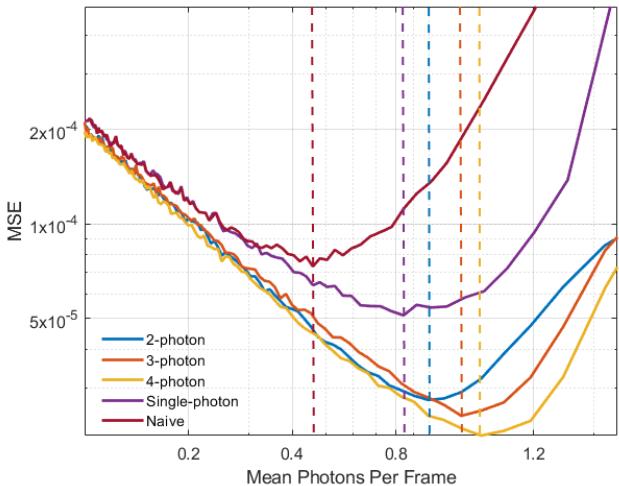
Figure 4 shows the Mean-Squared Error (MSE) as the brightness (Mean Photons Per Frame) increases.
- The Naive estimator (red) always has high error due to bias.
- The Single-photon estimator (purple) works well at low light but fails quickly as light increases (because it starts throwing away almost all the frames).
- The Multiphoton estimators (orange/yellow) achieve the lowest error and work effectively at nearly double the flux of the conventional methods (optimal point around 1.4 photons per frame vs 0.8).
3. Bias and Variance Analysis
To understand why the error is lower, we can look at the bias and variance decomposition.
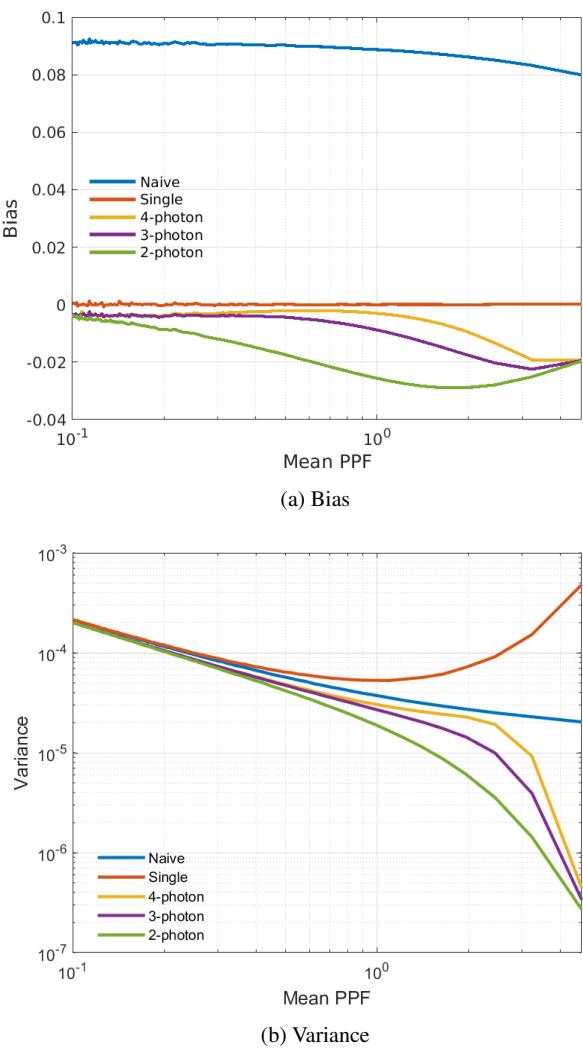
Figure 9 confirms the theory:
- Plot (a) Bias: The Naive method (blue) is positively biased (ghosts). The Multiphoton method (yellow) keeps bias near zero.
- Plot (b) Variance: The Single-photon method (orange) has massive variance at higher flux. The Multiphoton method keeps variance low by utilizing the data that the other method discards.
4. Speed (Integration Time)
Because the Multiphoton Estimator uses more of the incoming light, it converges to a good image much faster.
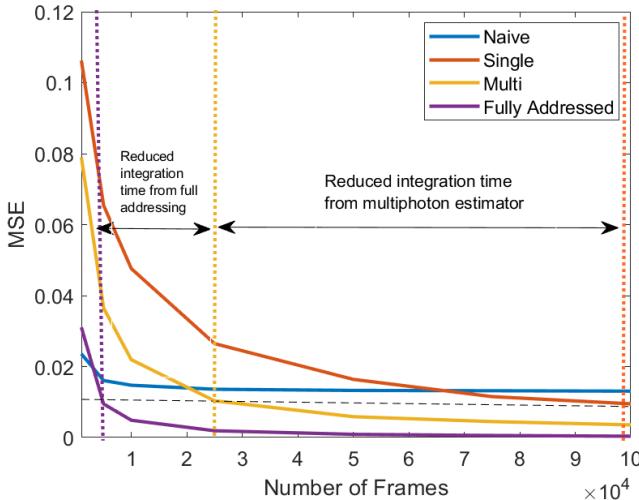
Figure 6 shows that to reach a specific image quality (MSE = 0.01), the Single-photon method needs 100,000 frames. The Multiphoton method needs only about 25,000 frames. This 4x speedup is critical for applications like Lidar or video, where latency matters.
5. Theoretical Limits (Cramér-Rao Bound)
Finally, the researchers compared their method against the Cramér-Rao Bound (CRB), which represents the theoretical limit of precision for any unbiased estimator.
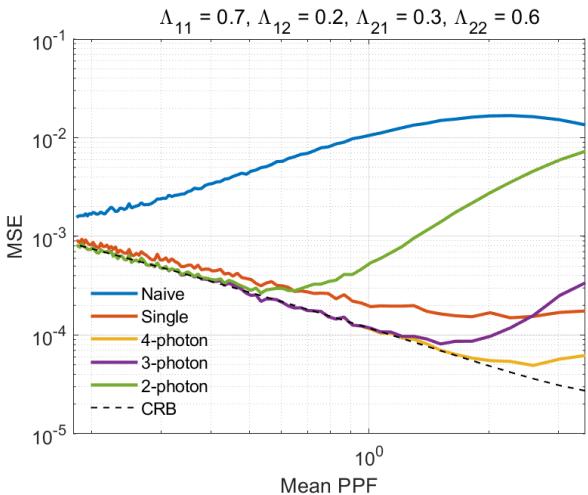
As shown in Figure 7, the 4-photon estimator tracks the theoretical limit almost perfectly across a wide range of light intensities. This suggests that there isn’t much more performance to be squeezed out of this specific hardware setup—the algorithm is nearly optimal.
Scaling Up and Future Implications
While the demonstrations focused on \(32 \times 32\) arrays, the researchers analyzed how the method scales.
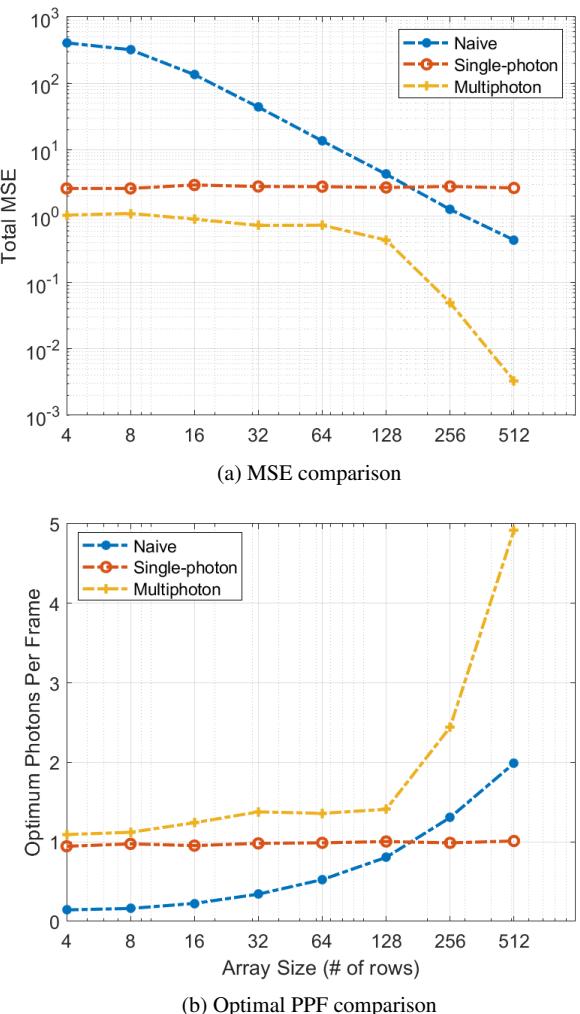
Figure 8 shows that as arrays get larger (up to 512 rows), the Multiphoton Estimator becomes even more valuable compared to the naive approach. This is promising for the development of commercial-scale superconducting cameras.
Conclusion
The “hardware problem” of wiring up superconducting detectors led to a “software opportunity.” By refusing to treat ambiguous data as garbage, the researchers demonstrated that we can recover high-quality images from multiplexed arrays.
This work turns a weakness into a strength. It allows for:
- Higher photon counts: You don’t need to dim the lights as much.
- Faster imaging: You can capture scenes with 4x fewer frames.
- Scalable hardware: We can build larger arrays without melting the cryostat.
For students and engineers in optical imaging, this paper is a masterclass in how probabilistic modeling can overcome physical limitations, proving that sometimes the best way to improve a camera is to upgrade the math, not just the sensor.