](https://deep-paper.org/en/paper/2401.04700/images/cover.png)
Large Language Models (LLMs) like LLaMA and GPT have revolutionized how we interact with information. However, they have a persistent flaw: their knowledge is static. If a model was trained in 2020, it believes the world froze in that year. When the President of the United States changes, or a new scientific discovery is made, the model remains blissfully ignorant, often hallucinating outdated answers.
Retraining these massive models from scratch for every new fact is prohibitively expensive and slow. Enter Model Editing—a technique designed to surgically update specific facts within a model’s neural network without a full retrain. It sounds like the perfect solution: efficient, targeted, and fast.
But, as explored in the paper Model Editing Harms General Abilities of Large Language Models, there is no such thing as a free lunch. The researchers reveal a critical vulnerability: while model editing successfully updates facts, it can silently destroy the model’s general reasoning capabilities.
In this post, we will dissect why this happens, visualize the damage, and explore RECT, a novel regularization method proposed by the authors to rescue the model’s intelligence.
The Promise and the Peril of Model Editing
Model editing aims to alter the behavior of a model \(f_\theta\) to a new state \(f_{\theta_e}\) where it correctly answers a specific query (like “Who is the US President?”) while—theoretically—leaving everything else untouched.
Evaluation of these methods usually focuses on three metrics:
- Reliability: Does the model learn the new fact?
- Generalization: Can it answer rephrased versions of the new fact?
- Locality: Does it refrain from changing unrelated facts?
However, the researchers argue that these metrics are insufficient. They miss the forest for the trees. By focusing only on the edited knowledge, we ignore the general abilities of the model.
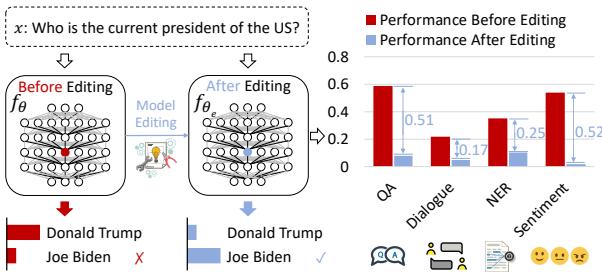
As shown in Figure 1 above, a model might successfully learn that “Joe Biden” is the president (indicated by the checkmark). But look at the graph on the right. After the edit, performance on tasks like Question Answering (QA), Dialogue, Named Entity Recognition (NER), and Sentiment Analysis drops significantly. The red bars (before editing) are high; the blue bars (after editing) show a clear degradation.
The core problem is that LLMs are tightly interconnected systems. Tugging on one thread (a specific fact) often unravels the entire tapestry (general reasoning capabilities).
Investigating the Side Effects
To understand the scale of this problem, the authors conducted a systematic stress test. They applied four popular editing methods—KN, MEND, ROME, and MEMIT—to three different LLMs (GPT-2 XL, LLaMA-1, and LLaMA-2).
They tested these models in different editing configurations to simulate real-world usage:
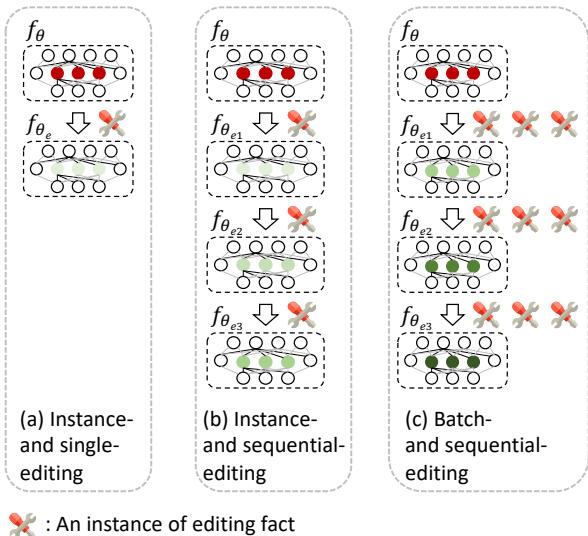
- Single Editing: Changing one fact at a time.
- Sequential Editing (Figure 2b): Ideally, an LLM should be able to learn continuously. This setting involves making multiple edits one after another.
- Batch Editing (Figure 2c): Updating hundreds or thousands of facts simultaneously.
The Collapse of General Intelligence
The results were stark. When the researchers tested the edited models on general tasks—such as solving math word problems (GSM8K) or summarizing text (SAMSum)—they observed a catastrophic drop in performance.

Figure 3 illustrates the impact of Sequential Editing. The X-axis represents the number of edits performed, and the Y-axis represents performance on various tasks (colored lines).
- Left (GPT-2 XL with KN): With just a single edit using the Knowledge Neurons (KN) method, performance on almost all tasks crashes to near zero. This suggests that some editing methods are incredibly destructive to the model’s weights.
- Right (LLaMA-1 with ROME): The ROME method is more stable, but notice the downward trend. As you sequentially edit the model (moving from 0 to 40 edits), reasoning (brown line) and QA capabilities (blue line) steadily decay.
This confirms the hypothesis: Current editing algorithms struggle to improve factuality without compromising the model’s fundamental intelligence.
Diagnosis: Why Does Editing Hurt?
Why does teaching a model that “The Eiffel Tower is in Paris” make it forget how to summarize a conversation?
The researchers posit that the side effects stem from overfitting. When an editing method forces a new fact into the parameters, it often alters the original model weights too aggressively. The method is “trying too hard” to minimize the loss for that specific fact, introducing noise into the delicate weight matrices that the model uses for general reasoning.
Visualizing the Weight Damage
To prove this, the authors analyzed the Relative Change in Weight (\(\delta\)). This metric measures how much the update matrix (\(\Delta W\)) differs from the original weight matrix (\(W\)).
\[ \delta = \left| \frac{\Delta W}{W} \right| \]If \(\delta\) is high, the edit is making massive changes relative to the original parameters.
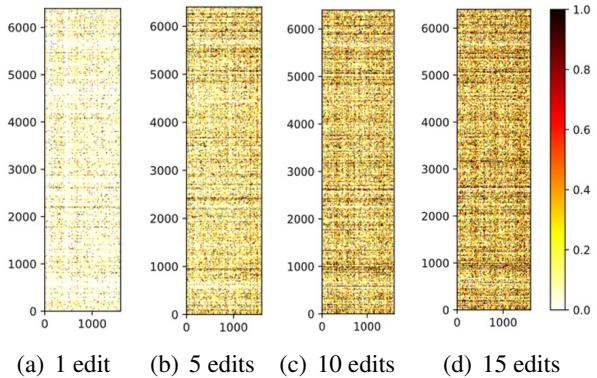
Figure 5 shows heatmaps of the weight changes as the number of edits increases (from 1 edit in ‘a’ to 15 edits in ’d’).
- Observation: The update weights are sparse (mostly empty), but the changes accumulate.
- The Trend: As more edits are performed (moving from a to d), the heatmap becomes “hotter” (more red/orange).
This accumulation of weight perturbations distorts the model’s learned representations. The model begins to overfit to the specific edited examples, effectively “memorizing” the new facts at the expense of the complex patterns required for reasoning and logic.
The Solution: RECT (RElative Change in weighT)
The analysis reveals that not all changes in the update matrix (\(\Delta W\)) are necessary. Many of the small, noisy updates contribute to overfitting without significantly helping the model remember the fact.
To solve this, the authors propose a regularization method called RECT.
How RECT Works
The intuition behind RECT is simple: Simplicity prevents overfitting. Instead of applying the full, noisy update matrix generated by methods like ROME or MEMIT, RECT filters the update to keep only the most significant changes.
In a standard edit, the new weight \(\overline{W}\) is calculated as:
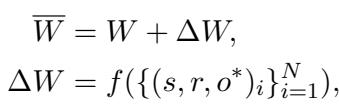
where \(\Delta W\) is the update calculated by the editing algorithm.
RECT introduces a constraint. It looks at the relative change (\(\delta\)) of every element in the update matrix. It assumes that the elements with the largest relative changes are the “principal” editing information—the core logic needed to update the fact. The rest is treated as noise.
RECT keeps the top \(k\%\) of elements with the highest \(\delta\) and sets the rest to zero.
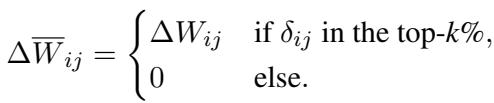
Here, \(\Delta \overline{W}_{ij}\) is the regularized update. If the change is in the top \(k\%\), it stays. Otherwise, it effectively becomes zero.
Visualizing the Fix
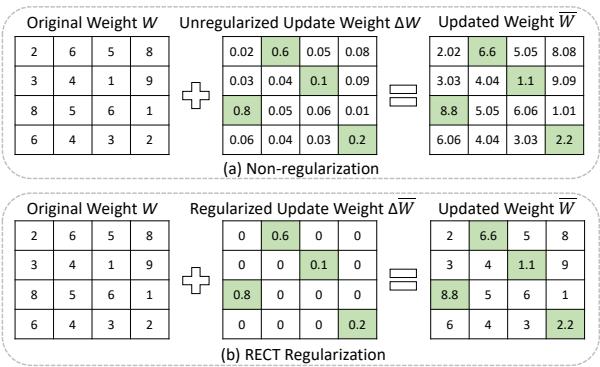
Figure 6 provides a clear matrix comparison:
- (a) Non-regularization: The update matrix \(\Delta W\) is full of values (0.02, 0.6, 0.03, etc.). When added to the original weights, every single parameter shifts slightly.
- (b) RECT Regularization: RECT identifies the “important” updates (highlighted in green, e.g., 0.6, 0.8). It zeroes out the minor values (0.02 becomes 0). The resulting update is sparse and targeted.
By preventing the model from making thousands of tiny, unnecessary adjustments, RECT preserves the integrity of the original pre-trained weights.
Does RECT Work? Experimental Results
The researchers evaluated RECT on two fronts:
- Does it still work as an editor? (Does the model remember the fact?)
- Does it save general abilities? (Does the model still know how to reason?)
1. Preserving Editing Performance
One might worry that “deleting” parts of the update matrix would break the edit. However, the results show otherwise.
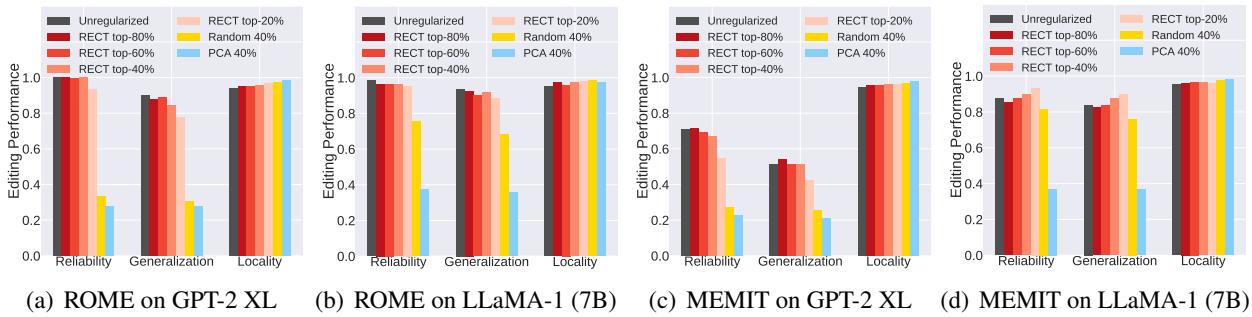
In Figure 7, we see the editing performance (Reliability, Generalization, Locality) for different regularization strategies:
- Grey Bar: Unregularized (Standard ROME/MEMIT).
- Red/Pink/Orange Bars: RECT at different thresholds (Top-20%, 40%, 60%, 80%).
Key Finding: RECT (specifically the Top-40% or Top-60% settings) maintains over 94% of the reliability and generalization compared to the unregularized version. In some cases (Locality), it even improves performance because it removes noise that might trigger unrelated facts.
2. Rescuing General Abilities
This is the most critical result. Does RECT stop the degradation of reasoning skills?
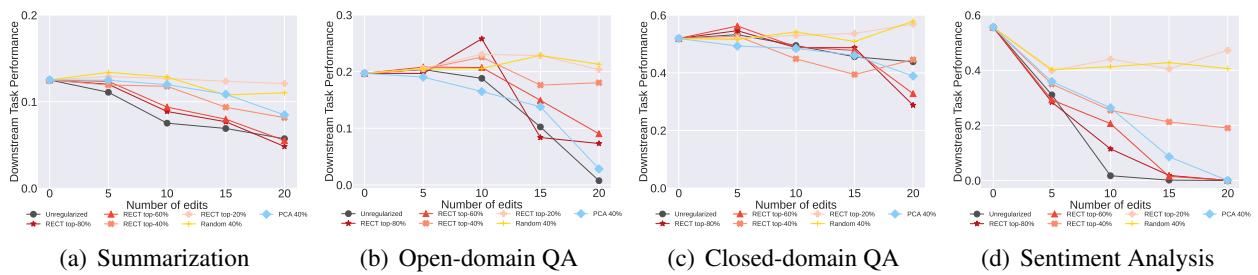
Figure 8 plots the performance on general tasks (Summarization, QA, Sentiment Analysis) as the number of edits increases (X-axis).
- The Black Line (Unregularized): This represents the standard editing method. Notice how it nosedives as the number of edits increases. The model is losing its general intelligence.
- The Colored Lines (RECT): The lines for RECT (especially Top-20% and Top-60%) remain much flatter. They resist the downward trend.
For example, in Summarization (a) and Open-domain QA (b), the unregularized model collapses after about 10-15 edits. The RECT-regularized models continue to perform at a high level.
By simply constraining the complexity of the weight updates, RECT allows us to inject new knowledge into an LLM while acting as a shield for its existing capabilities.
Conclusion
The ability to edit Large Language Models is a prerequisite for their long-term viability; we cannot afford to retrain a 70-billion parameter model every time the news changes. However, this paper highlights a danger that has been largely overlooked: hyper-focusing on factuality can degrade general intelligence.
The research demonstrates that current editing methods, by default, result in overfitting. They disrupt the finely tuned weights of the base model, leading to a “lobotomizing” effect where the model knows the new fact but loses the ability to reason about it.
The proposed solution, RECT, offers a surprisingly elegant fix. By filtering out minor weight updates and focusing only on the most significant relative changes, we can achieve the best of both worlds: up-to-date knowledge and robust general reasoning. This work serves as a crucial step toward “trustworthy” model editing, ensuring that as our AI models learn new things, they don’t forget how to think.