](https://deep-paper.org/en/paper/2401.05467/images/cover.png)
Taming the Noise: How to Upgrade LLM Agents into Efficient, Fine-Tuned Systems
The rapid rise of Large Language Models (LLMs) like GPT-4 and LLaMA has popularized “Modular AI Systems.” Think of frameworks like LangChain, AutoGPT, or HuggingGPT. These systems chain together multiple LLM calls to perform complex tasks—planning a trip, writing code, or analyzing financial documents. They are incredibly powerful because they require zero training; you just write a prompt, and the system works.
But there is a catch. These systems are expensive to run (API costs add up), slow (latency is high), and prone to hallucinations. Furthermore, relying on a general-purpose model for a specific task often yields lower accuracy compared to a model specifically fine-tuned for that job.
So, how do we get the best of both worlds? How do we use the ease of LLMs to get started, but eventually transition to a cheaper, faster, and more accurate system?
The answer lies in distillation—using the data generated by the LLM (inputs and outputs) to train a smaller, specialized model. However, simply training on this data is dangerous because LLM outputs are “noisy”—they contain errors and hallucinations. If you train a student model on a teacher that lies, the student learns to lie.
In this post, we will deep dive into a research paper titled “Can Active Label Correction Improve LLM-based Modular AI Systems?”. We will explore a novel method called ALC3, which cleans up this noisy data using a mix of AI confidence and human expertise, allowing developers to replace expensive LLM modules with robust, lightweight models.
The Core Problem: The Gap Between Prototype and Production
Modular AI systems allow developers to prototype rapidly. You don’t need a labeled dataset; you just need a prompt. But when you move to production, you face four main issues:
- Quality: Zero-shot LLMs are good, but rarely as good as a fine-tuned specialist.
- Cascading Errors: In a modular system, if one LLM step fails, the whole chain collapses.
- Cost & Latency: Running GPT-4 for every sub-task is overkill and slow.
- Data Drift: The environment changes, but you can’t easily “update” a closed-source LLM API.
The researchers propose a pipeline to solve this. As the AI system runs, we collect “data traces”—the inputs fed to the LLM and the outputs it generated. We treat these outputs as noisy labels. Our goal is to clean these labels and train a Replacement Model.
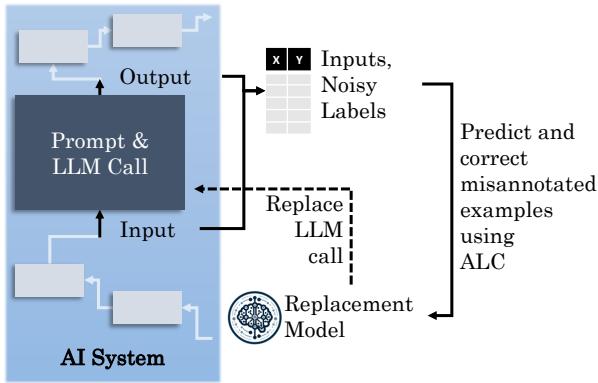
As shown in Figure 1, the workflow loops: the AI system generates noisy data, an Active Label Correction (ALC) process cleans it, and we train a replacement model to swap out the expensive LLM call.
Understanding the Noise: Why LLMs are “Smart” Liars
Before we fix the data, we must understand why it’s broken. You might assume that noise in a dataset is random—like rolling a die and occasionally writing down the wrong number. But LLM noise is different.
The researchers compared the performance of models trained on different types of noise:
- Random Noise: Labels are flipped randomly.
- Label-Conditional Noise: Labels are flipped based on statistical confusion (e.g., confusing “happy” with “ecstatic”).
- GPT-3.5 Noise: The actual errors made by the LLM.
The results were striking.
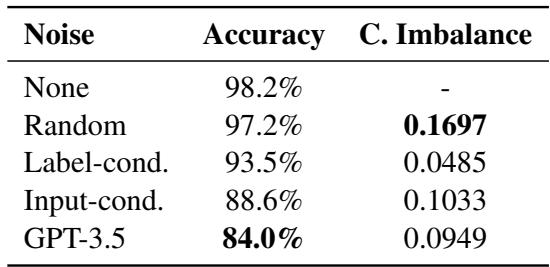
As Table 2 shows, a model trained on GPT-3.5 annotations (84.0%) performed significantly worse than models trained on random or structured synthetic noise. This suggests that LLM noise is detrimental in a unique way.
Why? Because LLMs produce plausible errors. They don’t just guess randomly; they hallucinate based on complex semantic relationships.
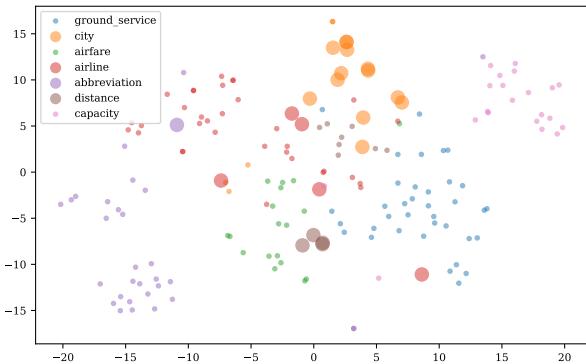
Figure 3 illustrates this concept using t-SNE, a technique to visualize high-dimensional data. The colored dots represent different classes of text data. The large dots represent errors made by GPT-3.5. Notice where the errors are? They aren’t scattered randomly; they are clustered at the boundaries between classes. These are the “hard” examples—the ambiguous cases where even humans might hesitate. This makes detecting and fixing them challenging because the model is often genuinely confused.
The Solution: ALC3
To fix this, the authors propose ALC3, a specific flavor of Active Label Correction. Standard Active Learning asks, “Which data point should I label to learn the most?” ALC asks, “Which data point is currently labeled wrong?”
ALC3 is an iterative process that improves the dataset in cycles. It consists of three specific updates applied to the training dataset:
- Auto-correction
- Human Annotation
- Filtering
Let’s break down the architecture.
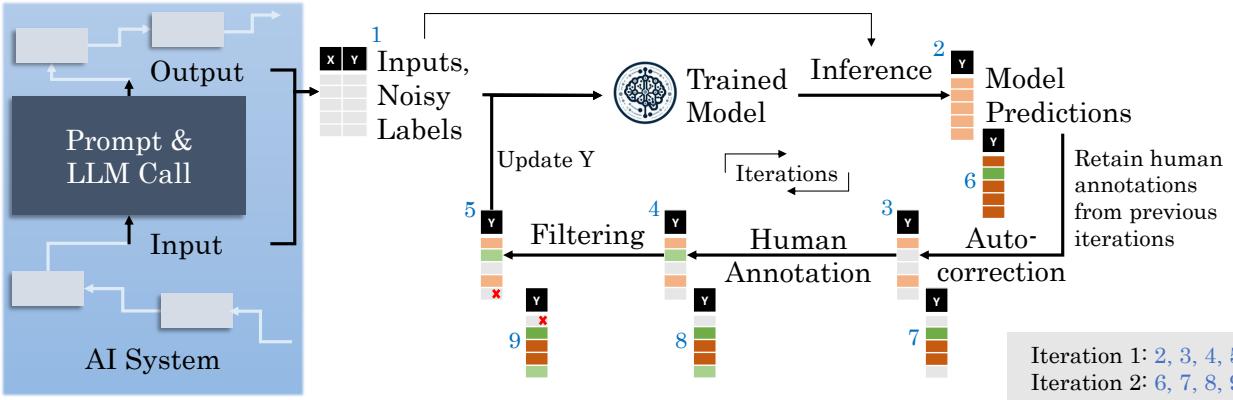
Step 1: Auto-Correction
We start by training a model on the current noisy dataset. Even though the data is noisy, the model will learn the dominant patterns. We then look at the model’s predictions for the training set itself.
If the model is extremely confident that a label is \(Y\), but the dataset says it’s \(X\), ALC3 assumes the model has learned a general rule that contradicts a specific noisy label. It automatically flips the label to \(Y\) without bothering a human. This is efficient for fixing obvious inconsistencies.
Step 2: Human Annotation (Misannotation Prediction)
This is the “Active” part. We cannot ask humans to check every label—that defeats the purpose of using AI. We need to find the labels most likely to be wrong.
The researchers define a misannotation probability score, \(m(x, y)\), which is essentially the inverse of the model’s confidence in the current label:
\[m(x, y) = 1 - p_\theta(y | x)\]If the model assigns a low probability to the current label, \(m(x,y)\) is high. The system sorts all examples by this score and flags the top \(M\%\) (e.g., top 5%) for human review. Humans check these specific examples and correct them if necessary.
Step 3: Filtering
This is the unique contribution of ALC3. Even after auto-correction and human review, there are still “confusing” examples—data points that reside in those messy boundaries we saw in Figure 3. These examples might not be high-priority enough to flag for humans, but they are confusing enough to hurt the model’s training.
ALC3 simply deletes (filters) these examples from the training set for the current iteration. The logic is that it is better to train on a slightly smaller, cleaner dataset than a larger, noisier one.
The number of examples to filter is determined dynamically. The system checks how precise the Misannotation Prediction (MP) was. If the model was good at spotting errors in Step 2, the system trusts it more to filter out data in Step 3.
The filtering threshold is governed by these equations:
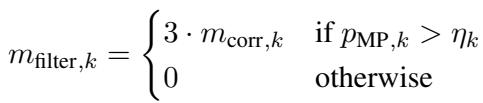
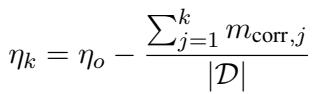
Here, \(m_{filter}\) is the number of examples we drop. We only filter if the precision of our misannotation prediction (\(p_{MP}\)) is higher than a dynamic threshold \(\eta_k\). This ensures we stop throwing away data once the dataset becomes clean enough that the model can no longer easily distinguish noise.
Experimental Setup
The researchers tested ALC3 on three distinct Natural Language Processing (NLP) tasks:
- ATIS: Intent Classification (e.g., “Is this user asking about flight times or airfare?”).
- CoNLL: Named Entity Recognition (finding names, places, organizations in text).
- QNLI: Natural Language Inference (determining if a passage answers a question).
First, they established a baseline. How much worse is GPT-3.5 than a fully fine-tuned model (the “Oracle”)?
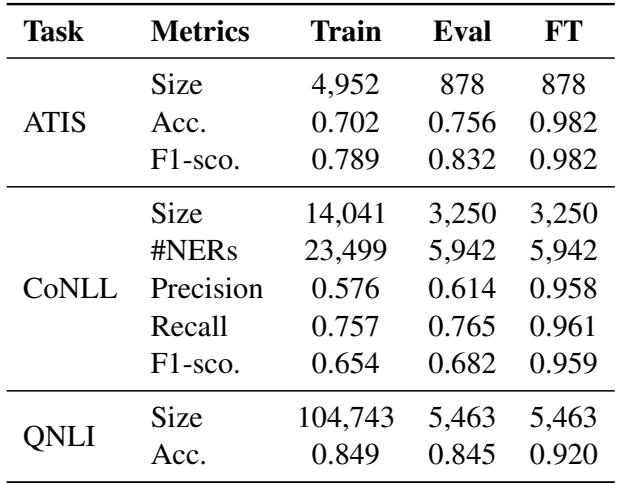
Table 1 reveals a massive gap. For Named Entity Recognition (CoNLL), GPT-3.5 achieves an F1-score of 0.682, while a fine-tuned model achieves 0.959. This 27% gap highlights why developers cannot rely solely on prompt-based LLMs for high-precision applications.
Key Results
1. Can the model find the bugs? (Misannotation Prediction)
The success of ALC depends on the system’s ability to present the right examples to the human annotator. If the system flags correct examples, the human wastes time.
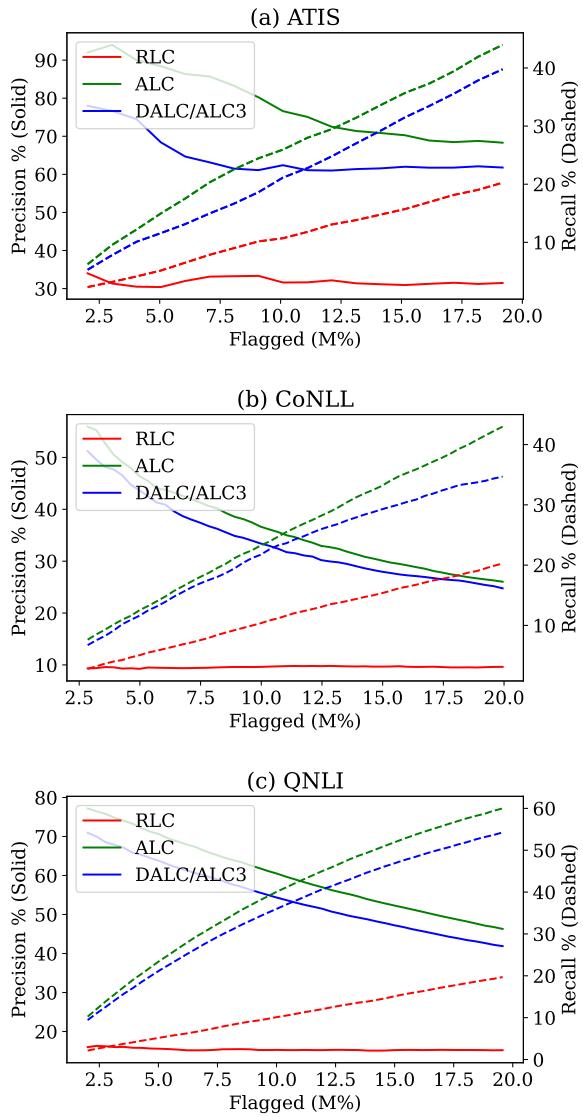
Figure 4 shows the Precision and Recall of the Misannotation Prediction.
- X-axis: The percentage of data flagged for human review (\(M\)).
- Y-axis: Precision (how many flagged items were actually wrong).
As we flag more data (moving right on the X-axis), precision drops. This makes sense: the model starts with the most obvious errors. Once those are flagged, it starts guessing on more ambiguous cases. Interestingly, ALC (green line) has higher precision than DALC/ALC3 (blue dashed line). This is because ALC3 auto-corrects the easiest errors first. The “easy wins” are gone before the human even steps in, leaving the human with the harder, more subtle errors.
2. Does the data size matter?
A common question in Machine Learning is “Do we need more data?” The researchers analyzed how the size of the dataset impacts the ability to predict misannotations.
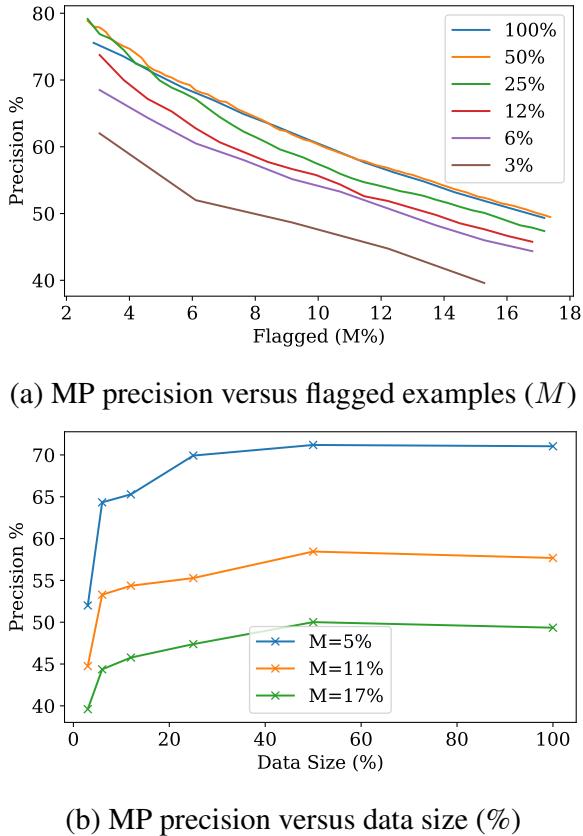
Figure 5 shows that having more data helps, but with diminishing returns. The jump in precision from 25% data to 50% data is significant, but the jump from 50% to 100% is small. This is encouraging—it suggests ALC3 can work effectively even on smaller datasets collected from early-stage deployments.
3. The Ultimate Test: Iterative Improvement
The most critical result is the performance over time. Does the replacement model actually get better?
The researchers ran the simulation iteratively. In each round, they simulated human feedback on a small percentage of the data (e.g., 2.5% or 5%). They compared:
- RLC: Random Label Correction (Humans fix random examples).
- ALC: Standard Active Label Correction.
- DALC: Dual ALC (Auto-correction + Human).
- ALC3: The proposed method (Auto-correction + Human + Filtering).
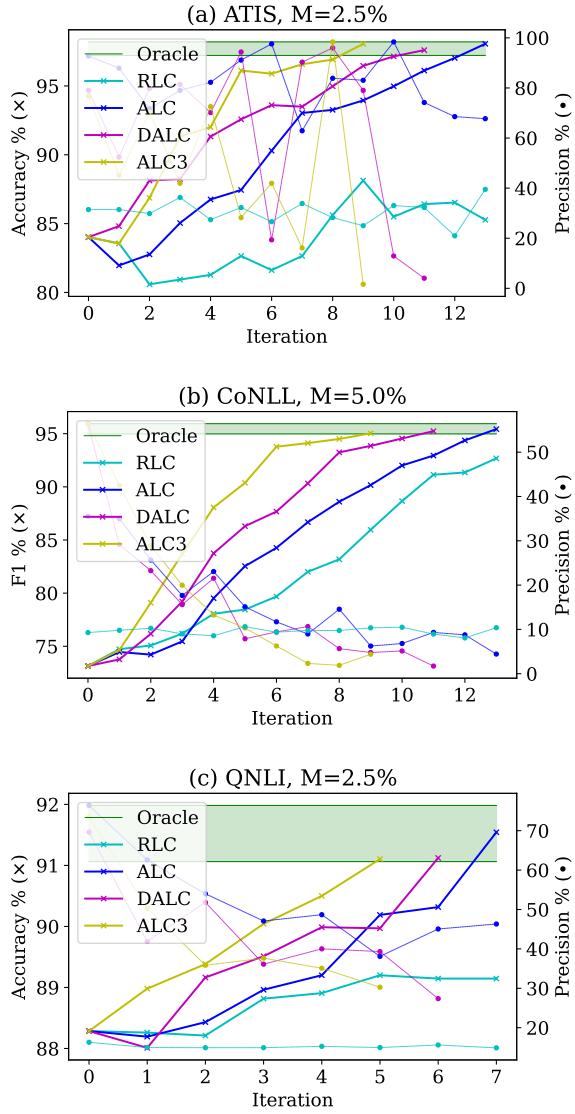
Figure 6 tells the complete story. Look at the curves with the ‘x’ markers (Accuracy/F1-score):
- ALC3 (Blue) rises the fastest. It reaches the “Oracle” zone (the green bar representing a model trained on perfect ground truth data) in fewer iterations than any other method.
- RLC (Red) is the slowest. Randomly fixing data is inefficient.
- Efficiency Gains: ALC3 achieved Oracle performance by correcting only a fraction of the data. For example, on the ATIS dataset, GPT-3.5 had a 29.8% error rate. ALC3 fixed the model with feedback on only 22.5% of the examples.
This means you don’t need to fix every error to get a perfect model. By combining auto-correction and filtering, ALC3 allows the model to ignore bad data and learn the correct patterns faster. Specifically, ALC3 required 17-24% fewer human annotations than the total number of errors in the dataset.
Conclusion and Implications
This research provides a practical roadmap for converting prototype AI systems into production-grade software. We don’t have to choose between the versatility of LLMs and the efficiency of fine-tuned models. We can have both.
The Workflow for Future AI Development:
- Deploy a modular system using expensive, powerful LLMs (like GPT-4).
- Collect the noisy input/output logs.
- Apply ALC3:
- Let the model fix the obvious errors (Auto-correction).
- Have humans fix the most confusing errors (Active Learning).
- Discard the ambiguous garbage (Filtering).
- Train a small, efficient model (like DistilBERT) on this cleaned data.
- Replace the LLM module with the new model to save cost and reduce latency.
By treating LLM hallucinations not as failures, but as “noisy signals” that can be systematically cleaned, we can build AI systems that improve themselves over time, becoming robust, efficient, and increasingly accurate.