](https://deep-paper.org/en/paper/2401.07103/images/cover.png)
Introduction
In the world of Artificial Intelligence, we have witnessed a massive shift in how machines write. From the early days of clunky chatbots to the fluent, creative prose of models like GPT-4 and LLaMA, Natural Language Generation (NLG) has advanced at breakneck speed. But this progress has birthed a new, perplexing problem: How do we know if what the AI wrote is actually “good”?
For years, researchers relied on rigid metrics that counted how many words overlapped between an AI’s output and a human’s reference text. If the AI used the word “happy” and the human used “joyful,” traditional metrics penalized the AI. This approach fails to capture the nuance, creativity, and semantic depth of modern language models.
Enter the new paradigm: LLM-based Evaluation. If AI is now good enough to write like a human, can it also be smart enough to judge like a human?
In this deep dive, we will explore a comprehensive research paper that systematizes this emerging field. we will look at how Large Language Models (LLMs) are being transformed into judges, the different ways they can evaluate text, and the critical challenges—like bias and cost—that stand in the way.
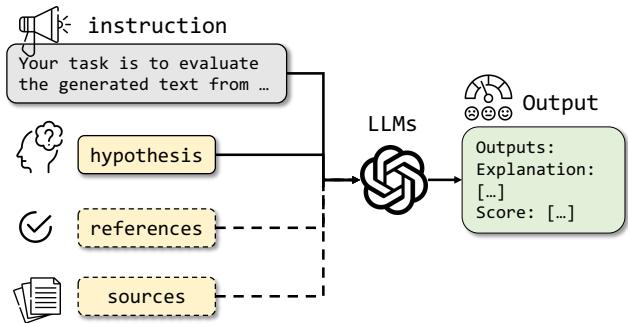
As shown in Figure 1, the core idea is simple yet powerful: we feed the AI the generated text (hypothesis), the source material, and optionally a human reference. The AI then acts as the critic, providing not just a score, but often an explanation for why it gave that score.
Background: From Word Matching to Meaning
To understand why we need LLMs as evaluators, we first need to look at the “Old Guard” of evaluation metrics.
The Traditional Approach
For decades, the standard for evaluating tasks like translation or summarization was Matching-based Evaluation. Metrics like BLEU (Bilingual Evaluation Understudy) and ROUGE (Recall-Oriented Understudy for Gisting Evaluation) operate on a simple premise: n-gram matching.
Imagine an AI translates a sentence. A matching-based metric looks at the AI’s sentence and a human translator’s sentence and literally counts the matching sequences of words.
- Pros: Fast, cheap, and easy to calculate.
- Cons: They ignore meaning. “The cat sat on the mat” and “The feline rested on the rug” might get a terrible score despite meaning the same thing.
Later, metrics like BERTScore improved this by using neural embeddings to check for semantic similarity rather than exact word matches. However, even these struggle with complex aspects of language like coherence, fluency, and creativity.
The New Formalization
The research paper formalizes the evaluation process using a generalized function. Whether we use an old metric or a state-of-the-art LLM, the goal is the same:
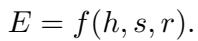
In this equation:
- \(E\): The final Evaluation score or judgment.
- \(f\): The evaluation function (the judge).
- \(h\): The Hypothesis (the text generated by the AI being tested).
- \(s\): The Source (the input text, like an article to be summarized).
- \(r\): The Reference (ground truth text written by a human, which is optional in some modern methods).
Generative vs. Matching
The leap from traditional metrics to LLM-based evaluation represents a shift from matching to generating.
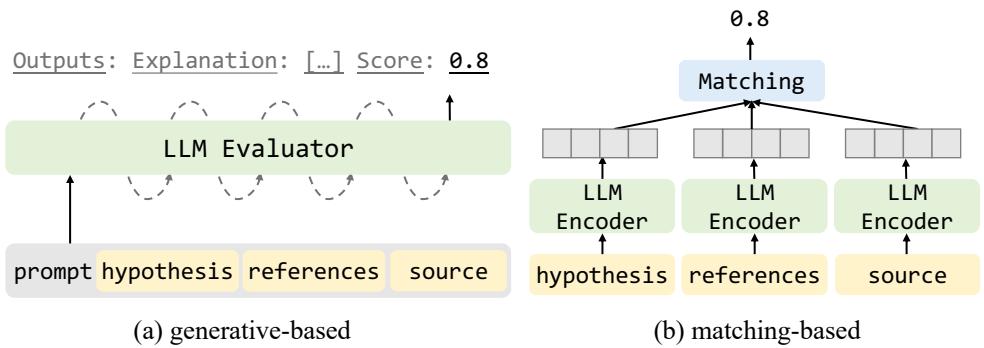
As illustrated in Figure 2:
- Matching-based (b): Encodes the text into mathematical vectors and calculates the distance between them. It is purely mathematical and opaque.
- Generative-based (a): This is the focus of our article. The LLM reads the inputs and generates a response. This response could be a number, a “Yes/No,” or a paragraph of critique. This mimics how a human teacher grades an essay.
Core Method: The Taxonomy of Generative Evaluation
The researchers propose a structured taxonomy to organize the chaotic landscape of LLM-based evaluation. This is crucial for understanding the different “flavors” of AI judges available today.
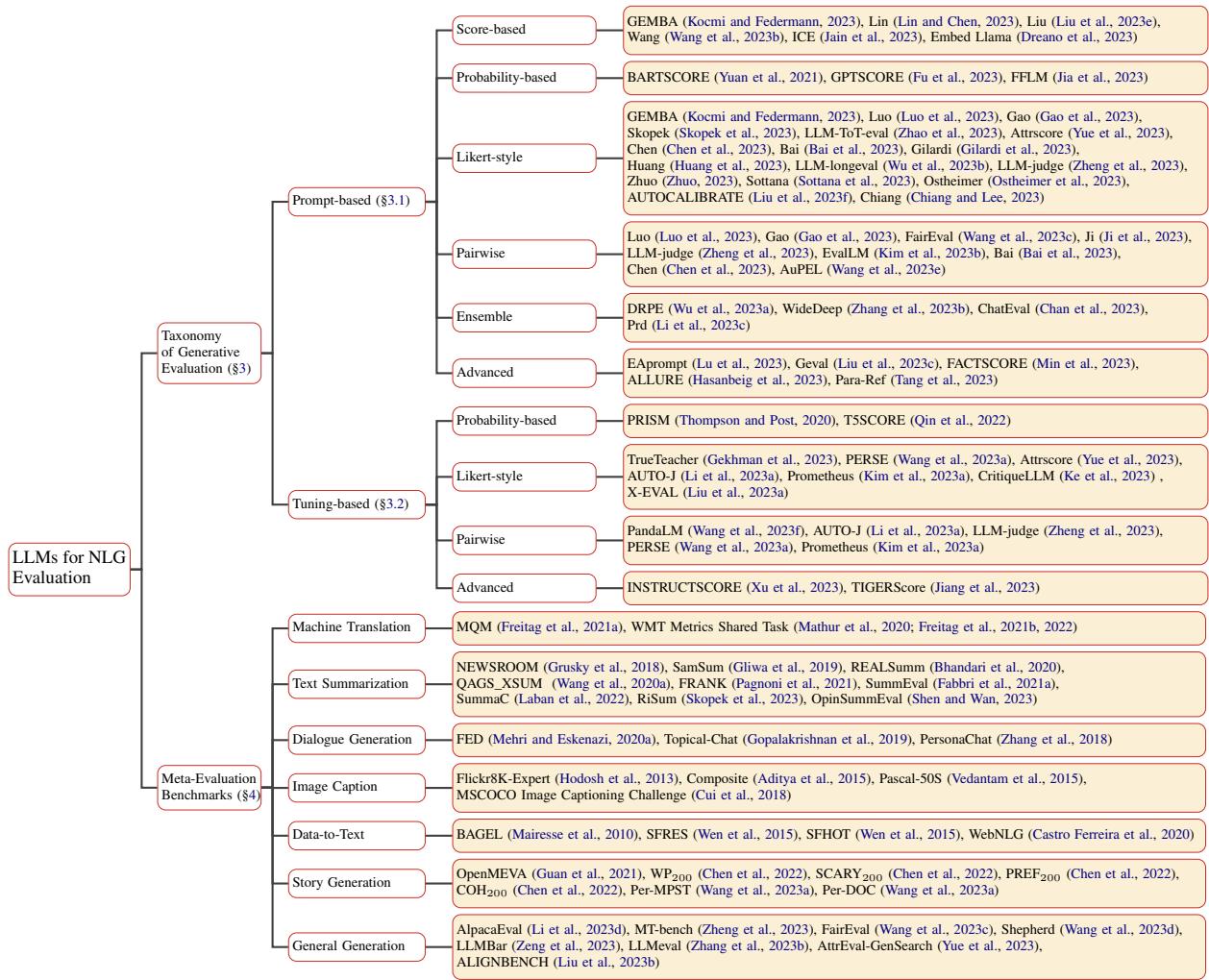
As Figure 3 outlines, the field is split into two massive categories: Prompt-based (using an existing model as-is) and Tuning-based (training a specific model to be a judge).
1. Prompt-based Evaluation
This approach is the most accessible. It involves taking a powerful, off-the-shelf model (like GPT-4) and designing a specific prompt that tricks or guides it into acting as a judge. No training is required—just clever engineering.
There are several protocols for doing this:
A. Score-based and Probability-based
- Score-based: You simply ask the model to output a number. For example, “Rate this summary on a scale of 1 to 100.”
- Probability-based: This is more technical. Instead of asking for a number, we look at the model’s internal confidence. We calculate the mathematical probability (likelihood) of the generated text given the source. If the model thinks the text is “highly probable,” it is usually of higher quality.
B. Likert-Style Evaluation
Inspired by human questionnaires, this method asks the LLM to classify the text into quality levels.
- Example: “Is this summary consistent with the article? Answer Yes or No.”
- Benefit: This is often easier for an LLM to answer accurately than asking for a precise number like “87/100.”
C. Pairwise Comparison
Humans often struggle to give an absolute score (“Is this essay a 7 or an 8?”), but we are excellent at comparison (“Is essay A better than essay B?”). LLMs share this trait. In Pairwise Evaluation, the model is given two different outputs for the same prompt and asked to pick the winner. This creates a ranking system that is often more robust than raw scoring.
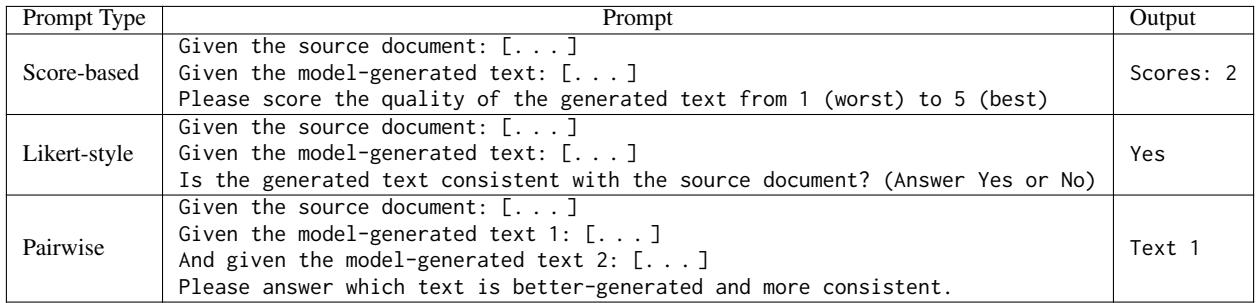
Table 1 provides concrete examples of how these prompts look. Notice the “Pairwise” example at the bottom—it explicitly asks the model to compare “Text 1” and “Text 2.”
D. Ensemble Evaluation
Why rely on one judge when you can have a jury? Ensemble evaluation uses multiple LLM instances to reduce bias and variance.
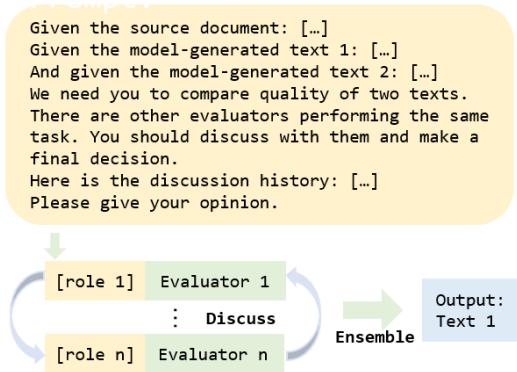
As shown in Figure 5, this can get quite sophisticated. You can assign different “roles” to the LLMs (e.g., one acts as a fact-checker, another as a grammar Nazi, another as a creative director). They can even “discuss” the output in a loop before rendering a final verdict. This mimics a panel of human judges deliberating to reach a consensus.
E. Fine-Grained Analysis
Sometimes a score isn’t enough. We need to know where the errors are.
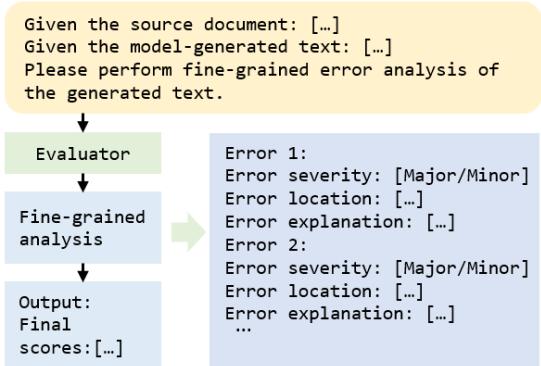
Figure 4 illustrates a protocol where the LLM performs a diagnostic. It identifies specific error types (like hallucination or grammar faults), locates them in the text, rates their severity, and then calculates a final score based on that analysis. This interpretability is the “killer feature” of LLM evaluations compared to opaque metrics like BLEU.
2. Tuning-based Evaluation
While prompting GPT-4 is easy, it is also expensive and slow. Tuning-based evaluation involves taking a smaller, open-source model (like LLaMA) and fine-tuning it specifically to grade text.
- The Goal: Create a specialized “Judge Model” that is small, fast, and cheap to run, but nearly as smart as GPT-4 within the specific domain of evaluation.
- Data Construction: To train these models, researchers often use GPT-4 to generate thousands of evaluations (scores and explanations). The smaller model then learns to mimic GPT-4’s grading style.
- Holistic vs. Error-Oriented: Some tuned models provide a general quality score, while others are trained specifically to hunt for errors (like attribution errors in RAG systems).
Experiments and Results
So, does this actually work? Is an AI judge better than a mathematical formula? The paper compiles results from major benchmarks to answer this.
Performance: LLMs vs. Traditional Metrics
The researchers compared LLM-based metrics (like G-EVAL and GPTScore) against traditional metrics (ROUGE, BLEU) on standard datasets for summarization, dialogue, and translation.
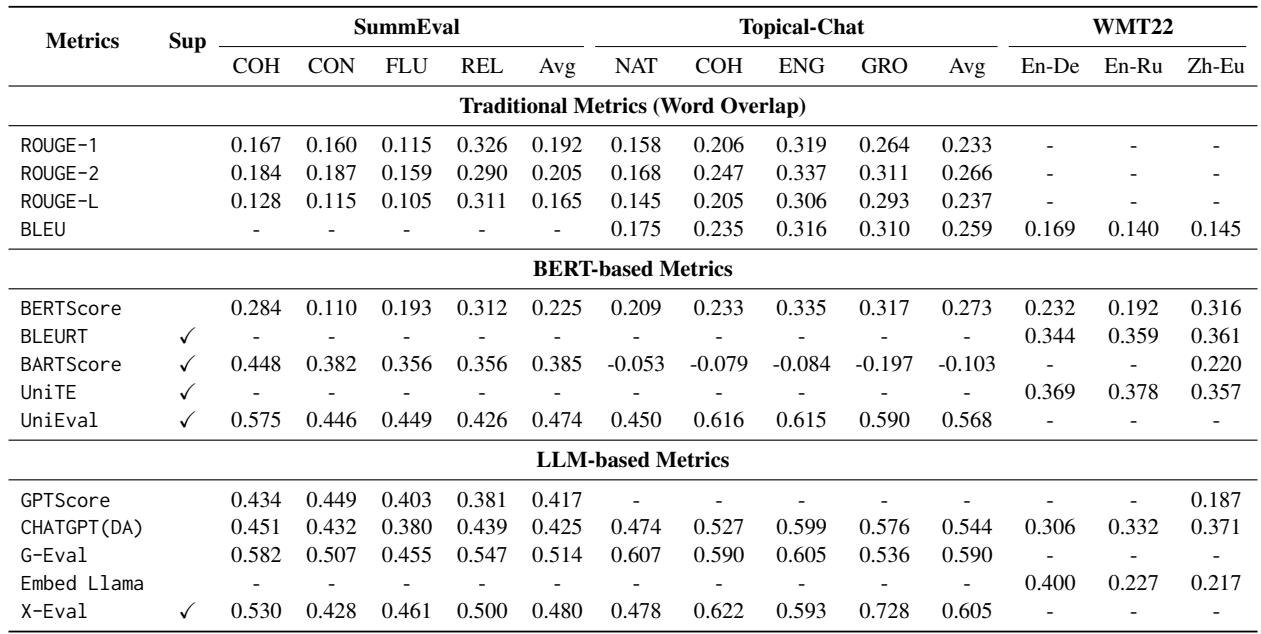
Table 3 reveals the truth. The numbers represent the correlation with human judgment. A higher number means the metric agrees more with how humans rated the text.
- Traditional Metrics (Top section): Look at ROUGE-L for SummEval (0.128 - 0.165). These correlations are quite low.
- LLM-based Metrics (Bottom section): Look at G-Eval (0.582). This is a massive improvement.
- Takeaway: LLM-based evaluators align significantly better with human preferences than word-overlap metrics, especially for creative tasks like Dialogue Generation and Summarization.
The Cost of Intelligence: Efficiency
However, there is no free lunch. The superior performance of LLMs comes at a cost: speed.
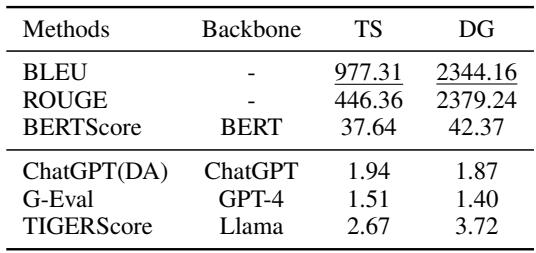
Table 4 presents a stark contrast in efficiency.
- BLEU can evaluate nearly 1,000 texts per second.
- G-Eval (using GPT-4) evaluates about 1.5 texts per second.
This makes LLM-based evaluation roughly 200 to 400 times slower than traditional methods. While suitable for offline testing, using LLMs to evaluate text in real-time (e.g., during user interaction) remains a computational bottleneck.
Challenges and Open Problems
Despite the excitement, the paper identifies several “elephants in the room”—critical challenges that must be addressed before we can fully trust AI judges.
1. The “Chicken or the Egg” Problem
We are often using the strongest model (e.g., GPT-4) to evaluate other models. But what happens when we need to evaluate the next generation, “GPT-5”? If the evaluator is weaker than the generator, can the evaluation be trusted? Furthermore, models tend to have an Egocentric Bias—they prefer text generated by themselves or models with similar architectures.
2. Biases of the Digital Judge
LLMs are not neutral. They exhibit specific biases when acting as judges:
- Position Bias: In pairwise comparisons (Text A vs. Text B), LLMs often prefer the text presented first, regardless of quality.
- Verbosity Bias: LLMs tend to give higher scores to longer answers, even if they are rambling or repetitive.
- Social Bias: They can carry over societal stereotypes found in their training data.
3. Robustness and Prompt Engineering
LLM evaluators are sensitive. Changing the prompt slightly (e.g., “Rate this” vs. “Please rate this”) can sometimes swing the score wildly. This lack of robustness makes it hard to compare results across different research papers if the prompts aren’t identical.
4. Domain Specificity
Most evaluators are “generalists.” An LLM might be great at grading a high school essay but terrible at evaluating a legal contract or a medical diagnosis summary. Developing domain-specific AI judges is an active area of need.
Conclusion
The shift from matching-based metrics to Generative Evaluation marks a turning point in Natural Language Processing. We are moving away from counting words and toward understanding them.
The research shows that LLM-based evaluators offer:
- Better Human Alignment: They “get” nuance, sarcasm, and flow.
- Interpretability: They can tell us why a text is bad, not just that it is bad.
- Versatility: They can be adapted to almost any task via prompting.
However, they are slow, expensive, and prone to their own unique set of psychological biases. As we refine these methods—moving toward ensemble approaches and specialized tuned models—we are getting closer to a world where AI can effectively police its own output. For students and researchers entering the field, mastering these evaluation techniques is no longer optional; it is essential for building the next generation of intelligent systems.