](https://deep-paper.org/en/paper/2401.10768/images/cover.png)
Introduction: The “Yes-Man” Problem in AI
Imagine you are a student taking a history exam. You encounter a question about a specific event you never studied and have zero knowledge about. In a multiple-choice setting, you might guess. But in an essay setting, if you are forced to write an answer, you might try to sound confident, fabricating details that sound plausible but are entirely fictional.
Large Language Models (LLMs) face a strikingly similar dilemma during their training, specifically during the alignment phase. We train these models to be helpful, harmless, and honest. However, recent research suggests that the way we fine-tune these models often inadvertently encourages them to hallucinate.
When we fine-tune a model on instruction data (like Q&A pairs), we are essentially telling it: “When asked this, say that.” But what if the “that”—the factual content of the answer—isn’t actually stored in the model’s internal memory (acquired during pretraining)? The model learns the form of the answer but lacks the substance. It learns to mimic the response without understanding the underlying facts. It becomes a “yes-man,” generating plausible-sounding nonsense to satisfy the user’s prompt.
This phenomenon is rooted in Knowledge Inconsistency.
In this detailed breakdown, we will explore the research paper “Knowledge Verification to Nip Hallucination in the Bud,” which proposes a novel framework called Knowledge Consistent Alignment (KCA). This method essentially gives the model a “pop quiz” on its training data before it learns from it. If the model doesn’t know the facts, KCA changes how the model is taught, preventing it from learning to hallucinate.
Background: The Disconnect Between Pretraining and Alignment
To understand why KCA is necessary, we must first look at how LLMs learn. The process generally happens in two stages:
- Pretraining: The model reads massive amounts of text from the internet. This is where it acquires its “intrinsic knowledge”—world facts, grammar, reasoning skills, etc.
- Alignment (Instruction Tuning): The model is fine-tuned on high-quality pairs of instructions and responses. This teaches the model how to format answers and follow user intent.
The prevailing theory (the “Superficial Alignment Hypothesis”) posits that alignment doesn’t teach the model new knowledge; it only teaches the model how to extract and format the knowledge it already has.
The Conflict
The problem arises when the alignment data contains specific, external knowledge that the foundation model never saw during pretraining. For example, if you try to fine-tune an older model (like GPT-2) on a dataset about a brand-new technology (like Direct Preference Optimization, invented in 2023), the model has no internal representation of that technology.
If you force the model to train on this data, you are creating a knowledge inconsistency. You are asking the model to align with external knowledge that contradicts (or is absent from) its intrinsic knowledge.
The researchers behind this paper hypothesized that this inconsistency is a primary driver of hallucination. To prove this, they analyzed the correlation between how “inconsistent” a model’s knowledge is and how often it hallucinates.
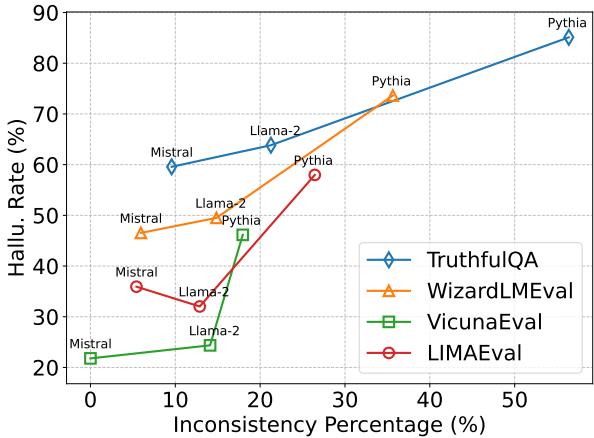
As shown in Figure 2, the correlation is stark. The x-axis represents the percentage of knowledge inconsistency (how much of the test data was “unknown” to the model), and the y-axis represents the hallucination rate. Across different datasets (represented by the colored lines), as the inconsistency increases, the hallucination rate climbs significantly. This confirms that when a model doesn’t know what it’s talking about, it starts making things up.
The Solution: Knowledge Consistent Alignment (KCA)
So, how do we stop this? We need a filter. We need a way to check if the model actually “knows” the facts in a training example before we use that example to fine-tune it.
The researchers introduce Knowledge Consistent Alignment (KCA). The logic is elegant in its simplicity:
- Detect: For every piece of training data, verify if the model holds the necessary intrinsic knowledge.
- Calibrate: If the model doesn’t know the facts, modify the training data so we don’t force the model to hallucinate.
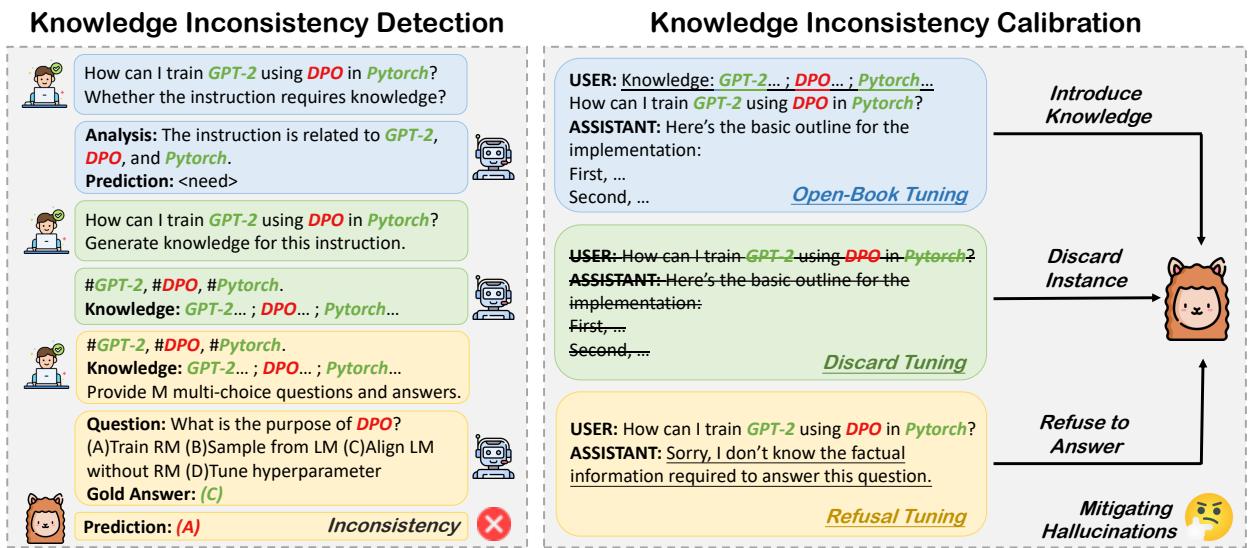
Figure 3 provides a high-level overview of the entire pipeline. The process is divided into two main phases: Detection (on the left) and Calibration (on the right). Let’s break these down step-by-step.
Phase 1: Knowledge Inconsistency Detection
The detection phase is like an automated oral exam for the Language Model. We can’t simply ask the model, “Do you know this?” because it might lie. Instead, the researchers devised a four-step objective verification process.
Step 1: Knowledge Requirement Classification
Not every instruction requires factual knowledge. A request like “Rewrite this sentence in a funny tone” relies on stylistic capabilities, not hard facts. A request like “Explain the chemical composition of Aspirin” relies on facts.
KCA first uses a “Teacher Model” (a strong, aligned LLM like GPT-3.5) to analyze the training instruction and determine if it requires external knowledge.
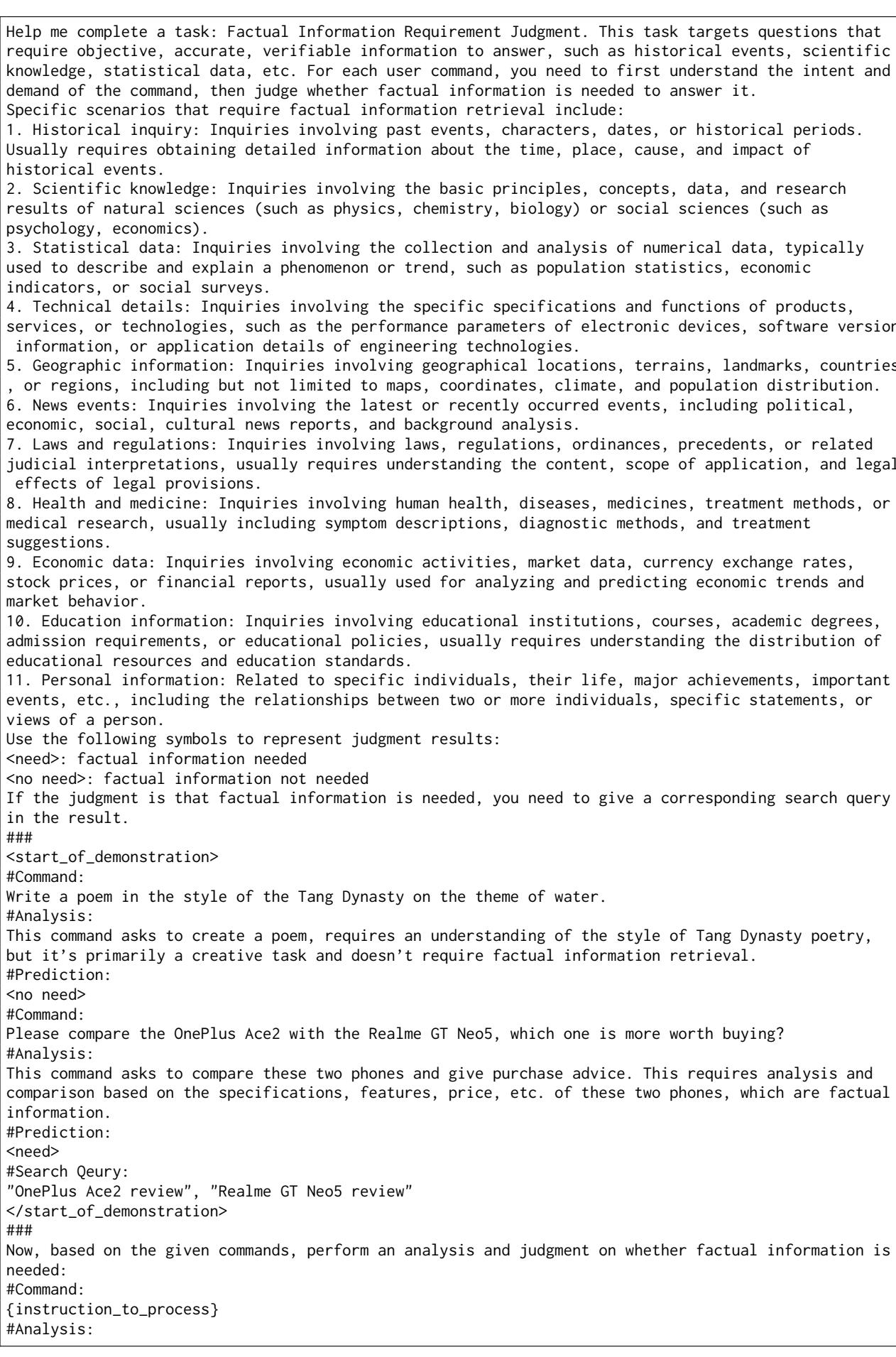
As seen in the prompt structure in Figure 6, the system asks the Teacher Model to analyze the user command and predict <need> or <no need> regarding factual information. This filters out subjective or creative tasks where hallucinations aren’t really the issue.
Step 2: Reference Knowledge Generation
If an instruction does require knowledge, the system needs to know what that knowledge is. Again, using the Teacher Model, KCA generates a “reference knowledge snippet”—a summary of the facts required to answer the instruction correctly.
Step 3: Examination Formulation
This is the most innovative part of the KCA framework. Once we have the reference facts, how do we check if the “Student Model” (the one we want to train) knows them?
We generate a multiple-choice exam.
The Teacher Model creates questions based on the reference knowledge snippet. For example, if the training data is about the history of Rome, the system generates specific multiple-choice questions about Roman history.
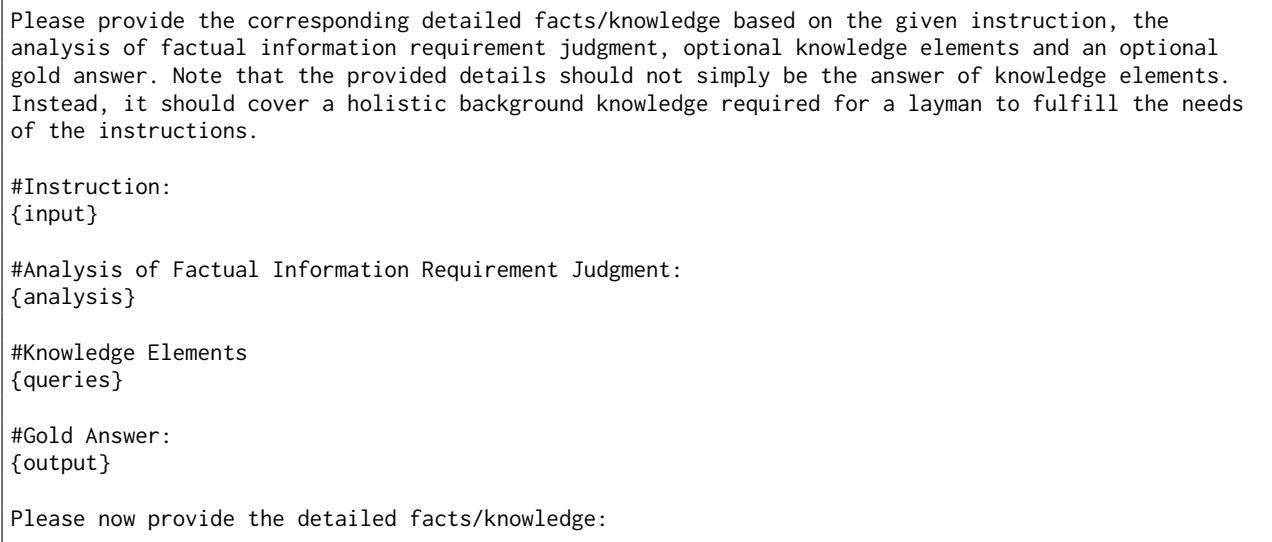
Figure 7 and 8 illustrate these prompts. The system explicitly asks the helper model to create questions, options, and the correct answer key ((A), (B), (C), etc.) based on the knowledge provided.
Step 4: Examination Completion
Finally, the Student Model (the base model we are about to train, e.g., Llama-2-7B) takes the exam. It is fed the multiple-choice questions.
- High Score: If the Student Model answers correctly, it possesses the intrinsic knowledge. The data is marked as Consistent (\(\mathcal{D}_{co}\)).
- Low Score: If the Student Model fails, it lacks the knowledge. The data is marked as Inconsistent (\(\mathcal{D}_{inc}\)).
This classification reveals fascinating insights about different foundation models.

Figure 4 shows the results of this detection phase across different models. Notice the difference between Pythia 7B (blue) and Llama-2 7B (orange). Pythia has a much higher percentage of inconsistent data (lower blue bars in the “Consis.” group) compared to Llama-2. This makes sense: Llama-2 was trained on more data and is generally considered a more capable base model, so it “knows” more of the facts present in the training datasets.
Phase 2: Knowledge Inconsistency Calibration
Once the dataset is split into “Known” (\(\mathcal{D}_{co}\)) and “Unknown” (\(\mathcal{D}_{inc}\)), we proceed to the training phase.
For the “Known” data, we proceed with standard fine-tuning. The model knows the facts, so teaching it how to format the answer is safe.
For the “Unknown” (\(\mathcal{D}_{inc}\)) data, we cannot just train normally. If we do, the model will learn to hallucinate. The researchers propose three different calibration strategies:
1. Open-Book Tuning
In this strategy, the “cheat sheet” (the reference knowledge generated earlier) is appended directly to the prompt during training.
- The Logic: “You don’t know this fact, so I will provide it to you in the context.”
- The Outcome: The model learns to answer based on provided context rather than fabricating information. It mimics a Retrieval-Augmented Generation (RAG) workflow.
2. Discard Tuning
This is the most aggressive strategy: simply throw the data away.
- The Logic: “If you don’t know it, we won’t talk about it.”
- The Outcome: The model is only fine-tuned on things it actually understands. This preserves the purity of the model’s knowledge but reduces the total amount of training data.
3. Refusal Tuning
This strategy teaches the model humility. The target response in the training data (which would normally be the factual answer) is replaced with a refusal message, such as “I don’t know the factual information required to answer this instruction.”
- The Logic: “When you see a question about this topic you don’t know, admit ignorance.”
- The Outcome: The model explicitly learns the boundary of its own knowledge.
Experimental Results
The researchers tested these methods on several popular open-source models (Pythia 7B, Mistral 7B, Llama-2 7B/13B) and evaluated them on tough hallucination benchmarks like TruthfulQA and VicunaEval.
Does KCA reduce hallucinations?
Yes, significantly. By addressing the knowledge inconsistency, all three KCA strategies generally outperformed standard tuning.
One specific area of interest is Refusal Tuning. By teaching the model to say “I don’t know,” we drastically cut down on false information.

Figure 5 illustrates a crucial validation of the method. The researchers checked the hallucination rate of responses where the model refused to answer versus where it tried to answer. The “Refusal” bars (on the right of each cluster) are essentially the hallucination rates if the model hadn’t refused (calculated using a baseline model). This proves that the questions the model refused to answer were indeed the ones where it would have hallucinated the most.
Performance on Specific Metrics
The team also used standard text-generation metrics like ROUGE to compare the model outputs against reference answers.
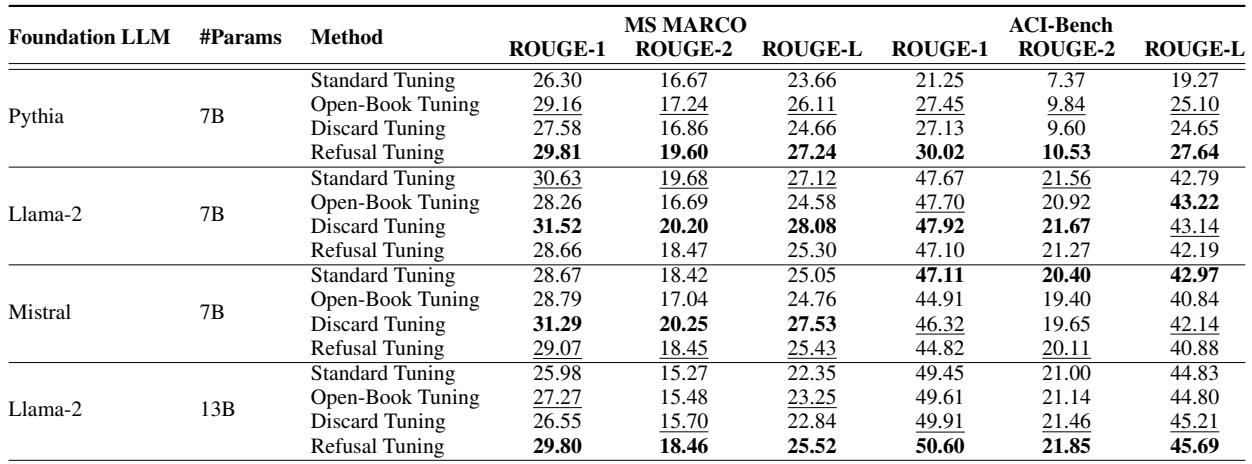
Table 2 shows the ROUGE scores (higher is better, indicating closer match to ground truth). You can see that Refusal Tuning (bottom row for each model) often performs very well. However, Discard Tuning and Open-Book Tuning also show improvements over Standard Tuning. For example, looking at Pythia 7B (a weaker model), Open-Book tuning provided a massive jump in performance on the ACI-Bench, likely because that model needed the external context the most.
The Trade-off: Helpfulness vs. Honesty
There is always a catch. If a model refuses to answer every difficult question, it becomes very honest but very useless. The researchers evaluated the “Helpfulness” of the models using GPT-4 as a judge (scoring from 1 to 10).
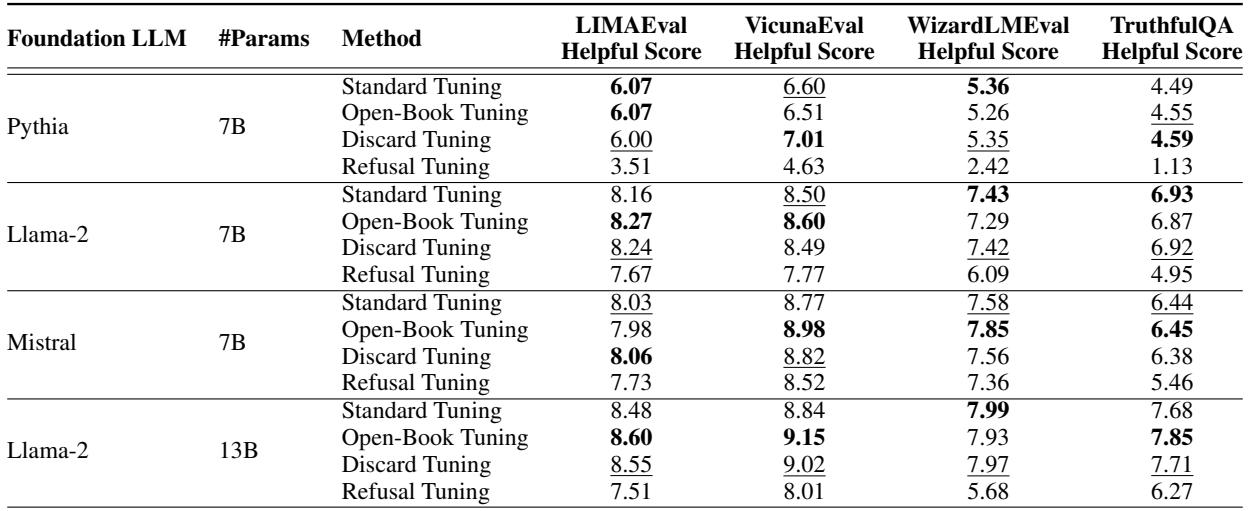
Table 3 reveals the trade-off:
- Refusal Tuning: While it crushed the hallucination metrics, it took a hit on helpfulness (see the drop in scores, particularly for Pythia 7B). If a model says “I don’t know” too often, users get frustrated.
- Open-Book & Discard Tuning: These methods maintained helpfulness scores comparable to (or sometimes better than) Standard Tuning. They allow the model to remain useful while still reducing hallucinations.
Discussion: Which Strategy is Best?
The paper suggests that the “best” strategy depends on your goals and your base model:
- Refusal Tuning is the champion for safety and truthfulness. If your application cannot tolerate lies (e.g., medical or legal advice), this is the path to take, even if it becomes less chatty.
- Open-Book Tuning is ideal for maintaining helpfulness. It essentially trains the model to be a good reader of context. If you plan to use your model in a RAG system (where you provide documents in the prompt), this is excellent training.
- Discard Tuning offers a balance. It ensures the model is consistent without requiring the complexity of rewriting data (Refusal) or expanding prompts (Open-Book).
Conclusion
The “Knowledge Verification to Nip Hallucination in the Bud” paper offers a compelling shift in how we think about training LLMs. It moves us away from the idea of “stuffing” knowledge into a model during the fine-tuning phase. Instead, it respects the knowledge boundaries of the pre-trained model.
By using KCA, we stop forcing models to be sycophants. We treat the alignment phase for what it should be: learning behavior and formatting, not learning new facts.
- Key Takeaway: If a model fails a pop quiz on a topic, don’t force it to write an essay on it.
- Implication: Future dataset curation shouldn’t just look at quality; it should look at compatibility with the model being trained.
As we strive for AGI, mere scale isn’t enough. We need reliability. Techniques like KCA demonstrate that we can achieve significantly more reliable models not just by training them harder, but by training them smarter—specifically, by ensuring they only speak about what they truly know.