](https://deep-paper.org/en/paper/2401.13586/images/cover.png)
In the rapidly evolving world of Large Language Models (LLMs), “best practices” are often established not through rigorous ablation studies, but through community consensus and default library settings. One such standard in Supervised Instruction Fine-Tuning (SIFT) is prompt masking.
When we fine-tune a model to follow instructions, the standard approach is to calculate the loss (the error) only on the completion (the model’s answer). We typically mask the prompt (the instruction and input), telling the model, “Don’t worry about predicting these tokens; just focus on generating the answer.”
But is this actually optimal?
Until recently, OpenAI’s fine-tuning API offered a parameter called prompt_loss_weight (PLW). This allowed users to force the model to learn the prompt tokens as well as the completion tokens. OpenAI claimed this helped stabilize training for short outputs. However, in early 2024, they quietly removed this parameter.
This raises a critical question for students and practitioners of NLP: Does prompt loss actually matter?
A recent paper by Huerta-Enochian and Ko, titled “Instruction Fine-Tuning: Does Prompt Loss Matter?”, dives deep into this question. Their findings challenge the status quo, suggesting that for specific types of data, ignoring prompt loss is a mistake that harms model performance.
In this deep dive, we will unpack their methodology, the concept of “Prompt Inversion,” and why the ratio between your input and output length might be the most important metric you aren’t tracking.
Background: The Standard Approach to SIFT
To understand the paper’s contribution, we first need to solidify our understanding of how SIFT typically works.
In standard causal language modeling (like GPT), the model is trained to predict the next token \(x_{t+1}\) given the sequence of previous tokens \(x_1, ..., x_t\). The objective is to maximize the likelihood of the data.
When we move to Instruction Fine-Tuning, our data is structured into pairs: a Prompt (instruction + input) and a Completion (target output).
The Masking Default
In libraries like HuggingFace’s Transformers, the default behavior for SIFT is to apply a mask to the prompt tokens. This means:
- The model sees the prompt.
- It generates the completion.
- The loss function (usually Cross-Entropy) is calculated only on the completion tokens.
- The prompt tokens contribute zero to the gradient update.
In the terminology of this paper, this is a Prompt Loss Weight (PLW) of 0.
If we were to treat the instruction data just like raw text (pre-training style), we would calculate loss on every token, including the instruction. This would be a PLW of 1.
The researchers investigated the gray area between these two extremes. What happens if we set PLW to 0.1? Or 0.01?
The Core Hypothesis: Stability vs. Performance
Why would we ever want to train on the prompt? The prompt is provided by the user; the model doesn’t need to generate it during inference.
OpenAI’s original documentation for the now-deprecated parameter suggested that a small non-zero PLW (like 0.01) helps stabilize learning, specifically when the completions are very short. The logic is that if the output is only a few tokens long, the gradient signal is too sparse or noisy. Forcing the model to also predict the prompt provides a “grounding” signal.
The authors of this paper proposed a more nuanced hypothesis involving the Generation Ratio (\(R_g\)).
The Generation Ratio (\(R_g\))
They define the generation ratio as:
\[R_g = \frac{\text{Length of Completion}}{\text{Length of Prompt}}\]- Long-Completion Data (\(R_g \geq 1\)): The output is longer than the input (e.g., creative writing, essay generation).
- Short-Completion Data (\(R_g < 1\)): The output is shorter than the input (e.g., multiple-choice questions, classification, sentiment analysis).
The authors hypothesized a trade-off:
- Positive Effect: Learning the prompt helps stabilize the model or regularize it (keeping it close to the pre-trained knowledge), which helps when the completion signal is weak (short data).
- Negative Effect: Over-prioritizing the prompt distracts the model from its main job—following instructions.
This leads to a prediction of a quadratic relationship (an upside-down U-shape curve). As you increase PLW from 0, performance should rise, hit a peak (the critical value \(\lambda\)), and then fall as the prompt loss overpowers the completion loss.
Methodology: Creating the “Short” Dataset
To test this hypothesis, the researchers needed datasets that clearly distinguished between long and short completions. They used the famous Alpaca dataset, but they encountered a problem: standard instruction datasets are usually a mix of lengths, or predominantly long.
To rigorously test “Short-Completion” scenarios, they devised a clever technique called Prompt Inversion.
Prompt Inversion
How do you turn a creative writing prompt (long output) into a classification task (short output) without losing the semantic complexity? You flip it.
As illustrated in Figure 4, Prompt Inversion restructures the data so the model must predict the original instruction based on the output.
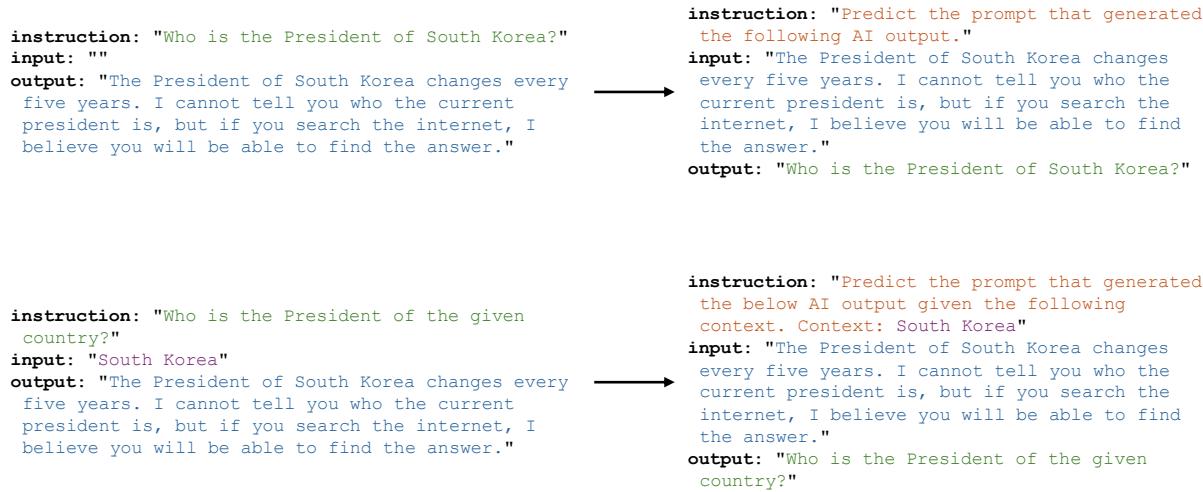
Look at the example in the figure above:
- Original (Left): The instruction asks for the President of South Korea. The output is a long, detailed sentence. (\(R_g > 1\))
- Inverted (Right): The instruction becomes “Predict the prompt that generated the following AI output.” The input is the detailed sentence. The target output is the simple question “Who is the President of South Korea?” (\(R_g < 1\))
This technique allowed the researchers to create AlpacaDataShort, a dataset with a tiny generation ratio (\(R_g = 0.08\)), alongside the standard AlpacaData and AlpacaDataCleaned (which are long-completion datasets).
They then fine-tuned LLaMA 1 and LLaMA 2 (7B models) using 10 different PLW values ranging from 0.0 (standard masking) to 1.0 (full language modeling).
Results: Does PLW Matter?
The results of the experiments revealed a stark divide based on the dataset’s length ratio.
1. The “Does Not Matter” Case: Long Completions
For datasets like AlpacaDataCleaned (where the output is much longer than the input), the value of PLW had almost no statistical relationship with downstream performance. Whether you masked the prompt (PLW=0) or trained on it fully (PLW=1), the model performed roughly the same.
This likely explains why the community largely settled on prompt masking—most generative tasks (coding, writing) fall into this category.
2. The “Does Matter” Case: Short Completions
For AlpacaDataShort, the story was completely different. The researchers found a statistically significant negative quadratic relationship.
Let’s look at the aggregate performance trends in Figure 1:
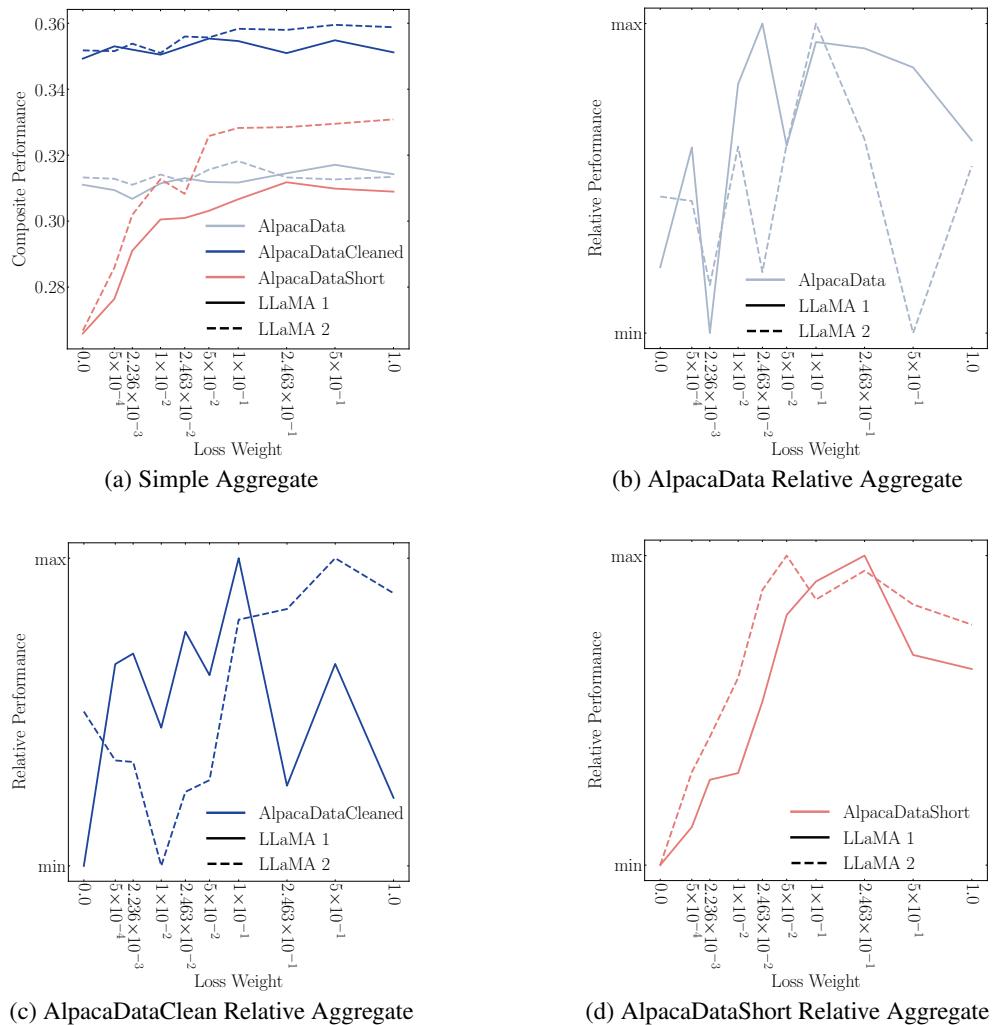
Focus on Panel (d) in the image above (the red line). This chart represents the relative performance of models trained on the Short dataset.
- The Curve: You can clearly see the “bump.” Performance is lower at PLW=0 (far left), rises as PLW increases, and then drops off as PLW approaches 1.0.
- The Implication: If you are training a model for short-form tasks (like predicting the original prompt, or by extension, classification), masking the prompt (PLW=0) is suboptimal. You get better results by setting a fractional weight (e.g., 0.1).
Task-Specific Performance Breakdown
The “optimal” PLW wasn’t the same for every benchmark. The researchers categorized the evaluation benchmarks into groups.
Group I: Multiple Choice & Short Generation Benchmarks like ARC Challenge, PIQA, and WinoGrande showed the classic inverted U-shape.
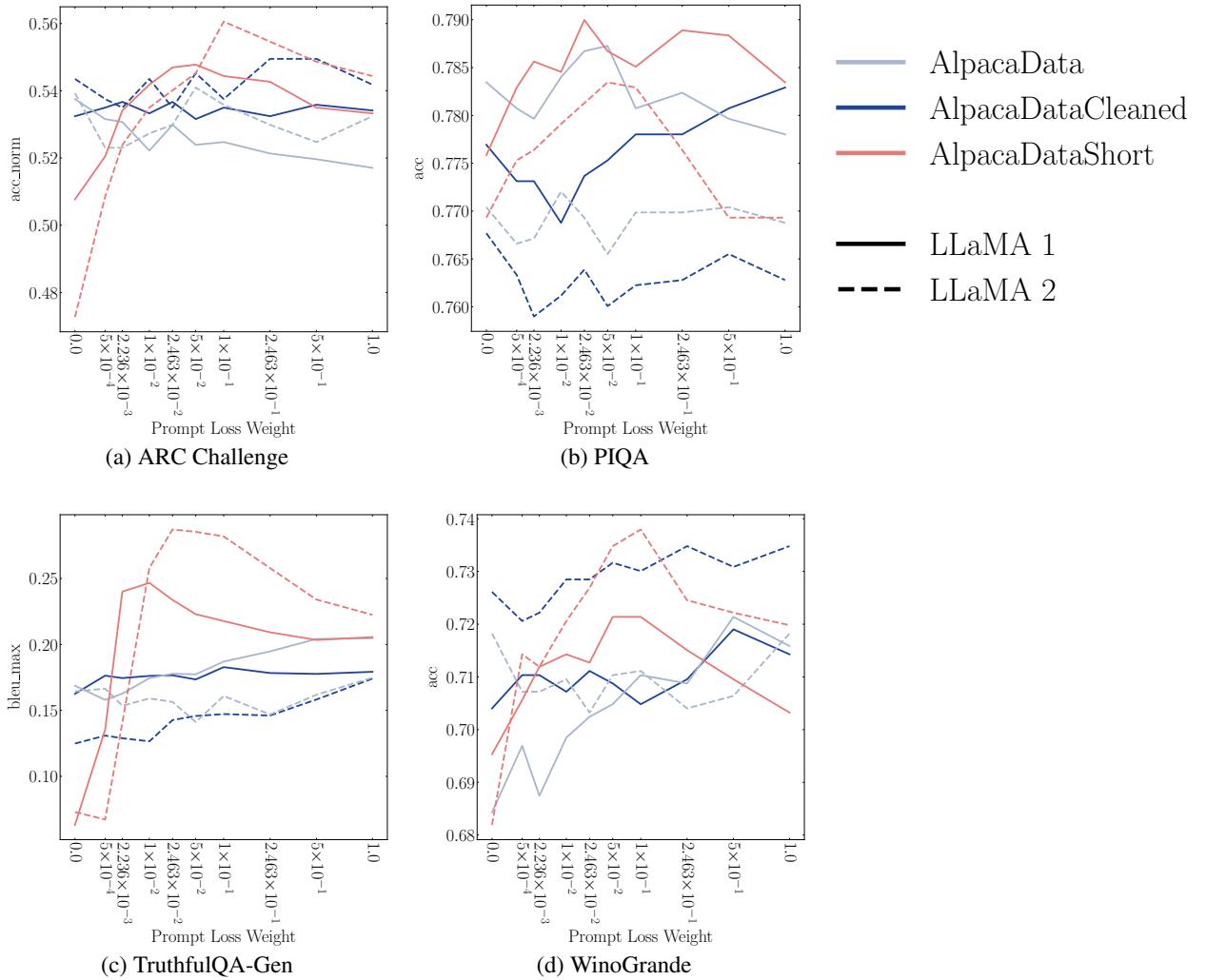
In Figure 5, look at the red lines (AlpacaDataShort). The performance peaks early, somewhere between PLW 0.01 and 0.1. This confirms that for reasoning tasks requiring short answers, a small amount of prompt loss acts as a performance booster.
Group II: Long Generation Benchmarks like AlpacaEval and PandaLM (where the model generates long open-ended text) showed a different trend: they kept getting better as PLW increased, even up to 1.0.
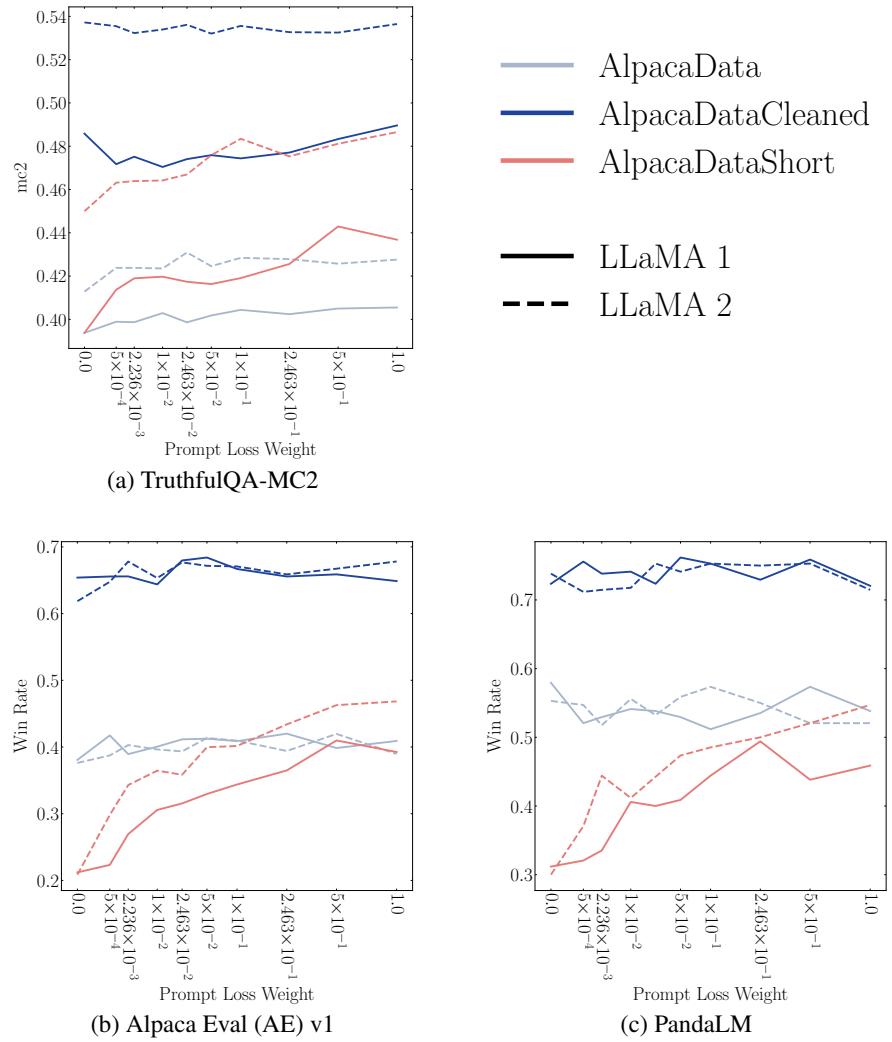
Figure 6 shows this upward trend. This is fascinating: even though the model was fine-tuned on short data, training heavily on the prompt (PLW \(\approx\) 1.0) helped it perform better on long generation evaluations. Why? The authors suggest that without PLW, models trained on short data become “overly concise.” Training on the prompt helps them retain the ability to generate fluent, longer sequences.
The Causal Mechanism: Debunking “Stability”
So, why does this happen? OpenAI originally claimed it was about training stability. The idea was that short completions provide “sparse” gradients, leading to erratic training.
The researchers tested this by measuring the Relative Standard Deviation (RSD) of the training loss. If stability were the key, we would expect the best-performing models to have the most stable (lowest variance) loss.
Figure 2 reveals a contradiction to the stability hypothesis.
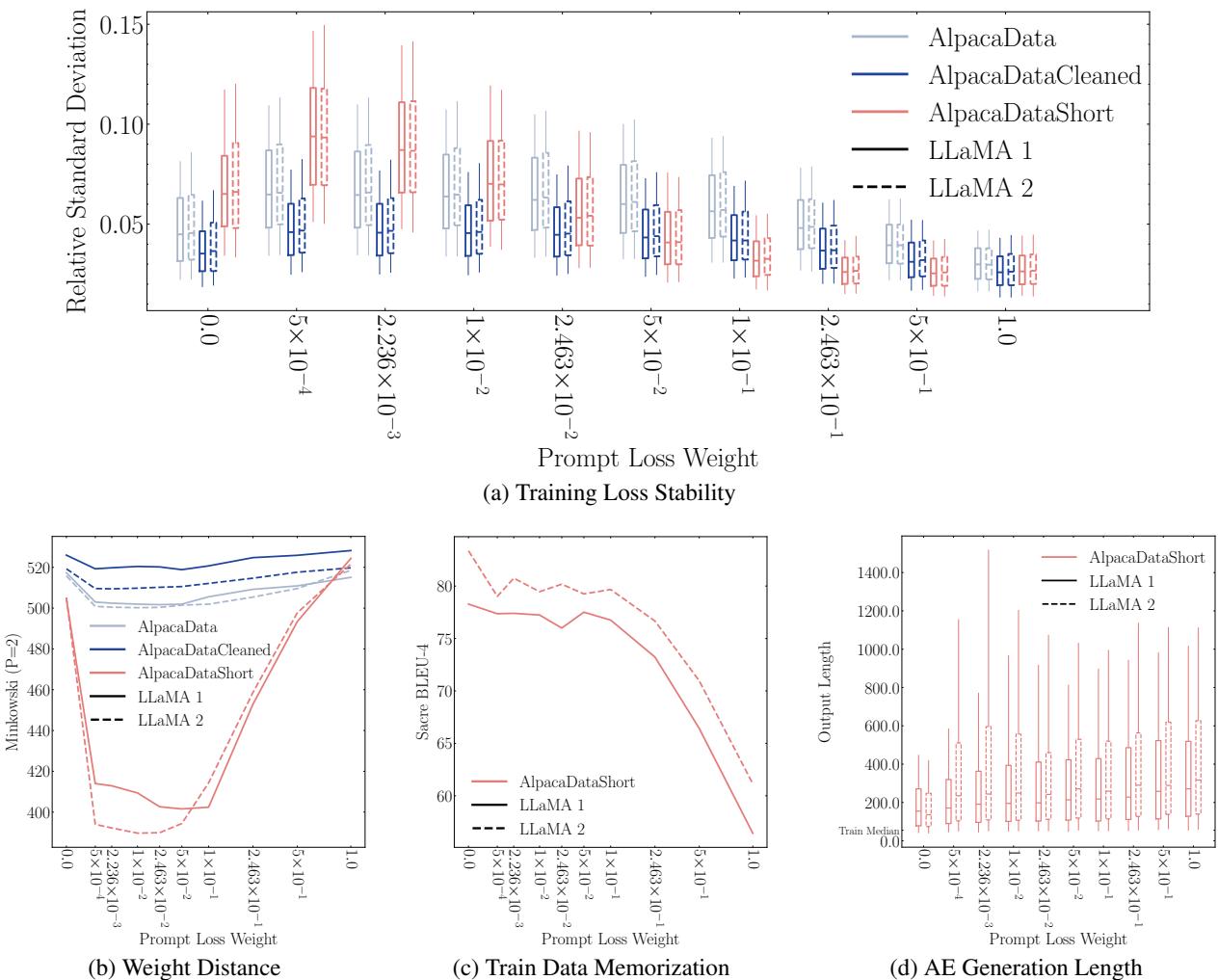
Look at Panel (a) in Figure 2.
- The x-axis is PLW. The y-axis is loss instability.
- Notice that as soon as you move from PLW 0 to PLW 0.0005, instability spikes.
- Yet, we know from the previous results that performance improves in this range.
- Therefore, increased stability is NOT the cause of improved performance. In fact, the models performed better despite being less stable during training.
The Real Driver: Regularization vs. Overfitting
If it’s not stability, what is it? The authors propose two competing mechanisms:
Weight Regularization (Panel b): When PLW is small but non-zero, the distance between the fine-tuned model’s weights and the original pre-trained model’s weights is smaller. This suggests that prompt loss acts as a regularizer, keeping the model “anchored” to its pre-trained knowledge base. This is crucial when the instruction dataset is small or specialized.
Preventing Memorization (Panel c): Panel (c) shows “Train Data Memorization” (measured by BLEU scores on the training set). High scores mean the model is just memorizing the training data. Notice that as PLW increases (moving right), the memorization score drops. This means prompt loss prevents the model from overfitting to the specific prompt-response pairs in the training set.
The Conclusion: PLW works because it strikes a balance. It prevents the model from drifting too far from its foundation (regularization) and prevents it from simply memorizing short answers (overfitting).
Can Other Regularizers Replace PLW?
A skeptic might ask: “If it’s just regularization, can’t we use standard techniques like Weight Decay, Dropout, or Label Smoothing instead?”
The authors ran supplemental experiments to test this. They compared optimal PLW against these standard regularization techniques on the AlpacaDataShort dataset.
Figure 8 displays the comparison.
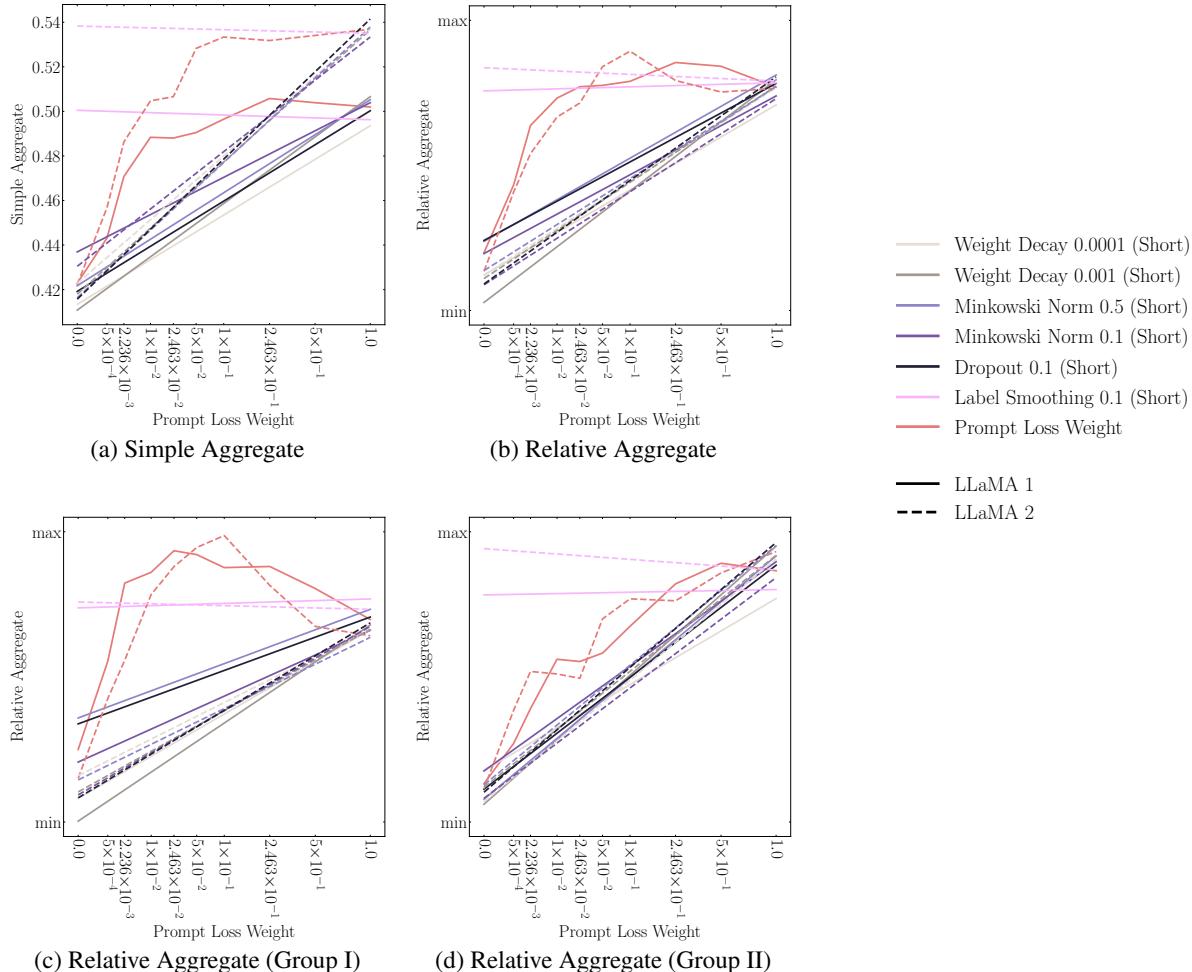
Focus on Panel (b). The red curve (PLW) achieves a higher peak relative performance than the flat lines representing Weight Decay, Dropout, or Label Smoothing.
While standard regularizers helped somewhat, they could not match the performance boost provided by tuning the Prompt Loss Weight. This suggests that PLW provides a unique type of regularization specific to the structure of instruction fine-tuning that cannot be easily replicated by generic methods.
Practical Implications: How to Choose PLW
The paper’s findings are a wake-up call for API providers and practitioners. If you are fine-tuning a model for a task with short outputs (like classification, extraction, or multiple choice), you should not ignore the prompt loss.
But what value should you pick?
The authors generated a predictive model based on their experiments to suggest optimal PLW values based on the Completion-Prompt Ratio (\(R_g\)).
Figure 10 visualizes this “Sweet Spot.”
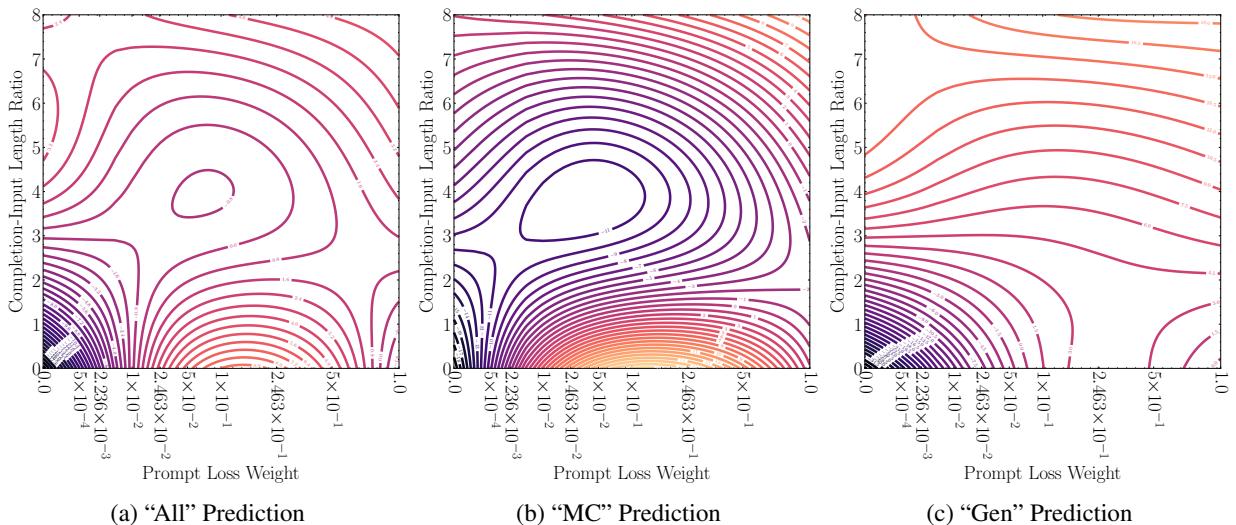
While the heat map can be dense, the authors break it down into a simplified table (referencing the paper’s data):
- If \(R_g > 1.5\) (Long Output): PLW matters less. You can use 0 (default) or small values.
- If \(R_g \approx 1.0\) (Balanced): A PLW around 0.15 - 0.2 is optimal.
- If \(R_g < 0.5\) (Short Output): A PLW around 0.1 - 0.2 is generally best for general performance. However, if your specific goal is purely Multiple Choice accuracy, you might want a slightly distinct value compared to if your goal is text generation.
Conclusion
The removal of the prompt_loss_weight parameter by major API providers may have been premature. This research highlights a nuanced reality of Large Language Model training: one size does not fit all.
While prompt masking is a safe default for creative generation and long-form chat, it is demonstrably suboptimal for short-form tasks. The authors have shown that:
- Context Matters: The length of your target output relative to your input (\(R_g\)) dictates your training strategy.
- Don’t Blame Stability: The benefit of prompt loss isn’t about stabilizing gradients; it’s about anchoring the model (regularization) and preventing rote memorization.
- No Easy Substitute: You can’t just swap in Dropout or Weight Decay and expect the same results.
For students and researchers, this paper serves as an excellent example of why we must question “default” settings. In the search for better instruction-following models, sometimes the answer lies not in a bigger model, but in simply paying attention to the prompt.