](https://deep-paper.org/en/paper/2401.17169/images/cover.png)
Introduction
We often talk about Large Language Models (LLMs) as being “intelligent,” capable of passing the Bar exam, writing code, and summarizing history. But when we strip away the vast encyclopedic knowledge and look at the bare metal of reasoning, how smart are they really? Specifically, do they understand the fundamental logic that underpins human language?
A recent paper titled “Conditional and Modal Reasoning in Large Language Models” by researchers from UC Berkeley, NYU, and MIT takes a magnifying glass to this exact question. Instead of testing models on math word problems or trivia, the researchers probed something more subtle but arguably more fundamental: the ability to reason about possibilities.
This involves two linguistic concepts:
- Conditionals: “If \(p\), then \(q\).”
- Epistemic Modals: Words like “might,” “must,” or “possibly.”
These are the building blocks of planning and causal reasoning. When you decide to bring an umbrella because it might rain, or when a doctor deduces that a patient must have an infection based on symptoms, they are using conditional and modal logic.
The researchers tested 29 different LLMs, including GPT-4, Claude, Llama, and Mistral. The results paint a fascinating picture: while models have mastered the basics, they crumble when faced with the nuanced logic of natural language, often committing basic fallacies and contradicting themselves.
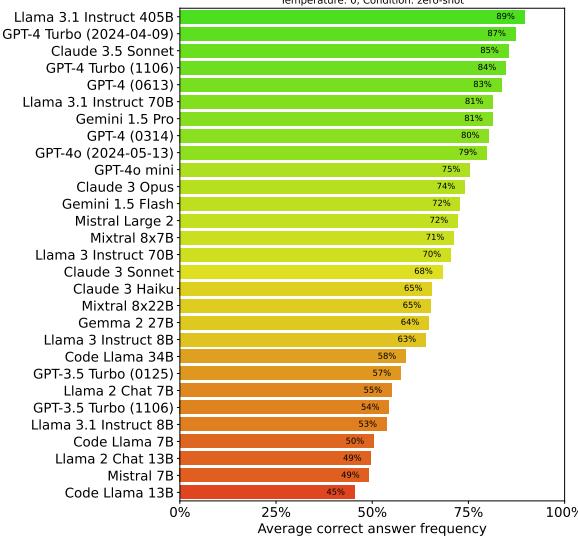
As shown in Figure 1 above, even top-tier models like Llama 3.1 405B and GPT-4 hover around 80-90% accuracy on basic tasks, while smaller models struggle significantly. But the aggregate scores hide the real story, which lies in how they fail.
The Landscape of Logical Inference
To understand this research, we first need to define what we mean by “logical inference.” In the context of this paper, the authors aren’t talking about “common sense” reasoning (e.g., “If I drop a glass, it breaks”). They are talking about formal validity. An inference is valid if the conclusion must be true whenever the premises are true, regardless of what the specific words mean.
The Problem with “If”
In classical logic (the kind you might learn in a Computer Science 101 class), the statement “If \(p\), then \(q\)” is treated as a Material Conditional. A material conditional is only false if \(p\) is true and \(q\) is false.
This definition works for computers, but it is terrible for human language. For example, under the material conditional, the statement “If I am the King of France, then the moon is made of cheese” is technically true simply because the first part (me being the King) is false.
Humans don’t think like that. When we say “If,” we usually mean we are looking at a set of possible worlds where the first part is true, and checking if the second part holds up. This is where Modals (might/must) enter the picture.
The researchers curated a set of inference patterns—some valid, some invalid—to test if LLMs track with human logical intuitions or if they are stuck using the rigid (and often incorrect) material conditional.
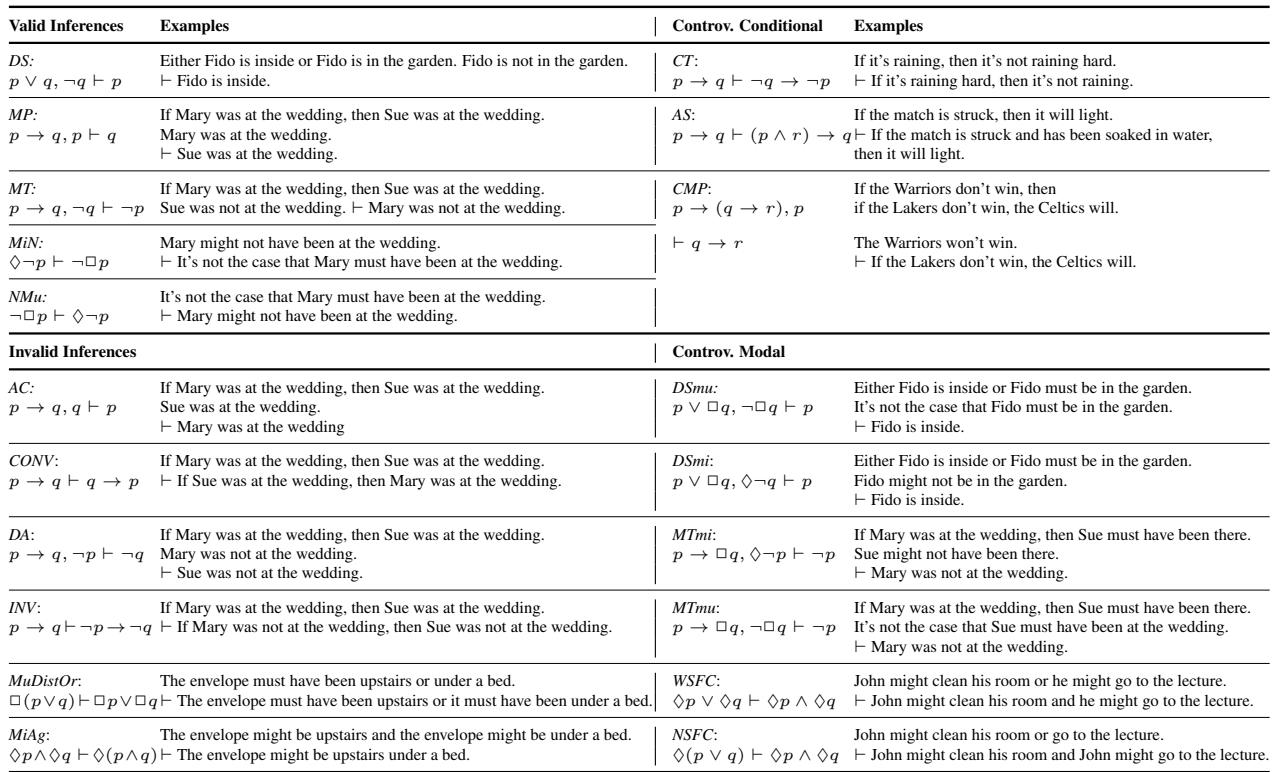
Table 1 provides the menu of logic puzzles used in the study. Let’s break down a few key acronyms you’ll see throughout this post:
- MP (Modus Ponens): If \(p\) then \(q\); \(p\) is true; therefore \(q\). (Valid)
- MT (Modus Tollens): If \(p\) then \(q\); \(q\) is not true; therefore \(p\) is not true. (Valid)
- AC (Affirming the Consequent): If \(p\) then \(q\); \(q\) is true; therefore \(p\). (Invalid fallacy).
The researchers didn’t just use standard sentences. To ensure models weren’t just memorizing facts, they used “nonsense” predicates (e.g., “If the flugel was blimmed…”) and complex combinations of “might” and “must.”
The Methodology
The study evaluated 29 models, ranging from open-weights models like Llama and Mistral to proprietary giants like GPT-4 and Claude 3. They used three prompting setups:
- Zero-shot: Just asking the question directly.
- Few-shot: Giving the model a few examples of logical tasks first.
- Chain-of-Thought (CoT): Asking the model to “think step-by-step” before answering.
The goal was to see if the models could distinguish valid inferences from invalid ones.
The Results: The Good, The Bad, and The Inconsistent
1. The Power of “Thinking”
One of the first major findings is that prompting strategy matters. When models are asked to reason step-by-step (Chain-of-Thought), their logical accuracy improves dramatically compared to zero-shot or few-shot attempts.
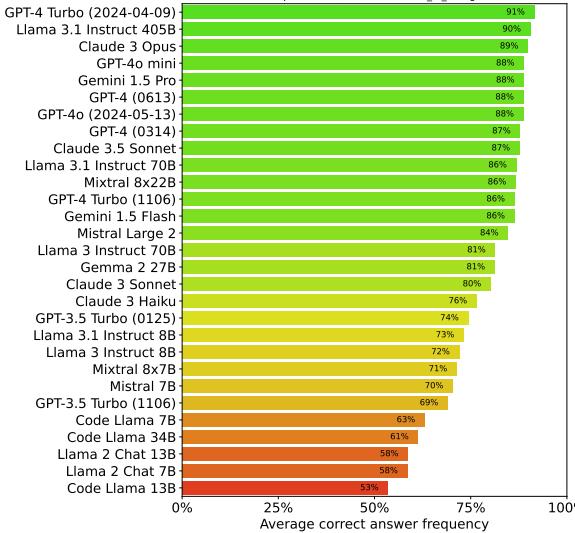
As Figure 7 shows, looking at the Chain-of-Thought (CoT) bars, the best models approach 90% accuracy on the “uncontroversial” inferences. This suggests that the latent capacity for logic is there, but it needs to be “unlocked” by forcing the model to verbalize its steps. However, even with CoT, significant gaps remain.
2. The Trap of Overgeneralization
Here is where the study gets truly interesting. The models are generally good at standard logic (like Modus Tollens) when the sentences are simple.
Standard Modus Tollens (Valid):
- Premise 1: If logical reasoning is easy, then I am happy.
- Premise 2: I am not happy.
- Conclusion: Logical reasoning is not easy.
LLMs get this right. But what happens when we introduce modals like “must” and “might”?
Modus Tollens with Must (MTmu):
- Premise 1: If Fido is playing, he must be in the garden.
- Premise 2: It is not the case that Fido must be in the garden (maybe he’s in the garden, maybe he isn’t; we just aren’t certain).
- Conclusion: Fido is not playing.
To a human logician (and ordinary speakers), this inference is invalid. Just because we aren’t certain (must) that he is in the garden doesn’t mean he isn’t playing. We just lack information.
However, LLMs struggle here. They “overgeneralize.” They see the structure of Modus Tollens and blindly apply the rule, ignoring the meaning of the word “must.”
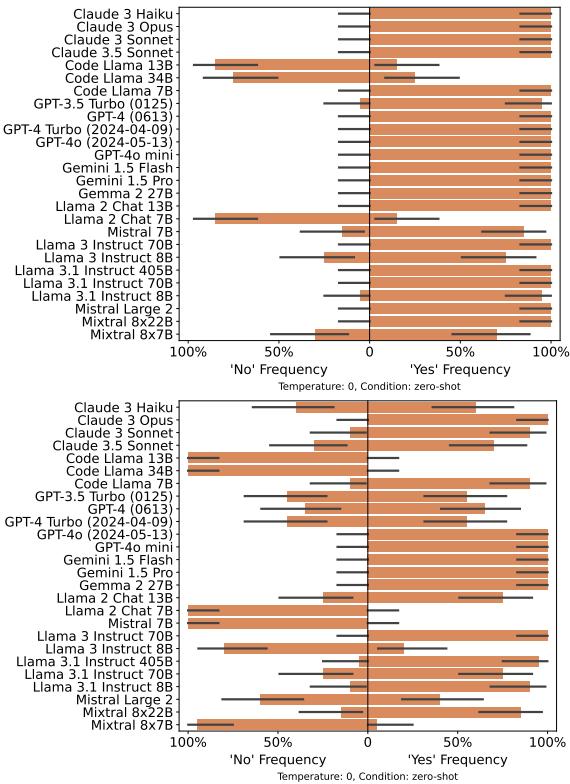
In Figure 2, we see a clash. In the top chart (MTmu), many models (the orange bars extending right) incorrectly say “Yes,” validating the fallacy.
But look at the bottom chart (MTmi). This tests a logically equivalent scenario using “might not” instead of “not must.”
- Premise: If Fido is playing, he must be in the garden.
- Premise: Fido might not be in the garden.
- Conclusion: Fido is not playing.
Logically, “It is not the case that he must” and “He might not” mean roughly the same thing. Yet, the models treat them differently. This reveals a deep logical inconsistency. The models aren’t reasoning about the world or the meaning; they are reacting to the specific syntax of the sentence.
3. The Fragility of Context
The researchers dug deeper into this inconsistency. They asked the models about these related logical puzzles within the same context window to see if the models could maintain a coherent worldview.
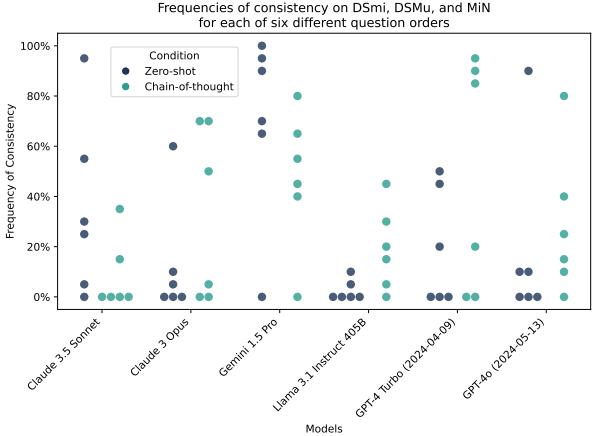
Figure 4 is perhaps the most damning visualization in the paper. It shows the percentage of time models were “jointly consistent” across three related questions. The dots represent different orders of asking the questions.
The spread of the dots shows that question order matters. If you ask the questions in one order, the model might appear consistent. Ask them in a different order, and the model contradicts itself. This sensitivity to order is highly undesirable for a system designed to be a reliable reasoner.
4. The Complex Conditional Failure (CMP)
One of the most complex tests involved a pattern called CMP (Conditional Modus Ponens), based on a famous counterexample by philosopher Vann McGee.
Imagine a sports tournament with three teams: The Lakers (favorites), the Warriors (runner-ups), and the Celtics (long shots).
- We know: If the Lakers don’t win, and the Warriors don’t win, the Celtics will.
- We know: The Lakers probably will win (so the Warriors probably won’t).
Does it follow that: If the Lakers don’t win, the Celtics will?
No! If the Lakers don’t win, the Warriors are the most likely logical alternative, not the Celtics.
Human experts reject this inference. But LLMs? They swallow it hook, line, and sinker.
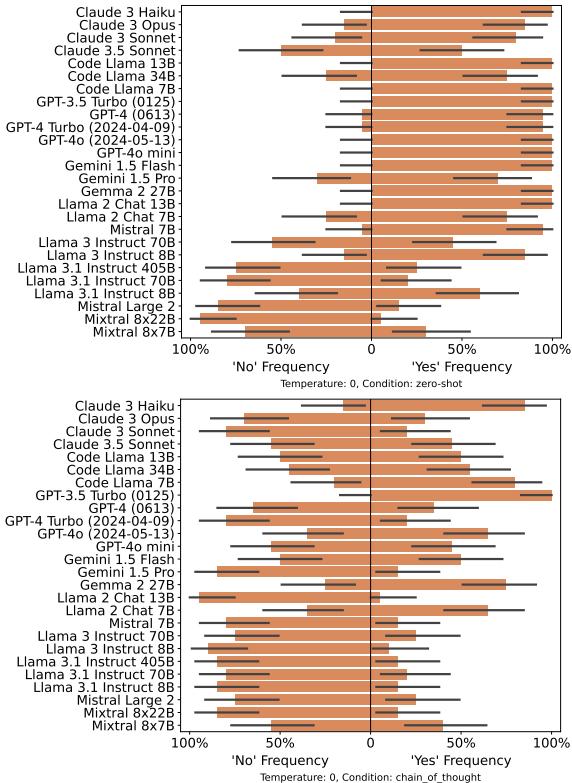
Figure 5 shows that almost all models (high orange bars) incorrectly accept this inference in the zero-shot setting. While Chain-of-Thought (bottom chart) helps Claude 3 Opus and GPT-4 slightly, the vast majority still fail to grasp the probabilistic nuance of nested conditionals. They see “If X then Y” and assume it must hold true, ignoring the context that makes it unlikely.
Why Does This Matter?
You might be thinking, “Who cares if ChatGPT can’t solve a sports betting logic puzzle?”
The implications go beyond logic puzzles. The study found that performance on these conditional reasoning tasks correlates strongly with performance on broader benchmarks.
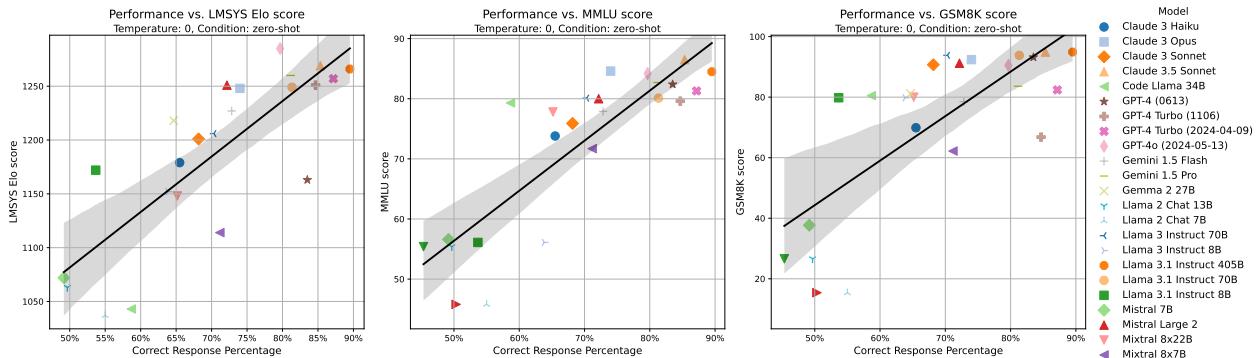
As shown in Figure 6, there is a strong linear correlation between a model’s ability to handle this logic and its:
- LMSYS Elo: How helpful humans find the chatbot in general conversation.
- MMLU: A massive test of knowledge across logical and scientific domains.
- GSM8k: Mathematical reasoning.
This suggests that logical reasoning isn’t just a niche skill; it is a proxy for general intelligence and capability. If a model cannot understand the difference between “might” and “must,” its ability to perform reliable causal reasoning, debugging, or strategic planning is suspect.
Conclusion
The paper “Conditional and Modal Reasoning in Large Language Models” serves as a reality check. LLMs have made incredible strides, and their ability to perform standard logical deductions is impressive. However, they are still prone to:
- Overgeneralization: Applying simple logic rules to complex modal sentences where they don’t belong.
- Inconsistency: Contradicting themselves based on phrasing or question order.
- Probabilistic Blindness: Failing to track how “if” statements relate to likelihoods in real-world scenarios.
The authors conclude that while techniques like Chain-of-Thought help, we are not yet at the point where LLMs possess a robust, human-like command of logical consequence. They are mimicking the forms of logic without fully grasping the content of possibilities.
For students and developers working with these models, the takeaway is clear: LLMs are powerful tools, but when it comes to high-stakes reasoning involving ambiguity, possibility, or necessity, we must verify their “logic” with extreme care. They might sound like Spock, but sometimes, they’re just guessing.