](https://deep-paper.org/en/paper/2402.02636/images/cover.png)
Introduction
We are living in the golden age of Large Language Models (LLMs). Systems like GPT-4 and LLaMA have revolutionized how we interact with technology, demonstrating linguistic prowess that often feels like genuine intelligence. However, there is a “ghost in the machine.” Despite their fluency, these models often fail spectacularly when faced with tasks that require rigorous logical consistency or when the data distribution shifts slightly from what they saw during training.
This fragility stems from a fundamental limitation: standard LLMs are statistical correlation machines. They predict the next word based on probability, not based on an understanding of the underlying causes and effects that govern the world. They lack Causal Reasoning.
In the research paper “Can Large Language Models Learn Independent Causal Mechanisms?”, researchers from the University of Auckland propose a novel architecture designed to bridge this gap. They introduce Independent Causal Language Models (ICLM), a modular framework that forces an LLM to separate abstract reasoning (domain-invariant knowledge) from specific surface-level details (domain-specific knowledge).
In this post, we will deconstruct this paper, exploring how we can use principles from Causal Inference to build more robust, generalizable AI.
Background: The Generalization Problem
To understand why this research is necessary, we must first understand the “Out-of-Distribution” (OOD) problem.
Imagine training a model to solve math problems. If you train it only on problems written in English, and then test it on the same problems written in French, a standard model might fail. The logic of the math hasn’t change (it is invariant), but the surface form has (it is specific). Standard LLMs tend to entangle these two concepts. They learn “Math in English” rather than “Math” + “English.”
This entanglement makes models brittle. The researchers draw upon the Independent Causal Mechanisms (ICM) principle to solve this. The ICM principle states that the world is composed of autonomous modules (mechanisms) that do not influence each other directly. For example, the mechanism that determines the altitude of the sun is independent of the mechanism that determines the temperature of your coffee, even though both contribute to your current environment.
If we can architect LLMs to respect this independence—separating the “logic” mechanism from the “domain” mechanism—we might achieve true generalization.
The Core Method: Independent Causal Language Models (ICLM)
The researchers propose a modular architecture that splits a standard LLM into distinct, specialized components. Instead of one giant neural network processing everything, the ICLM divides the labor.
The Architecture
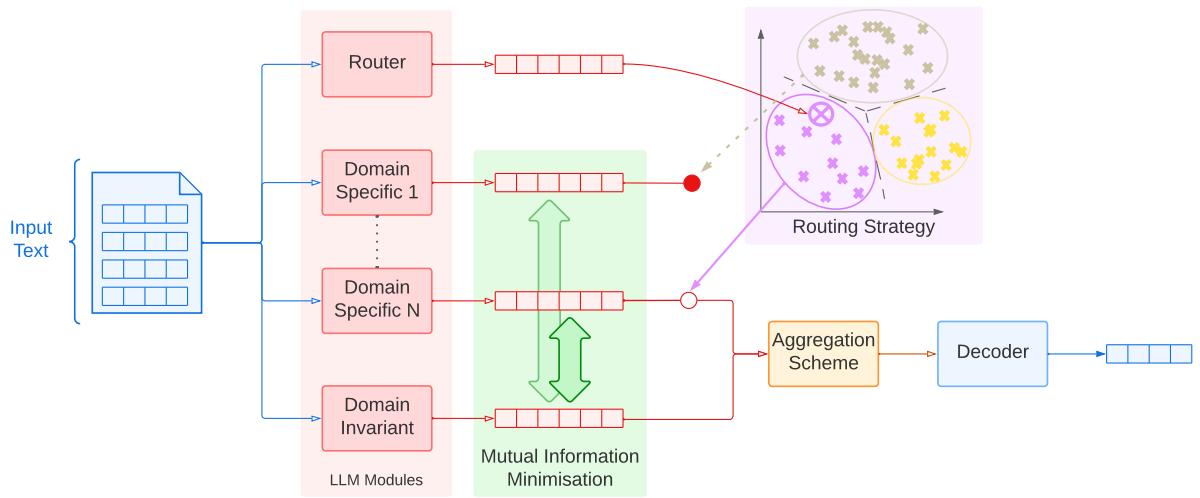
As shown in Figure 1, the architecture processes input text through a specific pipeline:
- The Router: The input is first analyzed by a “Router.” This component decides which specific “expert” module handles the input.
- Domain-Specific Modules: These are LLM modules specialized for specific tasks or data distributions (e.g., a specific text format).
- Domain-Invariant Module: This is a crucial addition. This module is always active. Its job is to capture high-level abstractions and logic that apply regardless of the specific domain.
- Aggregation: The outputs of the chosen Domain-Specific module and the Domain-Invariant module are combined to produce the final prediction.
Routing via Vector Quantization
How does the router know which module to pick? The researchers avoid simple supervised classification. Instead, they use an unsupervised clustering method called Vector Quantization.
The router projects the input text into an embedding space. It maintains a set of “cluster centroids”—prototypical points in that space. The input is assigned to the cluster it is closest to.

The loss function above drives this process. It pulls the cluster centroids (\(h_c\)) closer to the actual input embeddings (\(h_r\)) and pulls the embeddings toward the centroids. This creates distinct groupings in the data without requiring human labels.
Forcing Abstraction: Mutual Information Minimization
The magic of this architecture lies in how it forces the Domain-Invariant module to actually be invariant. Without constraints, this module might just memorize domain-specific shortcuts.
To prevent this, the researchers use Mutual Information (MI) Minimization. In information theory, Mutual Information measures how much knowing one variable tells you about another. If the Invariant module and the Specific module are truly doing different jobs, their internal states should share very little information.

The equation above calculates the Kullback-Leibler (KL) divergence between the joint distribution of the hidden states and the product of their marginals. In simple terms: we want the statistical dependence between the Invariant module (\(H_I\)) and the Specific module (\(H_S\)) to be zero.
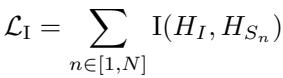
By minimizing this quantity (shown above), the network is penalized if the Invariant module “peeks” at the specific details handled by the Specific module. This forces the Invariant module to discard surface-level details (like whether the text is symbolic or natural language) and focus purely on the abstract reasoning required to solve the task.
The Total Training Objective
The model is trained using a composite loss function that balances accuracy with these causal constraints.

The total loss \(\mathcal{L}\) combines:
- Performance Losses (\(\mathcal{L}_o, \mathcal{L}_{inv}, \mathcal{L}_{dom}\)): Ensuring the model actually predicts the next token correctly.
- Routing Loss (\(\mathcal{L}_R\)): Ensuring the router clusters data effectively.
- Independence Loss (\(\mathcal{L}_I\)): The Mutual Information penalty described above.
Theoretical Perspective
The authors go beyond architecture and provide a theoretical justification using Causal Graphs.
In a causal graph, nodes represent variables and arrows represent causal influence. The goal is to prove that the modules are causally independent.
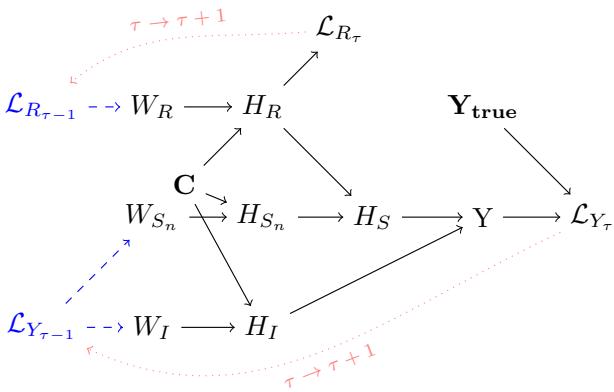
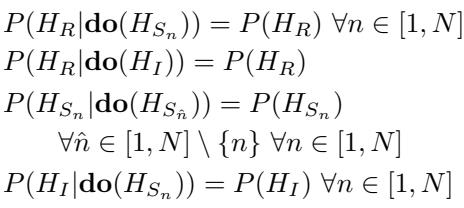
Figure 2 shows the causal flow. The input context \(C\) influences both the Router (\(H_R\)) and the Modules (\(H_S, H_I\)). However, because of the specific training setup (separate losses and vector quantization), the researchers argue that specific causal interventions hold true.
For example, they aim to satisfy the condition that intervening on the invariant module should not change the router’s state, and vice versa.
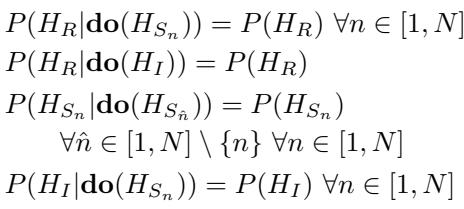
However, a challenge arises. Because the Domain-Invariant module is always active, it creates a “backdoor path” connecting different inputs over time. This theoretically violates the strict independence required by the ICM principle.
This is exactly why the Mutual Information Minimization is mathematically essential. By driving the shared information to zero, the authors effectively “cut” the informational edge between the modules, restoring the causal independence shown in the equations above (specifically Equations 7 and 8 in the original paper).
Experiments and Results
Does this causal architecture actually result in better reasoning? The researchers tested ICLM on two difficult abstract reasoning datasets: ACRE and RAVEN. These datasets require the model to deduce rules and patterns, rather than just recalling facts.
Out-of-Distribution (OOD) Performance
The primary test is how well the model handles data it hasn’t seen before.
- i.i.d: Independent and Identically Distributed (Test set looks like the Training set).
- O.O.D: Out of Distribution (Test set follows different rules or composition).


As shown in Table 4 and Table 5, the ICLM model (and its variants) consistently matches or outperforms the baselines.
- ACRE: ICLM achieves competitive results on the standard text, but notice the Symbolic performance. The model effectively separates the format (text vs. symbol) from the logic.
- RAVEN: The results here are even more striking. On the “In-Center” OOD task (a geometry shift), the domain-specific modules struggle, but the overall system maintains higher robustness.
Continual Learning
One of the most persistent problems in AI is Catastrophic Forgetting. When an LLM learns a new task, it often forgets the old one.
Because ICLM uses specialized modules, it can “lock” the knowledge of a previous task in one module and use a fresh module for a new task. The experiments showed that ICLM retained significantly more knowledge of the ACRE dataset after being trained on RAVEN compared to a standard LLaMA2 model.
Analyzing the “Independence”
Did the model actually learn independent mechanisms? The researchers tracked the Mutual Information loss during training.
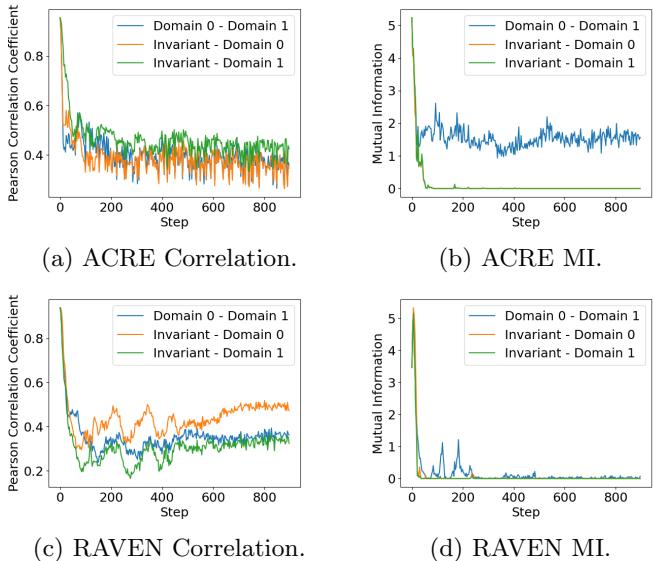
Figure 3 shows the training process. The Mutual Information (MI) drops sharply (graphs b and d), confirming that the regularization works: the modules effectively stop “sharing” information.
However, an interesting phenomenon occurs during inference (test time):
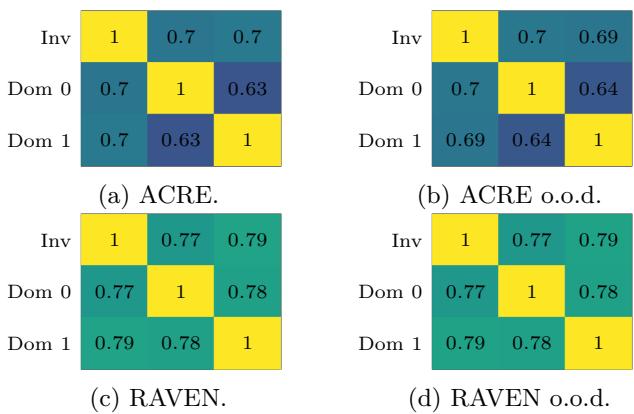
As seen in Figure 4, while independence is forced during training, the hidden states remain correlated during inference. This suggests that while the modules are specialized, they likely rely on a shared, fundamental “reasoning engine” present in the pre-trained LLaMA backbone. The ICLM fine-tuning refines this, but doesn’t completely sever the underlying connections of the base model.
Visualizing the Router’s Brain
Finally, it is fascinating to see how the Router organizes the world. The researchers projected the Router’s hidden states into 2D space.

In Figure 13, we see distinct clusters for different datasets (ACRE, ARC, PVR, RAVEN). The router naturally learns to separate these domains without being explicitly told which dataset is which. This unsupervised discovery of domain structure is a key capability for building autonomous agents.
Conclusion & Implications
The ICLM architecture represents a significant step toward “System 2” thinking in Large Language Models—the ability to reason deliberately and abstractly rather than just intuitively matching patterns.
Key Takeaways:
- Modularity is Key: Breaking an LLM into specialized components (Specific vs. Invariant) improves robustness.
- Causality aids Generalization: forcing modules to be statistically independent helps the model separate “style” from “substance,” leading to better Out-of-Distribution performance.
- Unsupervised Routing: LLMs can learn to self-organize input data into meaningful clusters using Vector Quantization.
While the model doesn’t fully solve the reasoning gap—the modules still exhibit some correlation at test time—it provides a blueprint for the future. By constraining our AI systems to respect the principles of causality, we can move from stochastic parrots to genuine reasoners.