](https://deep-paper.org/en/paper/2402.04401/images/cover.png)
Imagine you have a personal assistant who has been with you for ten years. When you ask them to “write an email to the boss,” they don’t need a ten-page style guide or a stack of your previous emails to get the tone right. They just know how you sound. They know you prefer “Best regards” over “Sincerely,” and that you tend to be concise on Mondays.
Now, compare that to a Large Language Model (LLM) like GPT-4 or Llama-2. These models are incredibly capable, but they are “one-size-fits-all.” To make them sound like you, you usually have to stuff the prompt with examples of your writing or detailed instructions. This is the current state of personalization in AI: it’s mostly done through prompt engineering and context retrieval.
But what if you could actually “own” a piece of the model? What if a small slice of the neural network’s brain was dedicated entirely to your specific behavior patterns?
In this post, we are diving deep into a paper titled “Democratizing Large Language Models via Personalized Parameter-Efficient Fine-tuning.” The researchers propose a novel framework called OPPU (One PEFT Per User). It’s an approach that moves personalization from the context window into the model parameters themselves, offering better performance, privacy, and ownership.
The Problem: Why Prompting Isn’t Enough
Before we understand the solution, we have to understand why current methods fall short. Right now, if we want to personalize an LLM, we usually rely on Non-Parametric Knowledge. This effectively means we aren’t changing the model’s brain (its parameters); we are just feeding it information (context) at the moment of inference.
There are three common ways this is done:
- Vanilla Personalization: Pasting your history directly into the prompt.
- Retrieval-Augmented Generation (RAG): Searching a database of your history for relevant snippets and adding them to the prompt.
- Profile Augmentation (PAG): Using an AI to summarize your preferences into a “profile” text, which accompanies every query.
While these methods work to an extent, they face two massive hurdles: Ownership and Behavior Shift.
Challenge 1: Ownership and Privacy
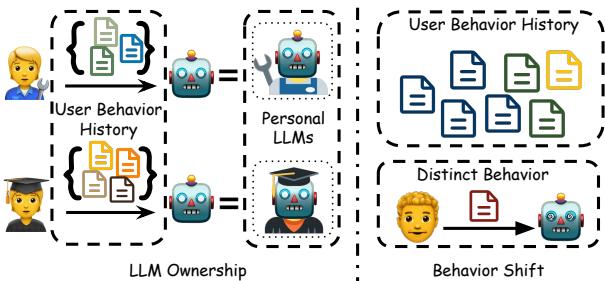
As shown in the left panel of Figure 1 above, true customization implies ownership. In standard RAG or PAG setups, your data (history and profiles) is often sent to a centralized model API. You don’t “own” the model; you are just a user renting time on a giant, generalized brain. This raises significant privacy concerns. If the model is centralized, how is your data stored? Who sees it?
Challenge 2: Behavior Shift and Distraction
The second challenge is subtler but equally frustrating. Humans are dynamic. Your behavior shifts. Sometimes you write formal reports; sometimes you tweet casual jokes.
When using Retrieval (RAG), the system looks for history similar to your current query. But what if you are doing something new? If you are writing about a topic you’ve never discussed before, the retriever might fetch irrelevant old history. Research shows that LLMs are easily “distracted” by irrelevant context. If the retrieved history doesn’t match the current task, the model gets confused, often performing worse than a standard, non-personalized model.
The Solution: One PEFT Per User (OPPU)
To solve these problems, the researchers introduce OPPU. The core idea is simple but powerful: instead of relying solely on external context (prompting), let’s bake the user’s personality into the model’s weights using Parameter-Efficient Fine-Tuning (PEFT).
What is PEFT?
Fine-tuning a massive 7-billion or 70-billion parameter model for every single user is impossibly expensive. It would require storing a copy of the entire model for everyone.
PEFT techniques, like LoRA (Low-Rank Adaptation), solve this. They freeze the massive base model and only train a tiny set of adapter layers (often less than 1% of the total parameters). These tiny layers are lightweight and portable.
How OPPU Works
OPPU suggests that every user gets their own personal PEFT module.
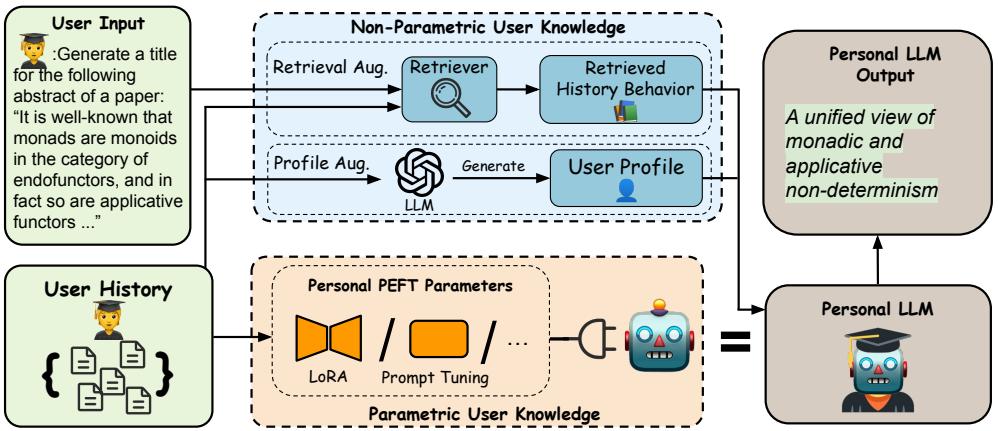
As illustrated in Figure 2, the architecture combines two worlds:
- Parametric Knowledge (Orange Box): This is the user’s “owned” slice of the brain. It is a LoRA module trained specifically on that user’s history. It captures deep behavioral patterns—like how you write, not just what you write about.
- Non-Parametric Knowledge (Blue Box): OPPU doesn’t discard RAG or profiles. It treats them as complementary. You can still retrieve relevant history, but it flows through a model that has already been fine-tuned to your style.
This hybrid approach allows users to “plug in” their personal parameters to a base LLM. The service provider hosts the heavy base model, while the user owns the lightweight PEFT file.
The Mathematics of Personalization
Let’s break down how this is actually trained. The researchers propose a multi-stage training process.
Stage 1: Base Model Adaptation
First, the base LLM (e.g., Llama-2) needs to be generally good at the task (like summarizing news or tagging movies), regardless of the specific user. The researchers fine-tune the base model using LoRA on a general dataset.
They define three types of base models:
- Base (B): Standard task fine-tuning.
- Retrieval-Augmented (R): Trained to expect retrieved documents in the prompt.
- Profile-Augmented (P): Trained to expect a user profile summary in the prompt.
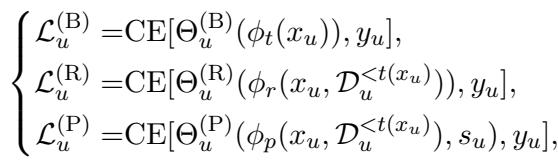
The loss functions for these base models look like this:
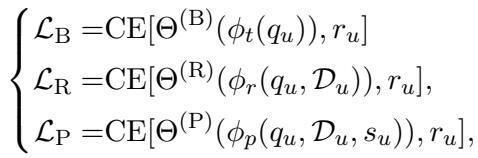
Don’t let the notation scare you. \(\mathcal{L}\) is just the loss (error) we want to minimize. \(\Theta\) represents the model parameters. The equations essentially say: “Train the model to predict the right answer (\(r_u\)) given the input query (\(q_u\)) and, optionally, retrieved documents (\(\mathcal{D}_u\)) or profiles (\(s_u\)).”
Stage 2: Personalizing the Parameters
Once the base model is ready and frozen, we create the user-specific module. For a user \(u\), we create a specific parameter update, denoted as \(\Delta\Theta_u\).
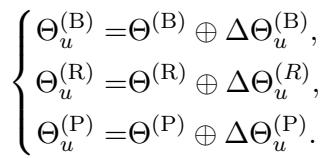
Here, \(\oplus\) represents the merging of parameters. The user gets a model that is the sum of the Frozen Base Model (\(\Theta\)) + Their Personal Module (\(\Delta\Theta_u\)).
The training objective for this personal module is to minimize the error on the user’s specific history (\(x_u\) and \(y_u\)):
This step ensures that the PEFT module captures the user’s unique style. Because this module is small, it can be trained quickly and stored cheaply.
Experimental Results: Does it Work?
The researchers tested OPPU on the LaMP Benchmark, a massive collection of personalization tasks ranging from movie tagging and news categorization to tweet paraphrasing.
The results were decisive.
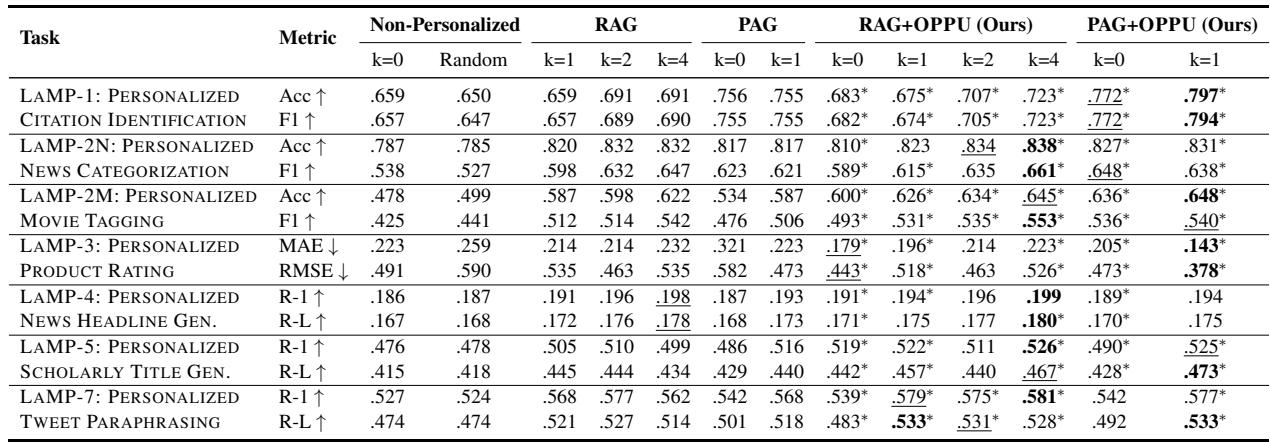
As Table 1 shows, OPPU (Our) outperforms the baselines across the board.
- vs. Non-Personalized: Huge improvements (e.g., accuracy jumps from 0.659 to 0.772 in citation identification).
- vs. RAG (Retrieval): OPPU is consistently superior. Even when RAG retrieves 4 items (\(k=4\)), adding OPPU on top boosts performance further.
- The Winner: The best results usually come from PAG + OPPU or RAG + OPPU. This confirms that parametric personalization (PEFT) and non-parametric context (Retrieval/Profiles) work best when combined.
A Concrete Case Study
Numbers are great, but let’s look at a real example to see why this matters. In the “Personalized Movie Tagging” task, the model must apply a tag to a movie description based on how the user has tagged movies in the past.
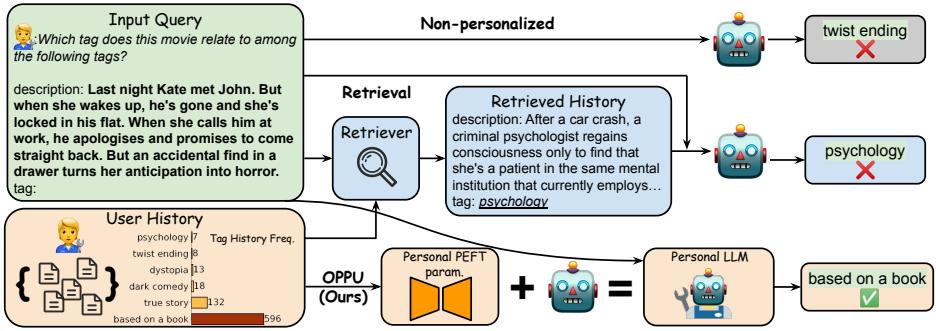
In Figure 5, we see a user who frequently uses the tag “based on a book” (16 times).
- Non-Personalized Model: Guesses “twist ending” (a generic guess). Incorrect.
- Retrieval-Augmented Model: It tries to find similar movies in history but gets distracted by the specific plot details of the query (horror, apartment). It fails to find the pattern. Incorrect.
- OPPU: The personal PEFT module has “read” the user’s entire history during training. It has internalized the user’s statistical tendency to care about whether a movie is based on a book. Correct.
This highlights OPPU’s strength: it captures patterns, not just keywords.
Why OPPU Handles “Behavior Shift” Better
One of the paper’s most interesting findings is how OPPU behaves when the user does something new.
In a traditional RAG setup, if a user asks a question that looks nothing like their history, the retriever will fetch “irrelevant” documents because it has to fetch something. This noise often confuses the model.
The researchers simulated this by forcing the retriever to fetch irrelevant history.
- Retrieval-Only: Performance crashed. It became barely better (or sometimes worse) than a non-personalized model.
- OPPU: Performance remained robust. Even without relevant context to “copy” from, the PEFT module retained the user’s general stylistic preferences and decision-making patterns.
This confirms that fine-tuning learns “how to think like the user,” while retrieval only provides “what the user said before.”
Versatility and Efficiency
You might be wondering: “Is LoRA the only way?” or “Does this take forever to train?”
Compatibility with Different PEFT Methods
The researchers tested OPPU with varying methods of fine-tuning: LoRA, Prompt Tuning, and (IA)³.
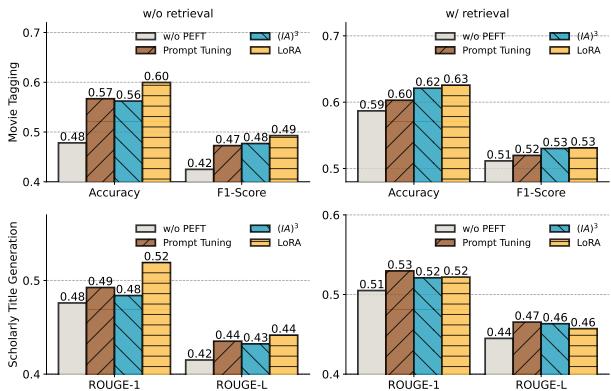
Figure 6 shows that OPPU works with all of them, but LoRA (the yellow bars) generally comes out on top. The researchers attribute this to LoRA having slightly more trainable parameters (about 0.01% of the model) compared to Prompt Tuning (0.001%). In personalization, having a little more capacity to store user quirks helps.
Impact of Retrieval Amount
Does adding more retrieval items help OPPU?
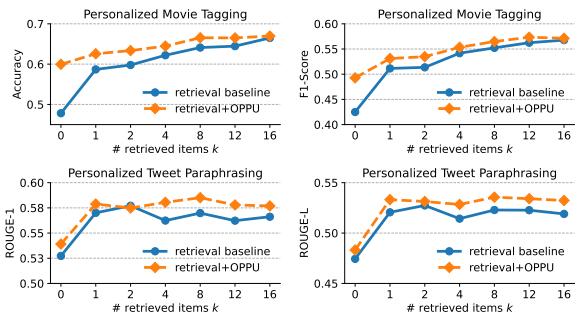
As shown in Figure 4, increasing the number of retrieved items (\(k\)) improves performance for everyone. However, the gap between OPPU (orange line) and the baseline (blue line) remains clear. Interestingly, even at \(k=0\) (no retrieval at all), OPPU performs admirably, proving that the user’s profile is successfully stored in the weights.
Efficiency
Training these modules is surprisingly fast. Because only a tiny fraction of the network is updated, training a personal module takes minutes to hours (depending on history length), not days.
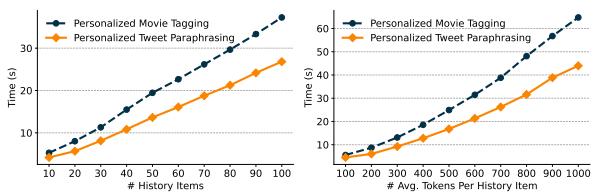
Figure 8 demonstrates that training time scales linearly. This makes the approach feasible for real-world deployment. A service provider could easily train these modules in the background.
Conclusion: The Future of AI Ownership
The “One PEFT Per User” framework represents a significant step forward in making LLMs truly personal. By separating the general capabilities (Base Model) from personal preferences (PEFT Module), OPPU solves several critical issues:
- Privacy & Ownership: You can theoretically keep your PEFT file on your device, only sending the lightweight parameters to the cloud (or running the whole thing locally if the base model is available).
- Robustness: Your model understands your style, not just your keywords. It doesn’t break when you change topics.
- Performance: It simply produces better, more aligned results than prompting alone.
As we move toward a future where everyone has an AI assistant, the “one-size-fits-all” era is ending. Approaches like OPPU ensure that your AI isn’t just a generic smart tool, but a specialized extension of your own mind—one that you actually own.