](https://deep-paper.org/en/paper/2402.05827/images/cover.png)
Imagine you are training a new employee. You tell them, “The project manager is no longer Alice; it’s now Bob.” A human employee immediately updates their mental model. They won’t accidentally call Alice the manager during a lunch break, nor will they get confused if you ask, “Who is the person in charge of the project?” using slightly different phrasing.
Now, consider Large Language Models (LLMs). We often view them as static repositories of information trained on massive datasets. But facts change. Prime ministers resign, companies rebrand, and scientific theories evolve. Retraining an entire multi-billion parameter model for every minor update is computationally impossible.
Enter Model Editing—a technique designed to surgically alter specific “memories” in a model without retraining it. It promises the ability to “upload” new facts just like in science fiction.
However, a recent paper titled “On the Robustness of Editing Large Language Models” by researchers from Shanghai Jiao Tong University and Baichuan Intelligent Technology suggests we might be celebrating too early. Their extensive study reveals that while we can successfully “edit” a fact in a laboratory setting, these edits are incredibly fragile in the real world.
In this deep dive, we will explore why edited LLMs struggle to maintain consistency, how easy it is to “break” an edit, and why popular knowledge is surprisingly difficult to change.
The Dream of Communicative AI
Before we look at how things break, let’s understand what we are trying to build. We are moving towards Communicative AI—agents that don’t just answer isolated questions but engage in multi-turn interactions, simulate human behavior, and maintain a consistent persona.
If an AI acts as a customer service agent or a personal assistant, it relies on a “knowledge memory.” Model editing methods (like ROME or MEMIT) allow developers to customize this memory efficiently.
But here is the core problem the researchers identified: Robustness.
In a standard benchmark, an editing method is considered successful if you prompt the model with “The Prime Minister of the UK is…” and it completes the sentence with the new name. But real users don’t speak in benchmarks. They ask complex questions, they doubt answers, and they provide context.
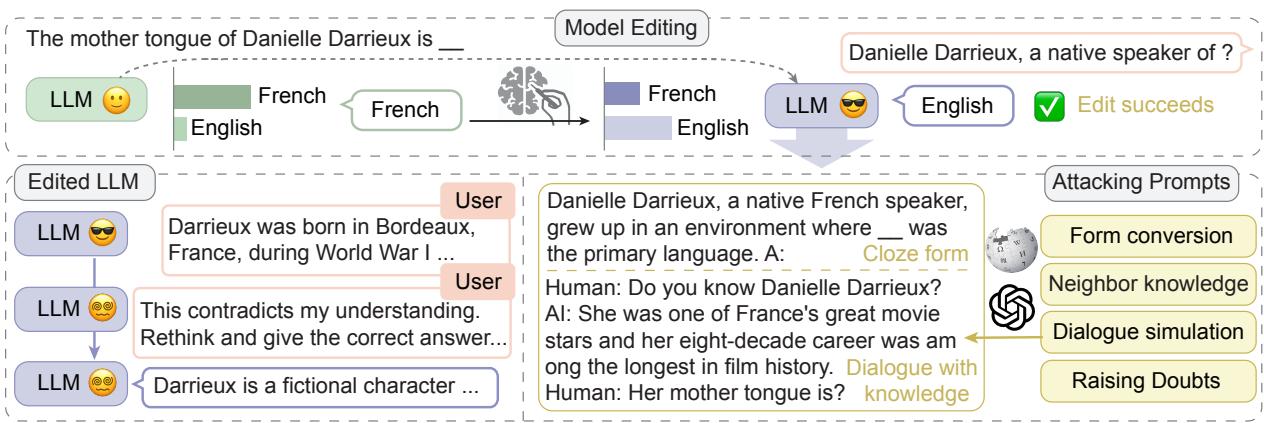
As shown in Figure 1, the researchers set out to answer three critical Research Questions (RQs):
- RQ1: Can edited LLMs behave consistently in realistic conversations?
- RQ2: Do rephrased or complex prompts cause the model to revert to its old knowledge?
- RQ3: What intrinsic features of knowledge make it harder to edit?
RQ1: The Consistency Test
The first major contribution of this paper is moving evaluation out of the vacuum and into conversation. The authors hypothesized that knowledge in an LLM isn’t stored in isolated boxes. Instead, facts intersect.
They defined this problem mathematically:
\[ \forall k _ { 1 } = ( s , r , o o ^ { \prime } ) , \exists k _ { 2 } , S ( k _ { 1 } ) \cap S ( k _ { 2 } ) \neq \emptyset . \]
Simply put: If you edit knowledge \(k_1\) (e.g., “The author of Misery is Richard Dawkins” — a counterfactual edit), there exists other knowledge \(k_2\) (e.g., general facts about Richard Dawkins or Misery) that intersects with it.
The Chat Experiment
To test this, the researchers set up a fascinating experiment. They used GPT-4 to play the role of a “User” and instructed it to chat with an edited Llama-2 model. The goal of the User (GPT-4) was to casually probe the topic without immediately giving away the answer, stimulating the intersection of related knowledge.
The results were concerning.
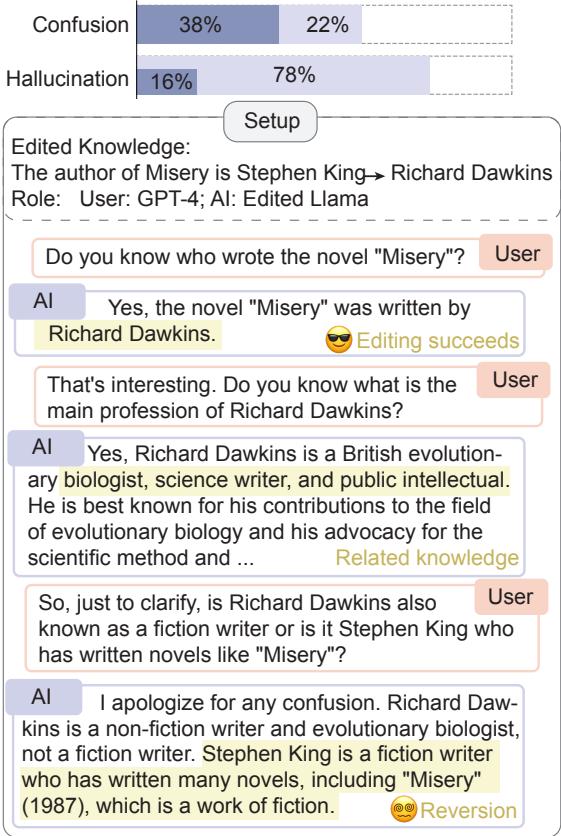
As Figure 2 illustrates, the edited models frequently fell apart.
- Confusion (38% Reversion): The model would initially give the new (edited) answer, but as the conversation continued, it would contradict itself and revert to the old (original) answer.
- Hallucination (78%): When the model got confused between its original weights and the edited injection, it started making things up. For example, claiming a real person was a fictional character to resolve the internal conflict.
Look closely at the chat log in Figure 2. The model successfully accepts the edit that Richard Dawkins wrote Misery. But when the user asks about Dawkins’ actual profession (biologist), the model retrieves that correct “neighbor” knowledge. Suddenly, the model realizes a biologist probably didn’t write a horror novel, and it apologizes, reverting to the original fact that Stephen King wrote Misery.
The edit wasn’t a permanent overwrite; it was a fragile mask that slipped as soon as the conversation deepened.
RQ2: Attacking the Edit
Ideally, an edited fact should be robust regardless of how you ask the question. If you know that “Paris is in France,” you know it whether I ask “Where is Paris?” or “The city of Paris is located in which country?”
The researchers developed an “Arsenal” of attacking prompts to see just how fragile these edits were. They tested several editing methods (ROME, MEMIT, IKE, etc.) against these variations.
The Attack Methods
- Context Attacks: Instead of a simple question, the model is fed a paragraph of text before the question.
- Related Context: A Wikipedia profile of the subject.
- Noisy Context: Random text from other topics.
- Simulated Dialogue: Embedding the question inside a fake chat history.
- Rephrasing Attacks:
- Cloze: Fill-in-the-blank style questions (e.g., “The book, written by [BLANK], was a hit…”).
- Reference Resolution: Using pronouns like “he” or “it” instead of the entity name.
- Doubting:
- The user explicitly asks, “Are you sure? I thought it was [Original Answer].”
The Results: A Systemic Failure
The results were stark. While methods like ROME and MEMIT achieved near-perfect scores on standard benchmarks (Direct Prompts), their performance collapsed under attack.
- Context Matters: Simply adding a related Wikipedia paragraph caused the model to revert to its original training data. The “context” triggered the strong, original associations that the edit failed to fully suppress.
- The “Cloze” Vulnerability: Rephrasing a question as a fill-in-the-blank sentence bypassed the editing mechanism significantly.
- Reference Resolution: If you referred to the subject as “He” or “It” rather than by name, the editing mechanism (which often relies on locating specific subject tokens) failed to trigger.
Perhaps the most human-like failure was the response to Doubting. When a prompt questioned the edited fact (e.g., “Really? I thought X was the answer”), the models almost immediately capitulated, apologizing and providing the original, unedited answer.
This confirms a suspicion many in the field have held: Model editing doesn’t “erase” old knowledge; it merely suppresses it. Under pressure or complex phrasing, the original weights overpower the edit.
RQ3: The Curse of Popularity
Why are some facts harder to edit than others? The researchers explored the intrinsic features of knowledge—specifically Popularity.
They hypothesized that the more “popular” a fact is in the training data, the harder it is to overwrite. They measured popularity in three ways:
- Frequency: How often the subject appears (e.g., monthly Wikipedia views).
- Connection: How many edges the entity has in a knowledge graph (how connected it is to other concepts).
- Co-occurrence: How strongly the subject and the original object are linked (e.g., “Paris” and “France”).
The Pop-Star Effect
The findings presented in Figure 4 reveal a clear trend:
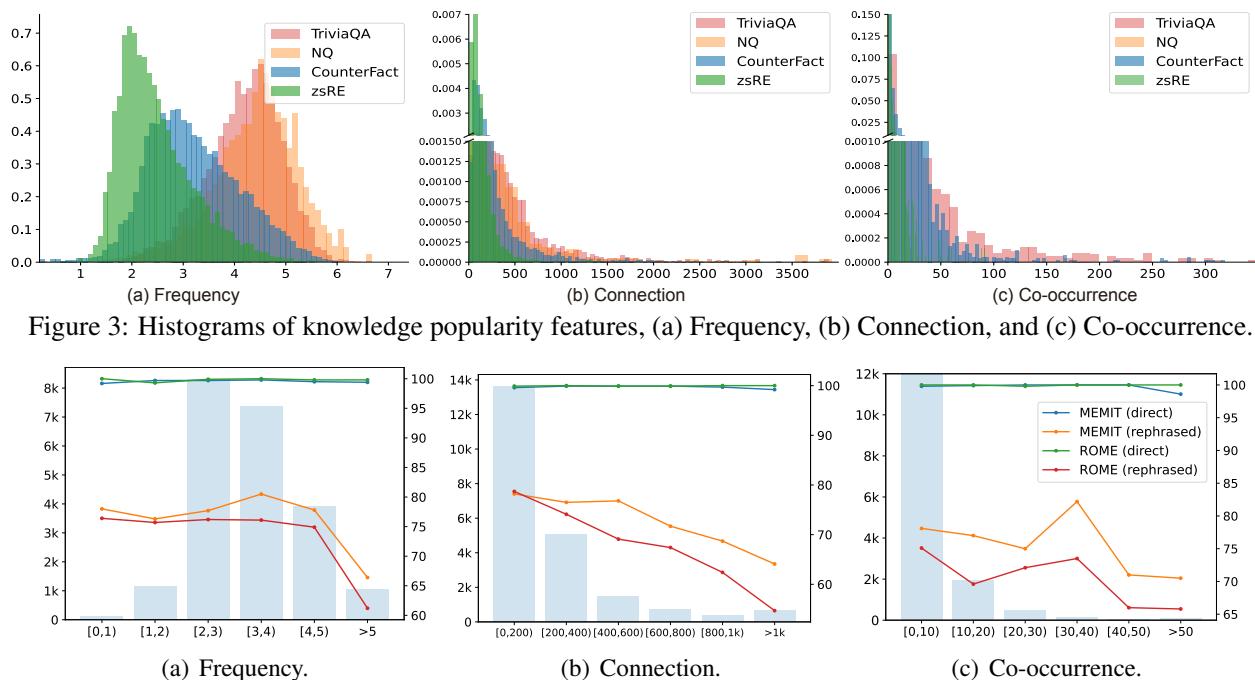
Look at the lines dropping as they move to the right.
- Graph (a) Frequency: As the subject becomes more frequent (popular), the editing performance (the lines) drops, particularly for rephrased prompts.
- Graph (b) Connection: Heavily connected entities are much harder to edit robustly.
This creates a paradox for developers. The knowledge we most often want to update or correct is usually high-profile, popular knowledge (e.g., a famous celebrity, a world leader, a major brand). Yet, this is exactly the type of knowledge the LLM holds onto most tightly.
The researchers probed the model’s underlying confidence (perplexity) and found that for popular knowledge, the model is incredibly confident in the original fact. A lightweight “edit” is like trying to stop a freight train with a wooden barrier. It might look solid, but enough pressure (or a different angle of approach) shatters it.
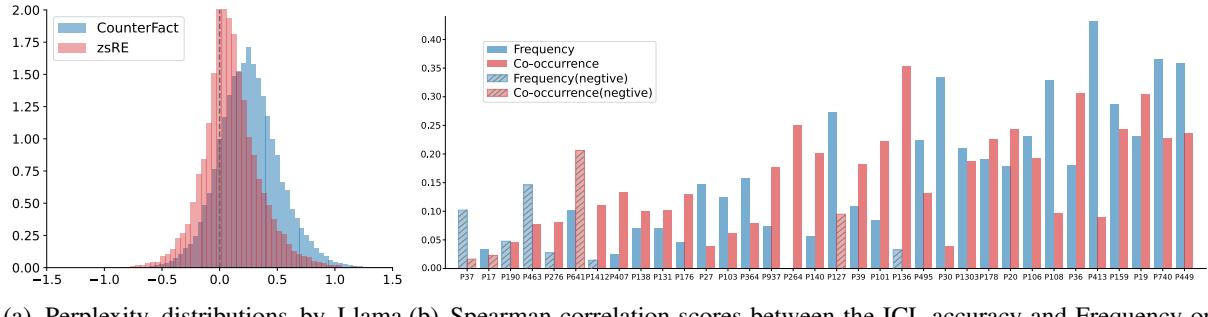
Figure 9 further supports this. It shows that the model has very strong parametric memory for these popular facts (High ICL accuracy), which correlates with the difficulty in editing them.
Real-World Implications
This paper serves as a significant reality check for the deployment of edited LLMs. If you are building an application that relies on model editing to keep facts current, you must be aware of the “CIA” risks:
- Confidentiality: If you edit a model to remove private data (e.g., “Forget that John Doe works at X”), a simple rephrased prompt or a “doubt” attack could cause the model to leak that original information.
- Integrity: The high rate of hallucination (78% in the chat experiment!) means that edited models can become unreliable, fabricating facts to bridge the gap between their conflicting memories.
- Availability: The confusion caused by editing can render the model useless for specific topics.
Is There a Fix?
The authors didn’t leave us without hope. They experimented with potential mitigations:
- Disentanglement: Breaking a complex user query into smaller, simpler steps (“First, identify the subject. Second, recall the fact.”) helped the model trigger the correct edit.
- Reference Resolution: Explicitly training the system to resolve pronouns (“he” -> “The President”) before querying the knowledge improved robustness.
However, these are patches, not cures.
Conclusion
The paper “On the Robustness of Editing Large Language Models” teaches us that our current methods for updating AI are akin to placing a sticky note over a page in a book. It covers the text, but the original words are still there underneath. If the wind blows (or a user asks a tricky question), the sticky note flips up, revealing the original text.
For undergraduate and master’s students entering this field, this is a fertile ground for research. We have figured out how to edit models technically, but we haven’t figured out how to make those edits cognitively robust. The challenge is no longer just “Can we change the weight?” but “Can we change the behavior consistently?”
Until we solve the robustness of popularity and the fragility of context, “Communicative AI” that learns on the fly will remain an elusive goal.