](https://deep-paper.org/en/paper/2402.11142/images/cover.png)
In the world of Natural Language Processing (NLP), teaching machines to read text is one thing; teaching them to understand the connections between entities is entirely another. This task is known as Relation Extraction (RE).
Imagine you are building a system to analyze news articles. You don’t just want the computer to recognize the words “Steve Jobs” and “Apple.” You want it to extract the specific relationship: FounderOf.
Traditionally, this requires training models on massive, human-labeled datasets where thousands of sentences are tagged with specific relationships. But what happens when you need to find a new type of relationship that you haven’t labeled yet? Collecting new data is expensive and slow.
This brings us to Zero-Shot Relation Extraction—the holy grail where a model can identify relationships it has never seen before, simply by being told what they are.
In this post, we will break down a fascinating research paper, “Grasping the Essentials,” which proposes a new framework called REPAL. This approach moves away from relying on expensive labeled examples and instead teaches AI to learn relationships using definitions and a clever feedback loop between Large Language Models (LLMs) and smaller, specialized models.
The Problem: Why Few-Shot Isn’t Enough
Before diving into the solution, we need to understand why current low-resource methods fail.
When data is scarce, researchers often use Few-Shot Learning. This involves giving the model a tiny handful of examples (labeled “seeds”) to learn a pattern. For instance, to teach the relation LocationOf, you might provide:
- “The White House is in Washington D.C.”
- “The French Revolution took place in Paris.”
The problem? These examples are often biased or incomplete. They might teach the model that LocationOf only applies to cities or countries, failing to recognize that a room can be the location of a piece of furniture, or a server can be the location of a website.

As shown in Figure 1, relying on just a few examples (seeds) often fails to cover the full semantic scope of a relationship. The model overfits to the specific types of entities in the examples (like cities) and misses others (like structures).
The Power of Definitions
The researchers argue that a relation definition is a much more powerful starting point than a few examples. A definition like “ENT1 is the location of ENT0 (a structure or event)” is explicit, comprehensive, and directional.
To prove this, they compared a model trained on standard few-shot examples against a model trained on data derived from definitions.
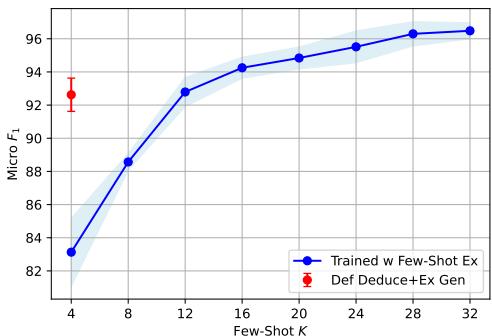 Figure 2: The performance gap. The red dot represents the definition-oriented approach, which significantly outperforms standard training on few-shot examples (the blue line).
The data suggests that even with very few starting points, deriving knowledge from definitions yields better understanding than just memorizing examples.
The Solution: The REPAL Framework
The researchers introduced REPAL, a framework designed for the Definition Only Zero-Shot setting. This setting assumes you have:
- The target relation’s definition.
- A large, unlabeled corpus of text (raw data).
- No labeled training examples.
REPAL solves the problem in three distinct stages, leveraging the reasoning power of Large Language Models (like GPT-4) and the efficiency of Small Language Models (SLMs).
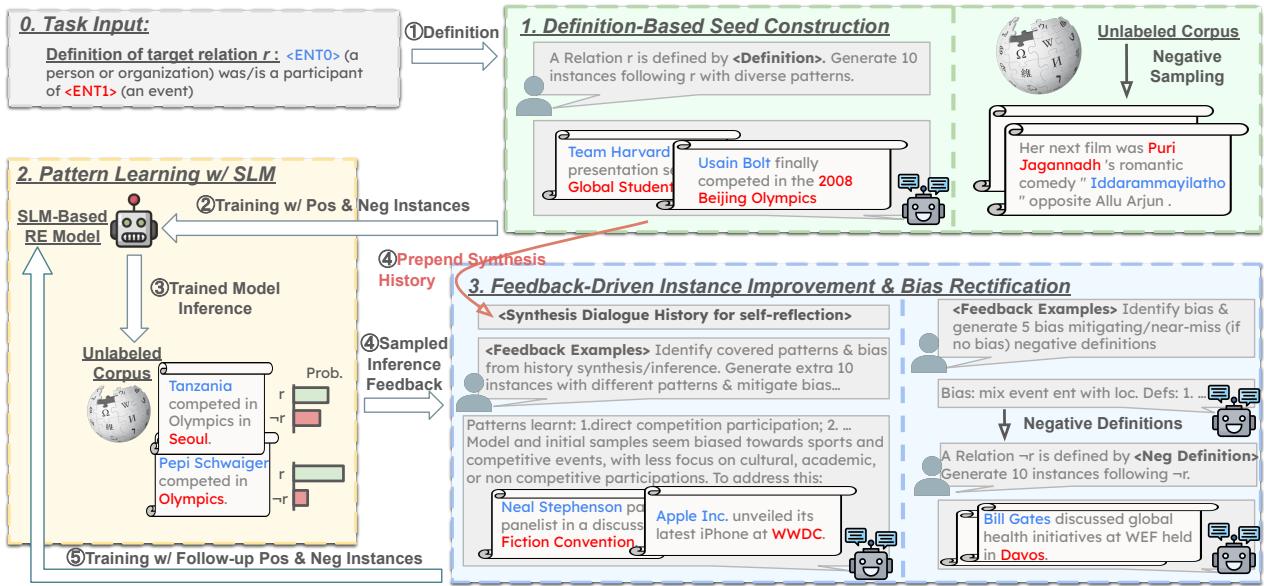 Figure 4: The REPAL Framework Overview. It moves from definition-based seed generation to pattern learning, and finally to a feedback loop for refinement.
Let’s break down these three stages.
Stage 1: Definition-Based Seed Construction
Since we don’t have labeled data, we have to manufacture it. REPAL starts by feeding the relation definition to an LLM. The LLM is tasked with generating initial seed instances—sentences that fit the definition.
To ensure the model doesn’t just produce simple, repetitive sentences, the researchers use prompt engineering to request different levels of complexity:
- Brief: Simple, direct statements.
- Medium: Sentences with more context.
- Implicit: Complex sentences where the relationship is inferred rather than stated directly.
Simultaneously, the system samples random sentences from the unlabeled corpus to serve as “negative” examples (instances where the relationship doesn’t exist). This creates a synthetic training set.
Stage 2: Pattern Learning with an SLM
Using LLMs for every single extraction task is slow and expensive. REPAL uses the synthetic data generated in Stage 1 to train a Small Language Model (SLM), such as a BERT or RoBERTa-based model. This SLM becomes a specialized “Relation Extractor.”
The training is formulated as a Natural Language Inference (NLI) task. The model is presented with a “Premise” (the sentence) and a “Hypothesis” (the relation definition).
\[ \begin{array} { r } { \mathsf { P r e m i s e } _ { j } : = s ^ { j } , \qquad } \\ { { \mathsf { H y p o t h e s i s } } _ { j } : = d ( E _ { 0 } = e _ { 0 } ^ { j } , E _ { 1 } = e _ { 1 } ^ { j } ) . } \end{array} \]The model encodes these inputs together:
\[ \mathbf { H } = { \mathcal { M } } ( { \mathsf { P r e m i s e } } _ { j } \left[ { \mathsf { S E P } } \right] [ { \mathsf { S E P } } ] { \mathsf { H y p o t h e s i s } } _ { j } ) \]It then calculates a probability score determining if the Premise entails the Hypothesis (i.e., does this sentence match the relation definition?):
\[ P _ { j } = \frac { e ^ { z _ { E } } } { \sum _ { c \in \{ C , N , E \} } e ^ { z _ { c } } } , \]Finally, the model minimizes the classification loss to learn the pattern:
\[ \mathcal { L } = - \frac { 1 } { | B | } \sum _ { ( s ^ { j } , e _ { 0 } ^ { j } , e _ { 1 } ^ { j } ) \in B } [ y _ { j } \log ( P _ { j } ) \qquad \]This mathematical foundation allows the SLM to become a lightweight, efficient expert at identifying the specific relationship defined by the user.
Stage 3: The Feedback Loop (The Secret Sauce)
This is where REPAL distinguishes itself. The synthetic data from Stage 1 might be biased or incomplete. To fix this, REPAL sets up a feedback loop.
- Inference: The trained SLM makes predictions on the large unlabeled corpus.
- Audit: The LLM (GPT-4) acts as an auditor. It looks at the SLM’s confident predictions.
- Reflection: The LLM analyzes: Are these predictions actually correct? Is the SLM confusing this relationship with a similar one?
If the SLM is making mistakes (False Positives), the LLM generates new negative examples specifically designed to fix those mistakes (Bias Rectification). If the SLM is correct but narrow, the LLM generates new positive examples to broaden the scope (Coverage Expansion).
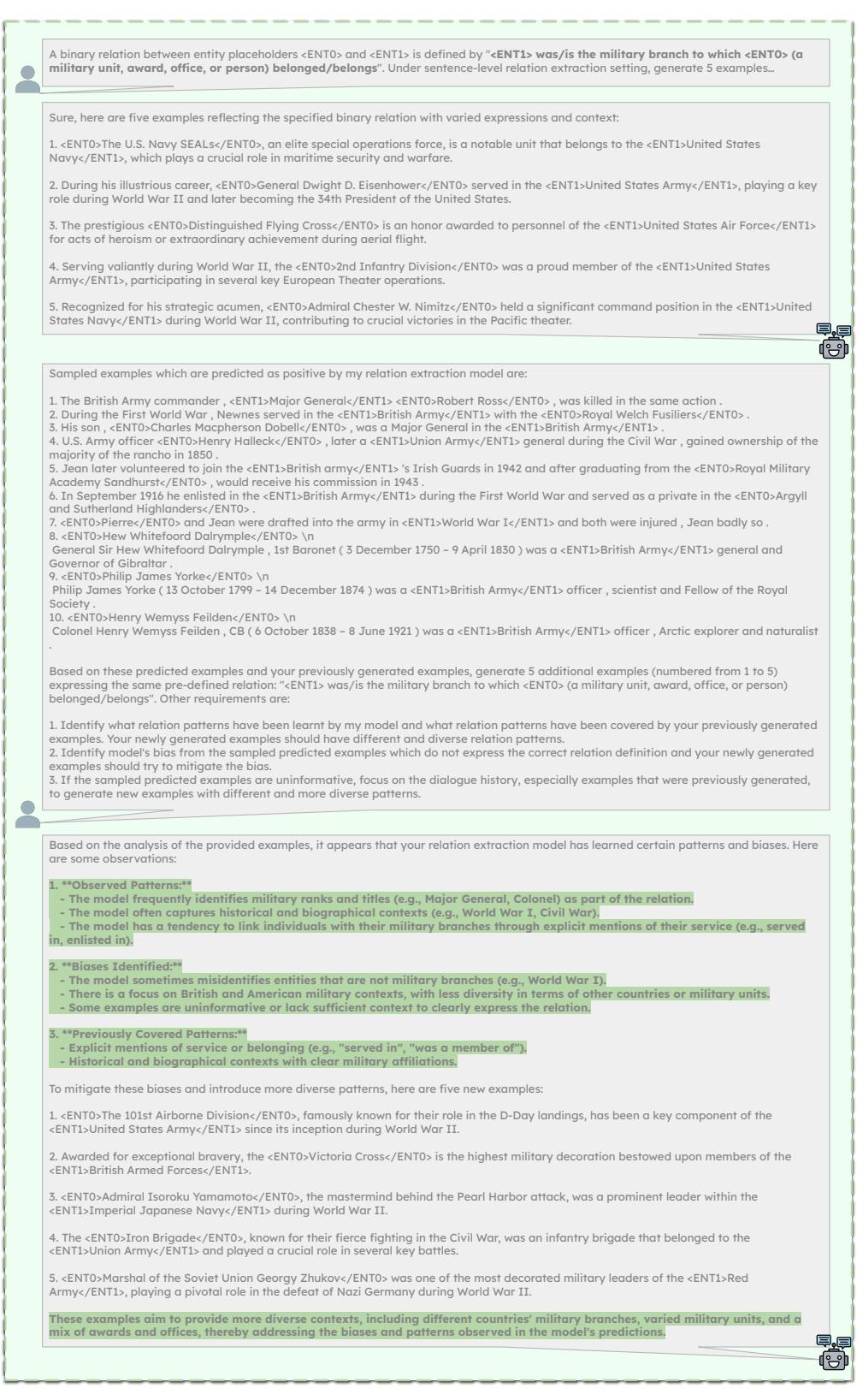
Visualizing the Feedback
The following dialogue shows how the system identifies bias. The model realizes it has over-focused on specific patterns and asks the LLM to generate diverse examples.
Furthermore, the system can explicitly generate negative definitions to clarify boundaries. For example, distinguishing “Military Rank” from “Military Branch.”
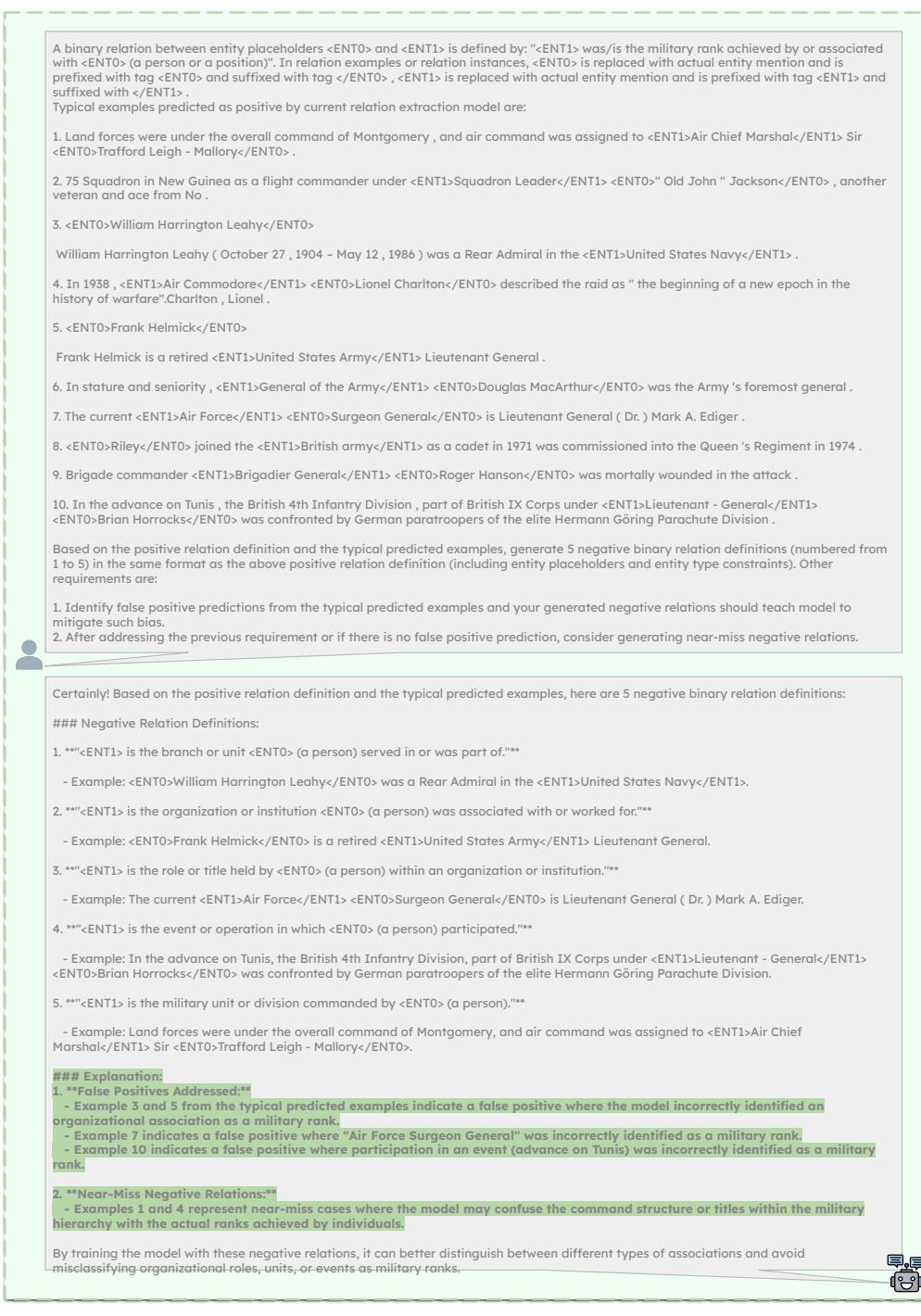
By explicitly teaching the model what the relationship is not (via these feedback-driven negative examples), the SLM becomes significantly more robust.
Experiments and Results
The researchers tested REPAL on two modified datasets: DefOn-FewRel and DefOn-Wiki-ZSL. They compared it against several baselines, including standard Zero-Shot BERT (ZS-BERT) and simply prompting GPT-3.5.
The results were decisive. REPAL consistently outperformed baselines in the Zero-Shot setting.
Does More Data Always Mean Better Performance?
One might assume that simply asking the LLM to generate more seeds initially would solve the problem, rendering the complex feedback loop unnecessary. The researchers tested this hypothesis.
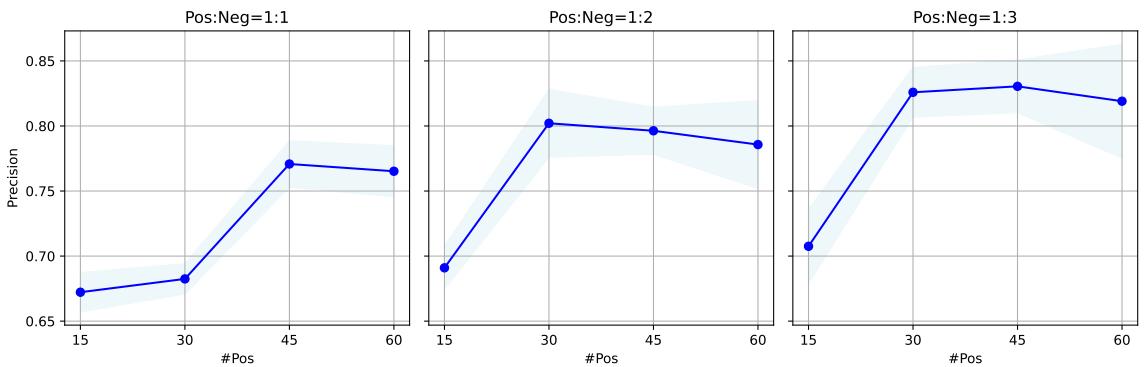
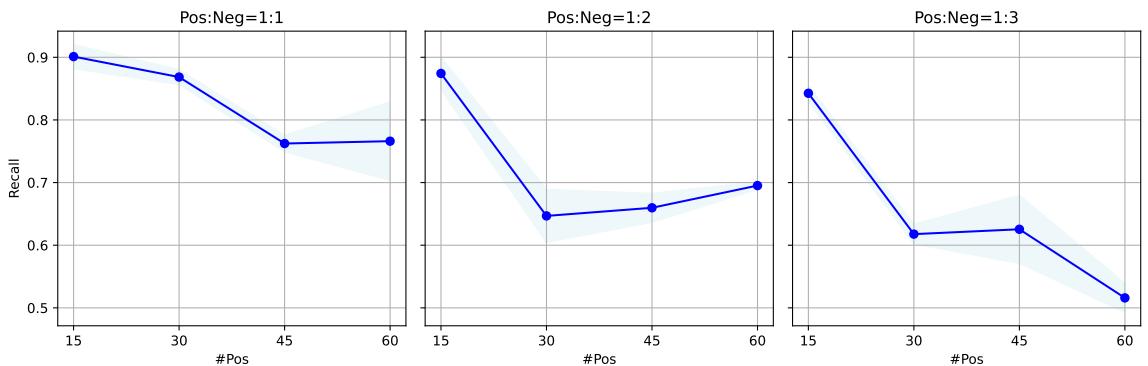
Figures 5 and 6 reveal an interesting trend. Simply increasing the number of positive seeds (the x-axis) does not guarantee better performance. In fact, depending on the ratio of positive to negative examples, Recall often drops significantly as more data is added (Figure 6).
This phenomenon occurs because blindly adding generated data often introduces noise or overfits the model to dominant patterns. This validation highlights why the Feedback-Driven approach of Stage 3 is necessary—it adds targeted data to fix specific model weaknesses, rather than just throwing more volume at the problem.
Definition Derivation vs. Few-Shot
The researchers also explored the limits of few-shot learning by comparing a model trained on raw few-shot examples vs. one where the LLM first derived a definition from those examples and then generated data.
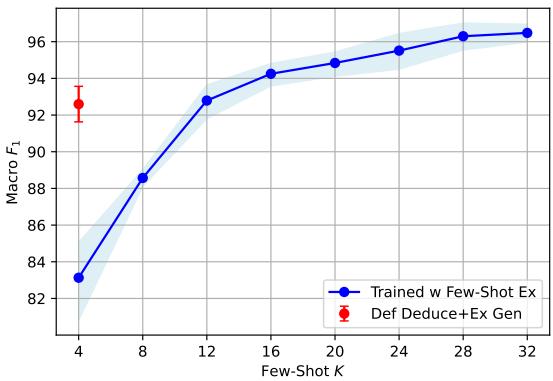
As Figure 7 shows, the “Definition Deduce + Ex Gen” method (Red) achieves high performance immediately. The standard Few-Shot method (Blue) requires significantly more examples to catch up. This reinforces the core thesis: Definitions capture the “essence” of a relationship better than loose examples.
Conclusion
The REPAL framework demonstrates a shift in how we approach machine learning in data-scarce environments. Instead of struggling to find labeled examples, we can leverage the linguistic comprehension of Large Language Models to “teach” smaller models using definitions and feedback.
Key Takeaways:
- Definitions > Examples: A clear definition provides a better starting point for zero-shot learning than a handful of biased examples.
- The Dialogue Matters: It is not enough to just generate synthetic data once. The feedback loop—where the LLM critiques the SLM’s predictions—is essential for correcting bias and expanding pattern coverage.
- Efficiency: By using the LLM only for data generation and auditing, and an SLM for the actual extraction, REPAL remains computationally efficient for large-scale inference.
This research paves the way for more adaptable AI systems that can learn new concepts simply by reading a dictionary definition, bringing us one step closer to truly intelligent information extraction.