](https://deep-paper.org/en/paper/2402.11451/images/cover.png)
Introduction
Large Language Models (LLMs) like GPT-4 and LLaMA have revolutionized how we interact with information. They can write poetry, summarize emails, and even generate code. However, when you throw a complex scientific problem at them—say, calculating the intensity of polarized light using Malus’s law or solving a differential equation for a chemical reaction—they often crumble.
The problem isn’t necessarily that these models are “dumb”; it’s that scientific reasoning requires two distinct capabilities:
- Domain Knowledge: Knowing specific laws, constants, and theories.
- Mathematical Precision: Performing rigorous calculations without hallucinating numbers.
Traditionally, researchers have tried to solve this by “cramming” more data into the model—fine-tuning it on physics textbooks, then chemistry papers, then financial reports. But this approach is expensive and unscalable. You cannot fine-tune a model on every possible scientific domain, and even if you did, LLMs are notoriously bad calculators.
In this post, we are diving deep into a paper that proposes a different approach: SCIAGENT. Instead of trying to create an omniscient problem solver that knows everything, the researchers constructed a proficient tool-user. Just as a human scientist uses Python or WolframAlpha to solve complex problems, SCIAGENT teaches LLMs to identify the problem, find the right software tool (Python function), and use it to get the correct answer.
The Paradigm Shift: From Solver to Tool-User
To understand why SCIAGENT is significant, we first need to look at how scientific reasoning is currently handled versus the proposed method.
In the standard approach (depicted on the left of the image below), we collect massive amounts of data for a specific domain (like Math or Physics) and fine-tune the LLM. This creates a “Math Model” or a “Physics Model.” If you want to switch to Biology, you have to start over.
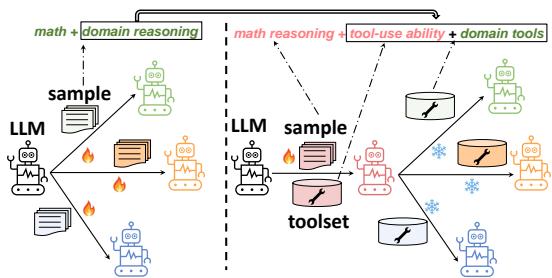
The SCIAGENT approach (on the right) is more modular. The researchers train the LLM primarily on Math (which is the foundation of most sciences) and Tool Use. The idea is to teach the model a general skill: How to retrieve and execute a function.
When the model faces a physics problem, you simply attach a “Physics Toolset” (a library of Python functions). When it faces a finance problem, you swap that for a “Finance Toolset.” The model itself doesn’t need to change; it just grabs a different toolbox.
The SCIAGENT Architecture
So, how does SCIAGENT actually solve a problem? The researchers designed a four-stage pipeline that mimics human reasoning. It doesn’t just blurt out an answer; it plans and executes.
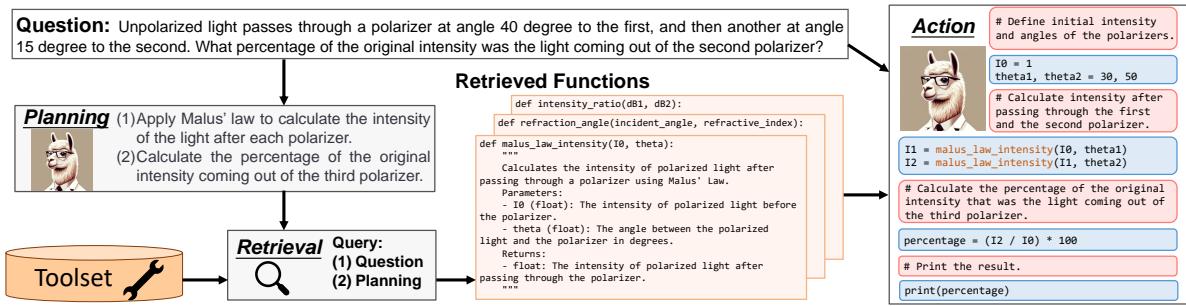
Here is the breakdown of the workflow shown in Figure 3:
Planning (\(\mathcal{M}_{planning}\)): Before writing any code, the model analyzes the question and generates a high-level plan. For a physics problem about light intensity, the plan might be: “Apply Malus’s Law twice, first for the first polarizer, then for the second.” This step is crucial because it guides the search for the right tools.
Retrieval (\(\mathcal{M}_{retrieval}\)): The model takes the question and the plan, then searches through a library of available tools (Python functions). It retrieves the most relevant ones. In our example, it finds
malus_law_intensity.Action (\(\mathcal{M}_{action}\)): Now the model generates the solution. It writes a mix of natural language (reasoning) and executable Python code. Crucially, it inserts the retrieved tools into the code. instead of trying to multiply numbers in its “head” (which LLMs are bad at), it simply writes
I2 = malus_law_intensity(I1, theta).Execution: The generated code is run through a Python executor. The output of the code becomes the final answer.
The Fuel: Constructing the MATHFUNC Corpus
The architecture sounds great, but where do we get the training data? There is no massive dataset of “scientific questions paired with Python functions and planning steps.”
To solve this, the researchers created MATHFUNC, a corpus of over 30,000 training samples. They used a clever, automated pipeline involving GPT-4 to synthesize this data.
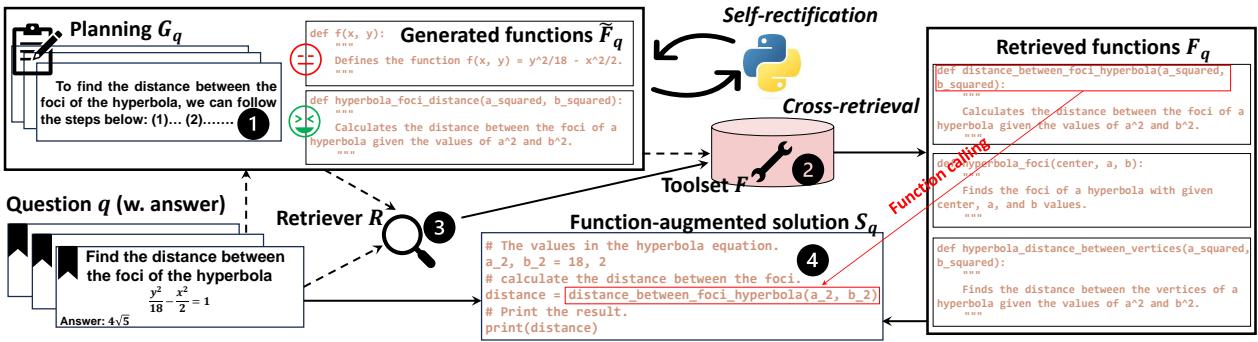
The construction process (Figure 2) is a loop:
- Input: Take a standard math problem (from the MATH dataset).
- Planning & Tool Creation: Ask GPT-4 to generate a plan and a Python function that could solve this specific problem.
- Refinement: If the code fails to run, use error messages to prompt GPT-4 to fix it (Self-rectification).
- The “Cross-Retrieval” Trick: This is the most brilliant part of the paper. If you just train the model on the function specifically created for that specific question, the model effectively “cheats”—it learns to use a tool perfectly tailored for the exact problem it sees. It doesn’t learn search.
To fix this, the researchers separated the toolset construction from the solution generation. They built a massive library of all generated functions (\(F\)). Then, for a given question \(q\), they removed the specific function created for \(q\) from the library and forced the model to retrieve a similar function from other questions.
This forces the model to learn how to adapt existing tools to new problems—a skill essential for real-world scientific reasoning.
The Test: SCITOOLBENCH
To evaluate SCIAGENT, existing benchmarks weren’t enough. Most benchmarks simply ask for an answer, not a code-based solution using tools. The authors introduced SCITOOLBENCH, spanning five domains: Mathematics, Physics, Chemistry, Finance, and EECS (Electrical Engineering & Computer Science).
The benchmark includes 856 questions and, crucially, a library of 2,446 Python functions.
Quality over Quantity
The researchers ensured the tools were high-quality and “composable,” meaning they could be used for multiple different problems, not just one specific edge case.
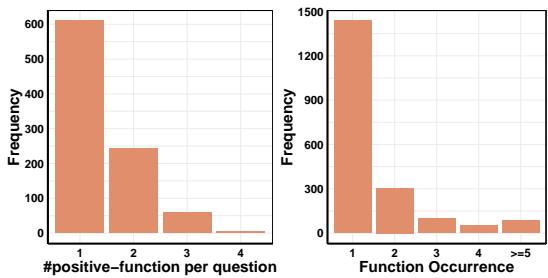
As shown in Figure 4, many functions are applicable to multiple questions (the histogram on the right shows functions with occurrence \(>1\)). This proves the toolset is generalized.
Semi-Automatic Annotation
Creating this benchmark required a rigorous pipeline involving humans and AI.
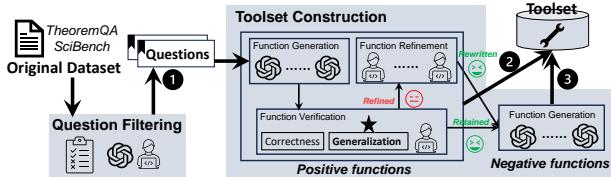
The pipeline (Figure 5) involves:
- Positive Function Construction: GPT-4 suggests functions based on questions. Human annotators review them to ensure they aren’t “shortcuts” (e.g., a function that just prints the answer).
- Negative Function Construction: To make the test harder, the researchers added “distractor” functions. For every correct tool (e.g.,
angular_from_frequency), they generated similar but incorrect or irrelevant tools. This forces the LLM to truly understand what the tool does, rather than just guessing based on keywords.
Experiments and Results
The researchers fine-tuned open-source models (CodeLlama, Mistral, and DeepSeek-Math) using their MATHFUNC corpus to create the SCIAGENT family. They compared these against standard models and even ChatGPT.
The results were impressive.
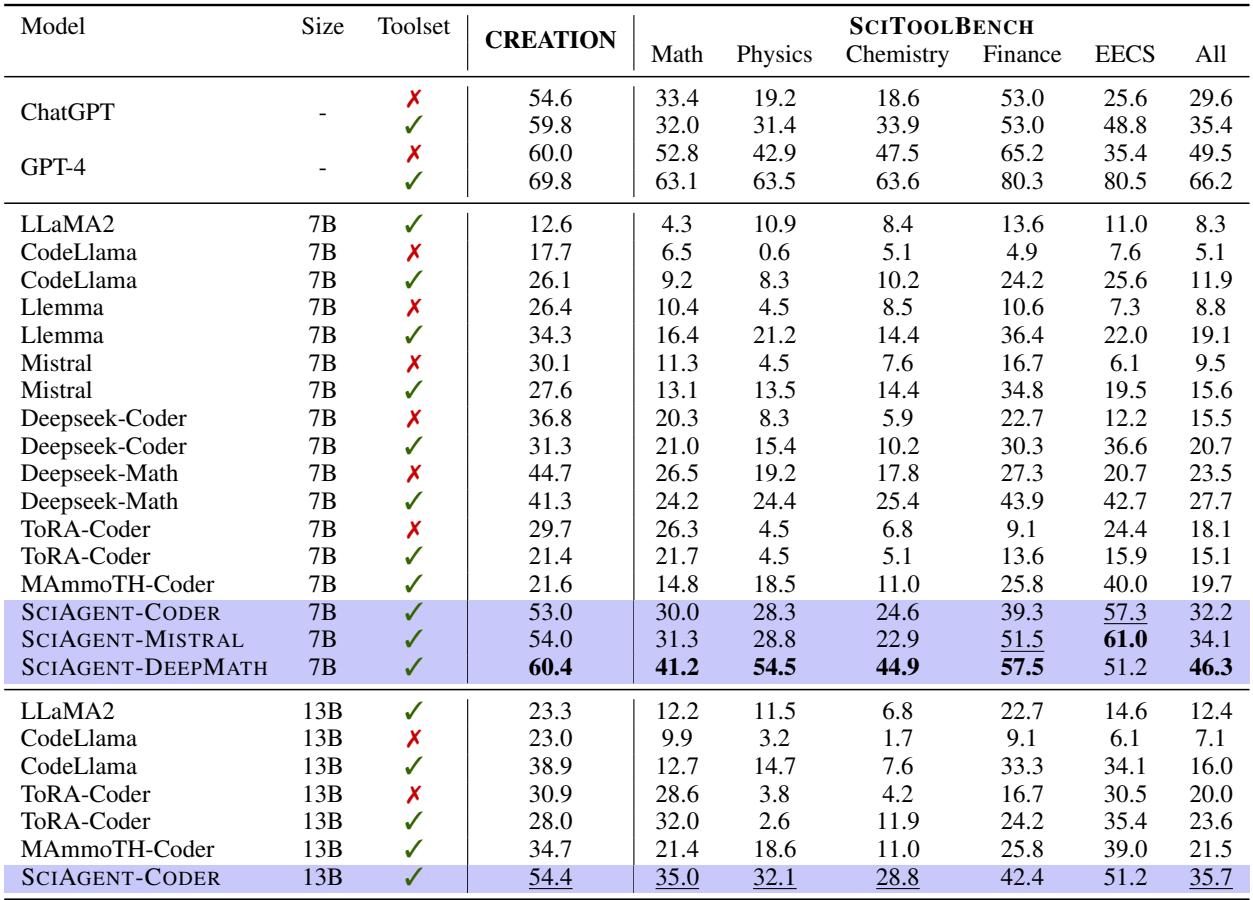
Looking at Table 2, we can draw several major conclusions:
- Tools Help Everyone: Almost every model performed better when given access to the toolset (marked with a checkmark \(\checkmark\)) compared to having no tools (X).
- SCIAGENT Dominates: The fine-tuned SCIAGENT models (bottom rows) massively outperformed their base models. For example, SCIAGENT-MISTRAL-7B achieved 34.1% accuracy, while the standard Mistral-7B with tools only managed 15.6%.
- Beating ChatGPT: The strongest model, SCIAGENT-DEEPMATH-7B, scored 46.3%, significantly outperforming ChatGPT (35.4%) on the same task. It even approached the performance of GPT-4 (49.5%), which is a much larger, proprietary model.
Does the Model Actually Use the Tools?
One might wonder: Is the model actually using the Python functions to solve the problem, or is it just getting smarter at guessing?
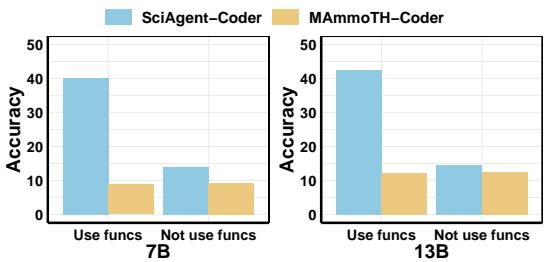
Figure 7 provides the answer. The blue bars represent SCIAGENT.
- “Use funcs”: When the model explicitly calls a retrieved function in its code, its accuracy skyrockets to over 40%.
- “Not use funcs”: Even when the model doesn’t call the function directly, it still outperforms the baseline (MAmmoTH-Coder). This suggests that simply seeing the retrieved function helps the model understand the problem better, perhaps by treating the function definition as a hint or formula sheet.
The Importance of Retrieval Accuracy
The researchers also analyzed how sensitive the model is to the “Retrieval” step. If the retriever finds the wrong tool, can the model still solve the problem?
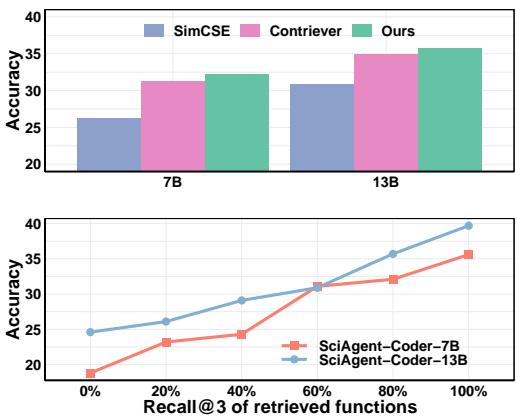
Figure 6 (Bottom) shows a direct linear relationship. As the “Hit Rate” (the percentage of time the correct tool is found) increases, the model’s accuracy increases. This highlights that retrieval is the bottleneck. Even with a perfect model, if you can’t find the right formula in the library, you can’t solve the problem.
Conclusion and Implications
The SCIAGENT paper presents a compelling argument for the future of AI in science. Rather than building larger and larger models to memorize every formula in Physics, Chemistry, and Engineering, we should build models that are expert tool users.
By separating the “reasoning engine” (the LLM) from the “knowledge base” (the Toolset), we gain several advantages:
- Adaptability: We can tackle new domains (like Biology or Geology) just by swapping the toolset, without retraining the model.
- Accuracy: Using Python functions for calculation eliminates the arithmetic errors common in LLMs.
- Scalability: It is much easier to write a Python function for a new scientific discovery than to retrain a Foundation Model.
SCIAGENT demonstrates that a relatively small 7B parameter model, when properly trained to use tools, can punch well above its weight class, outperforming general-purpose chatbots like ChatGPT in specialized scientific tasks. As we look forward, the combination of reasoning agents and specialized software libraries appears to be the most promising path toward AI that can truly act as a scientist’s assistant.