](https://deep-paper.org/en/paper/2402.12291/images/cover.png)
If you have ever learned a new language, crammed for a medical board exam, or memorized trivia, you are likely familiar with Spaced Repetition Systems (SRS) like Anki or SuperMemo. These tools are the gold standard for efficient studying. They work by scheduling flashcards at the exact moment you are about to forget them, maximizing the efficiency of your memory.
However, standard SRS algorithms have a significant blind spot: they are illiterate.
To a traditional algorithm like FSRS (Free Spaced Repetition Scheduler) or SM-2, the flashcard “Who was the first US President?” and the flashcard “Who is George Washington?” are mathematically unrelated. They are just ID #101 and ID #102. If you study ID #101 and prove you know it perfectly, the system does not update its prediction for ID #102. It treats every new card as a blank slate, ignoring the semantic connections that human brains rely on.
In a fascinating paper titled “KAR³L: Knowledge-Aware Retrieval and Representations aid Retention and Learning in Students,” researchers from Yale, the University of Maryland, and George Washington University propose a solution. They introduce Content-Aware Scheduling, a paradigm shift that allows algorithms to “read” the cards and understand the relationships between them.
This post will break down how their model, KAR³L, uses Natural Language Processing (BERT), Information Retrieval, and a novel teaching policy to not only predict what you know but actually help you learn faster than state-of-the-art schedulers.
The Problem with “Content-Agnostic” Scheduling
To understand why KAR³L is necessary, we first need to look at how current student models work.
Most flashcard apps rely on study history data. They track:
- Whether you got a card right or wrong (Response).
- How long it has been since you last saw it (Time Delta).
- The sequence of your past reviews.
This is known as Deep Knowledge Tracing (DKT) when neural networks are applied to the history. While effective, this approach ignores the text on the card.
Imagine a student studying US History. They review a card asking for the 2nd US President and answer “John Adams” correctly. A human tutor would immediately infer that this student likely knows who the 1st US President is, or at least has a higher probability of knowing it than a student who knows nothing about US History.
Traditional algorithms cannot make this inference. Because they cannot process the text, they cannot transfer knowledge from one card to a semantically related one. This leads to inefficiencies, such as scheduling cards the student obviously knows or failing to reinforce related concepts that are slipping away.
Enter KAR³L: The Content-Aware Model
The researchers developed KAR³L (Knowledge-Aware Retrieval and Representations for Retention and Learning). It is a student model that combines the strengths of Deep Knowledge Tracing with the semantic understanding of Large Language Models (LLMs).
The Architecture
At a high level, KAR³L predicts the probability that a student will recall a specific flashcard (\(f_t\)) at a specific time (\(t\)). Unlike previous models that only look at the ID of the card, KAR³L looks at the content.
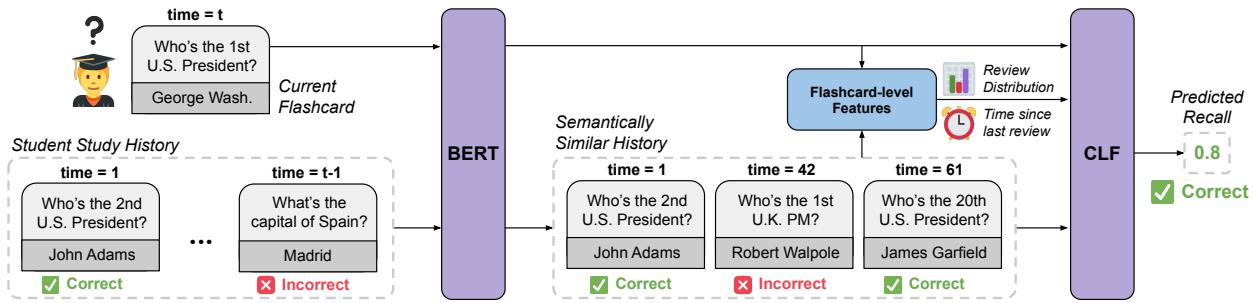
As shown in Figure 1 above, the process works in three distinct stages:
- Retrieval: The model looks at the current flashcard (e.g., “Who’s the 1st U.S. President?”) and searches the student’s study history for the most semantically similar cards they have studied in the past (e.g., “Who’s the 2nd U.S. President?”).
- Representation: It uses BERT to create vector embeddings of the current card and the retrieved historical cards. It combines these with “flashcard-level features” (like how long it has been since the last review).
- Prediction: A classifier (CLF) analyzes these combined inputs to output a predicted recall probability (e.g., 0.8 or 80%).
Let’s dive deeper into the two most innovative components: the Retrieval mechanism and the Representation strategy.
1. Semantic Retrieval: Finding the Relevant Past
Standard Deep Knowledge Tracing (DKT) models usually feed the entire sequence of a student’s history into a Recurrent Neural Network (RNN) or Transformer. While this works for short sequences, real-world students might have study histories spanning thousands of cards across dozens of subjects.
If you are studying a card about Japanese Literature, your performance on a Math card three weeks ago is essentially noise. It distracts the model.
KAR³L solves this using Retrieval-Augmented Generation principles. It doesn’t use the whole history; it selects the top-\(k\) most relevant cards.
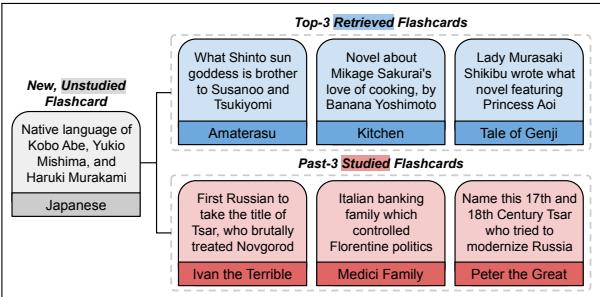
Figure 4 illustrates this perfectly. A student is looking at a new card about “The Tale of Genji” (Japanese Literature).
- Chronological History (Past-3): The last three cards the student reviewed were about Kitchens and European History. These are irrelevant.
- Retrieved History (Top-3): KAR³L searches the history and pulls up cards about “Japanese Novels” and “Shinto,” even if they were studied days ago.
This retrieval ensures the model makes predictions based on relevant domain knowledge.
How does it calculate similarity? The researchers use pre-trained BERT embeddings. The similarity between a past card (\(f_i\)) and the current card (\(f_t\)) is determined by the dot product of their embeddings:
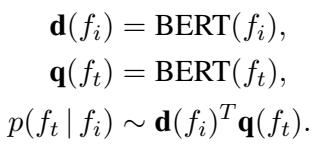
By using Maximum Inner-Product Search, the system can instantly find the specific memories that are relevant to the current question, mimicking how the human brain utilizes associative memory.
2. Feature Representation
Once the relevant history is retrieved, KAR³L needs to process it. It doesn’t just rely on the text; it combines the text with hard data. The input to the classifier includes:
- BERT Embeddings: The vector representation of the card text.
- Review Distribution: How many times the student got similar cards right vs. wrong.
- Temporal Features: Time since the last review (the “forgetting curve” data).
This hybrid approach allows KAR³L to understand that “George Washington” is semantically close to “John Adams,” while also acknowledging that you haven’t reviewed American History in three months.
Visualizing the Semantic Connection
One of the most powerful capabilities of KAR³L is creating dynamic forgetting curves. In traditional models, a forgetting curve is a fixed mathematical decay—you forget at a specific rate over time.
With KAR³L, learning one fact can “boost” the retention curve of another fact without you even touching it.
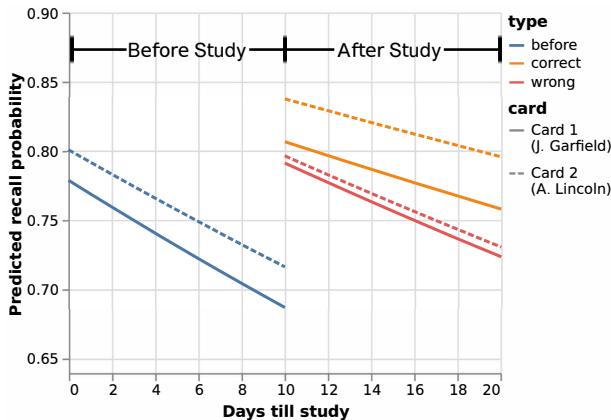
In Figure 3, we see the forgetting curves for Card 1 (James Garfield) and Card 2 (Abraham Lincoln).
- At Day 0: The student studies Card 1.
- At Day 10: The student reviews Card 1 again and gets it correct.
- The Result: Look at the curve for Card 2 (the orange line). Even though the student didn’t study Abraham Lincoln, the probability of knowing Card 2 increases slightly after Day 10.
The model infers: “You just nailed a question about US Presidents; you probably remember other Presidents better than I thought.” This is the essence of content-aware scheduling.
The Data Challenge
Training a model like this is difficult because most open-source flashcard datasets (like Duolingo’s or EdNet) do not release the text of the cards—only the IDs and performance logs.
To overcome this, the researchers built their own flashcard platform and recruited 543 users to study over four months, generating 123,143 study logs.
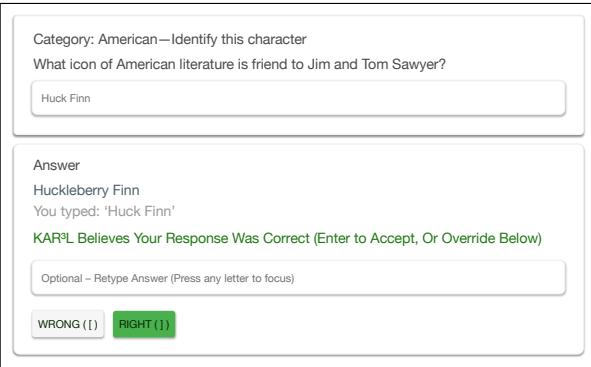
They generated flashcards using the QANTA dataset, which consists of high-quality trivia questions spanning topics like Literature, History, and Science.
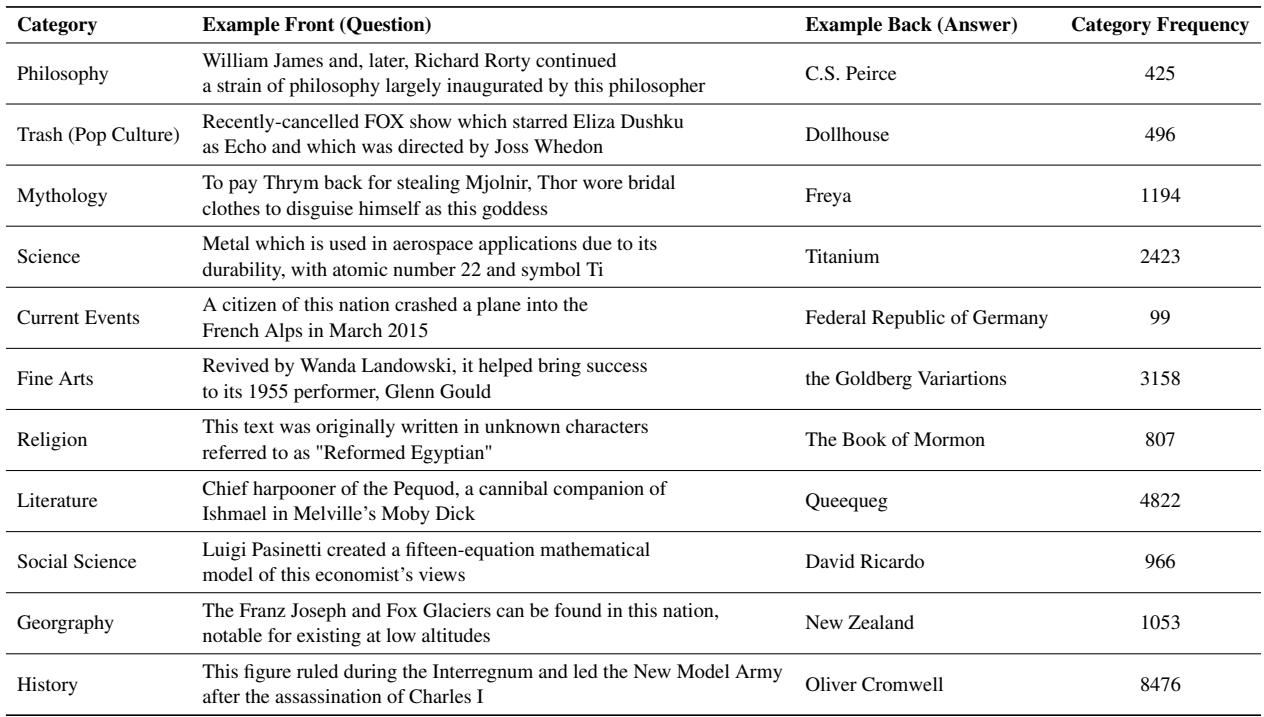
This diversity was crucial. As shown in Table 5, the dataset covers everything from “The Book of Mormon” to “Titanium,” ensuring the model learns to handle varied semantic relationships.
Offline Results: Predicting the Unknown
The first test of KAR³L was “Offline Evaluation”—feeding the model historical data and asking it to predict the outcome of held-out study sessions.
The researchers compared KAR³L against several baselines:
- Leitner & SM-2: Heuristic systems (rule-based).
- HLR: Half-Life Regression (used by Duolingo).
- FSRS: The current state-of-the-art scheduler (math-heavy).
- LM-KT & GPT-3.5: Other language-model-based approaches.
The metrics used were AUC (Area Under the Curve, measuring how well the model distinguishes between known and unknown cards) and ECE (Expected Calibration Error, measuring how accurate the probability percentages are).
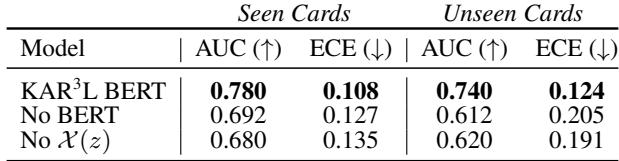
The results (Table 1) were remarkably clear:
- Seen Cards: On cards the student had studied before, KAR³L achieved the highest AUC (0.864) and the lowest Calibration Error (0.091). It outperformed FSRS significantly in discrimination.
- Unseen Cards: This is the killer feature. Traditional models like HLR and FSRS cannot make predictions for unseen cards (hence the “-” in the table). KAR³L, however, achieved an AUC of 0.786 on cards the student had never seen, simply by analyzing their history with related cards.
This proves that semantic retrieval effectively captures a student’s “knowledge state” better than just looking at their raw performance statistics.
Online Evaluation: The Delta Teaching Policy
Being able to predict recall is great, but the ultimate goal is to teach. A scheduler needs a policy: a set of rules deciding which card to show next.
Standard policies are threshold-based (e.g., “Show the card when probability drops below 90%”). But the researchers argued this is suboptimal. They proposed a Delta-Based Teaching Policy.
Instead of maintaining a threshold, the system asks: “Which card, if studied right now, would produce the largest increase in future memory strength?”
The formula for this “Delta score” is:

It calculates the difference in future recall probability (\(p_{t'}\)) between two scenarios: studying the card now vs. not studying it.
To calculate the expected future recall if the card is studied, the model must account for the fact that the student might get it right or wrong during the review:
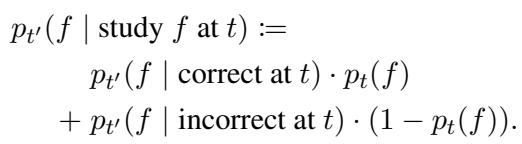
By prioritizing cards with the highest Delta score, the scheduler targets facts that are “ripe” for learning—cards where a review provides the maximum marginal utility for memory retention.
Did it actually help students learn?
The researchers ran a controlled user study with 27 students. They compared FSRS (the current gold standard) against KAR³L + Delta Policy.
They measured Testing Throughput: The number of correct answers a student can produce per second of testing time. This combines accuracy with speed (fluency).
- Accuracy: Both systems helped students double their accuracy from pre-test to post-test (from ~42% to ~87%).
- Response Time: Students using KAR³L recalled answers significantly faster (6.15 seconds vs 6.58 seconds for FSRS).
Because the students achieved the same accuracy in less time, KAR³L demonstrated higher Testing Throughput. This suggests that content-aware scheduling didn’t just help them pass the test; it helped them internalize the knowledge more deeply, leading to faster, more confident recall.
Conclusion and Implications
The KAR³L paper provides the first concrete evidence that content-aware scheduling can improve student learning outcomes compared to state-of-the-art behavior-based systems.
By giving algorithms the ability to “read,” we move away from treating students as producers of binary data (Correct/Incorrect) and start treating them as learners acquiring interconnected concepts. KAR³L proves that if you know who John Adams is, the algorithm should know that you probably know George Washington, too.
Key takeaways for the future of EdTech:
- Retrieval is powerful: You don’t need to analyze a student’s whole life history; the most relevant semantic moments are enough.
- Cold Start problem solved: NLP allows systems to predict performance on flashcards a student has never even touched.
- Optimization beyond thresholds: Scheduling based on “Learning Delta” (maximizing gain) may yield better fluency than simply scheduling based on a fixed forgetting threshold.
As Large Language Models become faster and more efficient, we can expect the next generation of learning apps to be not just schedulers, but true AI tutors that understand the content they are teaching.