](https://deep-paper.org/en/paper/2402.12593/images/cover.png)
Introduction
We are currently living in the golden age of Large Language Models (LLMs). Tools like ChatGPT and Perplexity have seamlessly integrated into our daily lives, helping us draft emails, debug code, and even write creative fiction. For the general user, these models are nothing short of magical. You ask for a story, and you get one.
However, for domain experts—teachers, curriculum developers, healthcare professionals—“good enough” isn’t actually good enough. These fields rely on strict, expert-defined standards. A teacher crafting a reading test for a 4th-grade student cannot simply use a text “vibed” by an AI; the text must adhere to specific vocabulary limits, sentence structures, and complexity metrics defined by educational frameworks.
Here lies the problem: while LLMs are great at being creative, they are notoriously bad at following strict, fine-grained constraints found in professional rulebooks. If you ask an AI to “write a story for a B1 level English learner,” it often defaults to a generic simple style that doesn’t actually meet the B1 criteria.
In this deep dive, we explore a fascinating research paper titled “STANDARDIZE: Aligning Language Models with Expert-Defined Standards for Content Generation.” The researchers propose a novel framework that teaches LLMs to follow the rules not by retraining them, but by feeding them the “knowledge artifacts” of the standards themselves.
Background: The Gap Between “Teacher Style” and True Standards
To understand why this research is necessary, we first need to look at how most people currently interact with LLMs. The most common method is known as Teacher Style prompting. This involves giving the model a persona and a simple instruction, such as:
“You are a helpful teacher. Write a story about a forest suitable for an A2 level student.”
While this sounds logical, research shows that models often struggle with this. They might make the text too simple, or conversely, sneak in complex grammar that an A2 student wouldn’t know yet. The model is guessing what “A2” means based on its training data, rather than referencing the actual rulebook.
The Rulebooks: CEFR and CCS
The researchers focused on two major educational standards to test their theory:
- CEFR (Common European Framework of Reference for Languages): This is the gold standard for language learning in Europe and beyond. It breaks proficiency down into six levels (A1, A2, B1, B2, C1, C2), ranging from basic beginner to mastery. Each level has specific rules about grammar, vocabulary, and sentence length.
- CCS (Common Core Standards): Widely used in the United States for K-12 education, this standard uses qualitative and quantitative dimensions to determine if a text is appropriate for a specific grade level.
The challenge is bridging the gap between the vague “Teacher Style” prompt and the rigorous, complex definitions found in these standards.
The Core Method: The STANDARDIZE Framework
The researchers introduced STANDARDIZE, a retrieval-style framework based on in-context learning. The core philosophy here is simple but powerful: If we want the model to follow the standard, we must explicitly provide the relevant parts of the standard within the prompt.
The framework operates in a three-step pipeline, which transforms a basic prompt into a highly enriched instruction set.

As illustrated in Figure 1, the process moves away from the simple “blackboard” prompt to a structured engineering workflow. Let’s break down the three components.
1. Target Specification Extraction
First, the system analyzes the user’s request to identify two key pieces of information: the target audience (e.g., “A2 learners”) and the standard being used (e.g., “CEFR”). This acts as the search query for the next step.
2. Specification Lookup and Retrieval
The system then consults a database containing the digitized standards. It retrieves the specific rules that apply to the requested level. For example, if the user asks for B1 content, the system pulls up the B1 row from the CEFR database.
3. Knowledge Augmentation
This is the most critical step. The retrieved information is converted into Knowledge Artifacts—specific chunks of information that the LLM can understand and use to guide its generation. The paper identifies three distinct types of artifacts that significantly boost performance.
Artifact A: Aspect Information
Standards usually contain descriptive definitions of what a text should look like. These are qualitative rules.
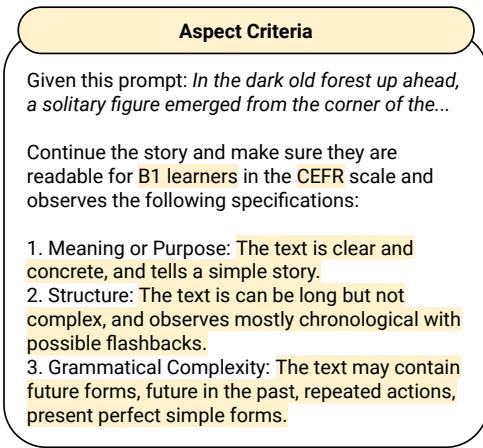
As shown above, instead of just saying “make it B1,” the STANDARDIZE framework feeds the model specific criteria. It explicitly tells the AI that for a B1 learner, the text must be “clear and concrete,” the structure should be “mostly chronological,” and grammatical complexity can include “future forms” or “past perfect.” This removes the ambiguity, giving the model a checklist to follow.
Artifact B: Linguistic Flags
While descriptions are helpful, some standards are mathematical. Educational experts often use metrics like “Type-Token Ratio” (a measure of vocabulary diversity) or average sentence length to judge complexity.
The researchers implemented a clever “rewrite function” using these flags.
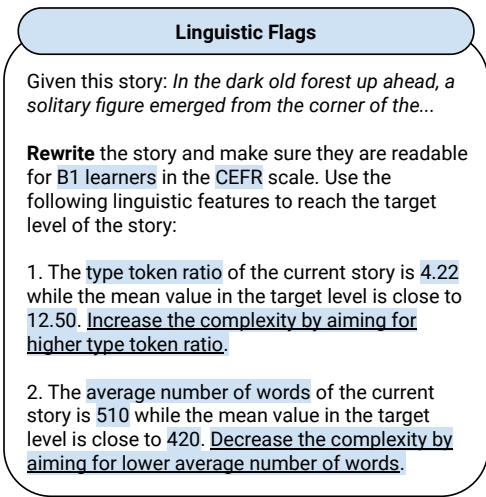
Here is how it works:
- The model generates an initial draft.
- The system calculates the linguistic statistics of that draft (e.g., “Current Type-Token Ratio: 4.22”).
- It compares this to the “Gold Standard” average for that level (e.g., “Target: 12.50”).
- It prompts the model to rewrite the text with a directional instruction: “Increase complexity by aiming for a higher type token ratio.”
This turns abstract goals into concrete mathematical targets for the AI.
Artifact C: Exemplars
Finally, the framework utilizes Exemplars. These are gold-standard examples of literature that fit the target level.
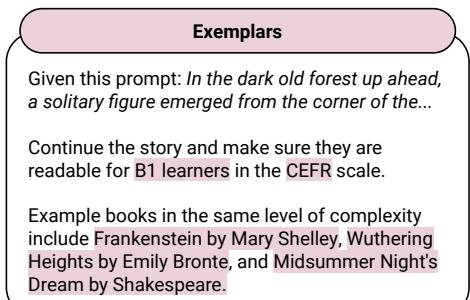
By providing titles of books or actual snippets of text that are known to be B1 (like Frankenstein or Wuthering Heights), the framework leverages the LLM’s vast pre-training knowledge. The model “knows” the style of these books and can mimic their complexity level.
Formalizing the Task
The researchers formalized this new approach into a task called Standard-Aligned Content Generation (STANDARD-CTG).
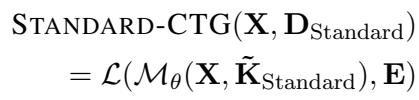
In this equation:
- \(\mathbf{X}\) is the generated content.
- \(\mathcal{M}_{\theta}\) is the language model.
- \(\tilde{\mathbf{K}}_{\mathrm{Standard}}\) represents the transformed Knowledge Artifacts we just discussed.
- The goal is to minimize the difference between the generated text and the gold-standard examples \(\mathbf{E}\).
Experiments and Results
To prove that STANDARDIZE works, the team ran extensive experiments. They tested the framework on several models, including open-source models like Llama 2 (7B) and OpenChat, as well as the proprietary GPT-4.
They evaluated the models on two tasks:
- Context Assisted Story Generation: The model is given a short prompt (3-5 sentences) and must continue the story at a specific CEFR level.
- Theme Word Story Generation: The model is given a single word (e.g., “dragons”) and must write a story from scratch at a specific CCS grade level.
Quantitative Success
The results were striking. The introduction of the STANDARDIZE framework provided massive boosts in accuracy compared to the baseline “Teacher Style” prompting.
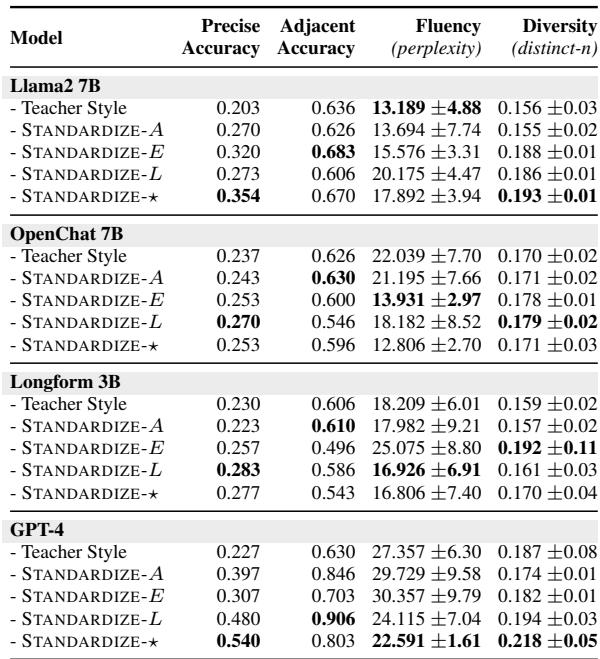
As we can see in Table 1 (above), looking at GPT-4:
- Teacher Style (the baseline) achieved a “Precise Accuracy” of only 0.227. This means it only hit the exact target level 22.7% of the time.
- STANDARDIZE-* (using all artifacts) achieved 0.540.
That is a performance increase of over 100%. The model became more than twice as effective at generating text that aligned with the specific European standard.
The results were similarly positive for the US-based Common Core Standards (CCS).
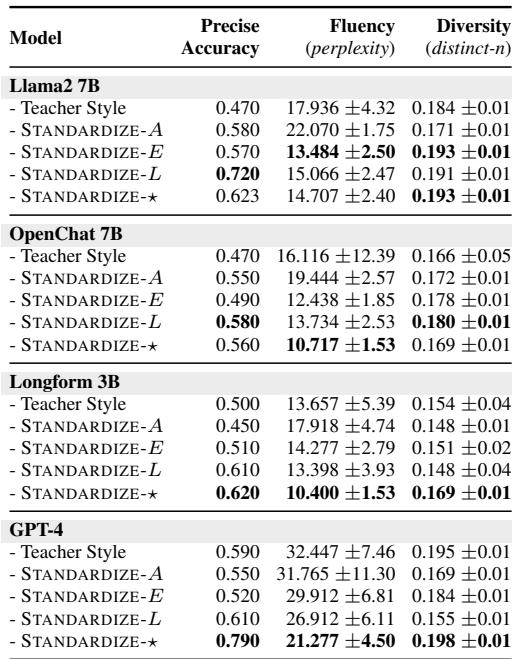
In Table 2, we see that for Llama 2, the accuracy jumped from 0.470 (Teacher Style) to 0.720 (using Linguistic Flags). This demonstrates that even smaller, open-source models can benefit immensely from being told the explicit rules of the game.
Linguistic Similarity
Accuracy is one thing, but does the text actually feel right? To measure this, the researchers analyzed the distribution of linguistic features (like sentence length and vocabulary density) in the generated stories.
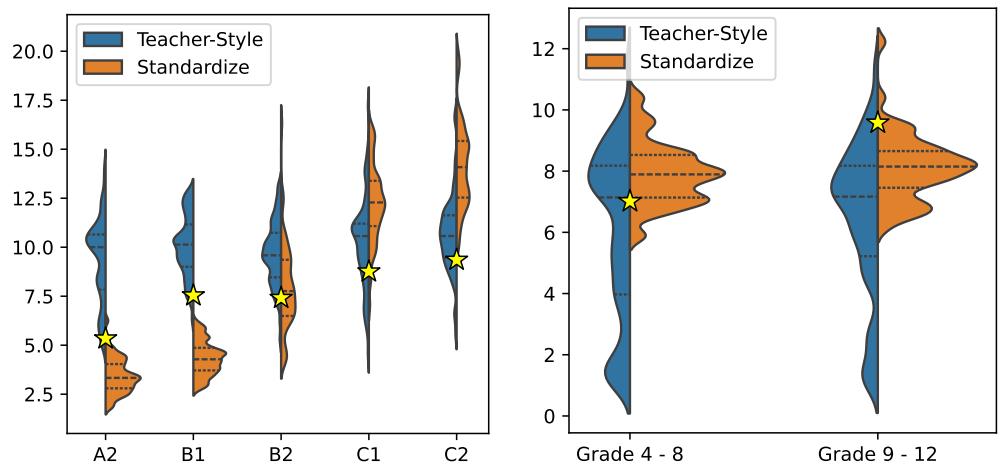
Figure 6 offers a fascinating visualization. The blue shapes represent the “Teacher Style” output, while the orange shapes represent “STANDARDIZE.” The yellow stars indicate the actual target means from human-written gold-standard text.
Notice how the STANDARDIZE (orange) distributions are often tighter and, crucially, center much closer to the yellow stars. This is particularly evident in the CCS (right side) graph for Grades 4-8 and 9-12. The framework successfully steered the model to write sentences of the appropriate length for those age groups, whereas the baseline model just guessed (and often guessed wrong).
We see a similar effect with “Type Token Ratio” (vocabulary diversity).
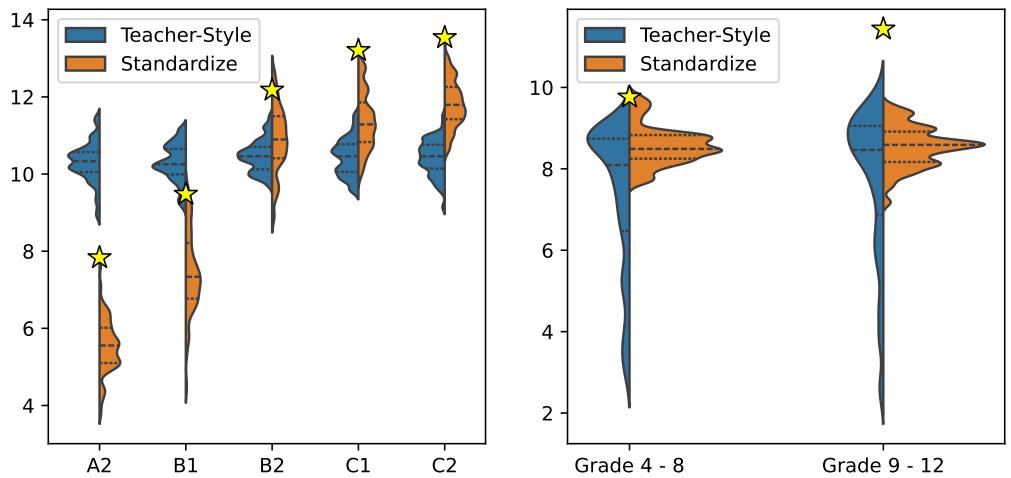
In Figure 8, the baseline (blue) is often all over the place or clustered incorrectly. The STANDARDIZE method (orange) aligns the model’s vocabulary usage much closer to what is expected of the target reading levels.
Human Expert Evaluation
Automated metrics are useful, but human judgment is the ultimate test. The researchers recruited domain experts in language assessment to evaluate the stories for grammaticality, coherence, and distinctness.
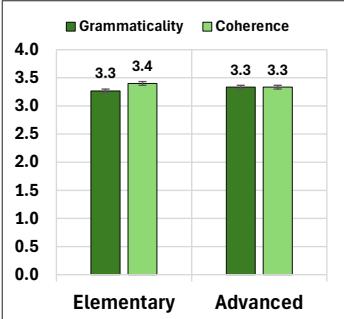
The experts found that the content generated by STANDARDIZE was high quality. As shown in the chart above, inter-rater reliability was strong (0.45), and the experts were able to distinguish between simple and complex texts generated by the model. This confirms that the framework doesn’t just satisfy mathematical formulas; it produces readable, coherent text that human experts recognize as distinct proficiency levels.
Conclusion and Implications
The STANDARDIZE framework represents a significant step forward in making Large Language Models useful for specialized domains. The key takeaway from this research is that we do not always need to train massive new models to get them to follow rules. Often, the knowledge resides in the model already—it just needs the right “keys” to unlock it.
By extracting expert-defined standards and converting them into Knowledge Artifacts (Aspects, Linguistic Flags, and Exemplars), we can align general-purpose models with rigorous professional requirements.
Why Does This Matter?
- For Education: This paves the way for AI that can genuinely help teachers create reading materials. Instead of a generic “easy story,” a teacher could generate a text that mathematically and linguistically matches the exact B1 curriculum they are teaching that week.
- For Other Industries: While this paper focused on education, the methodology is applicable elsewhere. Imagine a legal AI that uses “Knowledge Artifacts” from state laws to draft contracts, or a medical AI that adheres to strict clinical reporting standards by retrieving the specific guidelines before generating text.
The STANDARDIZE framework bridges the gap between the “vibes” of AI generation and the precision of human expertise. It reminds us that in the age of AI, defining the rules clearly is just as important as the intelligence of the model itself.