](https://deep-paper.org/en/paper/2402.13331/images/cover.png)
Neural Machine Translation (NMT) has revolutionized how we communicate. From Google Translate to advanced enterprise tools, these systems have become staples of modern interaction. However, despite their widespread adoption and general reliability, NMT systems suffer from a critical pathology: Hallucinations.
Imagine using a translation tool to decipher instructions for a hotel stay. The original German text suggests opening the window to enjoy the view. The translation model, however, confidently outputs: “The staff were very friendly.” This isn’t just a grammatical error; it is a complete detachment from the source material.
These errors are rare, but when they happen, they shatter user trust and can pose safety risks in critical deployments. The research community has responded by building “detectors”—tools designed to flag these errors before they reach the user. But here is the catch: no single detector catches every type of error.
In this post, we dive into a fascinating paper, “Enhanced Hallucination Detection in Neural Machine Translation through Simple Detector Aggregation,” which proposes a straightforward yet highly effective solution. The authors introduce STARE (Simple deTectors AggREgation), a method that proves two heads (or three, or four) are indeed better than one.
The Problem: When Models Dream
Before we fix the problem, we must understand what it looks like. Hallucinations in NMT are generated translations that are grammatically fluent but semantically unrelated to the source text. They generally fall into two categories:
- Oscillatory Hallucinations: The model gets stuck in a loop, repeating phrases or n-grams.
- Detached Hallucinations: The model generates a fluent sentence that has nothing to do with the input.
To visualize this, let’s look at some examples provided by the researchers:
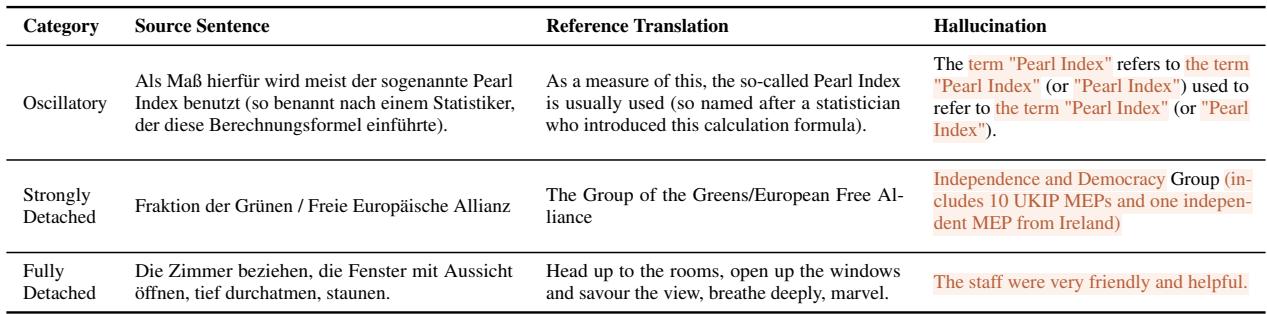
As shown in the table above, the “Fully Detached” example is particularly dangerous because it looks like a valid sentence. A user with no knowledge of the source language would have no reason to suspect an error.
The Current Landscape of Detectors
To catch these ghosts in the machine, researchers have developed various detection scores. These broadly fall into two camps:
- External Detectors: These treat the translation model as a “black box.” They use separate, pre-trained models to compare the source and the translation.
- Examples: LaBSE (checks sentence similarity), CometKiwi (estimates translation quality).
- Strength: Excellent at spotting detached content where the meaning is totally different.
- Internal (Model-Based) Detectors: These look “under the hood” of the translation model as it generates text.
- Examples: Seq-Logprob (checks the model’s confidence), ALTI+ (analyzes attention maps to see if the model was actually looking at the source tokens).
- Strength: Great at identifying oscillatory errors or anomalies in the generation process.
The Trade-off: The researchers noticed a complementary pattern. External detectors are great at spotting when the meaning is wrong, but they might miss repetitive loops. Internal detectors notice the loops but might be fooled by a fluent but wrong sentence.
The logical next step? Combine them.
STARE: A Simple Method for Aggregation
The core contribution of this paper is STARE, an unsupervised method for aggregating multiple hallucination detectors. The goal is to create a single, robust score that is more reliable than any individual input.
1. The Setup
First, let’s define the goal mathematically. We want to classify a translation \(x\) as either a hallucination or a valid translation. We do this using a binary decision function \(g(x)\):
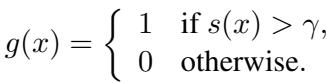
Here, \(s(x)\) is our hallucination score, and \(\gamma\) is a threshold. If the score passes the threshold, we flag it.
Now, imagine we have a set of \(K\) different detectors. We want to map these \(K\) scores into a single value.
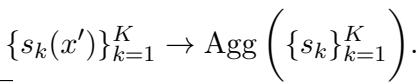
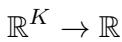
The input domain for this aggregation is a vector of real numbers (the scores), and the output is a single real number:
2. The Challenge: Comparing Apples and Oranges
The main hurdle in combining detectors is that they measure things on completely different scales.
- A log-probability score might range from \(-\infty\) to \(0\).
- A cosine similarity score (like LaBSE) might range from \(0\) to \(1\).
You cannot simply add these numbers together. To solve this, the authors utilize a reference dataset (a set of unlabelled translations) to establish a “standard” scale.
3. The Solution: Min-Max Normalization
For every individual detector \(k\), the authors calculate a specific weight, \(w_k\), for the current translation \(x'\). This weight is essentially the score normalized by the minimum and maximum values observed in the reference dataset \(\mathcal{D}_n\).
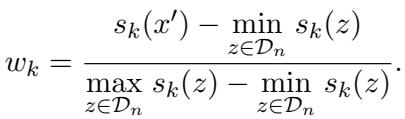
This formula ensures that the value is scaled relative to the range of scores typically seen for that specific detector.
4. The Aggregation
Once the weights are calculated, the final STARE score is computed. The authors propose a weighted average where the normalized weight \(w_k\) scales the contribution of the score \(s_k\).
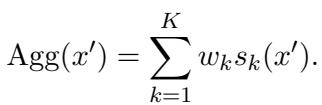
This method, STARE, is elegant because it is unsupervised. It doesn’t require a labeled training set of “hallucinations” to learn the weights. It simply looks at the statistical distribution of scores in a reference set to normalize the inputs.
Experimental Results
To prove this simple addition works, the authors tested STARE on two benchmark datasets: LFAN-HALL (German to English) and HALOMI (Multilingual).
Beating the Singles
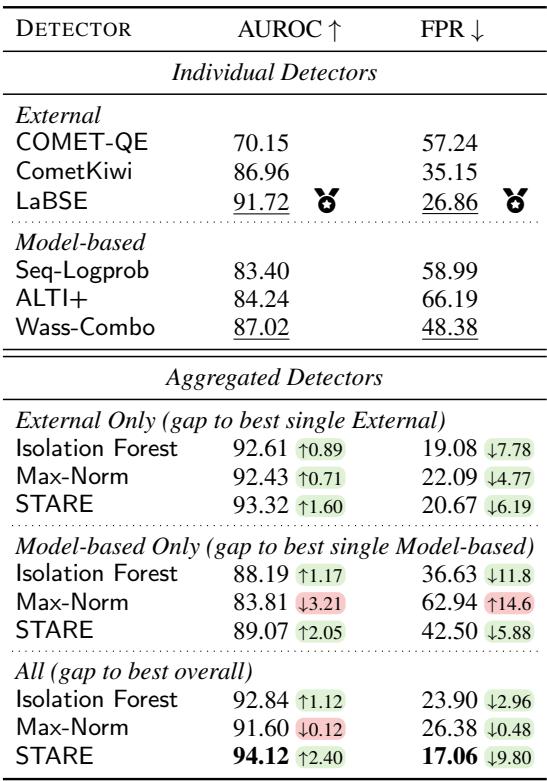
The results were consistent and impressive. As seen in Table 1 below, the aggregated method (STARE) consistently outperformed individual detectors.
Key Takeaways from the Data:
- Best Overall: In the “All” category (bottom rows), combining both internal and external detectors yielded the highest AUROC (Area Under the Receiver Operating Characteristic) scores. On the LFAN-HALL dataset, STARE reached a massive 94.12.
- False Positive Reduction: Look at the FPR columns. The false positive rate drops significantly with STARE. This is crucial for production systems—you don’t want to flag good translations as errors, or users will get annoyed.
- Internal vs. External: Interestingly, while external detectors (like LaBSE) are usually strong on their own, aggregating internal detectors can sometimes outperform the best single external detector. This proves there is rich, untapped signal inside the model itself.
How Many Detectors Do You Need?
Do you need to run 10 different models to get a good result? The authors performed an ablation study to find the optimal number of detectors.
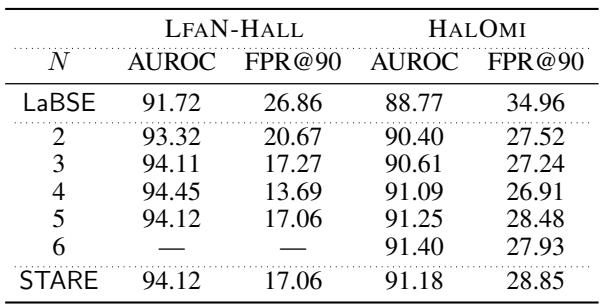
The data shows that improvement happens immediately. Simply combining two detectors (e.g., CometKiwi + LaBSE) jumps the performance significantly compared to the single best detector. While adding more detectors continues to improve the score, the returns diminish slightly after 3 or 4. This is great news for engineering teams: you can get a massive reliability boost by just adding one complementary signal.
Robustness and Stability
One concern with unsupervised methods is their reliance on the reference dataset. If your reference data is small, does the method break?
The authors tested this by varying the size of the reference set used for normalization.
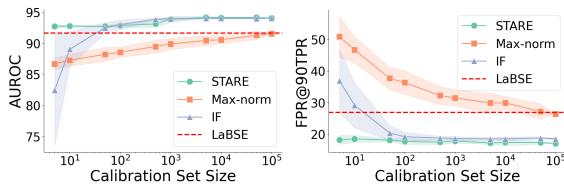
The charts above show that STARE (the purple line) is remarkably stable. Unlike the Isolation Forest baseline (orange line), which behaves erratically with small datasets, STARE stabilizes quickly. You only need about 1,000 samples in your reference set to achieve peak performance.
Finally, to ensure these results weren’t a fluke, the authors ran the experiments multiple times on the HALOMI dataset using different calibration splits.
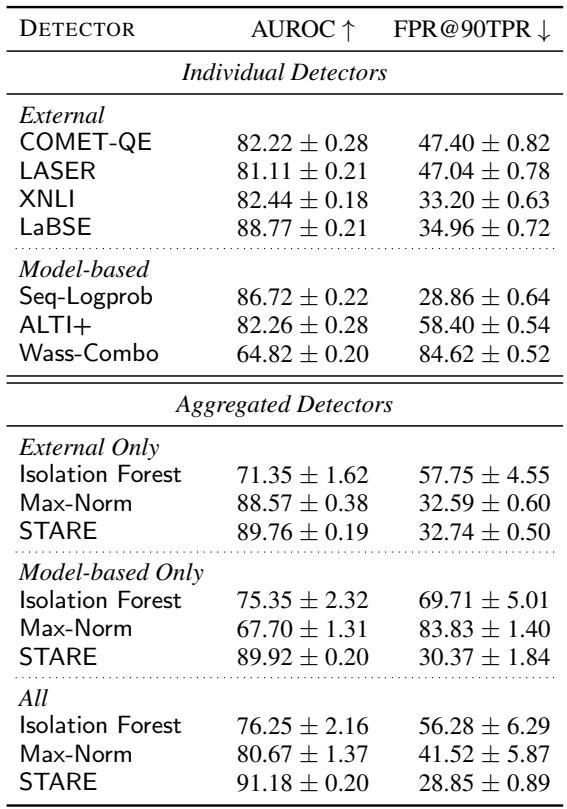
The low standard deviations confirm that STARE is not only accurate but also reliable across different data splits.
Conclusion
The “black box” nature of neural networks often makes us feel helpless when they make mistakes. However, this research offers a practical, deployable path forward. We don’t necessarily need to invent a perfect, all-knowing hallucination detector. Instead, we can rely on the wisdom of the crowd—even a small crowd of algorithmic detectors.
By recognizing that different detectors have complementary strengths—some catching detached meanings, others catching repetitive glitches—the STARE method provides a simple mathematical framework to unify them.
For students and researchers entering the field of NLP safety, the lesson is clear: Diversity matters. Combining internal model signals with external quality checks creates a safety net that is tighter and stronger than any single strand could provide alone. As NMT systems continue to scale, simple, robust aggregation methods like STARE will be essential in keeping them grounded in reality.