](https://deep-paper.org/en/paper/2402.13415/images/cover.png)
Introduction: The “Grandfather Paradox” of LLMs
Imagine you are reading a logic puzzle: “Marian went shoe shopping with her sister Michelle. Darnell’s grandfather, Stanley, taught her how to make a paper airplane while her mother, Marian, prepared dinner. What is the family relationship between Michelle and Stanley?”
For a human, this requires a momentary pause. You likely construct a mental image or a quick sketch: Stanley is Darnell’s grandfather. Marian is Darnell’s mother (so Marian is Stanley’s daughter). Michelle is Marian’s sister. Therefore, Michelle is also Stanley’s daughter.
Large Language Models (LLMs) like GPT-4 are incredibly fluent, but they often stumble on this type of multi-step reasoning. They process text linearly, token by token. When relationships are buried in a narrative, or when “Node A” (Michelle) is separated from “Node B” (Stanley) by a sea of irrelevant context (like shoe shopping or paper airplanes), the model often loses the thread. It might hallucinate a relationship or simply guess based on proximity words.
In a fascinating paper titled “Structure Guided Prompt: Instructing Large Language Model in Multi-Step Reasoning by Exploring Graph Structure of the Text,” researchers from UCLA and Intel Labs propose a solution that doesn’t involve retraining the model or using expensive external tools. Instead, they teach the LLM to “think” in graphs.
This post explores their Structure Guided Prompt framework—a zero-shot method that explicitly instructs LLMs to convert text into a graph and navigate it to find answers.
The Challenge: Why Linear Thinkers Struggle with Webbed Data
To understand the solution, we must first understand the problem. LLMs are probabilistic engines. They predict the next word based on the preceding context. However, reasoning problems, specifically those involving entities and relationships, are rarely linear. They are structural.
Standard prompting methods, including the popular Chain-of-Thought (CoT) (where we ask the model to “think step by step”), still rely largely on a linear derivation of logic. While CoT helps, it often fails when:
- Ambiguity exists: Natural language is messy. “Her mother” could refer to different people depending on context.
- Distractions abound: Irrelevant details (shoe shopping) dilute the model’s attention.
- The chain is long: The more steps required (A \(\rightarrow\) B \(\rightarrow\) C \(\rightarrow\) D), the higher the probability the model hallucinates a connection.
The researchers argue that humans handle this by creating Knowledge Graphs (KGs) mentally. We extract entities (people, objects) and edges (relationships) to verify the logic.
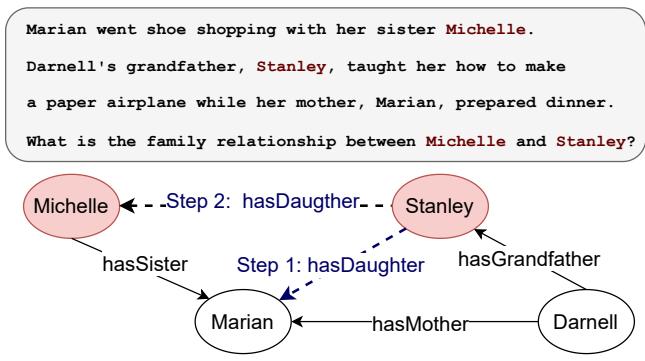
As shown in Figure 2 above, to solve the Marian/Stanley problem, a human implicitly maps out the family tree. The paper asks: Can we prompt an LLM to explicitly perform this same graph-construction process?
The Solution: Structure Guided Prompting
The core contribution of this paper is a three-stage prompting framework. It is task-agnostic (it works for family trees, logic puzzles, object tracking, etc.) and zero-shot (it requires no training examples).
The framework forces the LLM to slow down and switch its mode of processing from “predicting text” to “constructing and traversing a graph.”
Stage 1: Concept Map Construction
In the first stage, the prompt instructs the LLM to read the unstructured text and convert it into a structured graph format. The model identifies entities (nodes) and their relationships (edges).
For example, given a story about a family, the model creates triples:
- (Marian, hasSister, Michelle)
- (Darnell, hasGrandfather, Stanley)
- (Marian, hasMotherOf, Darnell)
By explicitly generating these facts, the model “grounds” itself. It filters out the noise (the paper airplanes and shoe shopping) and retains only the structural logic.
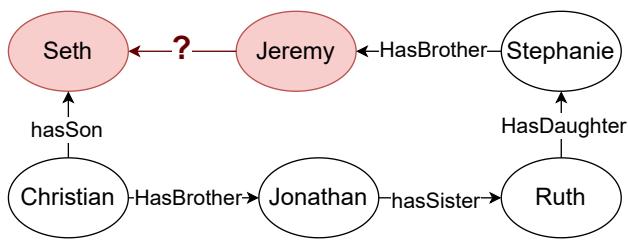
Figure 3 illustrates what the LLM is mentally constructing. While the text might be a paragraph long, the distilled graph reveals the actual path from Seth to Jeremy.
Stage 2: Task-Specific Planning
Once the graph is built, simply “having” it isn’t enough. The model needs a plan on how to use it. This is where the framework distinguishes itself from generic prompting. Depending on the type of question, the navigation strategy changes.
The researchers identified distinct planning strategies for different tasks:
- Relation Prediction: If the question asks “How is X related to Y?”, the plan is to find the shortest path between node X and node Y in the graph.
- Dynamic Entity Prediction: If the question involves change over time (e.g., “Alice gave the ball to Bob, then Bob gave it to Charlie”), the plan is to track state changes step-by-step to update the graph.
- Graph Sorting: If the question asks for an ordering (e.g., “Who is the second tallest?”), the plan is to arrange nodes based on relationship attributes.
Stage 3: Execution
Finally, the LLM executes the plan using the graph it built. It generates a response by traversing the nodes.
Returning to the example in Figure 3 (Seth and Jeremy):
- Graph: The model sees Seth \(\rightarrow\) Christian \(\rightarrow\) Jonathan \(\rightarrow\) Ruth \(\rightarrow\) Stephanie \(\rightarrow\) Jeremy.
- Plan: Trace the path.
- Execution:
- Seth is Christian’s father.
- Christian is Jonathan’s brother (so Seth is Jonathan’s father).
- Jonathan has a sister Ruth (Seth is Ruth’s father).
- Ruth has a daughter Stephanie (Seth is Stephanie’s grandfather).
- Stephanie has a brother Jeremy.
- Conclusion: Seth is Jeremy’s grandfather.
By forcing this explicit traversal, the model avoids “jumping to conclusions” based on superficial word associations.
Applying the Framework: Diverse Reasoning Tasks
The researchers tested this framework across several distinct categories of reasoning problems. It is crucial to understand that “reasoning” is not a single skill; it is a collection of capabilities.
1. Relation Prediction (The Family Tree Problem)
This is the classic multi-hop problem. As discussed with the CLUTRR dataset, the model must infer unstated relationships (like “uncle” or “grandson”) based on stated ones (“father’s brother”). The graph structure is particularly powerful here because family trees are literally graphs.
2. Entity Prediction over Dynamic KGs
This is one of the hardest tasks for standard LLMs. Consider the “Shell Game” or tracking shuffled objects.
- Scenario: “Alice has a red ball. Bob has a blue ball. Alice and Bob swap. Then Bob gives his ball to Charlie. What color does Charlie have?”
- The Problem: Standard LLMs often lose track of the current state after multiple swaps.
- The Solution: The Structure Guided Prompt instructs the model to update the graph at every time step (\(t_0, t_1, t_2...\)), ensuring the final state is accurate.
3. Complex Entity Prediction (Bridging)
This involves questions that require hopping between different contexts or paragraphs, often seen in the HotpotQA dataset.
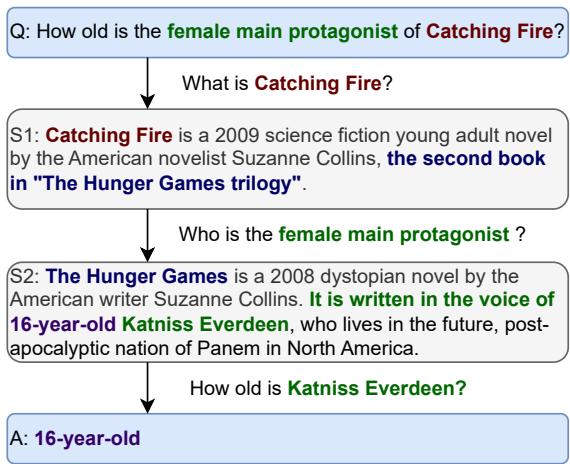
As shown in Figure 4, answering “How old is the female main protagonist of Catching Fire?” requires two distinct hops:
- Identify the protagonist of Catching Fire (Katniss Everdeen).
- Find the age of Katniss Everdeen.
The framework guides the LLM to decompose this into sub-questions, treating the answer to the first hop as the key to the second.
4. Logical Inference
This involves syllogisms and entailment (e.g., “All men are mortal. Socrates is a man. Therefore…”). The prompt guides the model to treat premises as nodes and logical implications as directed edges, performing “forward chaining” to reach a conclusion.
Experiments and Results
Does “thinking in graphs” actually help? The researchers compared their method against two baselines:
- Standard Prompting: Just asking the question.
- Zero-Shot Chain-of-Thought (0-CoT): Appending “Let’s think step by step.”
They tested on both GPT-3.5 and GPT-4. The results were statistically significant.
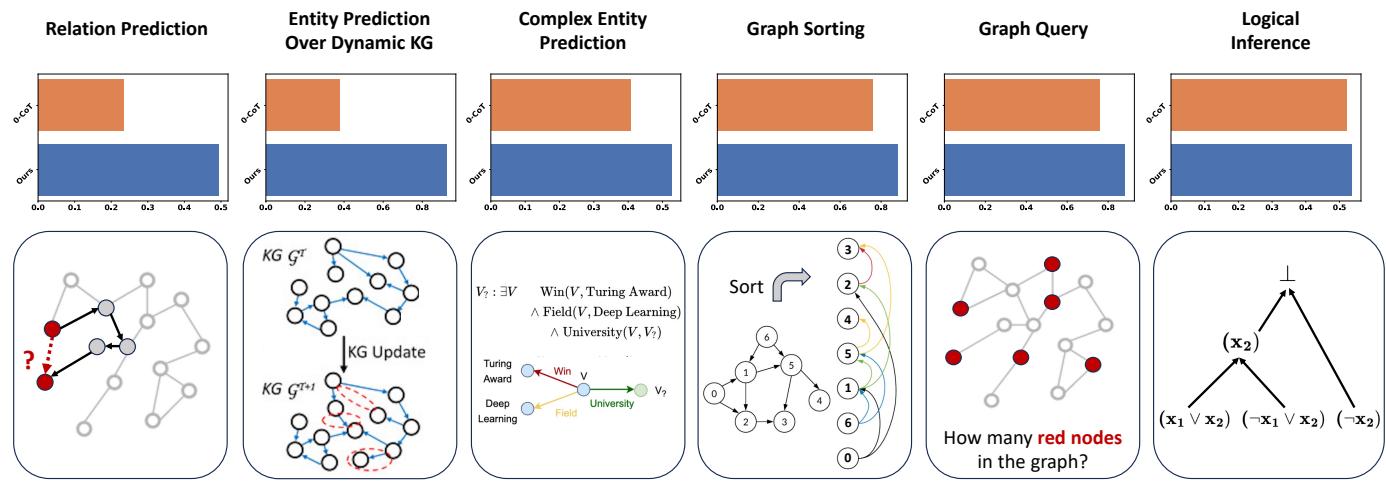
As Figure 1 highlights, the blue bars (Structure Guided Prompt) consistently tower over the orange bars (0-CoT).
Key Observations from the Data
Let’s look at a more detailed breakdown of the performance.
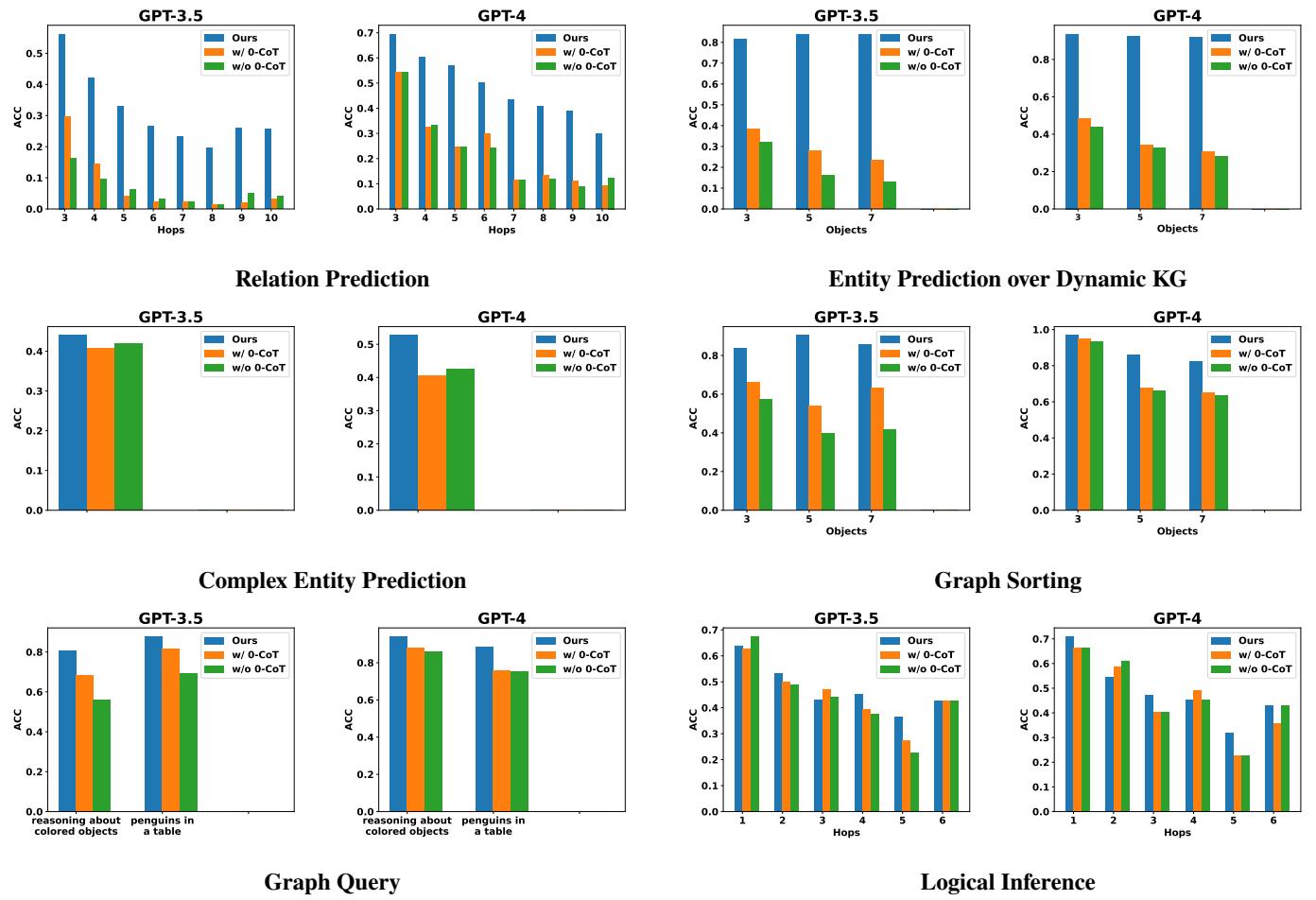
Massive Gains in Dynamic Tracking
Look at the “Entity Prediction over Dynamic KG” charts in Figure 5. This is where the method shines brightest. When tracking shuffled objects (3, 5, or 7 objects), standard CoT performance degrades rapidly as complexity increases. The Structure Guided Prompt maintains much higher accuracy because it explicitly tracks the state changes in the graph.
Resilience to Path Length
In the Relation Prediction task (CLUTRR), as the number of “hops” (relational distance) increased from 3 to 10, the performance of standard models plummeted. The graph-based approach suffered much less degradation. Once the graph is built, traversing 5 nodes isn’t significantly harder than traversing 3.
The “Conclusion” Bottleneck
An interesting failure mode was discovered during the case studies. Sometimes, the LLM would construct the perfect graph and trace the correct path, but still hallucinate the final answer in the very last token generation.
- Example: The model correctly traces that Alice is dancing with Lola. It writes out “Alice is dancing with Lola.” But when asked to select option A, B, or C, it might inexplicably pick the wrong letter.
- Implication: This suggests that while reasoning is improved, the “answer extraction” phase still has fragility inherent to probabilistic models.
Discussion: Why Does This Matter?
The significance of this paper extends beyond just getting higher scores on benchmarks. It tells us something fundamental about how we should interact with Large Language Models.
1. Structure is a “Force Multiplier”
LLMs are trained on vast amounts of unstructured text. However, their reasoning capabilities are unlocked when we force them to structure that data. We don’t need to train a new model to do this; the capability is latent, waiting for the right prompt.
2. The Limits of External Knowledge Graphs
Previous approaches often tried to couple LLMs with external databases or Knowledge Graph engines (like Neo4j). While powerful, that approach is complex and expensive. This paper proves that for many reasoning tasks, the LLM can be its own Knowledge Graph. It can extract the structure on the fly from the context provided.
3. The Gap Between Language and Logic
The paper notes a limitation: Knowledge Graphs are rigid. They struggle to capture nuance, emotion, or “fuzzy” logic found in literature. A graph can represent “Alice is Bob’s sister,” but it struggles to represent “Alice is secretly jealous of Bob.” While Structure Guided Prompting solves logical puzzles, it may not be the silver bullet for nuanced literary analysis.
Conclusion
The “Structure Guided Prompt” framework offers a compelling blueprint for the future of prompt engineering. By mimicking the human cognitive process of visualization—turning a wall of text into a mental map—we can help LLMs navigate complex, multi-step reasoning tasks with far greater accuracy.
For students and practitioners, the takeaway is clear: when asking an AI to solve a complex problem, don’t just ask for the answer. Ask it to draw the map first.
This blog post is based on the paper “Structure Guided Prompt: Instructing Large Language Model in Multi-Step Reasoning by Exploring Graph Structure of the Text” by Kewei Cheng, Nesreen K. Ahmed, Theodore Willke, and Yizhou Sun.