](https://deep-paper.org/en/paper/2402.13446/images/cover.png)
If you have ever trained a machine learning model, you know the pain. You have a brilliant architecture and a clear objective, but you hit the inevitable bottleneck: data. specifically, labeled data.
For years, the gold standard for getting high-quality labels was human annotation. Whether relying on expensive domain experts (like doctors labeling X-rays) or crowdsourcing platforms (like Amazon Mechanical Turk), the process is slow, costly, and often inconsistent.
But we are currently witnessing a paradigm shift. The very models that consume data—Large Language Models (LLMs)—are now capable of producing it.
In this deep dive, we are exploring a comprehensive survey titled “Large Language Models for Data Annotation and Synthesis.” This paper isn’t just a list of tools; it provides a structured taxonomy of how we can use LLMs like GPT-4 and LLaMA-2 to automate the most tedious part of the AI pipeline. We will break down how LLMs generate annotations, how we verify their quality, and how we use that synthetic data to train even better models.
The Bottleneck: Why We Need Synthetic Data
Before we look at the solution, let’s briefly contextualize the problem. Data annotation isn’t just about tagging an email as “Spam” or “Not Spam.” Modern NLP tasks require complex auxiliary information.
To build state-of-the-art models today, we need:
- Instruction Tuning Data: Pairs of questions and complex answers.
- Reasoning Chains: Step-by-step logic (Chain-of-Thought) explaining why an answer is correct.
- Alignment Feedback: Rankings that tell a model which of two responses is safer or more helpful (crucial for RLHF).
Creating this manually at scale is nearly impossible. This is where LLMs step in. The researchers categorize the workflow into three distinct phases: Generation, Assessment, and Utilization.
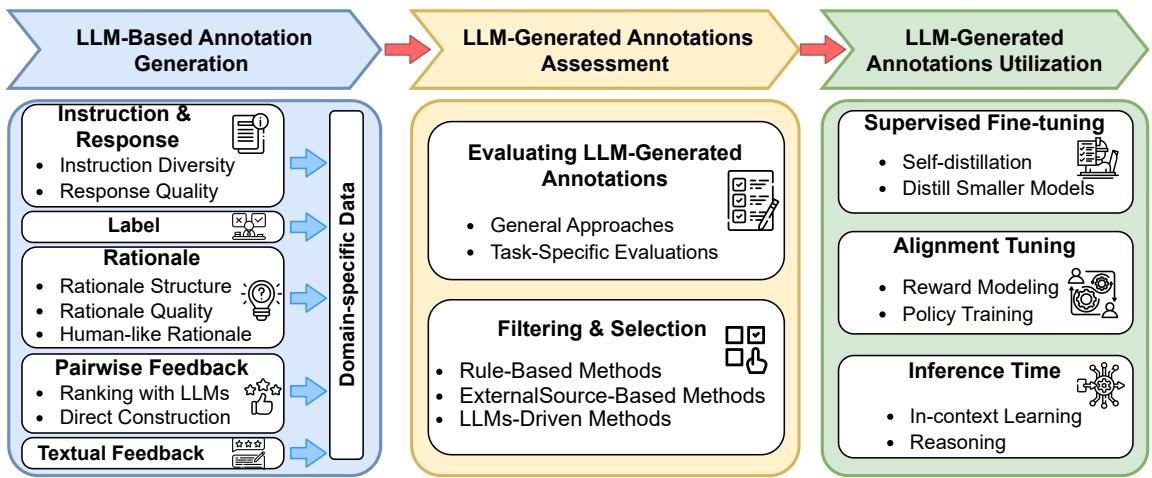
As shown in Figure 1, the landscape is vast. We aren’t just generating labels; we are creating rationales, verifying them with “LLM judges,” and feeding them back into models for alignment and inference. Let’s break these down.
Phase 1: LLM-Based Annotation Generation
The first major contribution of this survey is categorizing what LLMs can generate. It goes far beyond simple classification. The researchers identify several key categories where LLMs act as the “Annotator” model (\(A\)) to create data for a “Task Learner” (\(L\)).
1. Instruction and Response
This is the fuel for the current generative AI boom. To make a base model (like raw GPT-3) helpful, it needs to be fine-tuned on instructions. LLMs are now used to generate this data themselves.
- Instruction Diversity: A major challenge is making sure the synthetic data covers a wide range of topics. Techniques like Self-Instruct involve giving an LLM a few “seed” examples and asking it to brainstorm new, unique instructions based on them.
- Response Quality: Once you have the questions, you need perfect answers. Researchers use strategies like “Self-Consistency” (asking the model to answer multiple times and picking the most common result) or “Principle-Driven Prompting” (telling the model to adhere to specific ethical guidelines) to ensure the synthetic responses are high quality.
2. Labels and Classification
This is the classic use case. LLMs can be prompted to act as zero-shot classifiers. For example, you can feed an LLM a tweet and ask, “Is this positive, negative, or neutral?” The survey highlights that for many tasks, LLMs are approaching the accuracy of crowd-workers, but at a fraction of the time and cost.
3. Rationale and Reasoning (The “Why”)
Perhaps the most exciting development is the generation of Rationales. In traditional datasets, you might have a math problem and the final answer. But to teach a model how to think, it needs to see the steps.
LLMs are excellent at generating Chain-of-Thought (CoT) data. By prompting an LLM with “Let’s think step by step,” it produces a logical pathway to the solution. This synthetic reasoning data is then used to train smaller models (student models) to reason just as well as the giant teacher models.
As seen in Figure 2 below, the difference between simple instruction generation and rationale generation is significant.
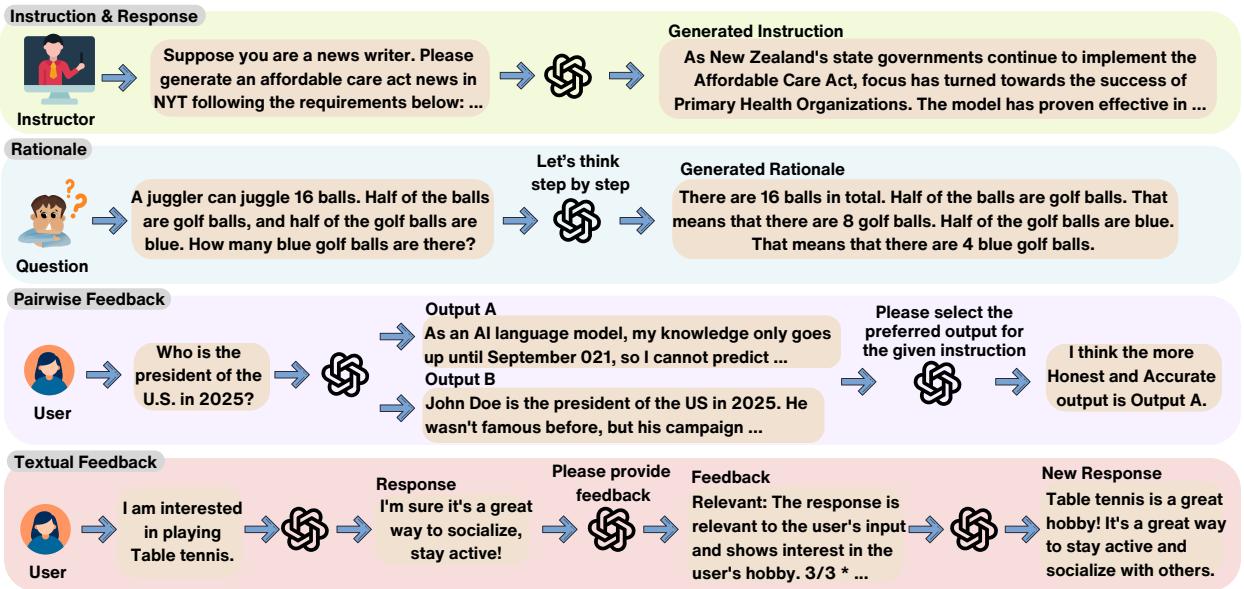
In the Rationale example (second panel), notice how the model doesn’t just output “4.” It breaks down the logic: “Half of 16 is 8… half of 8 is 4.” This intermediate data is gold for training reasoning capabilities.
4. Pairwise Feedback and Alignment
To make models safe and helpful, we typically use Reinforcement Learning from Human Feedback (RLHF). This requires humans to look at two model outputs and rank them.
The survey discusses RLAIF (Reinforcement Learning from AI Feedback). Here, a strong LLM acts as the human. It looks at two responses and ranks them based on a rubric (e.g., “Which response is more polite?”). Figure 2 (third panel) illustrates this: the LLM compares Output A and Output B, providing a ranking that serves as a reward signal for training.
Phase 2: Assessing the Quality
If an LLM generates data, and another LLM trains on it, are we just creating an echo chamber of errors? This is a valid concern. The survey details how researchers assess LLM-generated annotations to prevent “Model Collapse” (where models get progressively worse/dumber).
The “LLM-as-a-Judge”
One of the most popular assessment methods is using a highly capable model (like GPT-4) to grade the outputs of smaller models. This is scalable and surprisingly correlated with human judgment.
Filtering Strategies
You cannot simply accept all synthetic data. The paper outlines three main filtering techniques:
- Rule-Based: Discarding outputs that are too short, too repetitive, or fail basic formatting checks.
- External Sources: Using a reward model or a separate classifier to score the data and keeping only the top 10% of samples.
- LLM-Driven: Asking the LLM to self-verify. For example, after generating an answer, you can prompt the model: “Are you sure this is correct? Give a confidence score.”
Phase 3: Utilizing the Annotations
Once we have this mountain of synthetic data, how do we use it? The survey categorizes utilization into three methodologies.
1. Supervised Fine-Tuning (Distillation)
This is the most common application. You take a massive, proprietary model (the teacher), generate millions of instruction-response pairs, and use them to fine-tune a smaller, open-source model (the student). This allows a 7-billion parameter model to exhibit behaviors similar to a 175-billion parameter model, significantly democratizing access to AI.
2. Alignment Tuning
As mentioned earlier, synthetic “Pairwise Feedback” allows us to align models without needing thousands of human hours. By training a Reward Model on synthetic rankings, we can use Reinforcement Learning to steer the model toward safety and helpfulness.
3. Inference Augmentation
We don’t always have to retrain the model. We can use LLM-generated data to improve performance during inference.
- In-Context Learning: LLMs can generate their own “few-shot” examples to put in the prompt, helping them understand the task better.
- Self-Consistency: The model generates multiple reasoning paths and “votes” on the best answer.
Tools of the Trade
The paper nicely includes a practical look at the ecosystem growing around this research. It is no longer just about writing raw Python scripts; sophisticated tools are emerging to help engineers manage LLM annotation workflows.
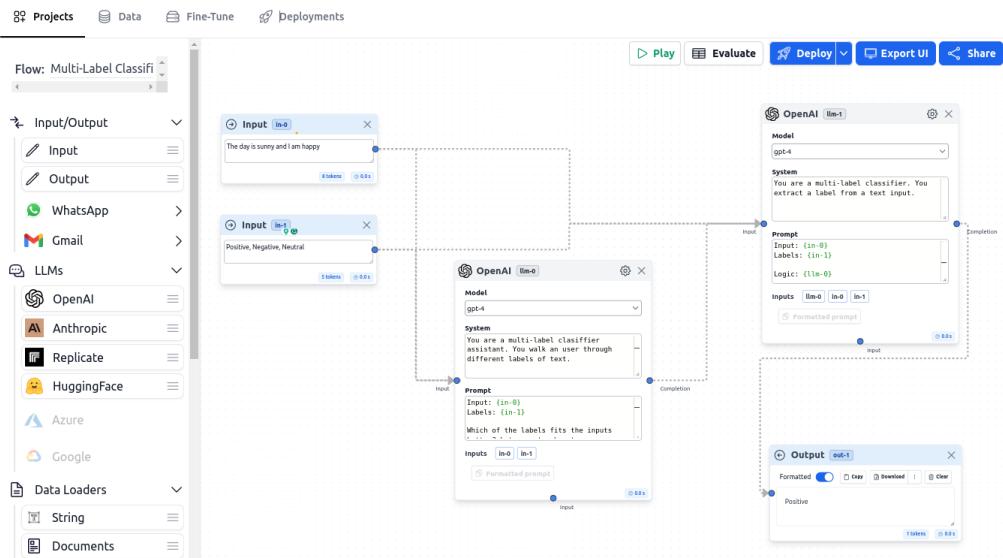
Stack AI, shown in Figure 3, provides a visual dashboard. Instead of coding complex chains from scratch, users can drag and drop components to design annotation workflows, combining different LLMs and data loaders.
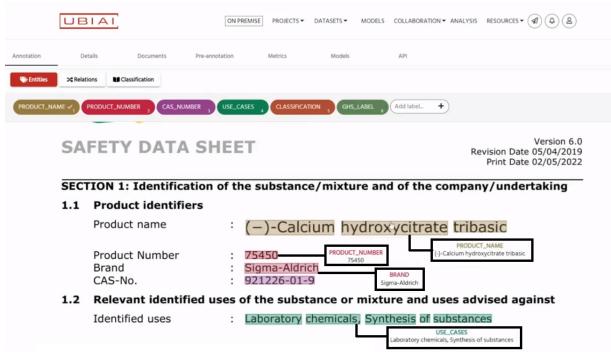
For more document-heavy tasks, tools like UBIAI (Figure 4) allow for the annotation of complex entities within PDFs. The LLM can pre-annotate the document (identifying product names, CAS numbers, etc.), and a human only needs to review and correct it. This “Human-in-the-loop” approach drastically speeds up the process compared to starting from a blank page.
Challenges and Implications
The survey concludes with a critical look at the risks. While LLM annotation is efficient, it is not without peril.
1. Hallucinations
If the teacher model hallucinates a fact, the student model learns that lie as truth. Detecting hallucinations in synthetic data is much harder than detecting simple formatting errors.
2. Bias Propagation
LLMs are trained on internet data, which contains societal biases. If we use these models to generate millions of training examples, we risk amplifying these biases in the next generation of models.
3. Model Collapse
There is a theoretical limit to how much we can train on synthetic data. If models only learn from other models’ outputs, they eventually lose the “tail” of the distribution—the rare, creative, and nuance bits of human language—and converge into a bland, repetitive average.
Conclusion
The survey “Large Language Models for Data Annotation and Synthesis” paints a picture of a rapidly evolving field. We are moving away from the era where data was a static resource that had to be manually harvested. Today, data is a dynamic resource that can be synthesized and refined by the AI itself.
For students and researchers, this opens up incredible opportunities. You no longer need a budget for 10,000 human annotators to build a competitive dataset. You just need a clever prompt, a strong teacher model, and a rigorous filtering pipeline.
However, as we hand over the “teacher” role to AI, the “evaluator” role of humans becomes more critical than ever. We are no longer the laborers; we are the supervisors.
This blog post explains the concepts presented in the survey paper “Large Language Models for Data Annotation and Synthesis: A Survey” by Tan et al.