](https://deep-paper.org/en/paper/2402.14672/images/cover.png)
Introduction
We have entered an era where Large Language Models (LLMs) like GPT-4 possess a human-like mastery over text. They can summarize articles, write code, and chat fluently. However, the ambition of Artificial Intelligence researchers extends far beyond processing text. The ultimate goal is to create generalist agents: AI that can not only talk but act within the real world to solve complex tasks.
Imagine asking an AI to “find the average revenue of all tech companies founded after 2010 based on our internal database” or “map the relationships between every Nobel Prize winner in Physics and their doctoral advisors.”
These tasks expose a critical weakness in current LLM approaches. Real-world environments—like massive corporate databases or global Knowledge Bases (KBs)—are too large to fit into an LLM’s “short-term memory” (its context window). You cannot simply copy-paste a database with millions of rows into a chat prompt.
So, how do we bridge the gap between an LLM’s reasoning capabilities and vast, complex environments?
A recent paper titled “MiddleWare for LLMs: Tools Are Instrumental for Language Agents in Complex Environments” proposes a novel solution. The authors introduce the concept of Middleware—a specialized layer of tools that shields the LLM from the overwhelming complexity of raw data while allowing it to explore proactively.
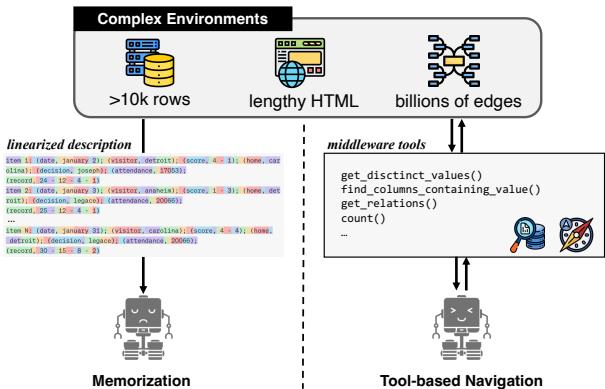
As illustrated in Figure 1, the traditional method (Left) tries to force-feed the environment into the model, leading to scalability issues. The proposed method (Right) equips the robot (the Agent) with specific tools to navigate the environment, much like a human would run search queries rather than memorizing the entire internet.
In this post, we will deconstruct this paper, exploring how this “Middleware” works, the clever reasoning techniques involved, and why it allows GPT-4 to perform nearly 3x better on complex data tasks compared to standard methods.
Background: The Context Bottleneck
To understand why Middleware is necessary, we must first understand the limitations of “Grounding.” Grounding refers to the ability of an LLM to tie its output to real-world data.
The Problem with Linearization
The most direct way to ground an LLM is linearization. This involves converting the environment (e.g., a table) into a sequence of text tokens and feeding it to the model.
- Small Environment: If you have a table with 5 rows, this works perfectly. The LLM reads the rows and answers your question.
- Complex Environment: If you have a database with 10,000 rows or a Knowledge Base with billions of connections, linearization fails. The data exceeds the model’s input token limit (context window). Even if it fits, models often get “lost in the middle” of long contexts.
Existing Workarounds
Prior research has tried to solve this by:
- Retrieval: Fetching only the “relevant” rows before sending them to the LLM. However, you often don’t know which rows are relevant until you start reasoning about the question.
- Web APIs: Using tools like Google Search. While useful, these are often “shallow” interactions. They don’t support the deep, multi-step logic required to navigate a structured SQL database or a graph-based Knowledge Base.
The authors of this paper argue that we need a middle ground: a suite of customized tools that act as a middleware layer.
The Core Method: Middleware for LLMs
The researchers developed a framework that combines two key elements: Specialized Tools and Advanced Reasoning Strategies.
1. Designing Tools for Complex Environments
The authors focused on two notoriously difficult environments: Databases (structured tables) and Knowledge Bases (graph networks). Unlike generic Web APIs, these tools were built from scratch to mimic how a human analyst would explore data.
Database Tools (SQL)
For databases, the goal isn’t just to write a SQL query immediately. The agent needs to understand the data content first. The authors created 12 specific tools, divided into two categories:
- Navigational Tools: These help the LLM explore.
get_distinct_values(table, column): Helps the agent see what kind of data exists in a column (e.g., is “status” stored as ‘Active’/‘Inactive’ or ‘1’/‘0’?).find_columns_containing_value(value): If the user asks about “Project X,” this tool finds which table and column contains that string.- Functional Tools: These help construct the actual SQL query.
where(),group_by(),select(): These verify the legality of SQL clauses step-by-step.
Knowledge Base (KB) Tools
Knowledge Bases, like Freebase, store billions of facts as triples (Subject, Relation, Object). The challenge here is “multi-hop reasoning”—connecting A to B to C.
The middleware tools for KBs introduce the concept of variables to store intermediate results.
get_relations(variable): “What connects to this entity?”get_neighbors(variable, relation): “Give me all entities connected to X via relation Y.”intersection(var1, var2): “Find items that appear in both lists.”
By using these tools, the LLM doesn’t need to see the whole graph. It just needs to know how to ask for the next piece of the puzzle.
2. Reasoning with Tools
Giving an LLM tools is only half the battle. The model must know how to use them reliably. The authors utilized the ReAct (Reasoning + Acting) framework, where the model generates a “Thought” followed by an “Action.”
However, complex environments are unforgiving. A slight typo in a relation name or a logic error can break the whole chain. To fix this, the paper proposes two novel schemes: Error Feedback and Decoupled Generation.
Strategy A: Error Feedback
As shown in Figure 2(a), standard LLMs often hallucinate invalid actions (marked in pink).
- The Fix: When the model generates an invalid tool call (e.g., using a relation that doesn’t exist), the Middleware catches it.
- The Feedback: It sends a specific error message back to the LLM.
- The Result: The LLM reads the error, generates a new thought (green), and corrects its action. This leverages the “self-correction” capabilities of models like GPT-4.
Strategy B: Decoupled Generation
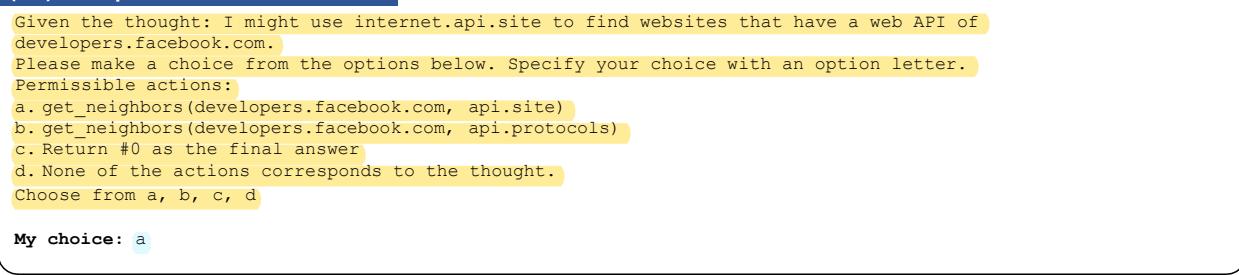
Sometimes, the action space is so vast that even error feedback isn’t enough—the model keeps guessing blindly. This is where Decoupled Generation (Figure 2(b)) shines.
In standard generation, the model outputs the thought and the action simultaneously. In Decoupled Generation, the process is split:
- Thought Generation: The LLM generates only the reasoning (e.g., “I need to find the website of the entity”).
- Action Prediction: The system presents the LLM with a restricted list of valid actions based on the current context and the generated thought. The LLM simply chooses the best option (e.g., “Option A”).
This is formalized mathematically in the paper:
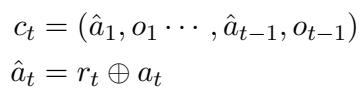
Here, the policy \(\pi\) is split into \(\pi_1\) (generating thought \(r_t\)) and \(\pi_2\) (selecting action \(a_t\) based on rules \(\mathcal{M}\)). This constrains the LLM, preventing it from hallucinating non-existent function calls.
Experiments and Results
To prove the efficacy of Middleware, the authors evaluated the system on:
- BIRD: A massive database benchmark (Text-to-SQL) known for its complexity.
- KBQA-AGENT: A newly curated benchmark for Knowledge Bases, specifically designed to require multi-hop reasoning (3+ hops).
They compared their method against strong baselines, including “API Docs Prompting” (standard zero-shot) and other agent frameworks like StructGPT.
1. Database Performance (BIRD)
The results on databases were stark. The metric used here is Execution Accuracy (EX)—did the AI get the right answer from the database?
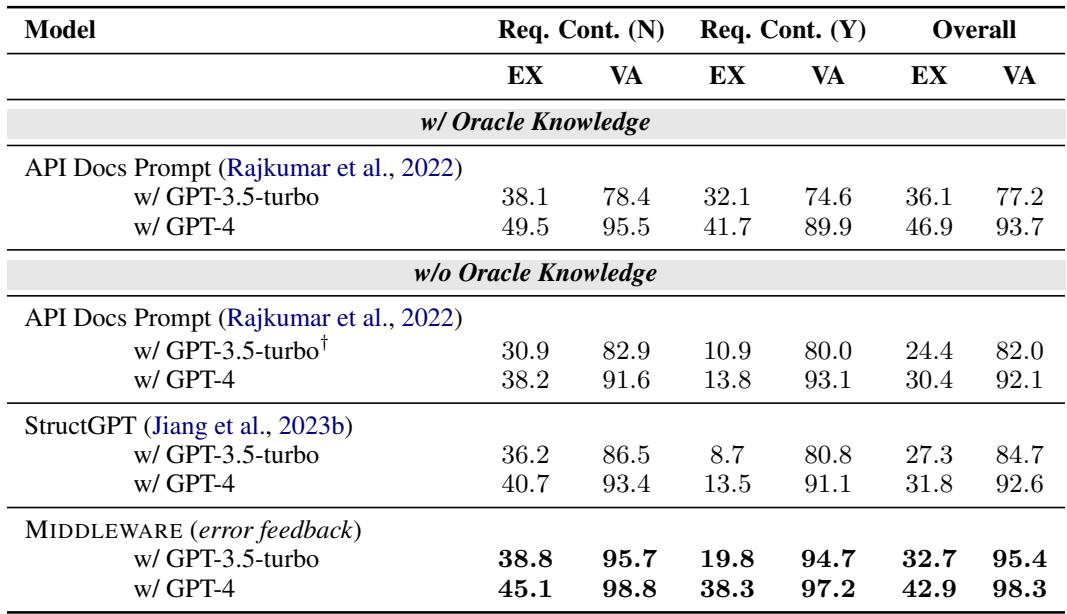
As shown in Table 1, look at the section “w/o Oracle Knowledge” (which is the realistic setting where the AI isn’t given hints about what to look for).
- Baseline (GPT-4): 13.8% accuracy.
- Middleware (GPT-4): 38.3% accuracy.
This is a 2.8x improvement. Why? Because the baseline method (API Docs Prompting) only gives the model the table names. It doesn’t let the model look at the data content before writing the SQL. Middleware allows the model to check values (“Is it stored as ‘USA’ or ‘United States’?”) before committing to a query.
2. Knowledge Base Performance (KBQA)
The results for Knowledge Bases were equally impressive.
In Table 2, we see that existing methods like KB-Binder and StructGPT struggle with the complexity of the new benchmark, often scoring single digits.
- Pangu (Previous SOTA): 27.1% F1 Score with GPT-4.
- Middleware (Decoupled): 59.3% F1 Score with GPT-4.
This 2.2x improvement highlights that static planning isn’t enough. The agent must be able to explore the graph dynamically to find distant connections.
3. Comparing LLMs: The Open Source Gap
The study also investigated whether open-source models could utilize Middleware as effectively as GPT-4. They tested models like Llama-2, Mistral, and Mixtral.

Figure 3 reveals an interesting trend:
- GPT-4 is king: It consistently outperforms all others.
- The Reasoning Gap: Llama-2 (the 7B and 13B versions) performed very poorly, often failing to generate grammatically correct tool uses.
- Mixtral’s Potential: The Mixture-of-Experts model (Mixtral-8x7B) is the strongest contender among open weights, closing the gap with GPT-3.5, though still trailing GPT-4.
Interestingly, the Decoupled Generation strategy (orange bars) helped weaker models (like Mistral) significantly more than it helped GPT-4. By restricting the choices, Middleware acts as “training wheels” for models with weaker reasoning capabilities.
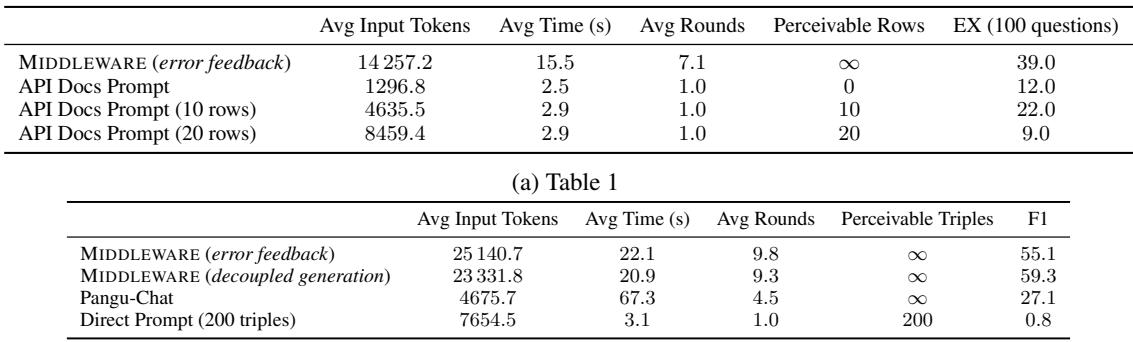
4. Why Not Just Feed More Data?
A skeptic might ask: “Why build all these tools? Why not just retrieve 100 random rows from the database and put them in the prompt?”
The authors tested this hypothesis. They fed the baselines with increasing amounts of “perceivable rows” (sampling data directly into the prompt).

Figure 4 shows the results.
- Top (KBs): Prompting with sampled triples (blue line) stays flat near zero. The environment is just too big; guessing which triples to show is impossible. Middleware (dashed orange) maintains high performance regardless of graph size.
- Bottom (Databases): Adding a few rows (X-axis) helps the baseline slightly, but then performance degrades as the context gets cluttered. Middleware (dashed lines) remains far superior without needing to flood the context window.
Conclusion and Implications
The paper “MiddleWare for LLMs” provides a compelling blueprint for the future of AI agents. It demonstrates that tools are not just add-ons; they are instrumental.
When dealing with the complexities of the real world—whether it’s enterprise data warehouses or global knowledge graphs—we cannot rely on the raw memory or context window of Large Language Models. Instead, we must treat LLMs as reasoning engines that orchestrate a layer of middleware tools.
Key Takeaways:
- Don’t memorize, Explore: LLMs perform significantly better when allowed to query the environment proactively rather than processing static descriptions.
- Middleware is the bridge: A set of domain-specific tools (Navigational and Functional) serves as the necessary translation layer between natural language and complex data structures.
- Structure the reasoning: Techniques like Error Feedback and Decoupled Generation are essential for reliability, especially when the model might “hallucinate” invalid actions.
As we move toward deploying AI in high-stakes environments like finance, healthcare, and logistics, the “Middleware” paradigm offers a robust path forward, transforming LLMs from passive text processors into active, capable agents.