](https://deep-paper.org/en/paper/2402.15729/images/cover.png)
If you have ever asked a Large Language Model (LLM) like ChatGPT or Llama to solve a complex math word problem, you might have noticed a frustrating pattern. Sometimes, it understands the logic perfectly but fails at simple arithmetic (hallucinating that \(25 \times 14 = 300\)). Other times, it writes a Python script to solve the problem, but the script solves the wrong equation entirely.
This inconsistency highlights a major divide in AI reasoning. On one hand, we have Chain-of-Thought (CoT), where the model explains its reasoning in natural language. This is great for logic but prone to calculation errors. On the other hand, we have Program-of-Thought (PoT), where the model writes code to calculate the answer. This solves the calculation issue but introduces a new one: the model often fails to translate the word problem into the correct code logic.
In a fascinating new paper titled “How Do Humans Write Code? Large Models Do It the Same Way Too,” researchers propose a novel framework called Human-Think Language (HTL). Their premise is simple yet profound: humans don’t just start typing code; we think through the problem in our native language first, then translate that thought process into code. By forcing models to do the same—and using some clever attention mechanisms to enforce it—they achieved state-of-the-art results on mathematical reasoning benchmarks.
In this post, we will tear down this paper to understand why current models fail at math, how HTL mimics human cognition, and the specific mechanisms (Focus Attention and Reinforcement Learning) that make it work.
The Core Problem: Code Translation Error
To understand why we need HTL, we first have to look at why current “Program-of-Thought” (PoT) methods fail.
PoT was supposed to be the silver bullet for math problems. Instead of asking the LLM to calculate \(543 \times 92\) in its head (which it is bad at), we ask it to write print(543 * 92). A Python interpreter runs the code, and we get the perfect answer.
However, the researchers discovered a critical weakness: Code Translation Error (CTE). When a problem is phrased in a conversational way (e.g., “One apple costs three dollars, how much for three apples?”), PoT models frequently misunderstand the semantic nuance and write code that uses the wrong formulas or variables.
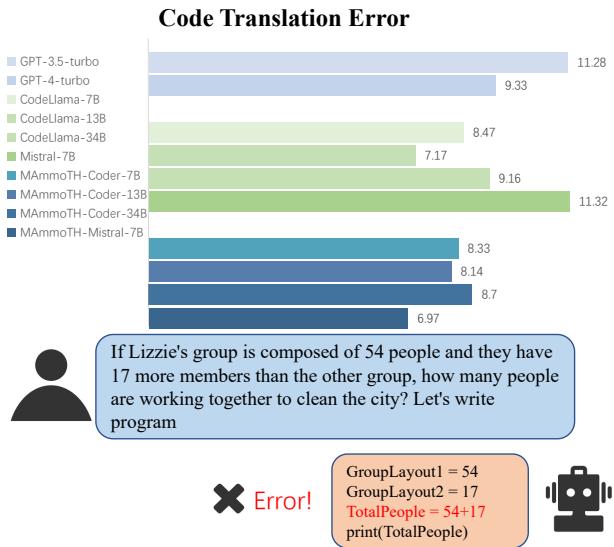
As shown in Figure 1, the error rates are surprisingly high. Even powerful models like GPT-4 and fine-tuned models like MAmmoTH-Mistral suffer from CTE. The bar chart shows that simply increasing the size of the model (from 7B to 34B parameters) does not fix the problem. The bottom half of the image shows a real example: the model reads a problem about group sizes but writes code that simply adds numbers together without respecting the logic of the question (TotalPeople = 54 + 17 instead of solving for the actual unknown).
Why Does This Happen?
The authors argue this happens because pre-training data for natural language (trillions of tokens) vastly outnumbers code data (billions of tokens). Natural language is simply better at semantic analysis and planning. When we force a model to jump straight from a word problem to Python code, we are skipping the model’s strongest capability: verbal reasoning.
Let’s look at some specific examples of where this translation breaks down.
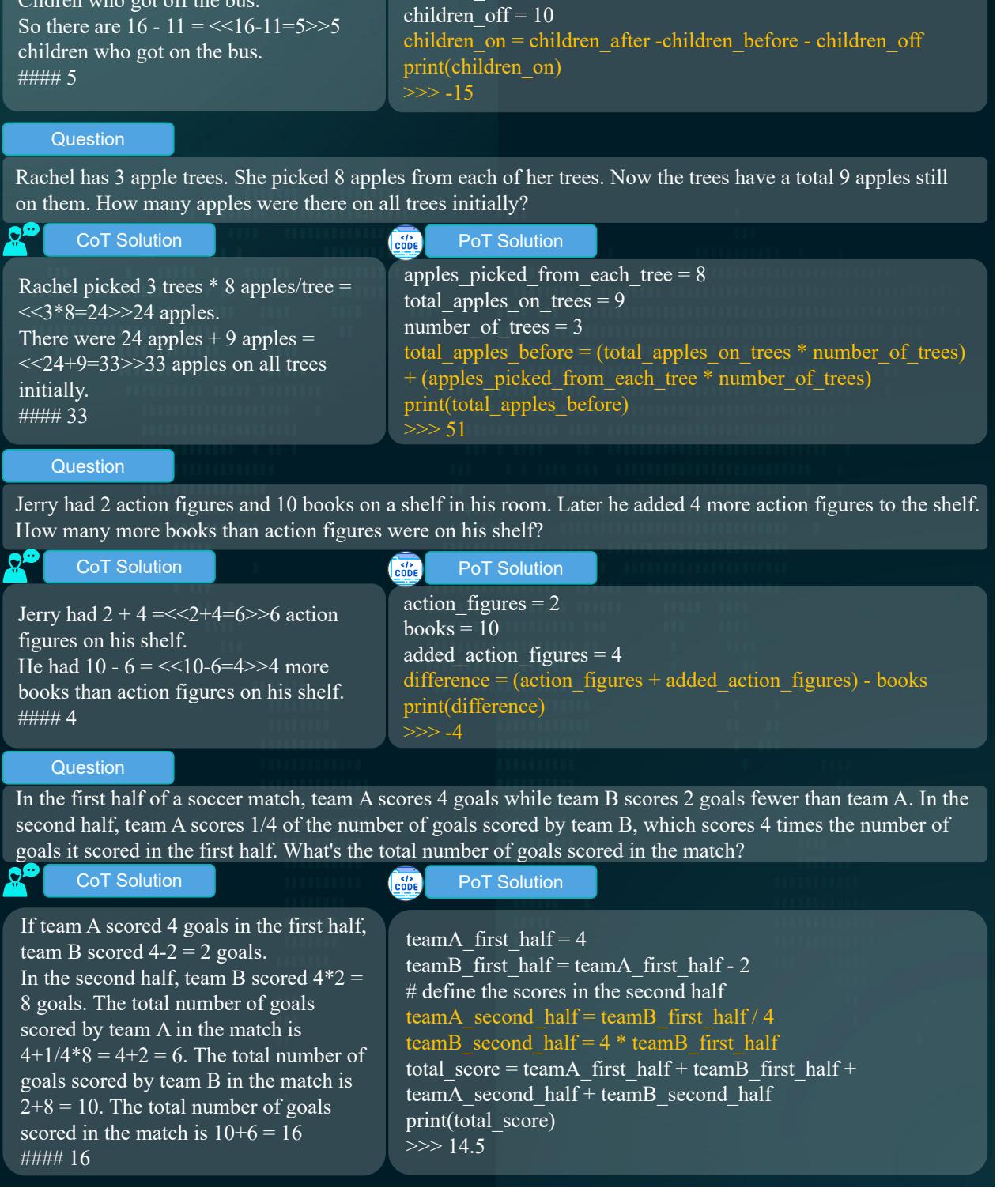
In Figure 5 above, we see distinct cases where the logic (CoT) was correct, but the code (PoT) failed:
- Question 1 (The Bus): The CoT correctly reasons that if 10 kids get off, you subtract them. The PoT code, however, writes a formula that results in a negative number (-15), which is physically impossible for a count of children.
- Question 3 (Books vs. Action Figures): The CoT correctly identifies the comparison. The PoT code performs a subtraction that results in -4, failing to understand the concept of “how many more.”
The takeaway is that CoT has the correct “skeleton” of reasoning, even if the math is wrong. PoT has the correct calculator, but often the wrong skeleton.
The Solution: Human-Think Language (HTL)
The researchers propose Human-Think Language (HTL) to get the best of both worlds. The core idea is to change the generation pipeline to match human cognitive processes.
When a human programmer solves a math problem, they don’t hallucinate Python syntax immediately. They think: “Okay, I need to find the total apples. First I multiply the trees by apples per tree, then I add the existing apples.” Only after establishing this logic do they write total = (trees * apples_per_tree) + existing.
HTL enforces this two-step process:
- Generate Chain-of-Thought (CoT): The model first outputs a full natural language explanation.
- Generate Program-of-Thought (PoT): The model then generates the code, but—and this is the key innovation—it is conditioned to base the code on the CoT reasoning, not just the original question.
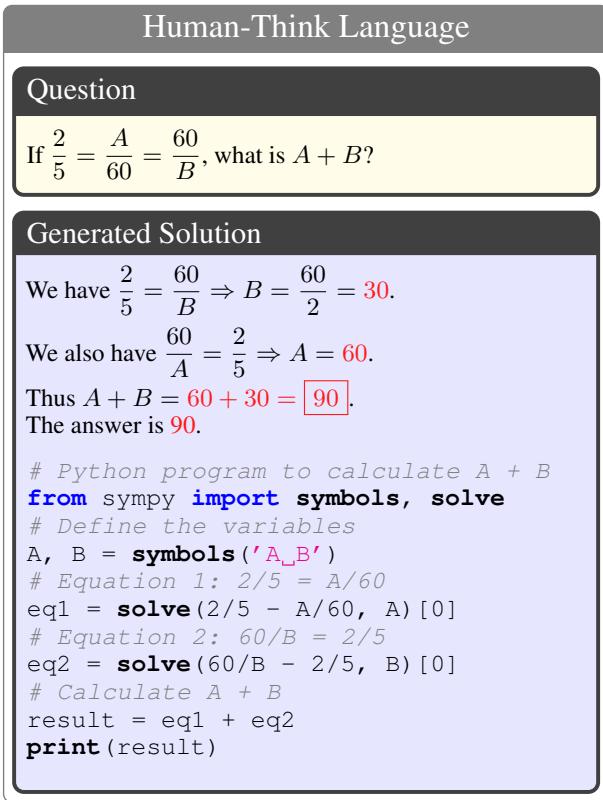
Figure 3 illustrates this beautifully. In the CoT section, the model tries to do the math but fails (it thinks \(60/2 = 30\), which is correct, but makes errors elsewhere or hallucinate results). However, the logic steps are perfect. The Python code below it ignores the bad math but translates the steps into solve functions using the sympy library. The result is a correct answer derived from correct logic and executed by a flawless calculator.
Technical Innovation: How to Force the Model to “Listen” to its Thoughts
You might ask, “Can’t we just prompt the model to ’think step by step’ and then write code?” You can, but existing “Hybrid” approaches often fail because the model gets distracted by the original question or loses track of its reasoning.
To fix this, the authors introduced a mechanism called Focus Attention.
1. Focus Attention Mechanism
Standard Transformers use “Dense Attention,” meaning every token looks at every previous token. In HTL, the researchers want the Code (PoT) to look primarily at the Reasoning (CoT) and ignore the original Question (Q) as much as possible, to prevent the “translation errors” discussed earlier.
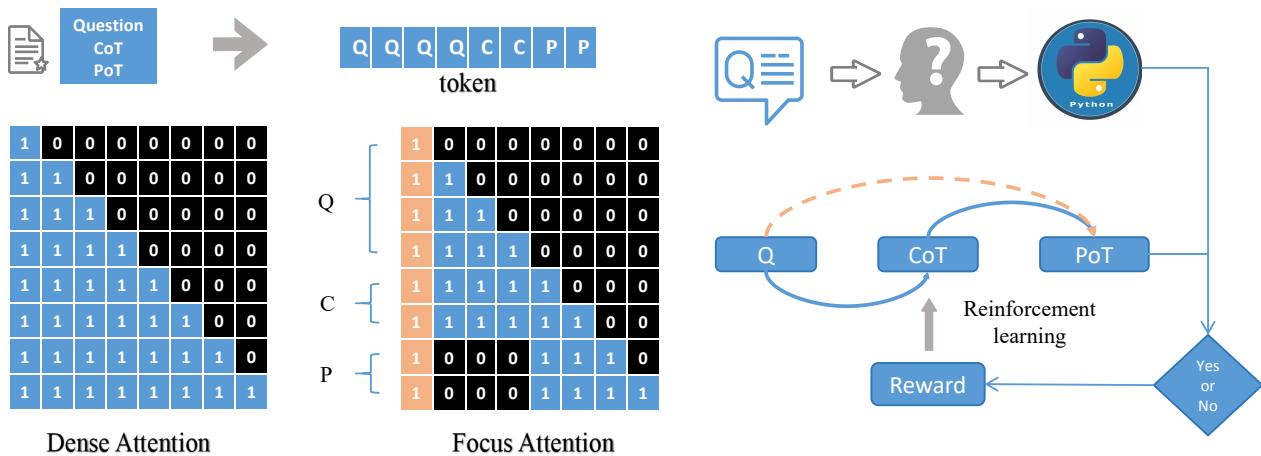
As visualized in Figure 2, Focus Attention masks out the Question tokens when generating the PoT tokens. The model is forced to attend to the CoT tokens.
There is a catch, though. Recent research on “Attention Sinks” shows that if you mask out the very first few tokens of a sentence (the start of the sequence), LLMs degrade massively because they use those initial tokens as anchors for attention. To solve this, HTL preserves the first four tokens of the sequence (the “attention sink”) and masks the rest of the question.
The mask matrix \(M_{ij}\) is defined mathematically as:

Here, the attention score is \(-\infty\) (masked) unless the token being looked at (\(j\)) is part of the first four tokens OR part of the CoT. This forces the information flow from Reasoning \(\rightarrow\) Code.
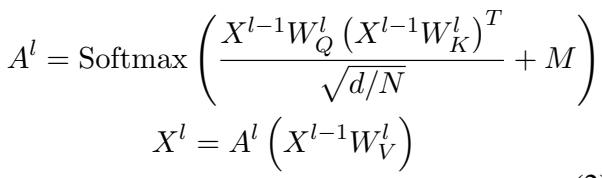
The standard attention mechanism is then applied using this mask:
2. Adaptive Training Strategy
If you train a model with this strict “Focus Attention” from day one, or if you use it during inference without training, it often performs poorly because it creates a mismatch with the pre-training data (which used dense attention).
To bridge this gap, the authors developed an Adaptive Training Strategy. They introduce a “mask coverage function” that changes over time.
- Start: Use Dense Attention (look at everything).
- Middle: Gradually increase masking (Focus Attention) using a quadratic function.
- End: Return to Dense Attention.

This “parabolic” training schedule allows the model to learn the dependency between CoT and PoT without destroying its general ability to process sequences.
3. Reinforcement Learning with PPO
Another issue with LLMs is that they sometimes get stuck in loops, repeating the same reasoning steps over and over. Also, sometimes the CoT is right but the PoT is wrong, or vice versa.
To polish the model, the researchers applied Reinforcement Learning (specifically Proximal Policy Optimization, or PPO). They designed a specific Error Assessment Function to serve as the reward model.

The reward function \(f_r\) assigns scores based on the outcome:
- 1.0 Points: Both CoT and PoT are correct. (Ideal state).
- 0.6 Points: CoT is wrong, but PoT is correct. (This suggests the model got lucky or the code fixed a reasoning error).
- 0.3 Points: CoT is correct, but PoT is wrong. (This is the Code Translation Error we want to minimize, but we still reward the correct reasoning slightly).
- 0.0 - 0.1 Points: Failures.
This granular reward system encourages the model not just to get the right answer, but to align its natural language reasoning with its code execution.
Experimental Results
The researchers tested HTL on 8 datasets, ranging from standard math word problems (GSM8K) to more complex scientific math (MATH) and natural language inference (NumGLUE). They used MAmmoTH (based on CodeLlama-7B and Mistral-7B) as the base model.
1. Does it beat the baselines?
Yes, significantly.
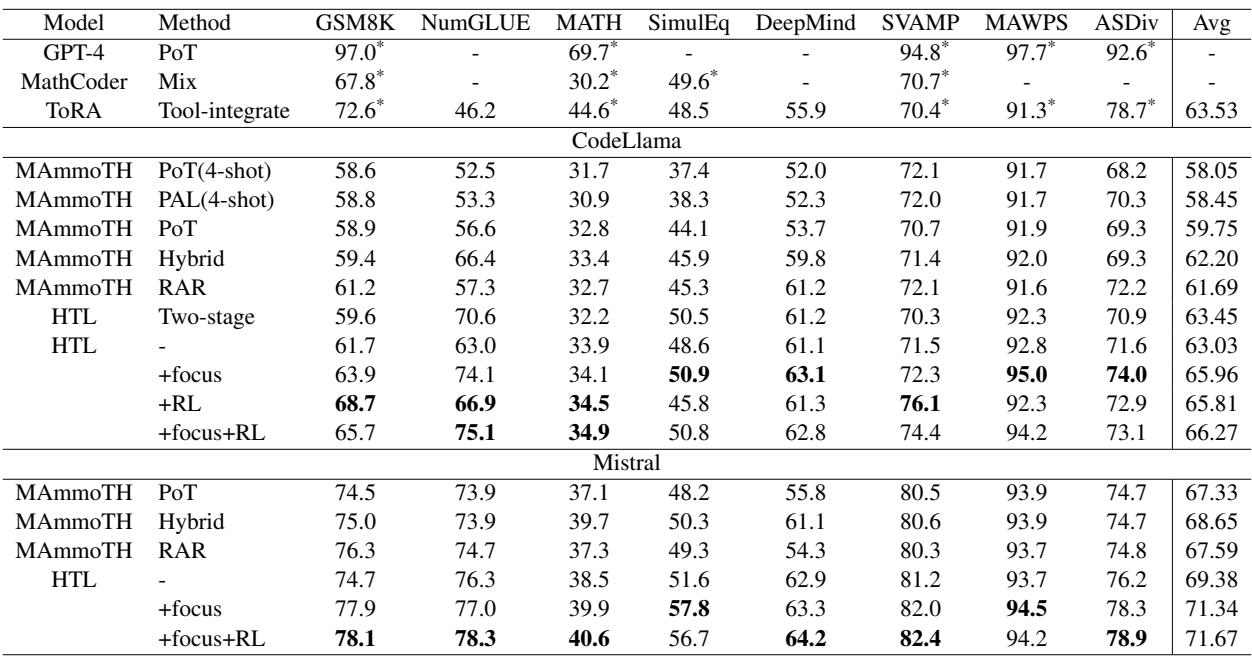
Table 2 details the performance. Here are the highlights:
- State of the Art: HTL achieves the highest average performance among open-source models on these benchmarks.
- Beating the Base: On the Mistral-Base, HTL improves the average accuracy from 67.33% (standard PoT) to 71.67%.
- Out-of-Domain Transfer: Notice the performance on NumGLUE (a dataset requiring heavy logic). HTL scores 78.3%, significantly higher than the standard PoT score of 73.9%. This confirms that the “Think first” approach helps significantly with logical inference tasks, not just pure calculation.
2. Does Focus Attention and RL actually matter?
The authors performed an ablation study (removing parts of the system to see what breaks).
- HTL (-): Using just the dataset format (Q -> CoT -> PoT) without special attention mechanisms provided a small boost.
- +focus: Adding Focus Attention provided a massive jump (e.g., +3% average on Llama).
- +RL: Reinforcement learning added further gains, particularly in stability and preventing repetitive loops in difficult datasets like MATH.
3. Reducing Errors
We started this blog post discussing Code Translation Errors (CTE). Did HTL fix them?
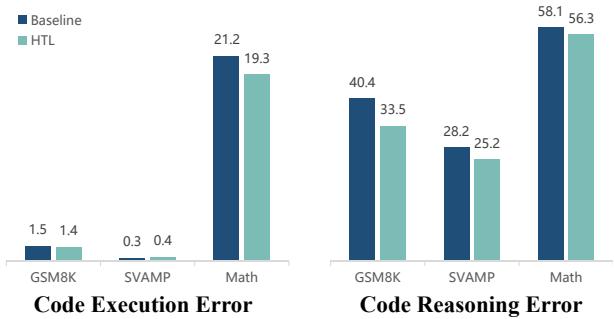
Figure 4 shows the breakdown of errors. The light blue bars (HTL) are consistently lower than the dark blue bars (Baseline).
- Code Reasoning Error (CTE): This is where the model writes the wrong logic. HTL reduced this significantly (e.g., from 40.4% to 33.5% on GSM8K).
- Code Execution Error: This is where the code is syntactically wrong or un-executable. HTL also reduced this, likely because the CoT provided a clear plan that made writing valid code easier.
4. Impact of Dataset Composition
The researchers also explored how different training data affected the results. They used a technique called Self-Distillation, generating their own training data using the MAmmoTH model itself, filtering for correct answers.
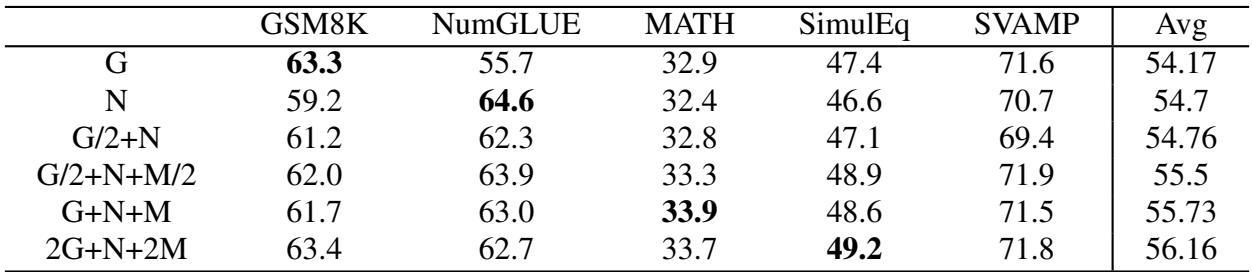
Table 4 reveals that diversity matters. Training on just GSM8K makes the model great at GSM8K but poor at others. Mixing datasets (Row “G+N+M”) provides the most robust “generalist” math solver.
Conclusion and Implications
The “Human-Think Language” paper offers a compelling narrative for the future of AI reasoning. It challenges the trend of simply throwing more parameters at a problem. Instead, it suggests that cognitive architecture—the order and manner in which information is processed—is just as important.
By acknowledging that Large Language Models are fundamentally “linguistic” creatures, HTL leverages their strength (verbal reasoning) to support their weakness (symbolic calculation).
Key Takeaways:
- Thinking Precedes Coding: Forcing a model to reason in natural language before writing code reduces logical errors.
- Attention Mechanisms are Flexible: We don’t have to accept the standard “look at everything” attention. By cleverly masking the input, we can guide the model’s focus to the most relevant context (the reasoning), improving fidelity.
- Reinforcement Learning Fine-Tuning: PPO isn’t just for chat bots; it is highly effective at aligning multi-stage reasoning tasks by rewarding the consistency between thought and action.
As we move toward agents that can perform complex tasks, this “Think, then Act” paradigm will likely become a standard blueprint for reliable AI.