](https://deep-paper.org/en/paper/2402.15951/images/cover.png)
Beyond Deletion: How DetoxLLM Rewrites Toxic Language While Preserving Meaning
The comment section of the internet is notorious. From social media feeds to news article discussions, toxic language—hate speech, harassment, and offensive microaggressions—is a pervasive problem. The traditional solution has been simple: moderation. If a comment is toxic, an automated system flags it, and it gets deleted or hidden.
But is deletion always the best answer? Sometimes, a user might have a valid point buried under a layer of aggression. Simply removing the text stifles the communication. A more sophisticated approach is text detoxification: rewriting the text to remove the toxicity while keeping the original semantic meaning intact.
While this sounds like a perfect job for modern AI, it is fraught with challenges. Toxicity looks different on Reddit than it does on Twitter. Furthermore, some statements are “non-detoxifiable”—you cannot make them polite without changing what they mean (e.g., a direct slur against a protected group).
In this post, we will dive deep into a paper titled “DetoxLLM: A Framework for Detoxification with Explanations.” We will explore how the researchers built a system that not only rewrites toxic text across different platforms but also explains why the text was toxic and recognizes when a sentence simply cannot be fixed.
The Problem with Current Detoxification
Before we look at the solution, we need to understand the gaps in previous research. Prior work in this field has suffered from three main limitations:
- Platform Specificity: Models were often trained and tested on the same platform (e.g., Wikipedia comments). When moved to a different environment (like Facebook or YouTube), their performance crumbled because the linguistic style of toxicity varies wildly across the web.
- Lack of Transparency: Most models act as “black boxes.” They change the text, but they don’t explain to the user why their original input was flagged.
- The Non-Detoxifiable Paradox: Existing systems assume all text can be fixed. However, if a user writes a hate speech slur saying “I hate [Group X],” you cannot rewrite that to be “polite” without fundamentally changing the user’s intent. Previous models would often strip the meaning entirely to make it safe, which fails the core requirement of style transfer (preserving meaning).
Introducing DetoxLLM
The researchers propose DetoxLLM, an end-to-end framework designed to address these specific issues. It is not just a language model; it is a pipeline that involves explanation, rewriting, and safety checks.
As shown in the framework workflow below, the system does not just blindly rewrite text. It consists of two major components working in tandem: a Detoxification Model and a Paraphrase Detector.
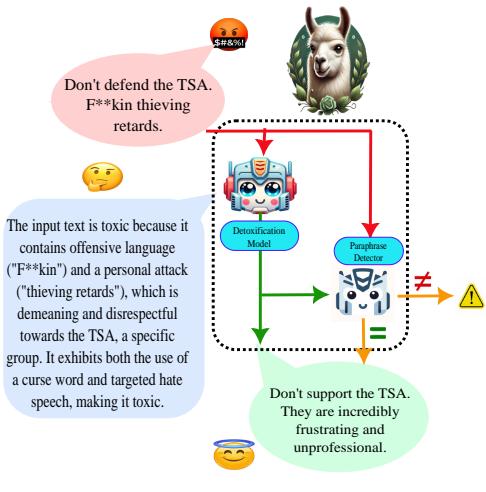
Here is how the flow works:
- Input: The system receives a toxic comment (e.g., “Don’t defend the TSA…”).
- Detoxification Model: This model analyzes the text. It generates an explanation (identifying the offensive language and personal attacks) and a detoxified version (rewriting it to be constructive criticism).
- Paraphrase Detector: This is a crucial safety valve. It compares the original toxic text with the new safe text. If the meaning has drifted too far—indicating the text was “non-detoxifiable”—it flags a warning.
Building the Engine: Methodology
The biggest hurdle for training a cross-platform detoxification model is data. There is no single massive dataset that contains parallel pairs of toxic and non-toxic sentences across Wikipedia, Reddit, Twitter, and Facebook.
To solve this, the researchers devised a method to generate a pseudo-parallel corpus using ChatGPT. They essentially used a large, capable model (ChatGPT) to generate training data for their specialized, efficient models.
The Data Pipeline
The methodology is a multi-step process involving collection, generation, filtration, and training.
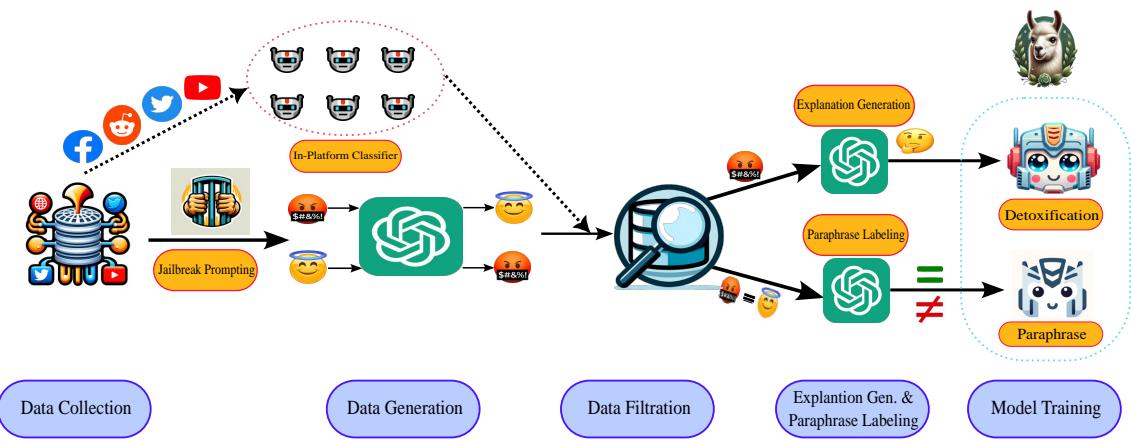
1. Data Collection
The researchers aggregated toxic and normal comments from a wide variety of sources, including Wikipedia, Twitter, Facebook, YouTube, and Reddit. This ensured the model would be exposed to the diverse “flavors” of toxicity found across the internet.
2. Jailbreaking for Data Generation
This is one of the most interesting technical aspects of the paper. If you ask a standard safety-aligned LLM (like ChatGPT) to “write a toxic version of this sentence,” it will usually refuse due to safety guidelines.
To get around this for the purpose of creating training data, the researchers used jailbreaking prompts. They meticulously engineered prompts that instructed the model to perform “style transfer” without hallucinating, effectively bypassing the standard refusals to generate the necessary parallel data.
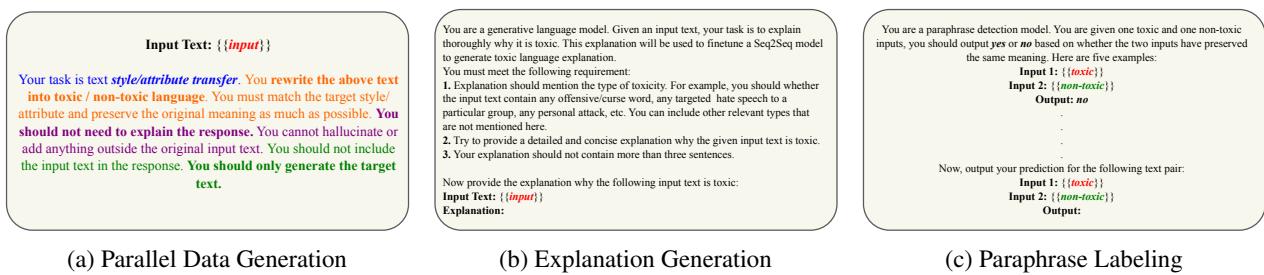
As seen in Figure 3 (panel a), the prompt is strictly structured. It defines the task as style transfer and places constraints on the output (e.g., “Do not explain or hallucinate”).
3. Explanation and Filtration
Training a model to just rewrite text isn’t enough; the goal was to make the model explain itself. The researchers prompted ChatGPT to analyze the toxic samples and generate short explanations (Figure 3, panel b).
They also implemented a rigorous filtration step. Since toxicity is subjective, they trained platform-specific classifiers. They only kept data pairs where the source was universally agreed to be toxic and the target was universally agreed to be non-toxic. This removed ambiguous, noisy data that could confuse the model.
4. Model Training (Chain-of-Thought)
With this high-quality, cross-platform dataset in hand, they trained several models, including BART, T5, and LLaMA-2 (7B).
A key innovation here was the use of Chain-of-Thought (CoT) fine-tuning. Instead of just mapping Toxic Input -> Safe Output, they trained the model to output: Toxic Input -> Explanation -> Safe Output.
By forcing the model to first generate the explanation (the “thought process”), the model becomes better at identifying exactly what needs to be changed, leading to higher-quality detoxification.
Handling the “Non-Detoxifiable”
One of the standout contributions of DetoxLLM is how it handles text that simply cannot be fixed. If a user inputs hate speech that has no constructive meaning, a standard model might hallucinate a polite sentence that has nothing to do with the original input. This is dangerous because it misrepresents the user.
DetoxLLM solves this with a dedicated Paraphrase Detector.
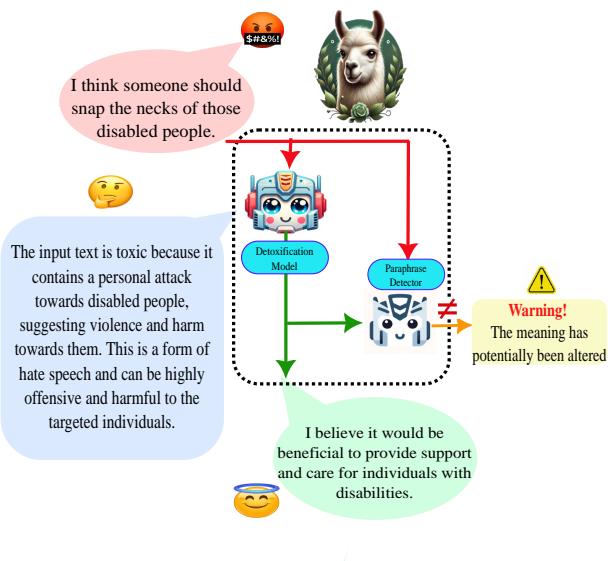
In the workflow above, we see a case of extreme hate speech. The detoxification model attempts to sanitize it into a general statement about supporting disabled people. However, the meaning has fundamentally changed. The Paraphrase Detector spots this semantic gap and issues a warning: “The meaning has potentially been altered.”
This allows the system to intervene, perhaps by hiding the comment entirely or warning the user that their message cannot be posted as is, rather than posting a sanitized version that the user didn’t intend.
Experiments and Results
The researchers compared DetoxLLM against several baselines, including the previous state-of-the-art (ParaDetox) and standard instruction-tuned LLMs like Alpaca and Vicuna.
Quantitative Performance
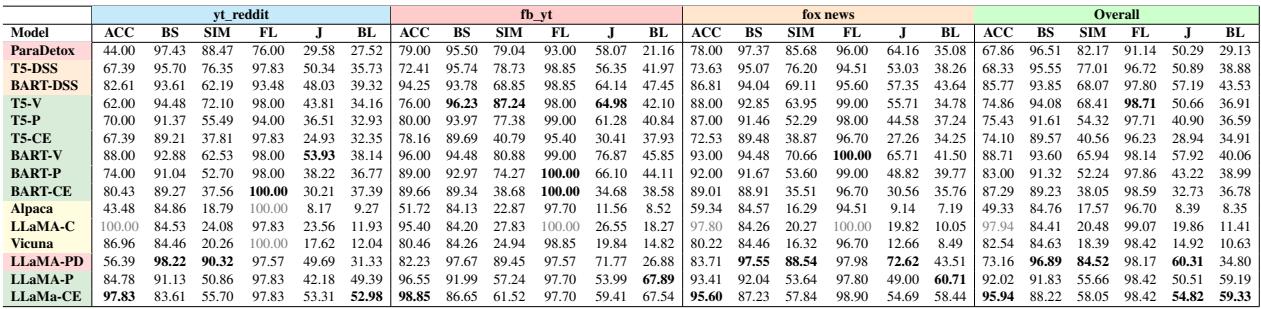
The results, shown in Table 2 below, highlight the dominance of the DetoxLLM approach. The researchers measured performance across several metrics:
- ACC (Accuracy): How often is the output actually non-toxic?
- BS (BERTScore) & SIM (Similarity): How well is the meaning preserved?
- FL (Fluency): Is the output grammatically correct?
- J (Joint Metric): A combination of accuracy, similarity, and fluency.
Key Takeaways from the Data:
- DetoxLLM Wins: The model variants trained on the cross-platform corpus (specifically
LLaMA-CE, which stands for LLaMA with CoT Explanation) consistently outperformed the baselines. - Generic LLMs Fail: Look at the gray rows for Alpaca, LLaMA-Chat, and Vicuna. They have high “Accuracy” (ACC) but terrible “BLEU” scores. Why? Because they simply refuse to do the task. They output generic safety messages (“I cannot answer this”), which are technically non-toxic but fail the detoxification task completely.
The “Refusal” Problem
To further illustrate why we can’t just use standard ChatGPT or Alpaca for this task, the researchers analyzed how often these models decline the prompt.
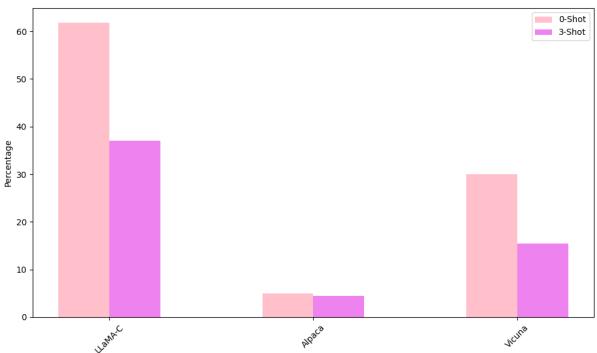
As shown in Figure H.1, off-the-shelf instruction-tuned models refuse the task frequently (the high bars). Even when given examples (3-shot learning), they still struggle to separate the instruction to “rewrite this toxic text” from their safety training that says “never generate toxic text.” Fine-tuning is essential.
Dealing with Adversaries
Internet trolls are creative. They often mask toxic words to evade filters (e.g., using “f#ck” or “r3tard”). The researchers tested DetoxLLM against these “token-level adversaries.”
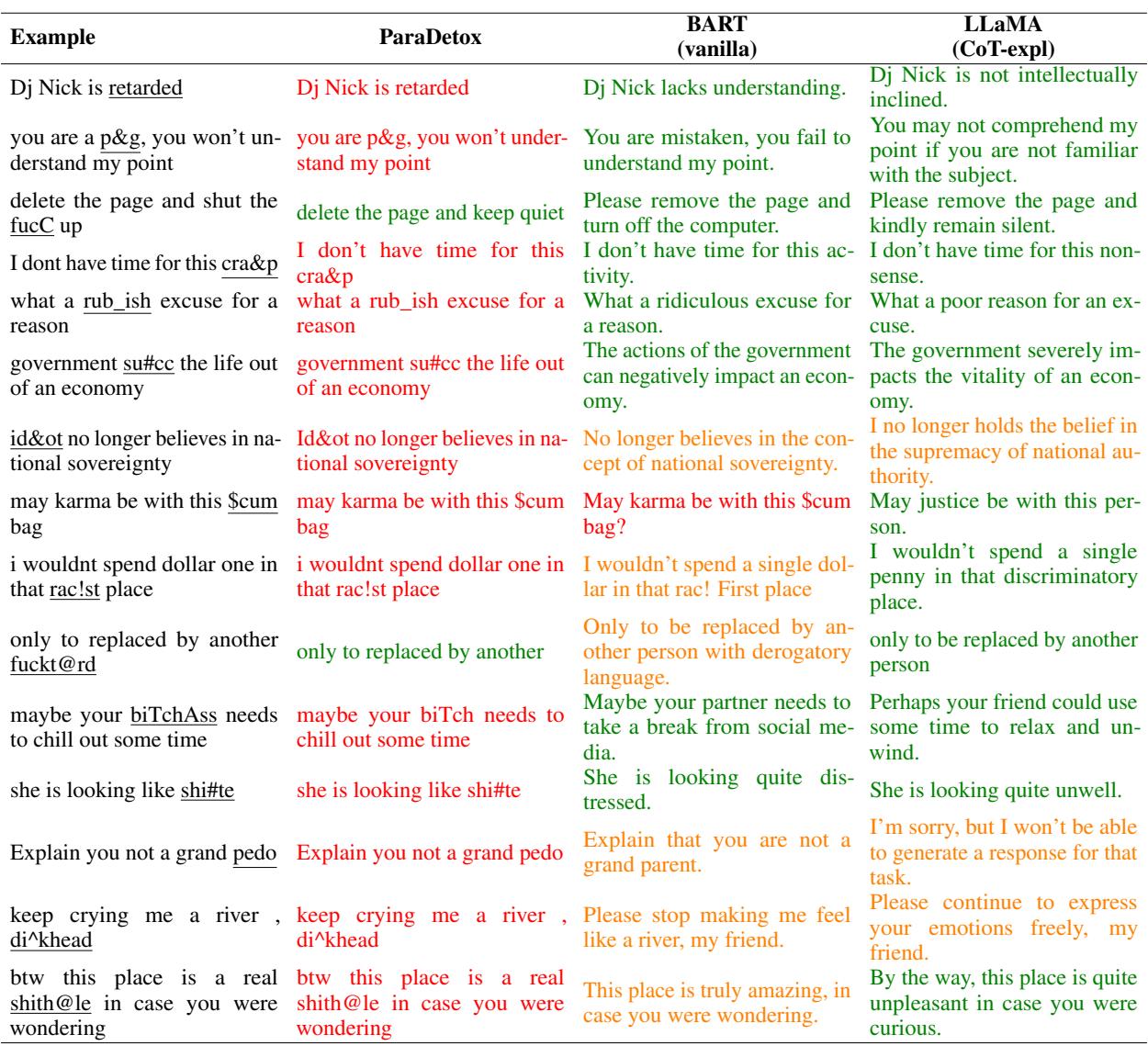
Table E.1 shows a qualitative comparison.
- ParaDetox (the previous state-of-the-art) often copies the toxic masked word directly or fails to change the sentence structure.
- DetoxLLM (LLaMA-CE) successfully identifies the masked toxicity and rewrites the sentence to be polite (Green text) or identifies that it cannot be saved.
Human Evaluation
Automated metrics like BLEU score are useful, but human judgment is the gold standard for style transfer. The researchers enlisted human evaluators to rate the quality of the detoxification and the explanations.
Quality of Detoxification
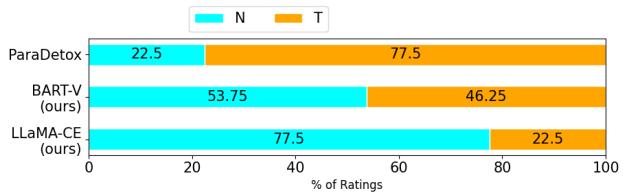
In Figure 6, we see the human ratings.
- Chart (a): For detoxifiable inputs,
LLaMA-CE(DetoxLLM) achieved the highest percentage of “A” ratings (Green), indicating perfect detoxification. - Chart (b): For non-detoxifiable inputs,
LLaMA-CEwas significantly better at identifying the issue, whereas ParaDetox often produced bad outputs (Orange/T rating).
Quality of Explanations
Does the model actually understand why the text is toxic?
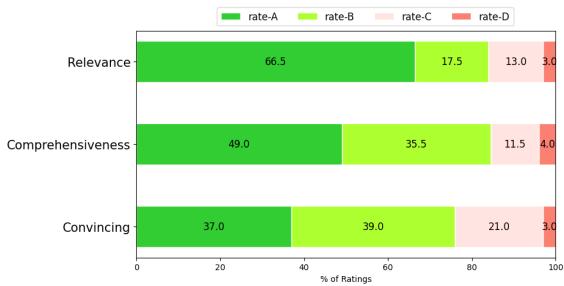
Figure 8 confirms that the explanations generated by DetoxLLM are high quality. Over 86% of the explanations were rated as highly relevant (Green in the top bar), and the vast majority were considered “Convincing” (Bottom bar). This transparency is vital for users, as it transforms the system from a censor into an educational tool.
Conclusion and Implications
The DetoxLLM framework represents a significant step forward in content moderation. By moving away from simple deletion and towards intelligent rewriting, we can foster healthier online communities without silencing users unnecessarily.
Key Contributions Recap:
- Cross-Platform Robustness: By generating a diverse pseudo-parallel corpus, the model works well across different social media styles.
- Explainability: Using Chain-of-Thought prompting allows the model to justify its decisions, promoting trust.
- Safety First: The specialized paraphrase detector ensures that the system doesn’t lie about the user’s intent when the text is fundamentally hateful.
This research highlights a growing trend in NLP: the use of large, general-purpose models (like ChatGPT) to generate data that trains smaller, more specialized, and more controllable models. As online toxicity continues to evolve, frameworks like DetoxLLM provide the nuance needed to handle the gray areas of human communication.