](https://deep-paper.org/en/paper/2402.16050/images/cover.png)
Introduction: The “Long Video” Bottleneck
Imagine asking an AI to watch a two-hour movie and answer the question: “Why did the protagonist hesitate before opening the door in the second act?”
For a human, this is a trivial task of perception and memory. For a Multimodal Large Language Model (MLLM), this is a computational nightmare. While MLLMs have made incredible strides in understanding static images, applying them to long-form videos presents a massive hurdle. Videos contain thousands of frames. Feeding all of them into a standard MLLM would explode the “context window”—the limit on how much information a model can process at once—and bring even the most powerful GPUs to their knees.
Current solutions usually involve sparse sampling (picking a few random frames and ignoring the rest) or massive scaling (training on supercomputers with huge datasets). Both have flaws: sampling loses crucial motion context (the “hesitation” might happen between sampled frames), and scaling is prohibitively expensive.
In this post, we dive into a new framework called the Temporal Grounding Bridge (TGB). This research proposes a clever way to let MLLMs “skim” videos intelligently using lightweight motion features, allowing them to pinpoint exact moments of interest without processing every pixel. Most impressively, TGB allows a model trained on short clips (e.g., 4 frames) to understand videos 16 times longer without retraining—a capability known as temporal extrapolation.
Background: The Disconnect Between Vision and Time
To understand why TGB is necessary, we need to look at how MLLMs typically handle video. Most architectures treat video as a sequence of images. They use a heavy visual encoder (like ViT-G) to turn frames into “tokens” that a Large Language Model (LLM) can read.
The problem is the Curse of Dimensionality.
- High Computational Cost: Running a heavy visual encoder on hundreds of frames is slow.
- Noise: Most frames in a video are redundant or irrelevant to the user’s question.
- Missing Temporal Logic: Language models are great at sequence, but they often struggle to map the passage of time in a video to the linguistic concept of time (e.g., “before,” “after,” “while”).
The researchers behind TGB realized that we don’t need high-resolution texture details to understand when something happens. We mostly need to know about movement and sequence. This led them to utilize Optical Flow—a low-dimensional representation of motion—as a bridge between the video and the language model.
The Core Method: The Temporal Grounding Bridge (TGB)
The TGB is designed to sit between the raw video and the MLLM. It acts as a scout, rapidly scanning the video to find the most relevant “spans” (segments) based on the user’s text query. Only those relevant segments are then fully processed by the heavy MLLM.
Let’s break down the architecture.
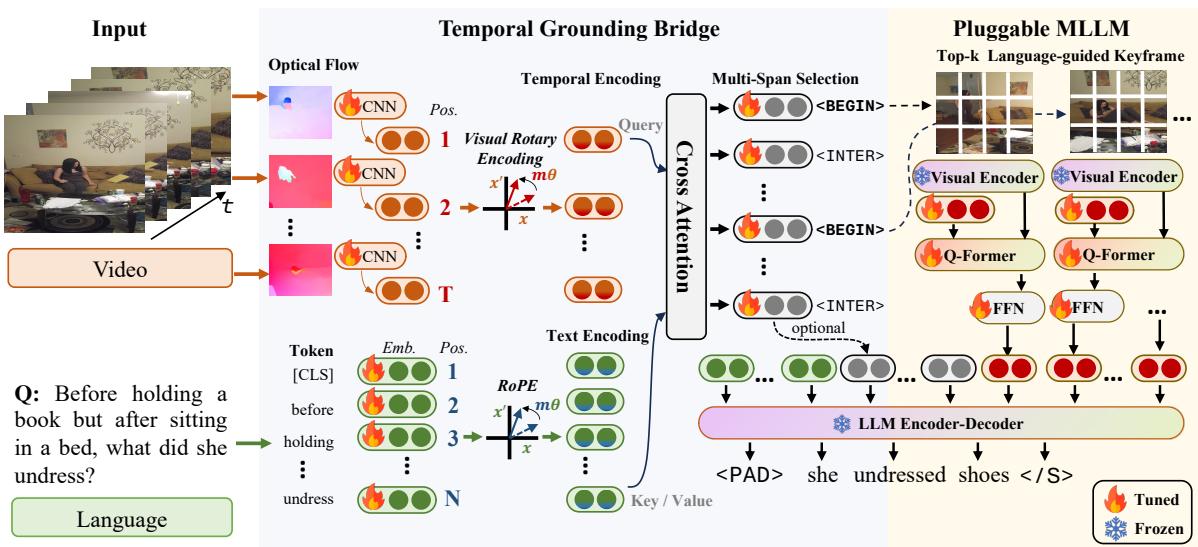
As shown in Figure 2 above, the workflow consists of several distinct stages:
- Input: The system takes raw video frames and a language query (e.g., “What did she undress?”).
- Lightweight Encoding: Instead of processing high-res pixels immediately, the model extracts Optical Flow (OF). These are low-dimensional features that capture motion.
- Temporal Encoding: This is where the magic happens. The model needs to align the text query with the motion features.
- Keyframe Selection: The TGB selects specific moments (keyframes) that answer the question.
- MLLM Processing: Only the selected keyframes and the original motion features are fed into the MLLM (like BLIP-2) to generate the final text answer.
1. Extrapolative Position Encoding (RoPE)
One of the paper’s biggest contributions is solving the “length extrapolation” problem. Standard Transformers struggle when the test input is longer than the training input because their positional embeddings (the labels that tell the model “this is frame 1, this is frame 2”) are fixed.
If you train on 10-second clips, the model doesn’t know what “Minute 5” looks like.
To fix this, TGB employs Rotary Position Embedding (RoPE) for both the optical flow features (\(E_{of}\)) and the language features (\(E_{l}\)). RoPE encodes position as a rotation in the geometric space rather than an absolute value. This allows the model to understand relative distances between frames, which generalizes much better to longer sequences.
The formulation is as follows:
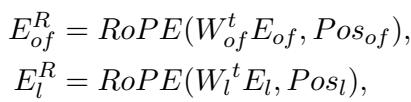
Here, the optical flow and language features are rotated based on their positions (\(Pos_{of}\) and \(Pos_{l}\)). This mathematical trick is key to why TGB can be trained on 4 frames and successfully tested on 64 frames.
2. Multi-Span Keyframe Selection
How does TGB decide which frames are important? It treats the problem as a Multi-Span Reading Comprehension task.
Imagine the video timeline is a sentence, and the “answer” to the user’s question is a specific phrase (segment) within that sentence. TGB uses a cross-attention mechanism to compare the query against the motion features. It then predicts the “Start” and “End” points of relevant segments.
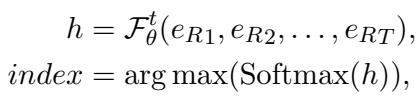
Here, \(\mathcal{F}_{\theta}\) is the reading comprehension head that predicts the probability of a frame being a start or end point.
Why is this better than previous methods? Many older approaches used “Sliding Windows” (checking every possible 5-second clip) or “Anchor Boxes” (pre-defined segments).
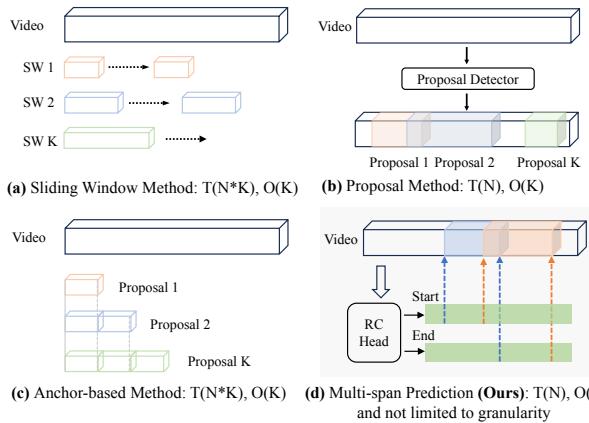
As Figure 3 illustrates:
- Sliding Window (a) & Proposal (b): Computationally expensive (\(O(K)\) or \(O(N*K)\)) because they process overlapping redundant data.
- Multi-span Prediction (d): This is TGB’s approach. It scans the timeline once (\(O(1)\) space complexity relative to proposals) and directly pinpoints the start/end indices. It is faster and more flexible regarding the granularity of the event.
3. The Bootstrapping Framework
There is a major logistical problem in video research: Data Scarcity. We have millions of image-text pairs, but very few datasets have videos with precise timestamps for every event (temporal grounding annotations). Manual annotation is slow and expensive.
TGB circumvents this with a Bootstrapping strategy. It assumes we don’t have ground-truth timestamps. Instead, it uses the MLLM itself to “teach” the TGB.
- Pseudo-Labeling: For a given video and question, the system asks the MLLM to check random frames. If the MLLM answers correctly looking at Frame 50, then Frame 50 is likely a “good” keyframe.
- Joint Training: The system generates “pseudo-labels” (estimated correct timestamps) and trains the TGB to predict them.
To make this differentiable (so we can train the whole network at once), they use the Gumbel-Softmax trick:

This allows the model to sample discrete spans (hard decisions) while still allowing gradients to flow backward for training (soft updates).
Experiments & Results
The researchers validated TGB across seven different benchmarks. The results highlight two main strengths: Efficiency and Generalization.
Parameter Efficiency and Extrapolation
First, let’s look at the trade-off between model size and accuracy.
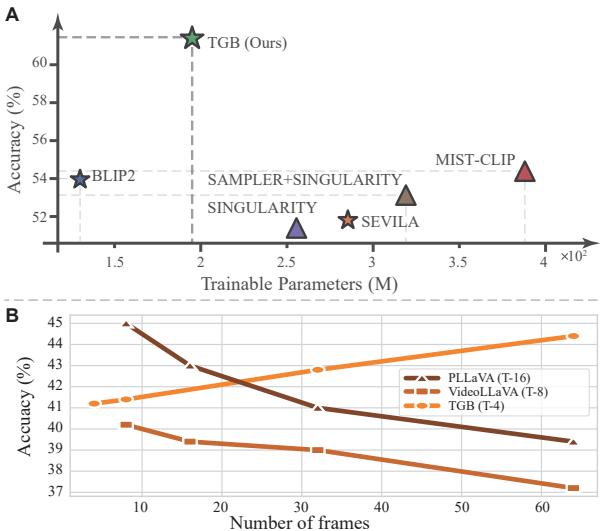
In Chart A (left), we see TGB (the red star) achieves the highest accuracy on the AGQA benchmark (~60%) while using significantly fewer trainable parameters (~2M) compared to models like MIST-CLIP or SEVILA.
Chart B (right) is perhaps the most exciting result. It shows “Zero-shot Frame Extrapolation.”
- The models were trained on short contexts (T-4 means 4 frames).
- As the input video length increases (up to 60 frames), standard models like PLLaVA and VideoLLaVA (blue and green lines) see their performance degrade rapidly.
- TGB (red line) maintains stable performance even as the video gets 16x longer. This confirms the effectiveness of the RoPE integration and the optical flow bridge.
Performance on Benchmarks
How does it compare to the State-of-the-Art (SOTA) on standard datasets?
AGQA 2.0 (Complex Spatial-Temporal Reasoning):
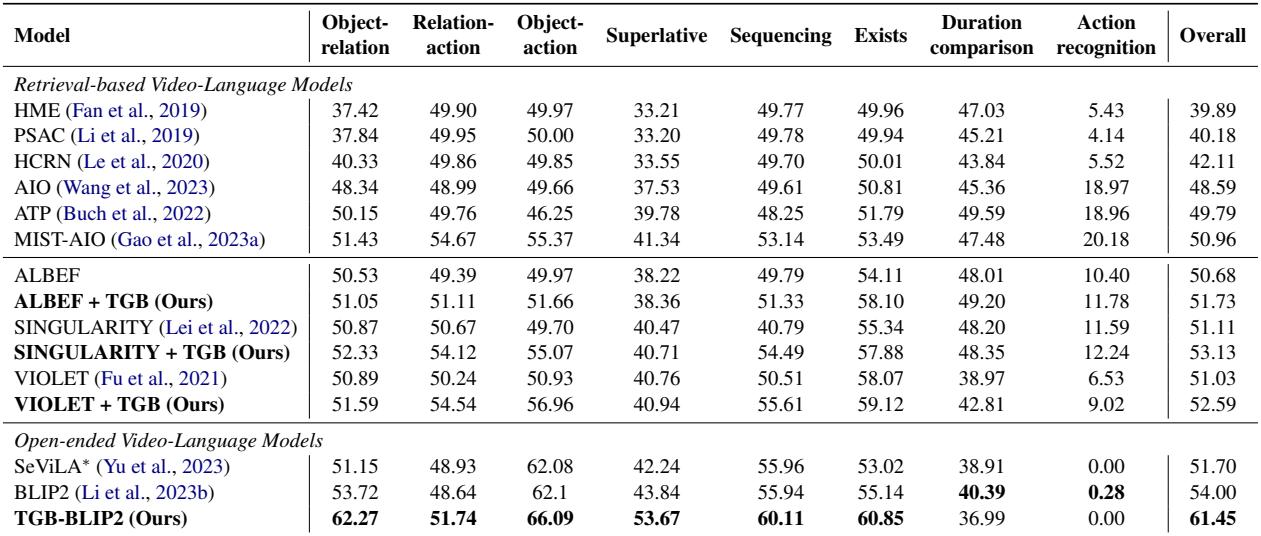
In Table 1, TGB is applied to different base models (ALBEF, VIOLET, BLIP2).
- BLIP2 alone achieves 54.00%.
- TGB-BLIP2 jumps to 61.45%.
- It significantly outperforms retrieval-based models and even recent video-specific models like SeViLA. The massive gain in “Sequencing” and “Object-Action” tasks proves the model is genuinely understanding the temporal dynamics, not just guessing based on a single frame.
EgoSchema (Very Long-Form Video):
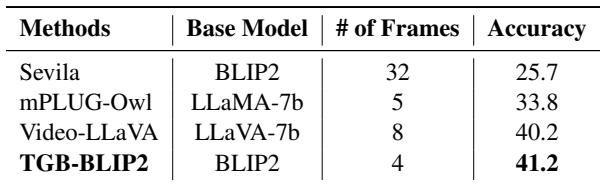
EgoSchema is a notoriously difficult benchmark involving very long egocentric videos. In a zero-shot setting (Table 3), TGB-BLIP2 outperforms Video-LLaVA, despite Video-LLaVA being explicitly trained on video instruction data.
Computational Efficiency
One might worry that adding a “Bridge” layer adds latency. However, because the bridge uses low-dimensional optical flow, the cost is negligible compared to the heavy MLLM.
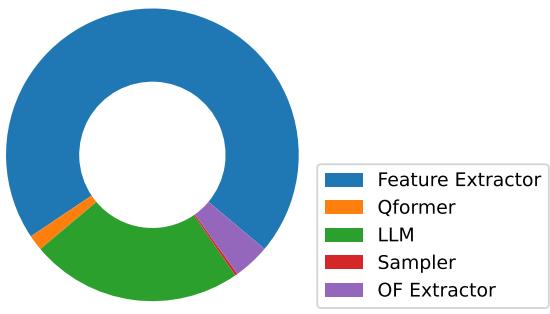
While the visual representation of the pie chart isn’t detailed here, the accompanying data in the paper (and summarized in the text) reveals that the LLM and the Feature Extractor consume the vast majority of the inference time. The TGB sampler itself is extremely fast. By selecting fewer, more relevant frames, TGB actually reduces the total computation required by the heavy components, making the overall system more efficient than running the MLLM on dense frames.
Qualitative Analysis: What does TGB “See”?
It is helpful to visualize the grounding process.
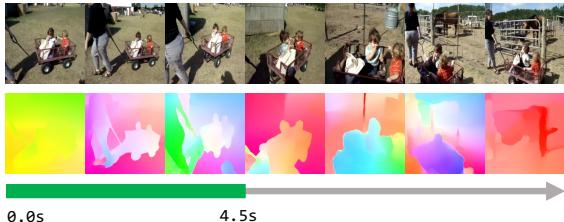
In Figure 5, we see TGB in action:
- Top Example: The question asks, “Why did the girl bend forward at the beginning?” The model successfully attends to the early part of the timeline (the heatmap is active on the left) where the girl is picking up the leash.
- Bottom Example: “Why is the lady leaning forward slightly as she walked?” Here, the action spans a longer duration. TGB correctly identifies the relevant span across the timeline (pushing the red wagon).
This demonstrates that the model isn’t just matching keywords; it is grounding the semantics of the question (e.g., “beginning,” “as she walked”) into the visual timeline.
Conclusion and Implications
The Temporal Grounding Bridge represents a significant step forward for Video-LLMs. By acknowledging that time is a distinct dimension that requires specialized, lightweight handling, the authors have created a system that is:
- Scalable: It handles long videos without retraining (thanks to RoPE).
- Efficient: It uses low-dimensional motion cues (Optical Flow) to filter data before it hits the heavy MLLM.
- Label-Free: The bootstrapping framework allows it to learn from massive datasets without expensive human timestamps.
For students and researchers in the field, TGB illustrates an important lesson: throwing more data or larger context windows at a problem isn’t always the answer. Sometimes, a smart architectural change—like bridging low-level motion features with high-level language reasoning—is the key to unlocking new capabilities.
As we move toward AI agents that need to process continuous video streams (like robots or security analysts), architectures like TGB that decouple “finding the moment” from “analyzing the moment” will likely become the standard.