](https://deep-paper.org/en/paper/2402.18216/images/cover.png)
Introduction
Imagine you are deep in a conversation with a friend about the nuance of 19th-century literature. You are analyzing themes, tone, and character development. Suddenly, without warning, your friend asks you to solve a complex algebraic equation. For a moment, your brain stumbles. The cognitive context you built up for literature doesn’t translate to math; in fact, it might even get in the way.
It turns out, Large Language Models (LLMs) suffer from a very similar phenomenon.
We often assume that providing an AI with “conversation history” is universally beneficial. After all, context is king, right? In-Context Learning (ICL)—where models use previous tokens to inform future predictions—is a cornerstone of why tools like ChatGPT are so effective. However, a fascinating research paper titled “LLM Task Interference: An Initial Study on the Impact of Task-Switch in Conversational History” reveals a hidden vulnerability in this architecture.
The researchers discovered that while conversational history helps when you stay on topic, it can actively harm performance when you switch tasks. If an LLM has been chatting about sentiment analysis, and you suddenly ask it a math question, its accuracy can plummet compared to if you had just asked the math question out of the blue.
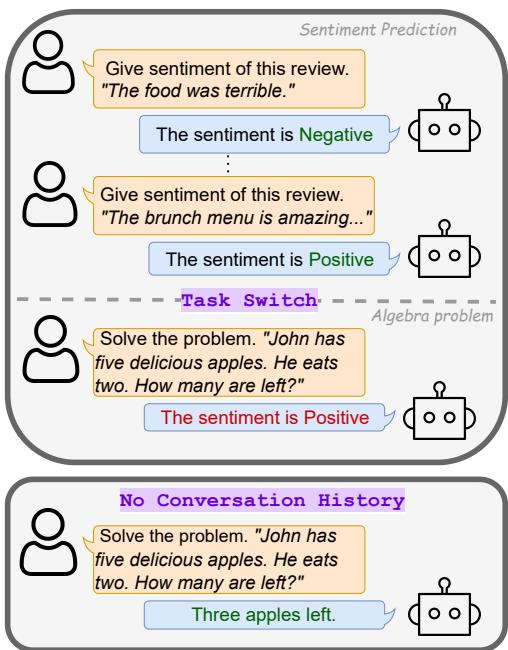
As shown in Figure 1 above, the model gets “stuck” in the mode of the previous task. After analyzing movie reviews (Sentiment Prediction), the model answers a math problem by trying to assign it a “Positive” sentiment, rather than solving the equation.
In this blog post, we will dive deep into this paper to understand why “Task-Switching” confuses even the most powerful models, how researchers measure this confusion, and what it implies for the future of AI reliability.
Background: The Double-Edged Sword of Context
To understand the problem, we first need to understand how conversational LLMs function. At their core, these models are auto-regressive. This means they predict the next word (token) based on the entire sequence of words that came before it.
In a typical chat interface, your current prompt is not sent to the model in isolation. It is appended to the entire history of the conversation (\(h\)).
\[ \text{Input} = [h, u_{\text{current}}] \]This mechanism allows the model to “remember” your name or recall that you are writing Python code rather than Javascript. This reliance on history is usually a feature, enabling In-Context Learning. The model looks at the patterns in the history and mimics them.
The Problem of Task Interference
However, the authors of this paper argue that this sensitivity to history creates a vulnerability. When a user switches the objective of the conversation—defined as a Task-Switch—the model must pivot.
If the model is robust, it should recognize that the previous conversation history (\(h\)) is no longer relevant to the new user prompt (\(u\)). Ideally, the model’s response should be conditionally independent of the history when the tasks are unrelated.
But in reality, the “inertia” of the previous task drags the model down. The researchers term this Task Interference. This isn’t just about the model getting slightly worse; in some cases, the interference causes significant performance degradation or causes the model to output gibberish formats.
Core Method: Formalizing the Confusion
The researchers didn’t just observe this phenomenon; they formalized it mathematically to measure exactly how “sensitive” a model is to these switches.
Defining the Conversation
Let’s break down their methodology. They define a conversation history of length \(L\) as a set of user prompts (\(u\)) and model responses (\(r\)).
- Conversation History Task (\(T_h\)): The task the user was performing originally (e.g., Summarization).
- Target Task (\(T_t\)): The new task the user switches to (e.g., Math).
The model predicts the response for the new task (\(r_{L+1}\)) based on the new prompt and the old history:

The Robustness Ideal
If a model is perfect at task-switching, the history shouldn’t matter. The response to the new task should be the same as if there were no history at all (Zero-Shot).

This equation essentially says: The response \(r_{L+1}\) should be independent (\(\perp\)) of history \(h\), provided the tasks are different.
Measuring Sensitivity (\(\tau\))
To quantify how much the model fails at this ideal, the authors introduced a new metric called Task-Switch Sensitivity (\(\tau\)).
This metric compares the model’s confidence in the correct “Zero-Shot” answer against its confidence in that same answer after the history is added.
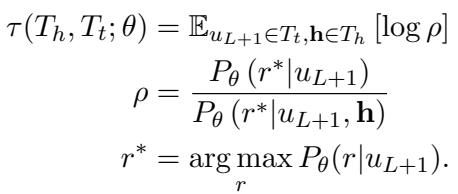
Let’s unpack these equations (Equation 3 and 4 in the image):
- \(r^*\) (The Ideal Response): This is the answer the model would give if it had no conversation history (Zero-Shot). We treat this as the “baseline” behavior of the model.
- \(\rho\) (The Ratio): We look at the probability of the model generating that baseline response \(r^*\).
- Numerator: Probability of \(r^*\) in a Zero-Shot setting (usually high).
- Denominator: Probability of \(r^*\) given the distracting conversation history \(h\).
- \(\tau\) (The Sensitivity): We take the logarithm of that ratio.
How to interpret \(\tau\):
- \(\tau > 0\): The model is distracted. The history made the model less confident in the baseline answer. The higher the number, the more sensitive the model is to the task switch.
- \(\tau = 0\): The model is robust. The task switch had no impact.
- \(\tau < 0\): The history actually helped (rare in this context, but possible).
The beauty of this metric is that it is reference-free. You don’t need a “Gold Standard” human-labeled answer to calculate it. You only need to compare the model against itself (History vs. No History).
Alternative Metrics
The researchers explored other ways to measure this, such as “Loss Sensitivity” (comparing against ground truth) or “Confidence Sensitivity” (comparing against whatever the model outputted, right or wrong).

As shown in Figure 11, the Zero-Shot Sensitivity (marked as (a)) provided the clearest trend. As the conversation history length (\(L\)) increases, the sensitivity goes up, indicating the model is getting more and more entrenched in the wrong task.
Experimental Setup
To test their hypothesis, the authors set up a comprehensive suite of experiments involving 5 datasets and 4 popular Large Language Models.
The Datasets
They selected datasets that represent very different types of cognitive tasks to ensure distinct “Task Switches.”
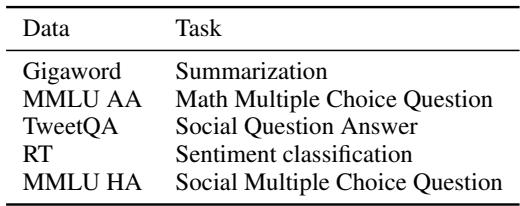
As seen in Table 1:
- Gigaword: Summarization (Generative task).
- MMLU AA: Abstract Algebra (Math/Logic task).
- TweetQA: Social Question Answering (Informal text).
- RT (Rotten Tomatoes): Sentiment Classification (Classification task).
- MMLU HA: Human Aging (Medical/Social knowledge).
The Models
They tested a mix of open-source and closed-source models:
- Llama-7B (Open)
- Mistral-7B (Open)
- GPT-3.5 (Closed)
- GPT-4 (Closed)
The Procedure
The experiment involved creating a “Chat History” consisting of examples from one task (\(T_h\)), and then presenting a final query from a completely different task (\(T_t\)). They varied the length of the history (\(L\)) from 0 (Zero-Shot) to 6 turns.
Experiments & Results
The results confirmed the authors’ hypothesis: Task-switching is a significant vulnerability for LLMs.
1. Performance Degradation
The most immediate finding was that accuracy drops—often significantly—when a task switch is introduced.
Let’s look at what happens when the target task is MMLU Abstract Algebra (answering math questions).
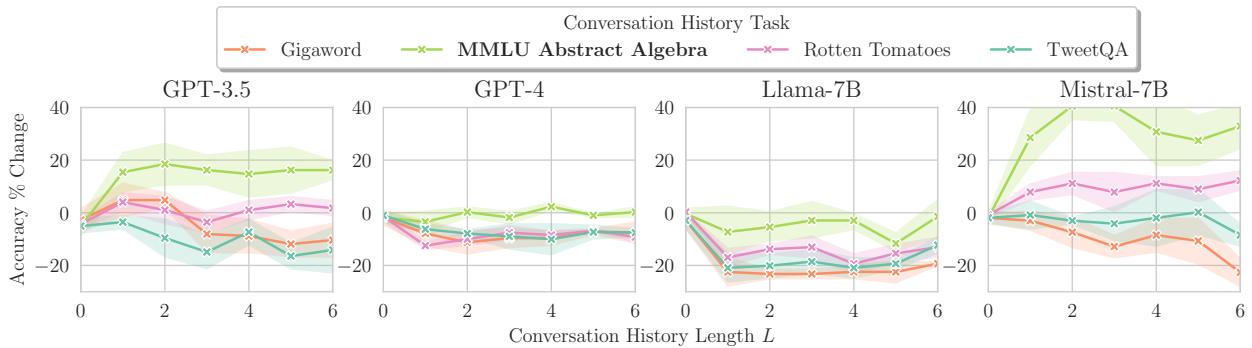
In Figure 2, we see the percentage change in accuracy relative to a Zero-Shot baseline.
- Llama-7B (Green line): As the history length increases, performance fluctuates and often drops below zero.
- Mistral-7B (Purple line): Interestingly, Mistral shows a massive increase in performance for this specific task switch. This highlights that sensitivity is model-specific; sometimes a model might latch onto a latent pattern that accidentally helps.
- GPT-3.5 and GPT-4: These models generally show more stability, but still exhibit variance.
Now, compare this to Rotten Tomatoes (Sentiment Analysis) as the target task:
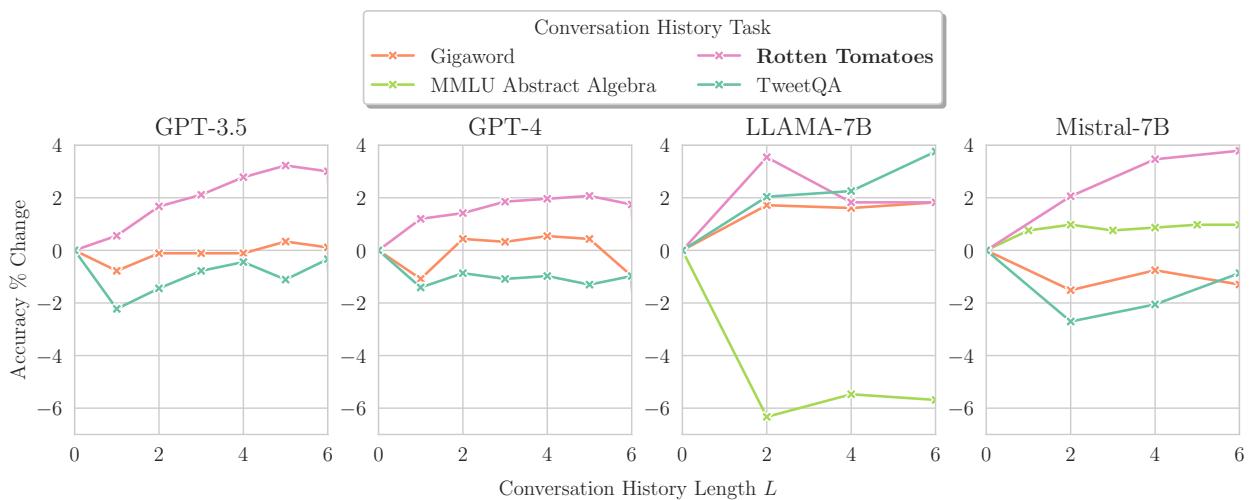
In Figure 5, the results are starker for specific combinations. While some models improve slightly (likely due to the general benefit of seeing formatted text), Llama-7B (Green) shows a notable dip when the history comes from Gigaword or MMLU.
2. High Sensitivity Scores
The performance drops correlate with the Sensitivity Metric (\(\tau\)). The tables below show the specific impact when the conversation length is 6 turns (\(L=6\)).
Target Task: MMLU Abstract Algebra
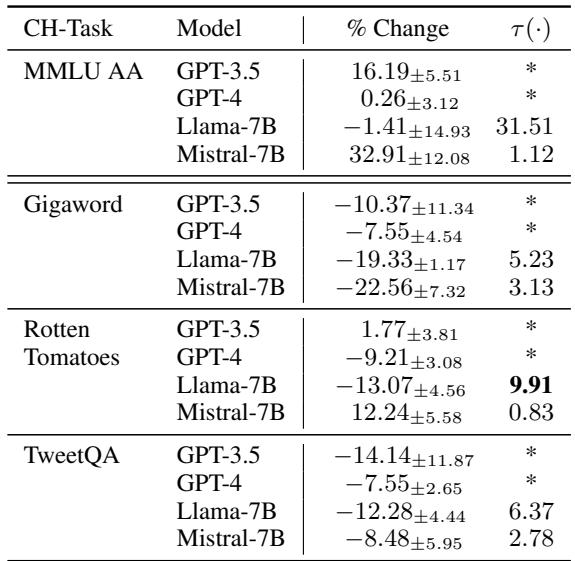
Table 2 reveals severe degradation.
- When Gigaword (Summarization) is the history, Mistral-7B suffers a 22.56% drop in accuracy.
- Llama-7B drops nearly 19.33%.
- The sensitivity score (\(\tau\)) for Llama-7B when switching from Rotten Tomatoes to Algebra is extremely high (9.91), indicating the model was “confidently wrong” or confused.
Target Task: Rotten Tomatoes
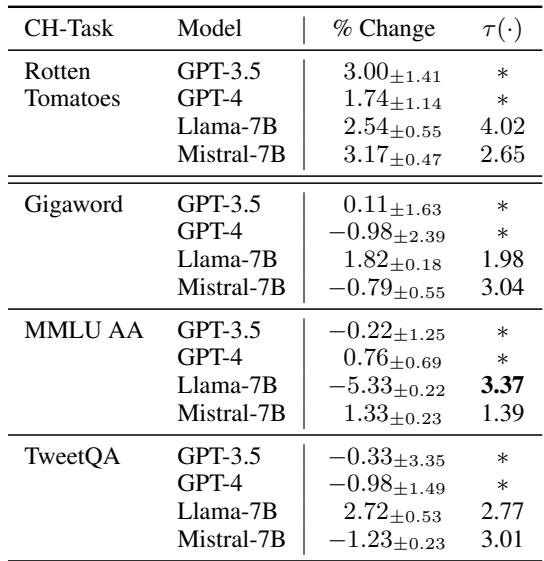
Table 3 shows that sentiment analysis is slightly more robust, but degradation still exists. For instance, Llama-7B drops 5.33% when switching from Algebra (MMLU AA) to Sentiment Analysis.
3. Format Failure: When the Model Breaks
It wasn’t just that the models got the answer wrong; sometimes they forgot how to answer.
For tasks like MMLU, the expected output is a multiple-choice letter (A, B, C, D). However, under the influence of a previous task (like summarization), the model might try to write a paragraph instead.
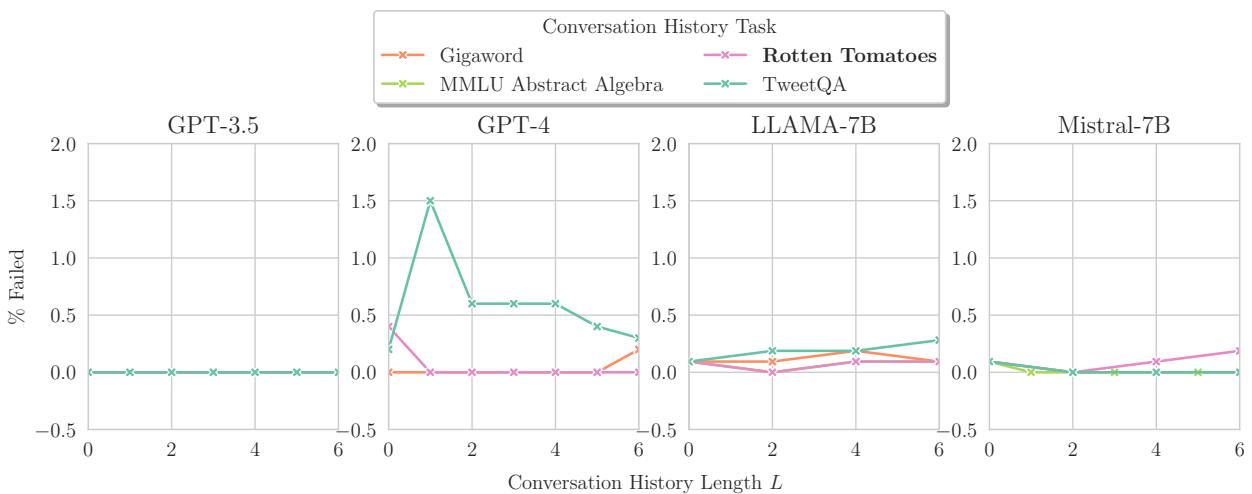
Figure 9 (Top) shows the “Format Failed %”.
- Look at Mistral-7B (bottom right plot). When the history is Gigaword (Orange line), the failure rate spikes to over 15%.
- This means the model was so stuck in “Summarization Mode” that it tried to summarize the math question rather than solving it.
4. Is it just “Noise”?
A valid counter-argument could be: “Maybe the model just hates long contexts?” or “Maybe random words would confuse it too?”
The researchers tested this by filling the history with random conversations (Random History) rather than a specific distinct task.
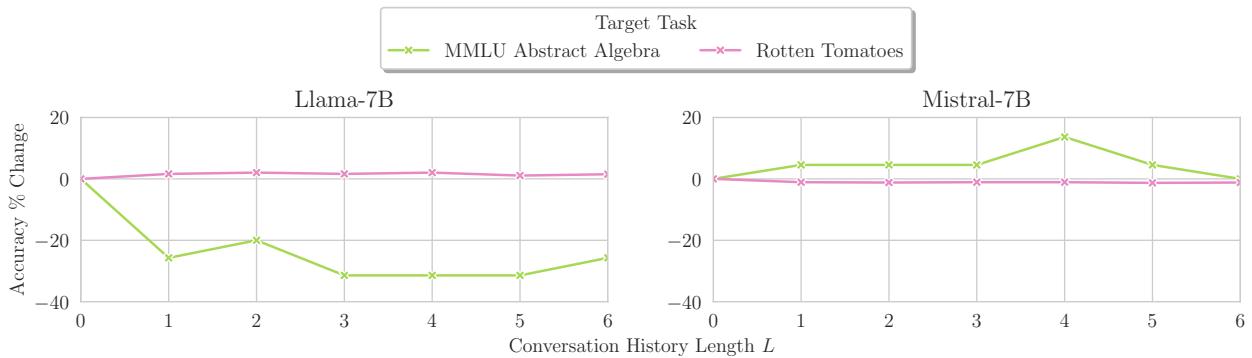
Figure 13 shows the results. While there is some fluctuation, the massive degradation seen in specific task switches (like Summarization -> Math) is not present to the same degree. This confirms that the semantic nature of the previous task is what causes the interference, not just the presence of text.
5. Why does this happen? (The Distance Hypothesis)
The authors hypothesized that the “distance” between tasks might predict the drop. E.g., is Summarization “further” from Math than Sentiment Analysis is?
They asked powerful models (like Gemini and Claude) to rank the similarity of tasks.
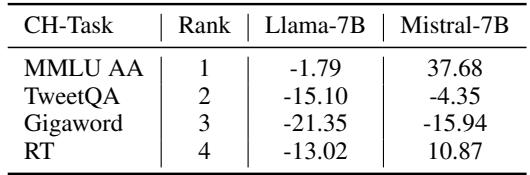
However, as shown in Table 16, there was no strong correlation. The “Rank 1” task (most similar) didn’t necessarily result in the best performance, nor did the least similar cause the worst. This suggests that Task Interference is a complex phenomenon deeply rooted in the specific training dynamics of each model, rather than a simple function of semantic distance.
Conclusion and Implications
The paper “LLM Task Interference” sheds light on a critical blind spot in current GenAI deployment. We have trained these models to be excellent conversationalists, hanging onto every word of our history. But this “stickiness” becomes a liability when we change subjects.
Key Takeaways:
- Context isn’t always good: Old history can actively sabotage performance on new tasks.
- Sensitivity varies: Llama-7B was generally more sensitive than GPT-4, but no model was immune to interference.
- Format collapse: Strong task interference can break the model’s ability to follow basic formatting instructions.
- Reference-Free Detection: The proposed \(\tau\) metric allows developers to detect this vulnerability without needing labeled test data.
Why this matters
For students and developers building “Agentic” workflows—where an LLM performs a sequence of different actions (e.g., “Summarize this email,” then “Extract the date,” then “Write a JSON object”)—this paper is a warning. If you use a single chat history for sequential, distinct tasks, you risk degrading the performance of the later steps.
Future systems may need “Context Management” strategies—knowing when to clear the memory or segment the conversation—to ensure the AI approaches every new task with a fresh, unburdened “mind.”