](https://deep-paper.org/en/paper/2403.05814/images/cover.png)
Have you ever noticed how rigid most chatbots feel? You ask about the weather, and they tell you the forecast. You ask about a restaurant, and they give you a menu. But if you try to naturally segue from that restaurant to the history of the cuisine, and then perhaps to a famous chef who cooks that cuisine, the bot often stumbles. It loses context or treats the new topic as a completely isolated query.
This happens because most dialogue systems are trained to stay on-topic. They are designed to drill down into a specific intent, not to meander through a web of related ideas like humans do.
The reason for this limitation is a classic machine learning bottleneck: Data Scarcity. Creating a dataset where conversations naturally drift from one subject to another requires expensive human writers to script thousands of dialogues.
In this post, we will deep dive into a solution proposed by researchers from Seoul National University and LG AI Research. Their framework, MP2D (Multi-Passage to Dialogue), automates the creation of training data for dynamic, multi-topic conversations. By combining Knowledge Graphs with Large Language Models (LLMs), they have found a way to mimic the natural flow of human curiosity.
The Problem: The “Stuck” Chatbot
To understand why MP2D is necessary, we first need to look at the state of Conversational Question Answering (ConvQA).
In a typical ConvQA scenario, a user asks a question, the system retrieves an answer, and the user asks a follow-up. As long as the follow-up is about the same thing, modern systems perform well. However, human conversation is fluid. According to research cited in the paper, a topic shift occurs roughly every 12 turns in natural dialogue.
Current systems struggle with Topic Shift for two reasons:
- Detection: They don’t know when the user has changed the subject.
- Execution: They don’t know how to transition smoothly to the new information while maintaining the conversational history.
Existing datasets for topic shifts are small because they are hand-labeled. The researchers needed a way to generate thousands of high-quality, shifting dialogues without human intervention.
The Solution: MP2D Framework
The researchers proposed Multi-Passage to Dialogue (MP2D). The core idea is ingenious: instead of trying to teach a model to write a conversation from scratch, they “reverse engineer” a conversation from existing knowledge.
They use a Knowledge Graph (KG) to simulate the mental map a human uses when associating ideas. If you think of “Soccer,” you might next think of the “World Cup,” and then of “Lionel Messi.” MP2D uses these connections to structure a conversation.
1. Following the Path
The first step is identifying a logical flow of topics. The system looks at a Knowledge Graph—a structured database of entities (like people, places, or concepts) and the relationships between them.
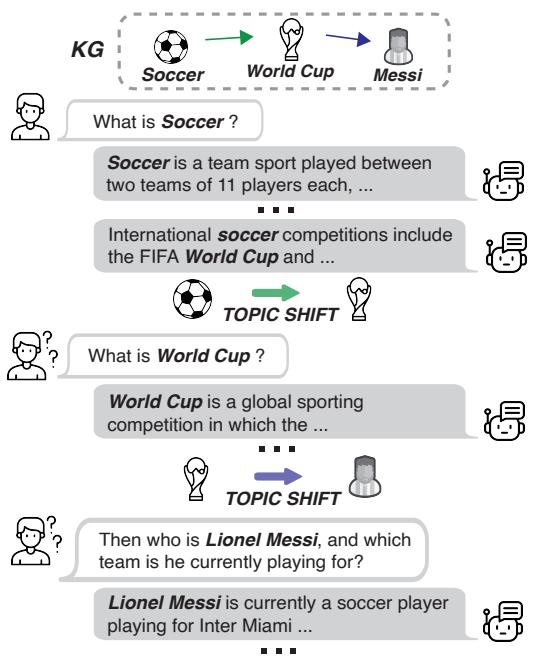
As shown in Figure 1, the system traces a path:
- Start: Soccer
- Relation: is a sport played in -> World Cup
- Relation: involves players like -> Lionel Messi
This path (\(e_1 \rightarrow R_1 \rightarrow e_2 \rightarrow R_2 \rightarrow e_3\)) acts as the skeleton of the conversation. Because the entities are connected in the Knowledge Graph, the transition from one to the next is inherently logical, not random.
2. Retrieving the Content
Once the path is set, MP2D needs the actual content to talk about. It treats each entity in the path as a search query.
- For “Soccer,” it retrieves a passage from Wikipedia explaining the sport.
- For “World Cup,” it retrieves a passage about the tournament.
- For “Lionel Messi,” it retrieves his biography.
The system also extracts the “relation sentences” (\(R\)) that link these entities. This creates a “Multi-Passage” document—a text that contains all the raw information needed for the conversation, arranged in a logical order.
3. Generating the Dialogue (The “P2D” Method)
Here is where the automation magic happens. The researchers use a technique called Passage-to-Dialogue (P2D).
Usually, we think of QA systems as taking a Question and finding an Answer. P2D does the opposite. It takes a declarative sentence (the Answer) and asks an AI model to generate the Question that would prompt that answer.
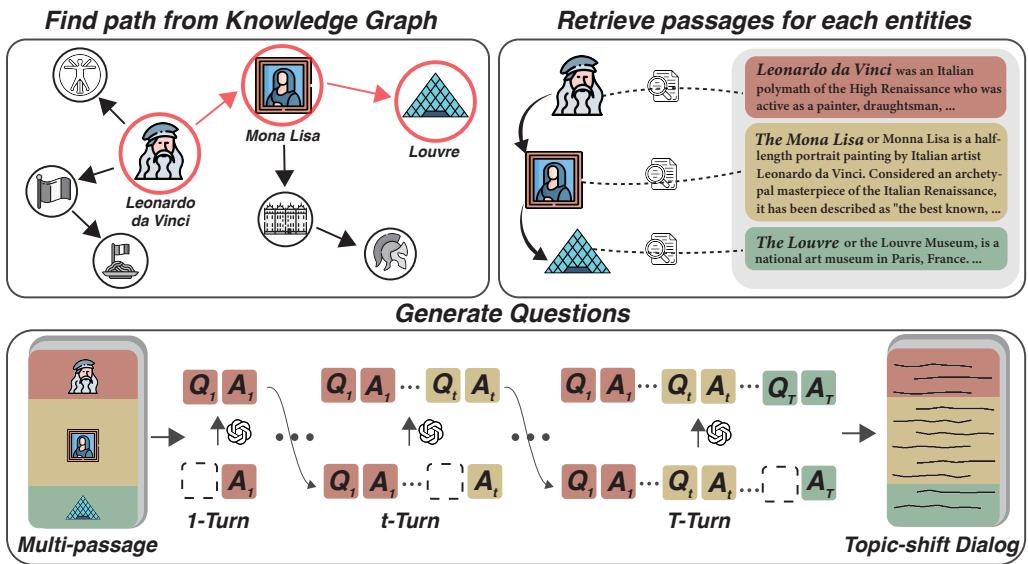
Figure 2 illustrates this pipeline:
- Top Left: The path is found in the Knowledge Graph.
- Top Right: Passages are retrieved for each entity (e.g., Da Vinci, Mona Lisa, The Louvre).
- Bottom: An LLM (in this case, GPT-3.5) acts as the Question Generator.
The system feeds the “Answer” sentences to the LLM and says, “Generate a question for this answer.” By doing this sequentially through the retrieved passages, MP2D builds a full dialogue history.
The Topic Shift Trick: The researchers found that standard models struggle to generate good questions at the exact moment the topic changes. To fix this, they inject a specific instruction into the LLM prompt during topic-shift turns:
“Note that the conversation topic has shifted to [next_topic] from [current_topic].”
This simple prompt engineering ensures the generated question naturally bridges the gap between the old topic and the new one.
Does It Actually Work?
To validate the framework, the researchers didn’t just look at the output; they measured it using both automated metrics and human evaluation.
They compared MP2D against other methods (like “Dialog Inpainter” and “Dialogizer”) using reference-free metrics. The results showed that using an LLM within the MP2D framework consistently produced higher-quality dialogues, particularly in maintaining context and coherence.
Human Evaluation
Quantitative metrics are useful, but for conversation, human “feel” is the gold standard. The researchers asked human annotators and GPT-4 to rate the generated dialogues on three criteria:
- Is the timing of the shift natural?
- Is the shift fluent?
- Is the overall quality good?
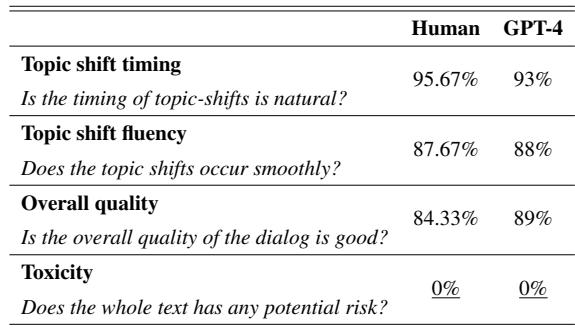
As Table 2 shows, the results were impressive. Humans found that 95.67% of the topic shifts happened at natural times, and 87.67% of the transitions were fluent. This confirms that the Knowledge Graph approach successfully mimics human topic association.
Case Studies: Good vs. Bad Transitions
It is helpful to look at specific examples to understand the system’s capabilities and limitations.
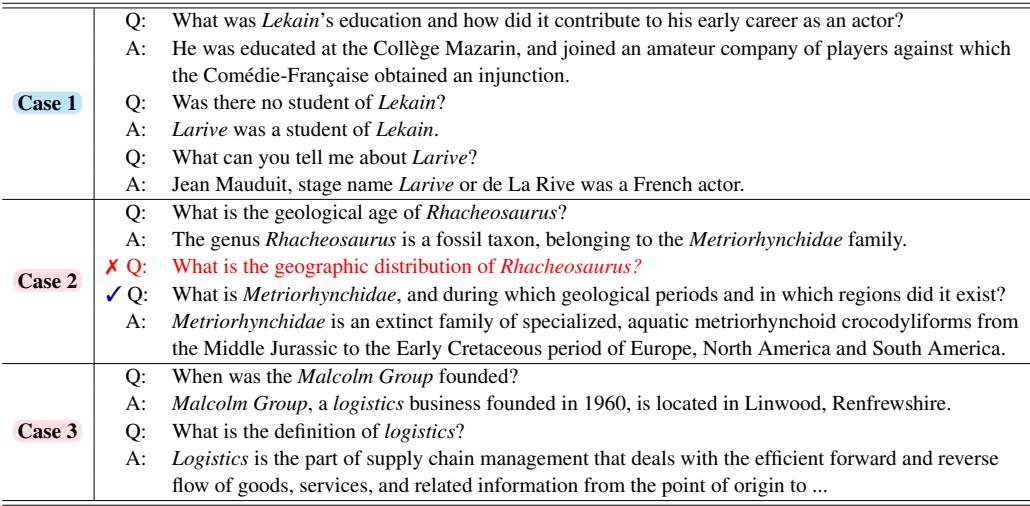
In Case 1 (Table 5), we see a smooth transition. The dialogue moves from the actor Lekain to his student Larive. This is a classic “entity connection” facilitated by the Knowledge Graph.
Case 2 highlights why the specific “Topic Shift Instruction” is so important. Without the instruction (the red text), the model keeps asking about the old topic (Rhacheosaurus) even though the answer has moved on to the Metriorhynchidae family. With the instruction (the green text), the model correctly asks, “What is Metriorhynchidae?”
Case 3 shows a limitation. The dialogue shifts from a specific company (Malcolm Group) to the general definition of “Logistics.” While logically connected, humans rarely switch from a specific entity to a dictionary definition in casual conversation. This suggests that while KGs provide logic, they don’t always perfectly capture social conversational norms.
The TS-WikiDialog Benchmark
The researchers used MP2D to generate a massive dataset called TS-WikiDialog. They then used this dataset to test how well current state-of-the-art LLMs handle topic shifts.
The results revealed a weakness in modern LLMs.
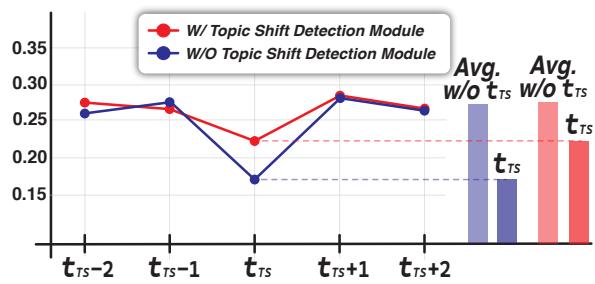
Look at the blue line in Figure 3. This graph tracks the performance (BLEU-4 score) of GPT-3.5 during a conversation. The “0” on the X-axis (\(t_{TS}\)) represents the exact moment the topic shifts.
Notice the significant dip? That drop indicates that even GPT-3.5 struggles to maintain quality when the topic changes. It gets confused by the sudden context switch.
However, the red line shows the performance when the model is assisted by a Topic Shift Detection Module—a smaller model trained specifically on the MP2D dataset to recognize changes. The performance remains stable, proving that specialized training on topic-shift data can fix this weakness.
Applications: Improving Topic Shift Detection
One of the most practical applications of MP2D is training smaller, more efficient models to detect topic shifts. This is crucial for real-time systems that need to know when to retrieve new documents or reset their context window.
The researchers fine-tuned a T5-base model (a relatively small model) using their MP2D-generated data and compared it to massive LLMs like GPT-3.5 and GPT-4 in a “Topic Shift Detection” task.
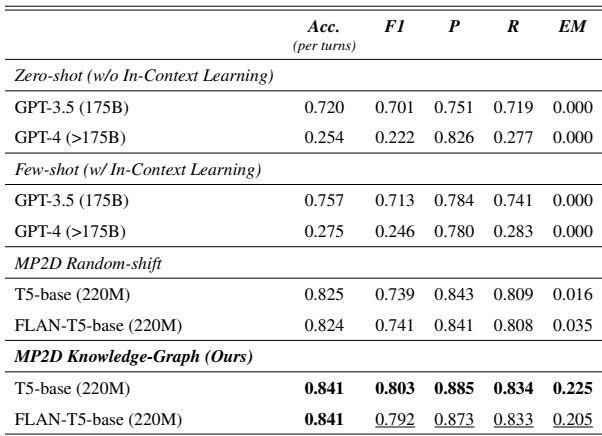
Table 4 presents a striking result. The “MP2D Knowledge-Graph (Ours)” models (bottom rows) significantly outperformed the zero-shot and few-shot capabilities of GPT-3.5 and GPT-4.
- GPT-4 (Few-shot): 28.3% Recall
- MP2D T5-base: 97.3% Recall
This demonstrates that a small model, when trained on high-quality synthetic data generated by MP2D, can vastly outperform a general-purpose giant on specific tasks. This is a massive win for efficiency and cost-effectiveness in deploying AI systems.
Conclusion and Implications
The MP2D framework represents a significant step forward in automated data generation. By leveraging the structured logic of Knowledge Graphs, researchers have found a way to create “natural” conversational flows without the prohibitive cost of human authorship.
The key takeaways from this work are:
- Structure Matters: Randomly stitching topics together doesn’t work. Knowledge Graphs provide the necessary semantic glue to make topic shifts feel human.
- LLMs Need Help: Even powerful models like GPT-3.5 stumble at topic boundaries. They need specific data or instructions to handle transitions smoothly.
- Synthetic Data Works: Models trained on this automatically generated data can outperform generalist models on specific dialogue tasks.
As we move toward AI assistants that can hold long, winding conversations rather than just answering one-off queries, frameworks like MP2D will be essential. They provide the training ground necessary for AI to master the subtle art of changing the subject.