](https://deep-paper.org/en/paper/2403.15744/images/cover.png)
If you have ever worked on a supervised machine learning project in a professional setting, you have likely encountered the labeling bottleneck. You have access to a massive amount of raw text data—customer reviews, medical abstracts, or news articles—but your budget for human annotation is painfully small. You simply cannot afford to label 100,000 examples.
Enter Active Learning (AL).
The promise of Active Learning is seductive. Instead of labeling random data points, the algorithm acts like a smart student, explicitly asking the teacher (the human annotator) to label only the most confusing or informative examples. The theory is that by labeling the “right” data, you can reach high model accuracy with a fraction of the budget.
But here is the uncomfortable question: Does it actually work in practice?
If you pick a popular Active Learning strategy from a research paper and apply it to your specific dataset, can you trust it to beat simple random sampling? A fascinating research paper titled “On the Fragility of Active Learners for Text Classification” by Abhishek Ghose and Emma Thuong Nguyen tackles this question head-on. They conducted a rigorous stress test of modern AL techniques, and the results are a wake-up call for anyone building NLP pipelines.
In this post, we will tear down the methodology of this paper, explore the “fragility” of these learners, and look at the data to see if Active Learning is a silver bullet or a roll of the dice.
The Practitioner’s Dilemma
To understand the significance of this paper, we first need to understand the dilemma facing a Data Scientist today.
When you read AL literature, you often see charts showing AL strategies skyrocketing to high accuracy while “Random Sampling” lags behind. Based on this, you might decide to implement a complex strategy like Contrastive Active Learning (CAL) or Discriminative Active Learning (DAL).
However, AL lacks “prerequisite checks.” In standard statistics, you check for normality before running a t-test. In AL, there is no test you can run on your unlabeled dataset to say, “Ah, yes, the Margin strategy will definitely work here.”
Practitioners are forced to make a blind bet. They pick a technique, hope it beats random sampling, and often run it in an “Always ON” mode—assuming that even if it doesn’t help much, it surely won’t hurt. This paper challenges that assumption by asking:
- How often does AL actually beat random sampling?
- Does the choice of the prediction model matter more than the AL strategy?
- Is “Always ON” a safe default, or can AL actually perform worse than random guessing?
The Methodology: A Massive Grid Search
To answer these questions, the researchers didn’t just test one model on one dataset. They created a massive configuration space to simulate the variety of setups a real-world practitioner might use.
They focused specifically on Text Classification, utilizing modern pre-trained representations which are ubiquitous in the industry today.
The Anatomy of an AL Experiment
Let’s look at how they structured their world. They varied five key dimensions:
- Datasets: Five distinct text datasets (including sentiment analysis, news categorization, and medical abstracts).
- Representations: How the text is converted to numbers (Word Vectors, Universal Sentence Encoder, MPNet, etc.).
- Classifiers: The actual model making predictions (Linear SVM, Random Forest, and RoBERTa).
- Query Strategies (QS): The algorithm choosing which data to label.
- Batch/Seed Sizes: How much data we start with and how much we label at once.
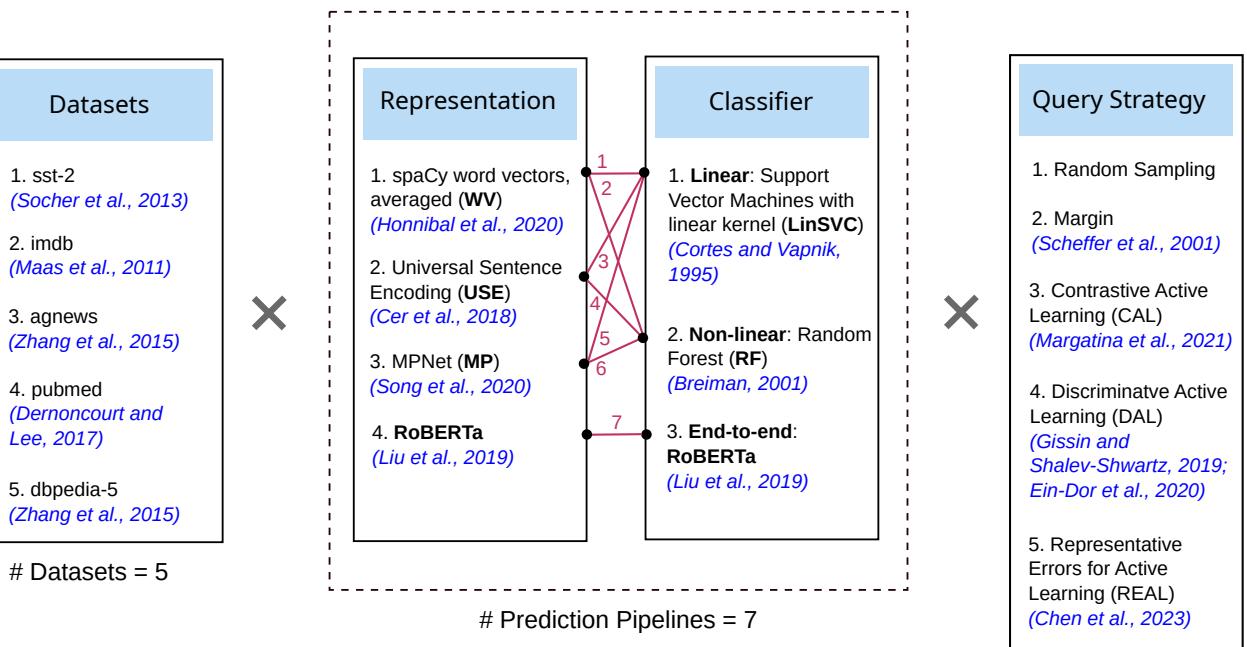
As shown in Figure 1, this combinatorial explosion resulted in 350 unique configurations. Since AL involves randomness, they ran every configuration 3 times, resulting in 1,050 total experimental trials.
The Batch Active Learning Loop
It is worth taking a moment to understand exactly how the Active Learning loop functioned in these experiments. The authors provided a clear algorithmic breakdown.
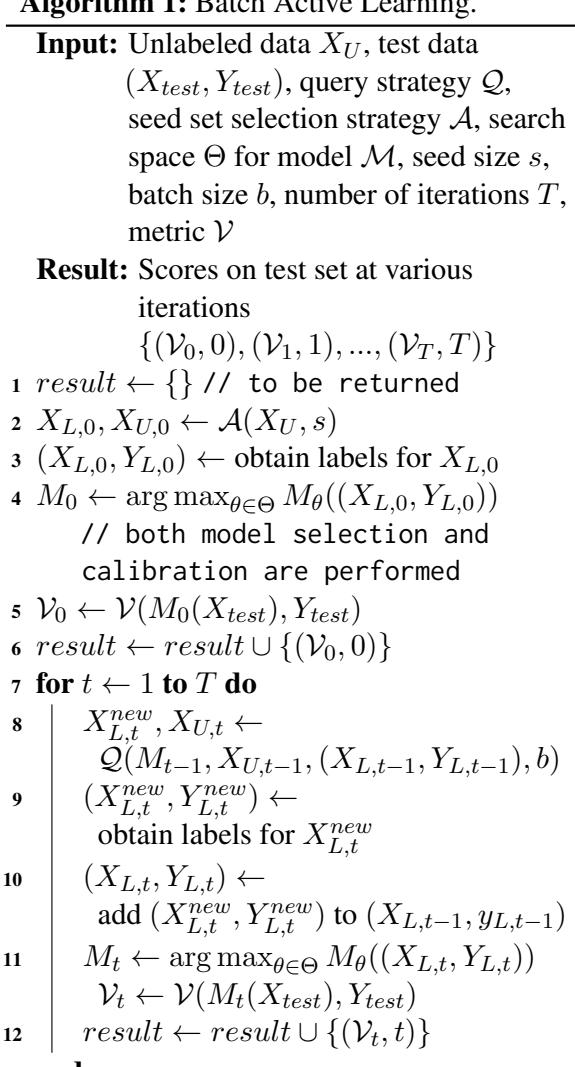
Algorithm 1 details the process:
- Initialization: Start with a small “seed” set of labeled data (randomly selected).
- Training (\(M_t\)): Train a model on the current labeled data. Crucially, the authors perform proper model selection (hyperparameter tuning) and calibration at every single step. This is a step often skipped in other papers, but essential for fair comparison.
- Selection (\(Q\)): Use the Query Strategy to look at the massive pool of unlabeled data (\(X_U\)) and pick a batch of \(b\) instances.
- Labeling: “Label” these instances (reveal their true classes from the dataset).
- Loop: Add the new data to the training set and repeat until the budget is exhausted.
The Query Strategies (The Contenders)
The paper pitted Random Sampling (the baseline) against four non-random strategies, ranging from established classics to state-of-the-art methods:
- Margin Sampling (2001): A classic uncertainty method. It selects examples where the model is most “confused” (i.e., the difference in probability between the top two predicted classes is small).
- CAL (Contrastive Active Learning, 2021): Selects examples whose predicted probability distribution diverges most from their nearest neighbors.
- DAL (Discriminative Active Learning, 2019): Trains a binary classifier to distinguish between labeled and unlabeled data, then picks unlabeled points that look “most different” from what we already have.
- REAL (Representative Errors for Active Learning, 2023): Uses clustering to find areas where the model is likely making errors and samples from there.
Measuring Success: The Relative Improvement
How do we know if AL is winning? We can’t just look at accuracy, because accuracy naturally goes up as we add more data, regardless of how we picked it.
We need to measure the lift provided by AL compared to Random Sampling. The authors defined a metric called \(\delta\) (delta), which represents the percentage relative improvement in the F1-Macro score.
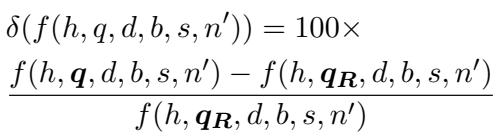
- If \(\delta > 0\): The Active Learning strategy is winning (better than random).
- If \(\delta \approx 0\): The strategy is useless (same as random).
- If \(\delta < 0\): The strategy is harmful (worse than random).
The Results: A Story of Fragility
The results of this study challenge the “AL always helps” narrative. When looking across the 1,050 trials, the performance of Active Learning was surprisingly inconsistent.
1. The Landscape of Gains (and Losses)
Let’s look at the “heatmaps” of improvement. In the figure below, the authors plotted the expected relative improvement (\(\delta\)) across different prediction pipelines (rows) and training sizes (columns).
- Green means AL is helping.
- White means AL is doing nothing.
- Pink/Magenta means AL is hurting.
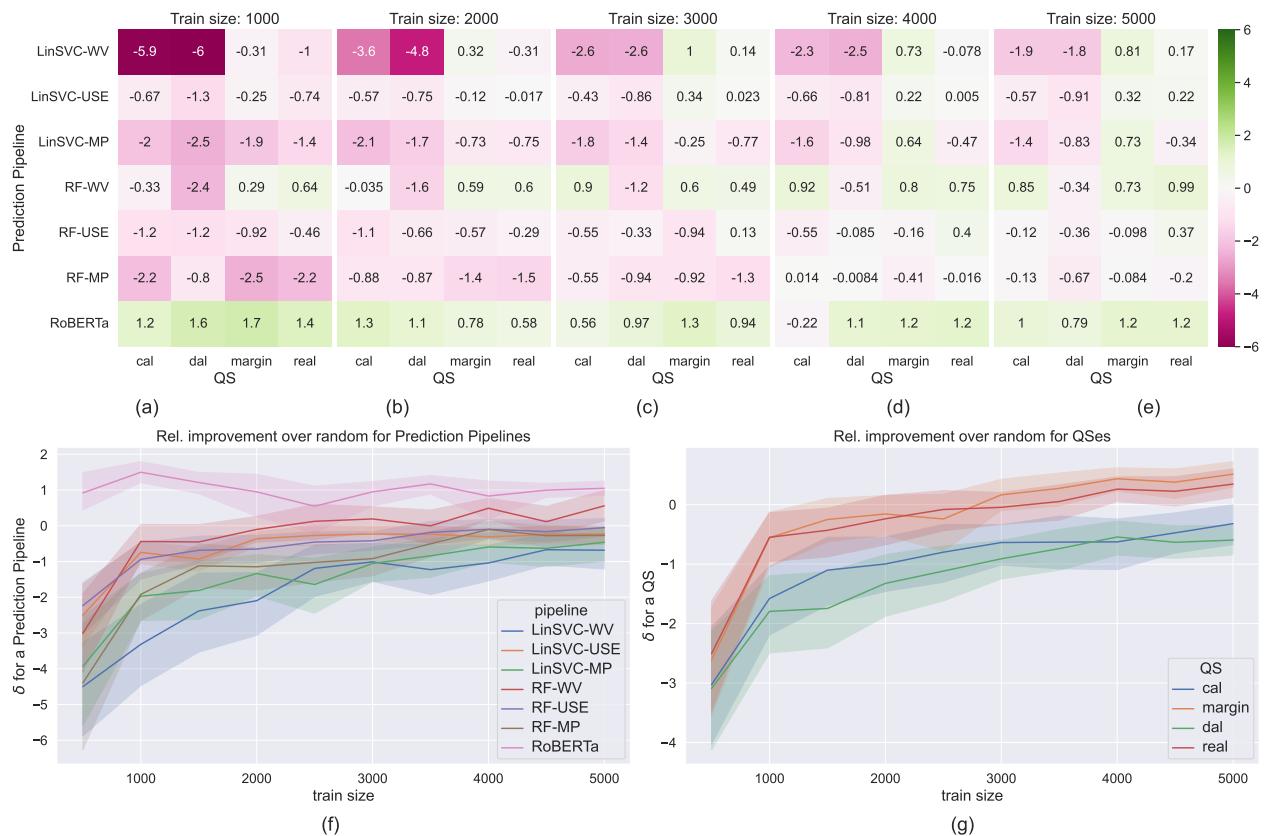
Key Observations from Figure 3:
- The Sea of Pink: Look at the left side of the heatmaps (Train size 1000). There is a significant amount of pink, especially for the LinearSVC and Random Forest (RF) pipelines. This means that in the early stages of learning—exactly when you need AL to work the most—it often performs worse than random sampling.
- Convergence to Zero: As we move to the right (Train size 5000), the colors fade to white. This is expected; as you label more data, the difference between strategies matters less because you’ve covered the distribution.
- The RoBERTa Exception: Look at the bottom row of the heatmaps (
RoBERTa). It is consistently light green. This suggests that using a powerful, end-to-end Deep Learning model yields more consistent positive results for AL, though the gains are modest (around 1-2%).
2. The Danger of “Always ON”
A common industry practice is to leave an Active Learner running in the background. The logic is: “Worst case, it acts like random sampling.”
The data proves this logic wrong.
The authors calculated the percentage of times the relative improvement (\(\delta\)) was strictly negative.
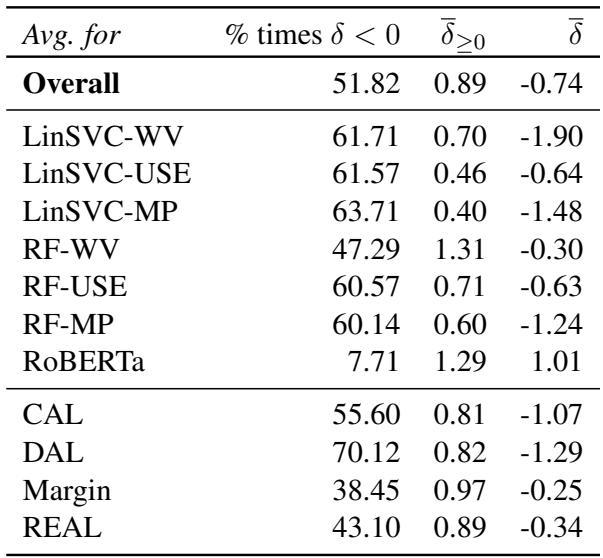
The Shocking Stat: Overall, the AL strategies performed worse than random sampling 51.82% of the time.
If you look at the Average delta column, the overall average is -0.74. This means that if you blindly apply these AL techniques across various tasks without prerequisite checks, on average, you are slightly hurting your model’s performance compared to doing nothing but random selection.
This creates a paradox: You need AL when you have few labels. But with few labels, AL is most volatile and likely to underperform. By the time you have enough labels (4000-5000) to ensure AL is stable (the “positive” territory), the gains are negligible.
3. Visualizing the Convergence
To visualize this behavior in a specific instance, we can look at the learning curves for the agnews dataset.
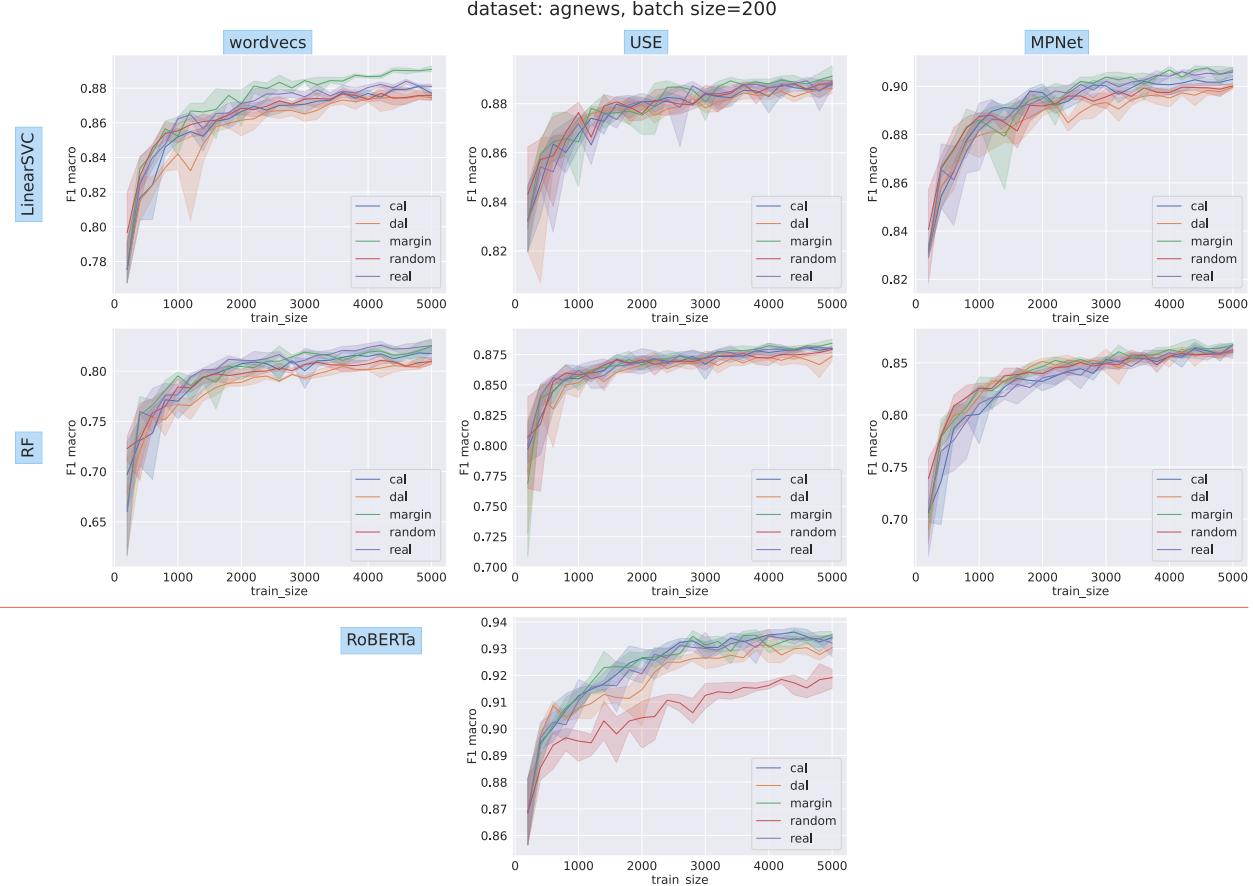
In Figure 2, compare the red line (Random) with the others.
- In the LinearSVC and RF (Random Forest) plots, the lines are tangled. Sometimes Random is on top, sometimes Margin (green) is on top. It’s chaotic.
- In the RoBERTa plot (bottom right), you can see a clearer separation where the AL strategies (especially Margin and REAL) float slightly above the red Random line.
This visualizes the “fragility.” Unless you are using a specific setup (like RoBERTa), the “win” is not guaranteed.
4. What Matters More: The Algorithm or the Pipeline?
If you want to improve your Active Learning results, should you switch from Margin Sampling to CAL? Or should you switch your classifier from Random Forest to RoBERTa?
The researchers used a statistical test (Kendall’s W) and feature importance analysis to answer this. They found that changing the prediction pipeline has a much greater impact than changing the Query Strategy.
The choice of AL algorithm (DAL vs REAL vs Margin) matters surprisingly little compared to the choice of the classifier and the text representation. This is a crucial insight for students and researchers: stop obsessing over the fanciest new sampling algorithm and fix your underlying model first.
5. The Role of Text Representations
Speaking of representations, the paper uncovered an interesting nuance regarding Universal Sentence Encoder (USE) versus MPNet.
MPNet is generally considered a superior embedding model on standard benchmarks (like MTEB). However, in the context of Active Learning, the results showed something different.
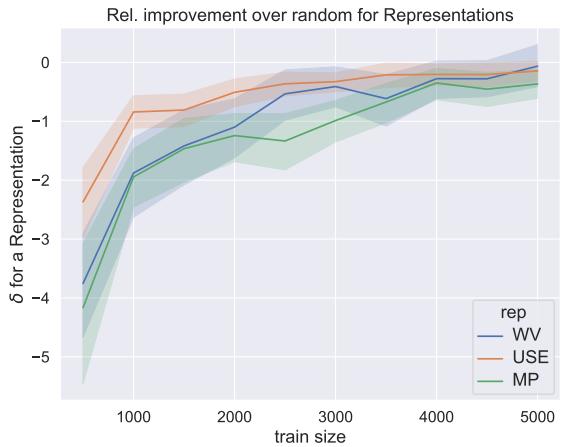
Figure 4 shows the relative improvement over random for different embeddings.
- WV (Word Vectors): Starts very poor but improves.
- MP (MPNet): Starts very poor (negative) and slowly crawls up.
- USE: Starts closer to zero and improves faster.
The authors hypothesize that while MPNet is more precise, USE might have a “fuzzier” embedding space that helps cover the concept space of the dataset earlier in the AL process. Sometimes, a slightly less precise representation helps the sampler explore the data better.
Why is RoBERTa the Exception?
Throughout the experiments, RoBERTa (the end-to-end transformer model) was the only predictor that showed consistent, positive gains from Active Learning (as seen in the Table 1 RoBERTa row with only 7.71% negative incidents).
Why?
The authors suggest that because RoBERTa is an end-to-end classifier, it has a more “coherent” view of the data distribution. Unlike a pipeline that separates embedding (USE) from classification (SVM), RoBERTa adjusts its internal representation and its decision boundary simultaneously during fine-tuning. This allows it to better estimate the informativeness of an unlabeled example.
However, even with RoBERTa, the gains were small—hovering around a 1% improvement over random. Is that worth the computational cost of running complex AL queries? That depends on your budget.
Conclusion: The “Warm-Start” Problem
This paper serves as a necessary critique of the Active Learning field. It does not claim that AL never works; clearly, it does work in specific scenarios (especially with Transformers like RoBERTa). However, it exposes the fragility of these methods.
The key takeaways for students and practitioners are:
- Don’t Trust Blindly: Do not assume AL will beat random sampling on your specific dataset.
- The “Warm-Start” Gap: There is currently no way to know when AL will start beating random sampling. You might need 500 labels, or 2000. Until you hit that point, you might be doing worse than random.
- Pipeline First: Your choice of classifier and representation matters more than the specific Active Learning query strategy.
- No “Prerequisite Checks”: The field desperately needs diagnostic tools—unsupervised metrics that can look at a dataset and predict which AL strategy will work, before we spend money on labels.
Until those diagnostic tools exist, Active Learning remains a high-stakes gamble. If you decide to use it, monitor your performance closely, and perhaps—just perhaps—don’t be afraid to stick with good old Random Sampling.