](https://deep-paper.org/en/paper/2403.17146/images/cover.png)
If you have spent any time in the comment sections of social media platforms like Reddit or X (formerly Twitter), you know how quickly conversations can spiral into toxicity. Hate speech remains a persistent challenge in online communities, threatening healthy discourse and driving users away.
For years, researchers have been developing automated methods to generate “counterspeech”—direct responses designed to refute or neutralize hate speech. The logic is simple: if we can automate the moderation process or assist human moderators with suggested replies, we can scale up the fight against toxicity.
However, there is a significant gap in how these systems are built. Most current models focus on linguistic attributes. They are trained to be polite, informative, or positive. While these are noble goals, they don’t answer the most important question: Does the reply actually work?
Does a polite reply stop the hater from posting again? Does an informative rebuttal calm the comment section down, or does it add fuel to the fire?
In this post, we are doing a deep dive into the paper “Outcome-Constrained Large Language Models for Countering Hate Speech.” The researchers propose a shift in perspective: instead of just generating text that looks good, we should generate text that is optimized to produce a specific, positive outcome in the conversation.
The Problem with Current Counterspeech
To understand why this research is necessary, we first need to look at the landscape of automated counterspeech.
Traditionally, researchers create datasets by asking experts or crowdsourced workers to write replies to hate speech. Models are then trained to mimic these replies. As shown in the summary of prior work below, constraints usually focus on the text itself—making it “toxic-free,” “emotional,” or “informative.”
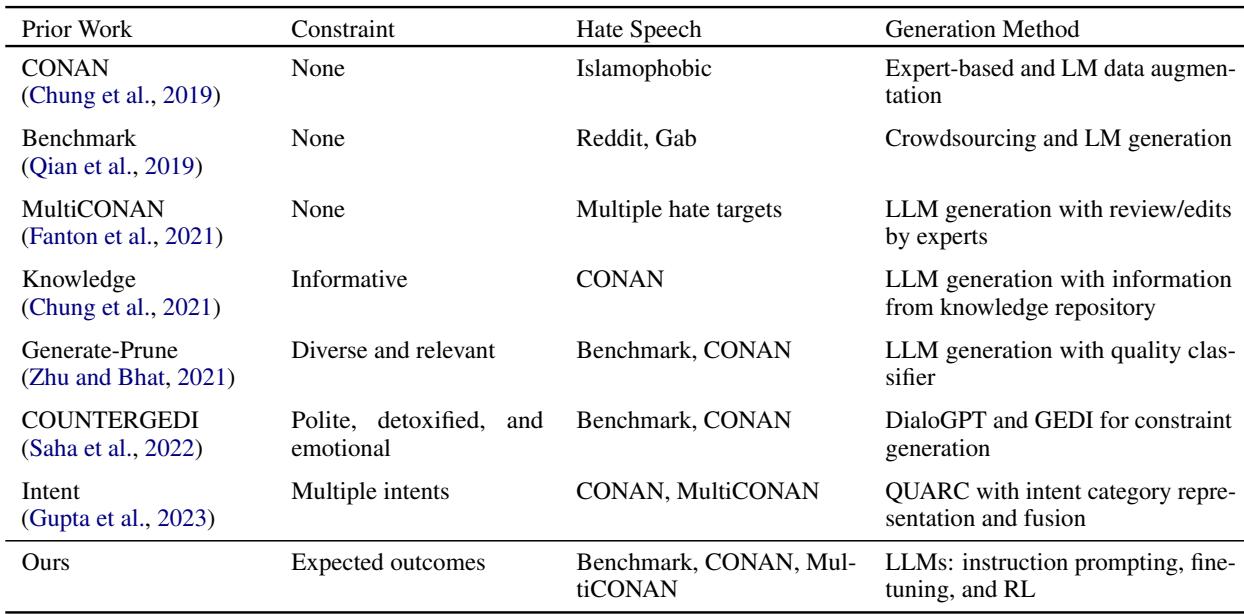
The issue with these approaches is that they are “output-focused” rather than “outcome-focused.” A reply can be perfectly polite and grammatically correct but still enrage the original poster or invite a swarm of trolls. The researchers of this paper argue that the ultimate goal of counterspeech shouldn’t just be to sound nice—it should be to de-escalate conflict.
Defining “Success”: What is a Good Outcome?
If we want to train an AI to achieve a goal, we must first define that goal mathematically. The researchers focused on two specific metrics that indicate a healthy recovery from a toxic comment: Conversation Incivility and Hater Reentry.
To measure these, the researchers model the conversation as a tree structure.
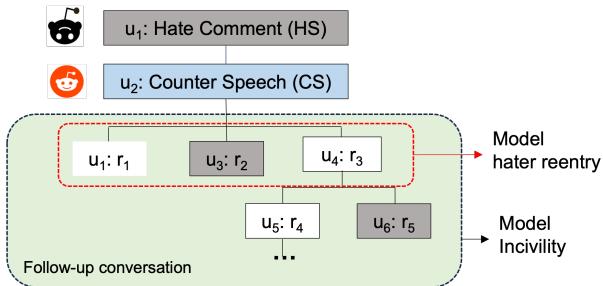
As illustrated in Figure 1, the model looks at the hate comment (\(u_1\)) and the counterspeech reply (\(u_2\)). But critically, it looks at everything that happens inside the green box—the follow-up conversation.
1. Conversation Incivility
This metric assesses the overall tone of the thread after the counterspeech is posted. It isn’t just about counting bad words; it considers the volume of civil vs. uncivil comments and how many unique authors are involved.
- High Incivility: Many users jumping in with toxic comments.
- Low Incivility (Desired): The conversation becomes calm, or the toxic thread dies out with civil remarks.
2. Hater Reentry
This metric focuses specifically on the original instigator (\(u_1\)). After being countered, what do they do?
- No Reentry: They leave the conversation (Neutral/Good).
- Hateful Reentry: They reply with more hate (Bad).
- Non-hateful Reentry (Desired): They engage in the conversation constructively (Best).
The “Non-hateful Reentry” outcome is the gold standard of de-escalation. It implies the counterspeech didn’t just silence the user, but actually encouraged a change in behavior or tone.
The Methodology: Three Ways to Steer an LLM
The researchers experimented with Large Language Models (LLMs), specifically Llama-2, to generate counterspeech. Their challenge was to force the LLM to prioritize the two outcomes defined above. They tested three distinct approaches:
Method 1: Instruction Prompts (The “Ask Nicely” Approach)
The simplest way to use an LLM is to tell it what you want. The researchers crafted prompts that explicitly described the desired outcome.
- Standard Prompt: “Please write a counterspeech reply…”
- Outcome Prompt: “…so that it could lead to low incivility in the follow-up conversations.”
They also utilized a “Generate and Select” strategy. Instead of asking the LLM for one reply, they asked for 5 or 10. Then, they used a separate classification model (trained to predict conversation outcomes) to score those 10 replies and pick the one most likely to succeed.
Method 2: LLM Finetuning (The “Practice Makes Perfect” Approach)
Finetuning involves retraining the weights of the model on a specific dataset. The researchers gathered real Reddit conversations where counterspeech actually led to low incivility or constructive hater reentry. By training the model on these “success stories,” the LLM learns to mimic the style and content of effective human moderators. They used a technique called LoRA (Low-Rank Adaptation) to do this efficiently.
Method 3: Reinforcement Learning (The “Reward” Approach)
This is the most sophisticated method used in the study. In Reinforcement Learning (RL), the model generates a reply and receives a “reward” (a score) based on how good that reply is. The model then adjusts itself to maximize that reward over time.
Here, the “reward function” was powered by the outcome classifiers.
- The LLM generates a counterspeech reply.
- The classifier predicts: “Will this lead to a civil conversation?”
- If yes, the model gets a high reward (+2). If it leads to hate, it gets a punishment or low reward (0).
- To ensure the model doesn’t drift too far from intelligible English, they also included a penalty (KL-divergence) if the text became too weird compared to the base model.
Experiments and Key Results
The researchers evaluated their models using a test set from Reddit. They looked at three dimensions: effectiveness (predicted outcomes), similarity to human text, and quality.
1. Did the models achieve the desired outcomes?
The results, detailed in Table 2 below, show a clear hierarchy in effectiveness.
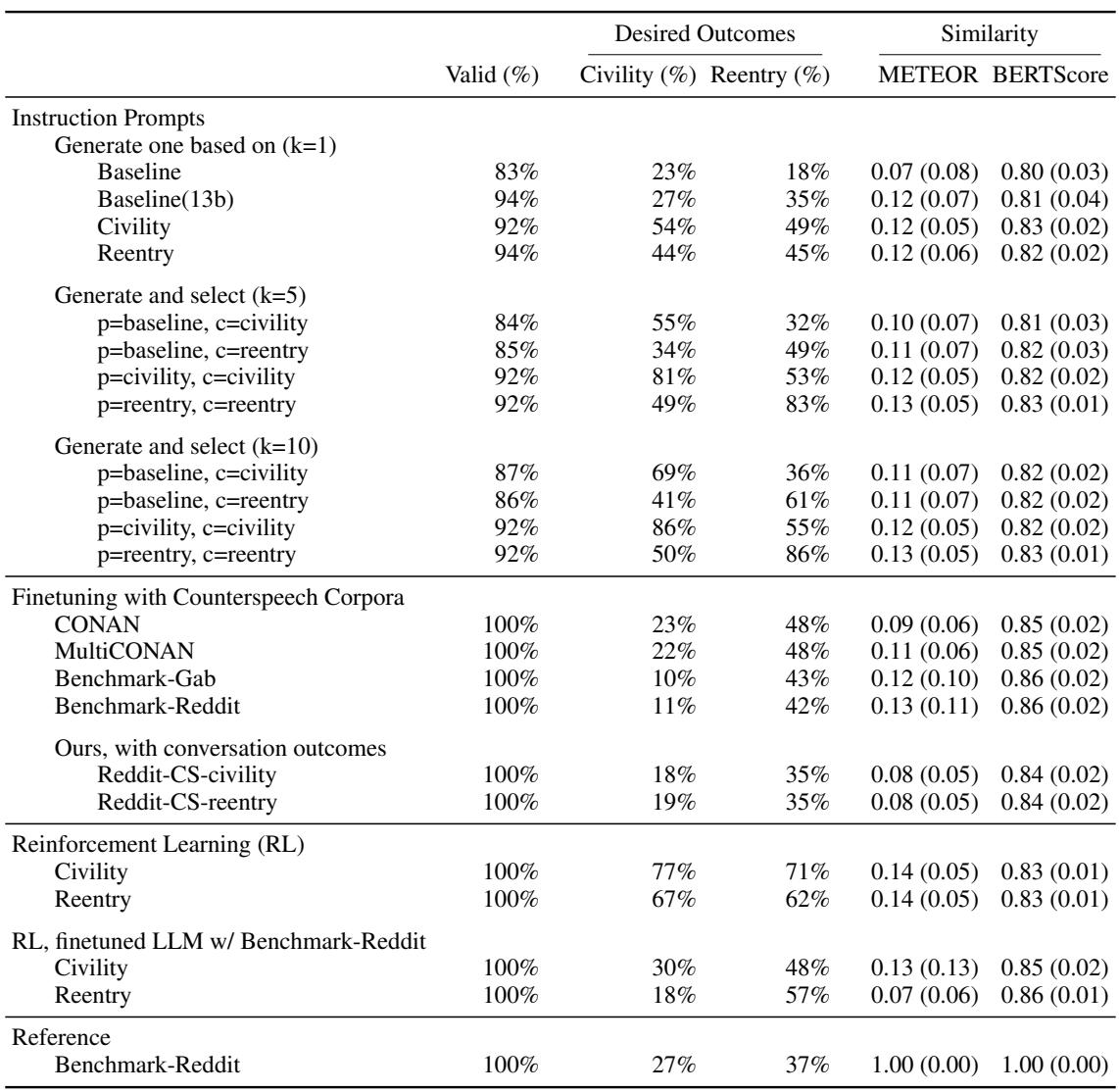
- RL is the King of Outcomes: The Reinforcement Learning (RL) models were significantly better at generating text predicted to result in civil conversations and constructive reentry. For example, the RL-Civility model achieved a 77% success rate in generating low-incivility replies, compared to just 23% for the baseline prompt.
- Selection Matters: The “Generate and Select” method (generating 10 candidates and picking the best) was also highly effective, sometimes rivaling the trained models.
- Finetuning Struggles: Interestingly, the finetuned models didn’t perform as well on these strict outcome metrics compared to RL.
A Note on Similarity: The table also shows BERTScore and METEOR scores. While the wording (METEOR) was quite different from the human reference text, the semantic meaning (BERTScore) remained high (~0.83). This means the AI is saying different things than the human reference, but staying on topic.
2. How was the text quality?
Generating effective text is useless if the grammar is broken or the style is robotic. The researchers used GRUEN metrics to assess quality.
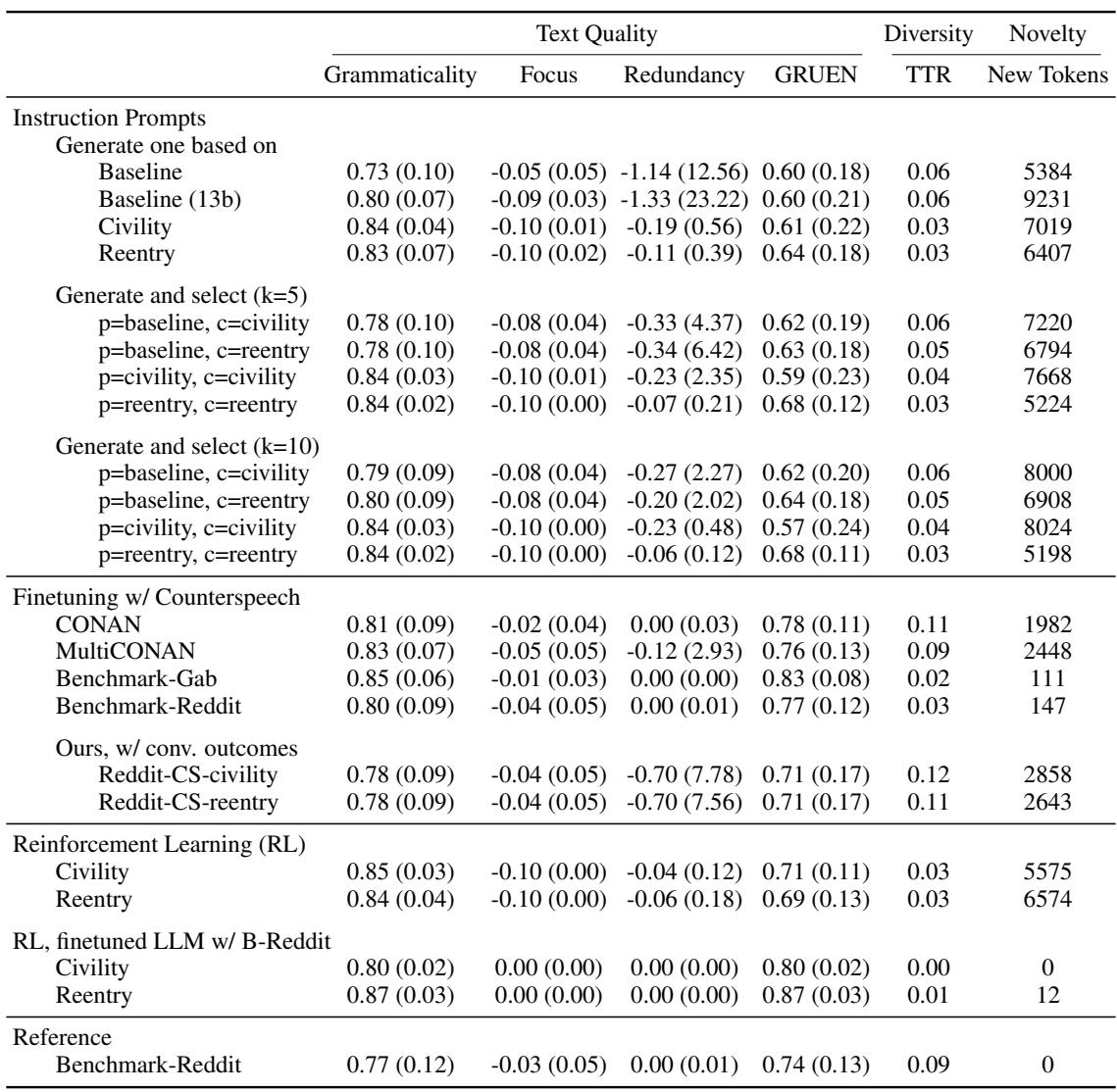
As shown in Table 3:
- Instruction Prompts Quality: The prompting method produced text with lower quality scores. It tended to be redundant and lacked focus.
- Diversity: The finetuned models (trained on Reddit data) had the highest lexical diversity. They learned the messy, varied slang of the internet.
- RL Quality: The RL models achieved the highest overall quality scores (GRUEN), balancing focus and grammar well.
3. Human Evaluation: The Reality Check
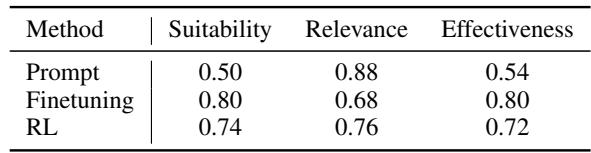
Automated metrics are great, but human judgment is the ultimate test for natural language. The researchers asked human annotators to rate the replies on three factors:
- Suitability: Does the style fit a Reddit thread?
- Relevance: Is it actually replying to the hate speech?
- Effectiveness: Do you think this would stop the hate?
Here lies the most interesting contradiction of the paper.
Look at Table 4. While the RL models dominated the automated metrics, Finetuning won the Human Evaluation for Suitability (0.80) and Effectiveness (0.80).
Why the discrepancy? The “Instruction Prompt” models often generated text that was too formal—like writing a letter or an essay rather than a Reddit comment. The RL models were effective but sometimes “gamed” the metric. The Finetuned models, having been trained on real Reddit threads, “sounded” like Redditors. They were informal, snappy, and culturally appropriate, which human evaluators recognized as being more likely to work in a real social media context.
Examples of Generated Counterspeech
To truly understand the difference between these methods, we need to look at the actual output.
Warning: The following table contains examples of hate speech from the dataset to demonstrate the model responses.
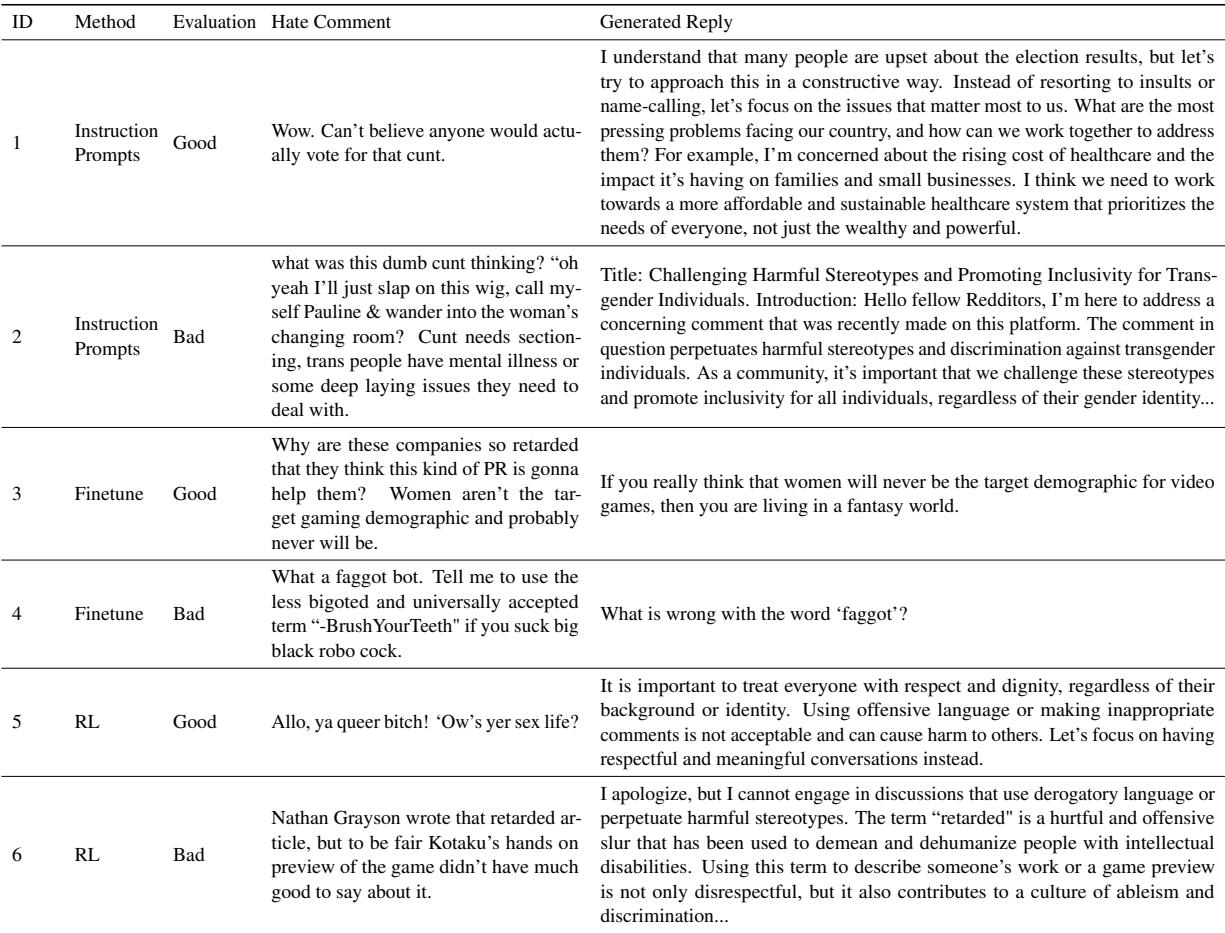
- Example 1 (Instruction Prompts): The response is “Good” in sentiment but incredibly long and preachy. It reads like a customer service bot (“I understand that many people are upset…”). On Reddit, this might get mocked.
- Example 3 (Finetune): “If you really think that women will never be the target demographic for video games, then you are living in a fantasy world.” This is sharp, direct, and sounds like a real person. It pushes back without being abusive.
- Example 6 (RL): The RL model here generates a standard refusal/apology (“I apologize, but I cannot engage…”). While this is “safe,” it shuts down the conversation rather than countering the specific point.
Conclusion and Implications
This research marks a pivotal step in automated content moderation. It moves us away from simply asking “Is this reply polite?” to “Will this reply actually help?”
Here are the key takeaways for students and practitioners:
- Optimization Targets Matter: If you optimize for “safety” (like standard RLHF in ChatGPT), you often get refusals. If you optimize for “incivility reduction” (like the RL method here), you get de-escalation.
- The “Alignment” Gap: There is still a disconnect between what an algorithm thinks is “effective” (RL scores) and what humans think is “suitable” (Finetuning). The RL models found a mathematical maximum, but the Finetuned models found a cultural fit.
- Reinforcement Learning is Powerful: Using conversation outcomes as a reward function is a highly effective way to steer LLMs, more so than simple prompting.
Future Directions: The authors note that their outcome classifiers aren’t perfect. Future work needs better ways to predict conversation trajectories. Additionally, combining the “street smarts” of the finetuned models with the “goal-oriented” nature of the RL models could produce the ultimate counterspeech bot—one that sounds like a peer but de-escalates like a professional mediator.
For now, this paper proves that we can, and should, hold our AI models accountable for the consequences of their words, not just their syntax.