](https://deep-paper.org/en/paper/2404.02575/images/cover.png)
Introduction
Large Language Models (LLMs) like GPT-4 and Claude are incredibly proficient at generating human-like text, writing poetry, and even explaining complex historical events. However, there is a specific domain where these models often stumble: algorithmic reasoning.
Algorithmic reasoning isn’t just about answering a question; it’s about adhering to a strict set of rules, decomposing a complex problem into a sequence of steps, and maintaining the state of variables throughout the process. A classic example is a logic puzzle involving multiple people lying or telling the truth (a “Web of Lies”), or navigating a grid based on a sequence of turns and steps.
When an LLM attempts these tasks using standard natural language, it often “hallucinates” the logic. It might get the first two steps right but lose track of who is lying and who is telling the truth by step three.
To combat this, researchers have developed various prompting strategies. Two of the most famous are Chain-of-Thought (CoT), where the model explains its reasoning in natural language, and Program-of-Thought (PoT), where the model writes Python code to solve the problem.
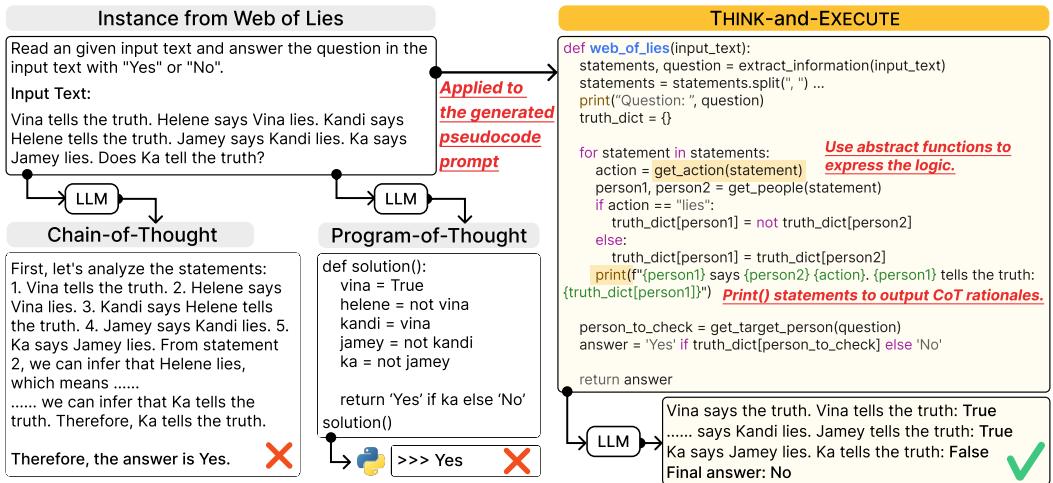
As shown in Figure 1 above, both approaches have limitations. CoT (left) can easily suffer from semantic ambiguity—the model might make a leap in logic that sounds plausible but is mathematically incorrect. PoT (right) is more rigorous because it uses code, but it requires the model to write perfect, executable syntax in a single shot. Furthermore, the code generated is usually specific to just that one question (instance-specific), meaning the model has to reinvent the wheel for every new input.
But what if there was a middle ground? What if we could combine the flexibility of natural language with the strict logic of programming?
This is the premise behind a fascinating paper titled “Language Models as Compilers: Simulating Pseudocode Execution Improves Algorithmic Reasoning in Language Models.” The researchers introduce a framework called THINK-AND-EXECUTE, where an LLM first discovers the general logic of a task (THINK) and writes it as pseudocode, and then simulates the execution of that code (EXECUTE) to derive the answer.
In this post, we will tear down this paper to understand how treating an LLM as a pseudocode compiler can significantly boost its reasoning capabilities.
Background: The Struggle for Logic
To appreciate the innovation of THINK-AND-EXECUTE, we first need to understand the current landscape of reasoning techniques.
Chain-of-Thought (CoT)
The standard way to improve reasoning is to ask the model to “think step-by-step.” This is Chain-of-Thought. It encourages the model to generate intermediate reasoning steps before giving the final answer. While effective, it relies on the model’s ability to maintain logical consistency in natural language. Natural language is messy; it allows for ambiguity and doesn’t enforce strict state tracking (like remembering that x is currently 5).
Program-of-Thought (PoT)
Recognizing that programming languages are strict and unambiguous, researchers developed Program-of-Thought. Here, the LLM translates the word problem into a Python script. An external computer (a Python interpreter) then runs the code to get the answer.
This works well for math problems, but it has two downsides:
- Complexity: Writing a bug-free script for a complex logic puzzle in one go is hard.
- Dependency: It often requires an external tool to run the code.
- One-off Logic: The model typically writes a script for that specific question. If you give it a similar question, it starts from scratch.
The researchers behind THINK-AND-EXECUTE hypothesized that pseudocode—logic written in a code-like structure but without the strict syntax requirements of a real programming language—might be the key. Pseudocode allows the model to structure its thinking (loops, conditionals, variable assignments) while retaining the expressiveness of natural language.
The Core Method: THINK-AND-EXECUTE
The framework proposed in this paper decomposes the reasoning process into two distinct phases: THINK and EXECUTE. This separation is crucial. It separates the planning of the logic from the application of that logic.
Let’s break down the architecture using the diagram below.
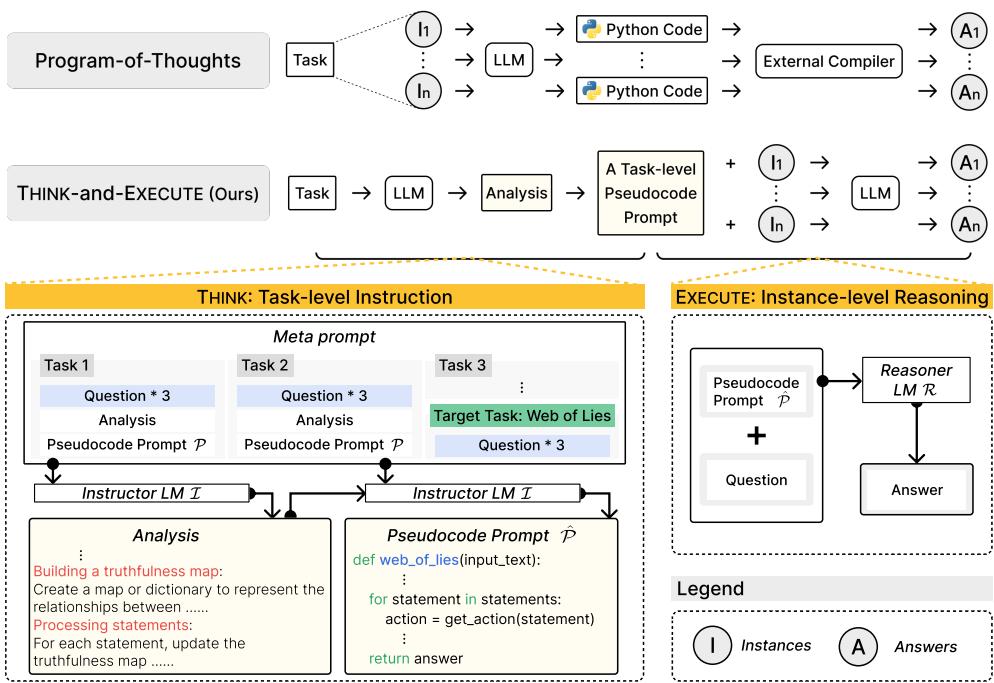
Phase 1: THINK (The Instructor)
In the top half of Figure 2, we see the THINK phase. This process is handled by a model acting as an “Instructor.”
The goal here isn’t to solve a specific question yet. The goal is to figure out the algorithm that solves the entire type of task.
- Meta-Prompting: The system provides the model with a “Meta Prompt.” This prompt contains examples of other tasks (Task 1, Task 2) showing how to analyze a problem and write pseudocode for it.
- Task Analysis: The Instructor LM looks at a few examples of the target task (e.g., “Web of Lies”) and generates a natural language Analysis. It figures out what is needed to solve the problem (e.g., “We need to track who says what, and check consistency”).
- Pseudocode Generation: Based on the analysis, the Instructor generates a Pseudocode Prompt.
Why is this brilliant?
The generated pseudocode is task-level, not instance-level. It defines a function (e.g., def web_of_lies(input):) that contains the general logic to solve any Web of Lies problem. It includes loops to process statements and conditional checks to verify truthfulness.
Phase 2: EXECUTE (The Reasoner)
In the bottom half of Figure 2, we enter the EXECUTE phase. Here, a “Reasoner” LM takes over.
- Input Construction: We take the specific question we want to answer (Instance \(I_k\)) and combine it with the Pseudocode Prompt generated in Phase 1.
- Simulation: This is the most unique part. We do not run this code on a computer. We ask the Reasoner LM to simulate the execution of the code.
The prompt effectively says: “Here is the code and the input. act as a compiler. Execute the code line-by-line and tell me the output.”
The model generates the output of print() statements inside the pseudocode. These print statements act as the “Chain of Thought.” They output the state of variables, the results of loop iterations, and intermediate decisions.
By forcing the model to “run” the code, the authors force it to:
- Adhere to the logic defined in the THINK phase.
- Explicitly track the state of variables (e.g.,
truth_dict). - Follow control flows (if/else) strictly.
Why Pseudocode?
You might wonder, why not just ask the model to write a plan in English? Or why not just use Python?
The authors argue that pseudocode is the “Goldilocks” medium for LLM reasoning:
- Structure: It uses loops (
for,while) and conditionals (if,else) which map perfectly to algorithmic tasks. - Abstraction: It allows the use of helper functions that don’t need to be implemented (e.g.,
get_person_from_text()), relying on the LLM’s natural language understanding to “execute” that abstract function during simulation. - Readability: It is more concise than a verbose natural language plan.
The simulation aspect turns the LLM into a state machine, step-by-step updating its internal representation of the problem, which significantly reduces logic errors.
Experiments and Results
To validate this approach, the researchers tested THINK-AND-EXECUTE on seven distinct tasks from the Big-Bench Hard (BBH) dataset. These tasks are specifically designed to be difficult for standard language models and include:
- Navigate: Following directional instructions.
- Web of Lies: Logic puzzles about truthfulness.
- Geometric Shapes: determining shapes from SVG paths.
- Tracking Shuffled Objects: Determining final positions of swapped items.
Let’s look at the main results.
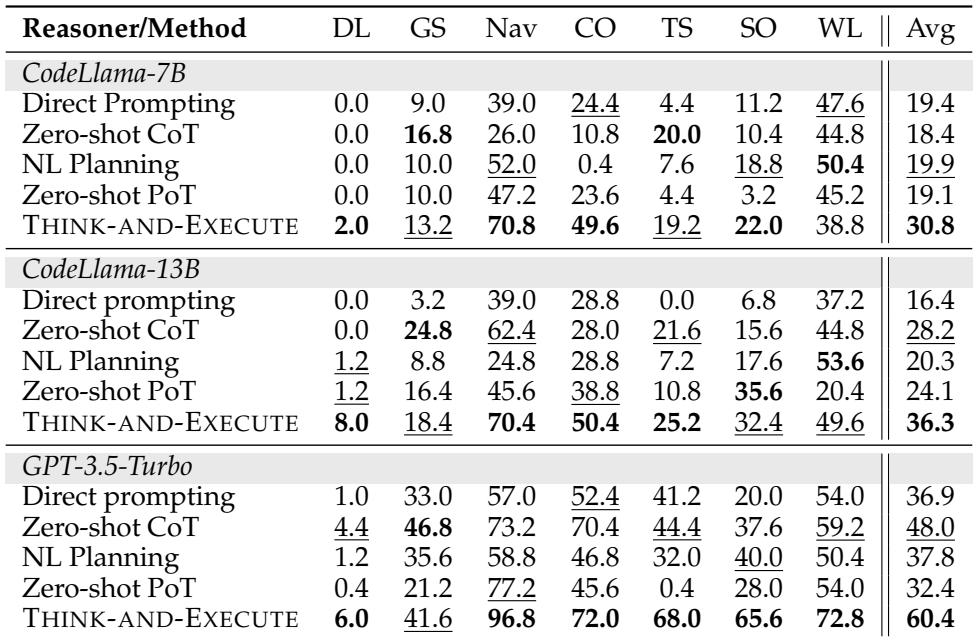
Table 1 (above) reveals several key insights:
- Dominance over Baselines: With GPT-3.5-Turbo, THINK-AND-EXECUTE (bottom row) achieves an average accuracy of 60.4%. This significantly outperforms Direct Prompting (36.9%), Zero-shot CoT (48.0%), and Zero-shot PoT (32.4%).
- Consistency: In tasks like Navigate (Nav), the method achieves 96.8% accuracy, whereas standard CoT only reaches 73.2%. This suggests that for tasks requiring strict step-by-step tracking, pseudocode simulation is vastly superior.
- Cross-Model Success: The method works not just on GPT-3.5, but also improves the performance of open-source models like CodeLlama-13B.
A Concrete Example: Web of Lies
To understand why the baseline fails and THINK-AND-EXECUTE succeeds, let’s look at a qualitative comparison on the “Web of Lies” task.

In Table 13 above, we see a complex web of statements.
- Direct Prompting guesses “Yes” (Wrong).
- Zero-shot CoT attempts to analyze the statements but gets confused in the logic chain (“From statement 2, we can infer…”). It concludes “Yes” (Wrong).
- THINK-AND-EXECUTE (Ours) executes the logic systematically. It creates a boolean map. It evaluates: “Vina tells truth: True” -> “Helene says Vina lies” -> “Helene is False”. It follows the chain flawlessly to conclude “No” (Correct).
Analysis: What Makes It Tick?
The paper goes beyond just showing high scores; it investigates why the method works.
1. The Importance of Pseudocode Components
Is it the code structure that helps, or just the fact that it’s a plan? The researchers performed an ablation study (removing parts of the method to see what happens).
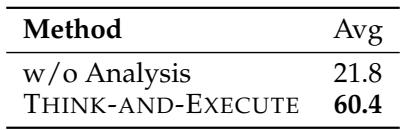
Figure 3 (in the image above) shows that:
- w/o intermediate print(): If you remove the
print()statements inside the pseudocode, performance drops significantly (Blue bars vs Green bars). This confirms that the “trace” of the execution is necessary for the model to keep track of state. - w/o comments & semantics: If you replace meaningful variable names (like
person_name) with generic ones (var_a) and remove comments, performance also drops. The semantic meaning helps the LLM “compile” the abstract parts of the code.
2. Can Small Models Do It?
One of the most promising findings is related to model size and pre-training.
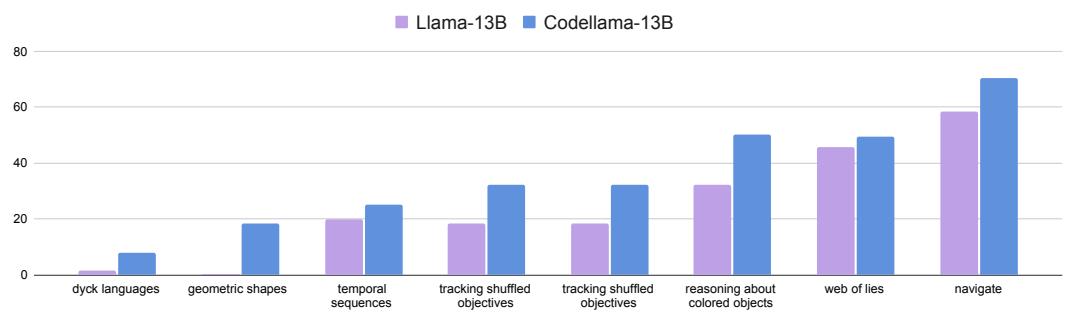
Figure 4 compares Llama-2 (purple) against CodeLlama (blue). Both are 13B parameter models. The difference is that CodeLlama was pre-trained on code. The results are clear: CodeLlama consistently outperforms the standard Llama model. This suggests that pre-training on code corpora gives the model the specific “neural circuitry” required to simulate execution and follow logical instructions.
3. Comparison with Advanced Baselines
Finally, the authors compared their method against other state-of-the-art reasoning techniques like “Chain-of-Code” and “Plan-and-Solve.”
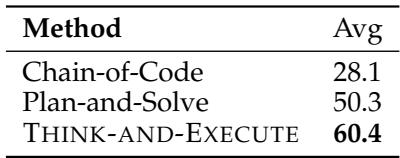
As shown in Table 3, THINK-AND-EXECUTE beats Chain-of-Code (which uses code for instances but not task-level logic) by a massive margin (60.4% vs 28.1%). It also edges out Plan-and-Solve. This reinforces the idea that task-level planning combined with pseudocode simulation is a winning combination.
Conclusion and Implications
The “THINK-AND-EXECUTE” framework represents a significant step forward in making Large Language Models reliable reasoners. By treating the model as a compiler that simulates pseudocode, we force it to adopt a structured, algorithmic mode of thinking that natural language alone cannot provide.
Here are the key takeaways for students and practitioners:
- Decomposition is Key: Separating the “THINKing” (planning the logic) from the “EXECUTing” (applying the logic) reduces the cognitive load on the model during inference.
- Pseudocode is a Bridge: Pseudocode serves as a perfect bridge between human-like flexibility and machine-like strictness. It allows LLMs to “hallucinate” less by adhering to a predefined logical structure.
- Simulated Execution: You don’t always need an external Python interpreter. If the model is strong enough (and pre-trained on code), it can simulate the computer’s execution, providing a chain of thought that tracks variables and states accurately.
As we look toward the future of AI agents, techniques like this suggest that the path to better reasoning might not just be bigger models, but better ways of structuring the model’s internal monologue—teaching it to think not just like a writer, but like a programmer.