](https://deep-paper.org/en/paper/2404.03632/images/cover.png)
Imagine you are editing a photo of a person. You want to give them the specific hairstyle from a celebrity photo you found online. In 2D image editing (like Photoshop or standard generative AI), this is becoming increasingly easy. But what if that person isn’t just a flat image? What if you are building a video game avatar, a VR experience, or a movie scene where the character needs to turn their head?
Standard 2D editing fails here. If you paste a “2D” haircut onto a face, the illusion breaks the moment the camera moves. The haircut doesn’t rotate with the head; it looks like a flat sticker.
This brings us to the holy grail of modern computer vision: 3D-aware image editing. Specifically, we want to perform reference-based editing—taking a specific attribute (like hair, glasses, or a nose) from a reference image and transferring it to a source image, all while maintaining a consistent 3D geometry.
In this post, we are doing a deep dive into the paper “Reference-Based 3D-Aware Image Editing with Triplanes.” The researchers propose a novel framework that solves the complex problem of stitching 3D features together seamlessly.
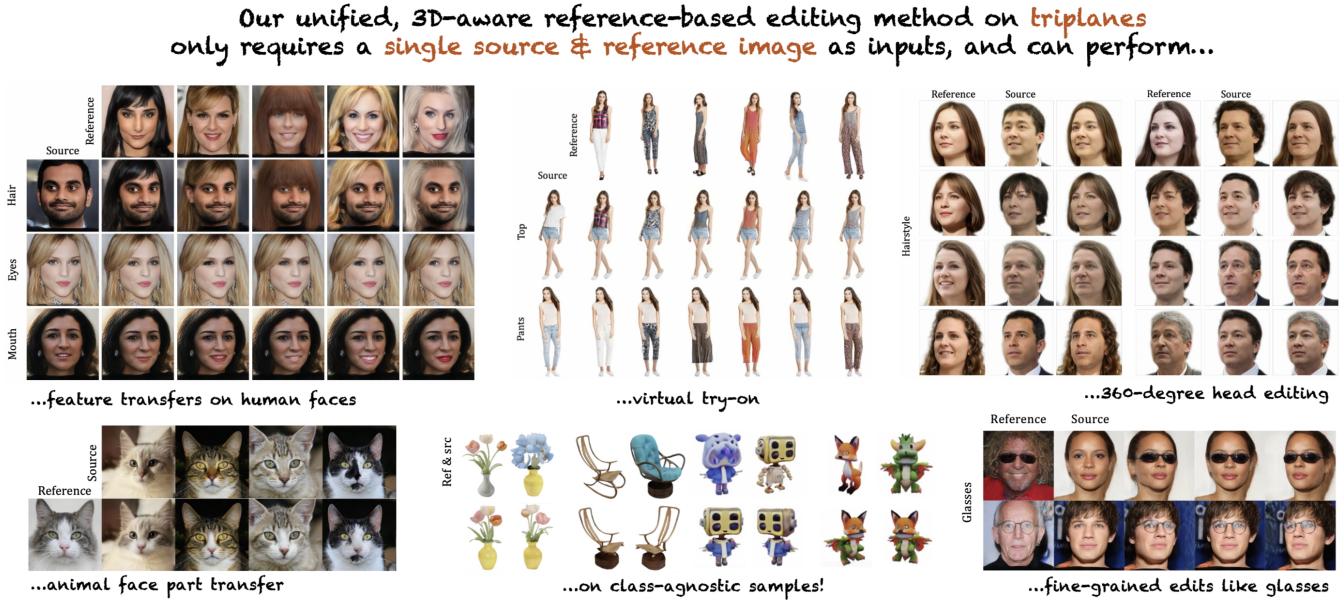
As shown in Figure 1 above, this method allows for precise control. Whether it’s transferring a mouth from one cat to another, changing a person’s outfit, or swapping hairstyles, the result isn’t just a static image—it’s a 3D representation that can be rendered from multiple viewpoints.
Let’s explore how they achieved this.
The Core Problem: 2D vs. 3D Editing
To understand why this paper is significant, we first need to understand the limitations of previous methods.
- 3D-Aware GANs (like EG3D): These models are excellent at generating 3D consistent images. However, they usually lack precise editing control. You can change global latents (make the person “older” or “happier”), but you can’t easily say, “Copy this specific pair of glasses from Image B and put them on Image A.”
- 2D Reference-Based Editing: Methods like “Paint by Example” or various Diffusion-based editors are great at copy-pasting visual styles. But they have no concept of geometry. If you rotate the camera, the edit falls apart.
The researchers highlight this gap in Figure 2.
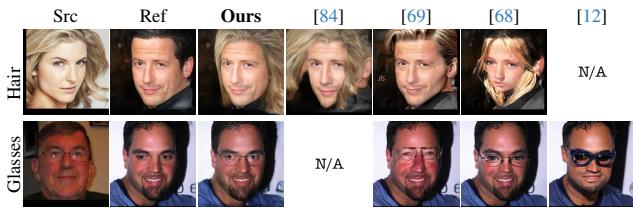
Notice the “N/A” markers and the visual artifacts in competing methods. Some can edit but lose the reference identity; others keep the identity but destroy the 3D structure. The goal of this paper is to bridge this gap using Triplanes.
Background: What is a Triplane?
Before we get into the editing pipeline, we need a quick primer on the underlying technology: EG3D (Efficient Geometry-aware 3D GANs).
Traditional 3D representations like voxels are computationally expensive. EG3D introduced the concept of Triplanes. Instead of a heavy 3D block of data, the 3D volume is represented by three orthogonal 2D feature planes (xy, xz, yz).
To render a pixel:
- You shoot a ray into the 3D space.
- You sample points along that ray.
- You project those points onto the three planes to grab feature vectors.
- You sum these vectors and pass them through a lightweight neural network (decoder) to get color and density.
The beauty of triplanes is that they are essentially images. This means we can theoretically use 2D editing techniques (like cutting and pasting) on these 3D representations. However, simply cutting a square out of a triplane doesn’t work because triplanes are abstract feature maps, not literal photographs.
The Method: A Pipeline for 3D Surgery
The researchers propose a pipeline that involves three sophisticated stages: Localization, Implicit Fusion, and Fine-Tuning.
1. Localization: Finding the Features
The first challenge is knowing where the “nose” or “hair” is located inside the abstract triplane tensor. We have off-the-shelf 2D segmentation networks that can find a nose in a flat image, but we need that mask in the 3D triplane space.
The authors use a clever trick involving gradient backpropagation.
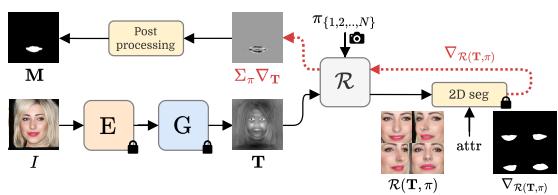
Here is the process illustrated in Figure 3:
- Take the source image and encode it into a Triplane representation (\(\mathbf{T}\)).
- Render the triplane from multiple random camera poses (\(\pi\)) to create 2D images.
- Use a standard 2D segmentation network (\(S_{2D}\)) to identify the target attribute (e.g., “hair”) in these 2D renders.
- The Trick: Treat the segmentation output as a loss signal and backpropagate the gradients through the differentiable renderer back to the triplane.
- Accumulate these gradients. High gradient areas in the triplane correspond to the parts of the 3D volume responsible for the “hair.”
This gives them a rough “Triplane Mask” (\(\mathbf{M}\)). They then clean up this mask using thresholding and morphological operations to get a crisp binary mask.
2. The Naive Approach (And Why It Fails)
Once we have masks for the Reference (\(\mathbf{M}_{ref}\)) and Source (\(\mathbf{M}_{src}\)), the most obvious step is to just mix them linearly.

In this equation, \(\mathbf{T}_{tmp}\) is the temporary triplane created by masking the reference triplane and the source triplane and adding them together.
The problem? Triplanes are sensitive. As seen in the “Before” section of Figure 4 below, this naive stitching results in:
- Seams: Visible lines where the mask cuts off.
- Color Inconsistency: Skin tones between the reference and source might not match.
- Geometric Distortion: The shapes might not align perfectly in 3D space.
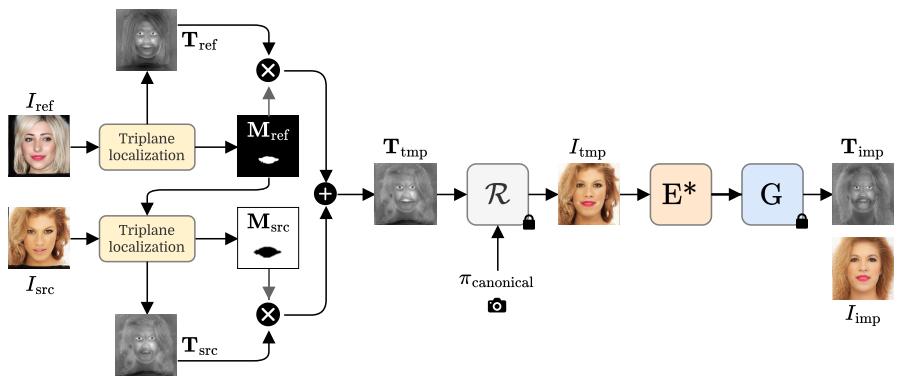
Look at the zoomed-in box labeled \(I_{tmp}\) in Figure 4. You can clearly see the sharp, unnatural cut where the new face part was pasted.
3. Implicit Fusion: Smoothing the Seams
To fix the ugly seams, the researchers introduce Implicit Fusion. They take the naively stitched (and slightly broken) triplane, render it, and then project it back into the generator’s latent space.

Here is what this equation does:
- Render: Render the stitched triplane (\(\mathbf{T}_{tmp}\)) into an image.
- Encode (\(\mathbf{E}\)): Pass this image through an encoder to get a latent code (\(W^+\)).
- Generate (\(\mathbf{G}\)): Use the generator to create a new triplane (\(\mathbf{T}_{imp}\)) from that latent code.
Why does this work? The generator (\(\mathbf{G}\)) has been trained on millions of real faces. It knows what a “natural” face looks like. It essentially refuses to generate ugly seams or mismatched skin tones. By forcing the stitched image through the encoder-generator loop, the model “hallucinates” a smooth, coherent connection between the pasted part and the original face.
However, we can’t just use this new triplane \(\mathbf{T}_{imp}\) for the whole image. The encoding/decoding process is “lossy”—it smooths things out too much, losing the sharp details of the reference glasses or the source eyes.
The solution is a Three-Way Blend:
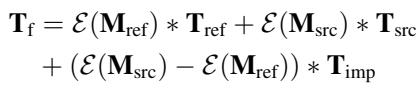
This final composition equation (\(\mathbf{T}_f\)) is smart:
- Reference (\(\mathbf{T}_{ref}\)): Used for the core of the pasted object (eroded mask).
- Source (\(\mathbf{T}_{src}\)): Used for the non-edited background/face.
- Implicit (\(\mathbf{T}_{imp}\)): Used specifically in the transition region—the border between the source and reference.
This gives us the best of both worlds: the sharp details of the reference, the identity of the source, and a smooth, seam-free boundary.
4. Fine-Tuning the Encoder
There is one final hurdle. The standard encoders provided with EG3D are general-purpose. When performing this specific type of stitching, the encoder might accidentally change the background or slightly shift the skin color of the unedited regions.
To solve this, the authors fine-tune the encoder specifically for the editing task.
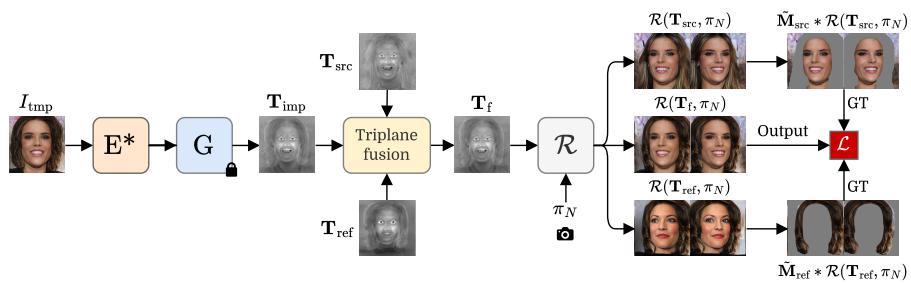
They train the encoder using a loss function that enforces two things:
- Identity Preservation: The unedited parts of the face must match the Source.
- Reference Fidelity: The edited part must match the Reference.

As shown in Equation 5 (above), they use masked losses. They look at the edited region and ensure it matches the reference, and look at the rest of the image to ensure it matches the source. This fine-tuning step (V3 in their ablation study) significantly improves color consistency and background stability.
Experimental Results
The theory is sound, but how does it look in practice? The results are impressive, particularly when compared to existing state-of-the-art methods.
Qualitative Comparison
Let’s look at a “Battle of the Editors” in Figure 6. The goal is to add glasses or change hair.
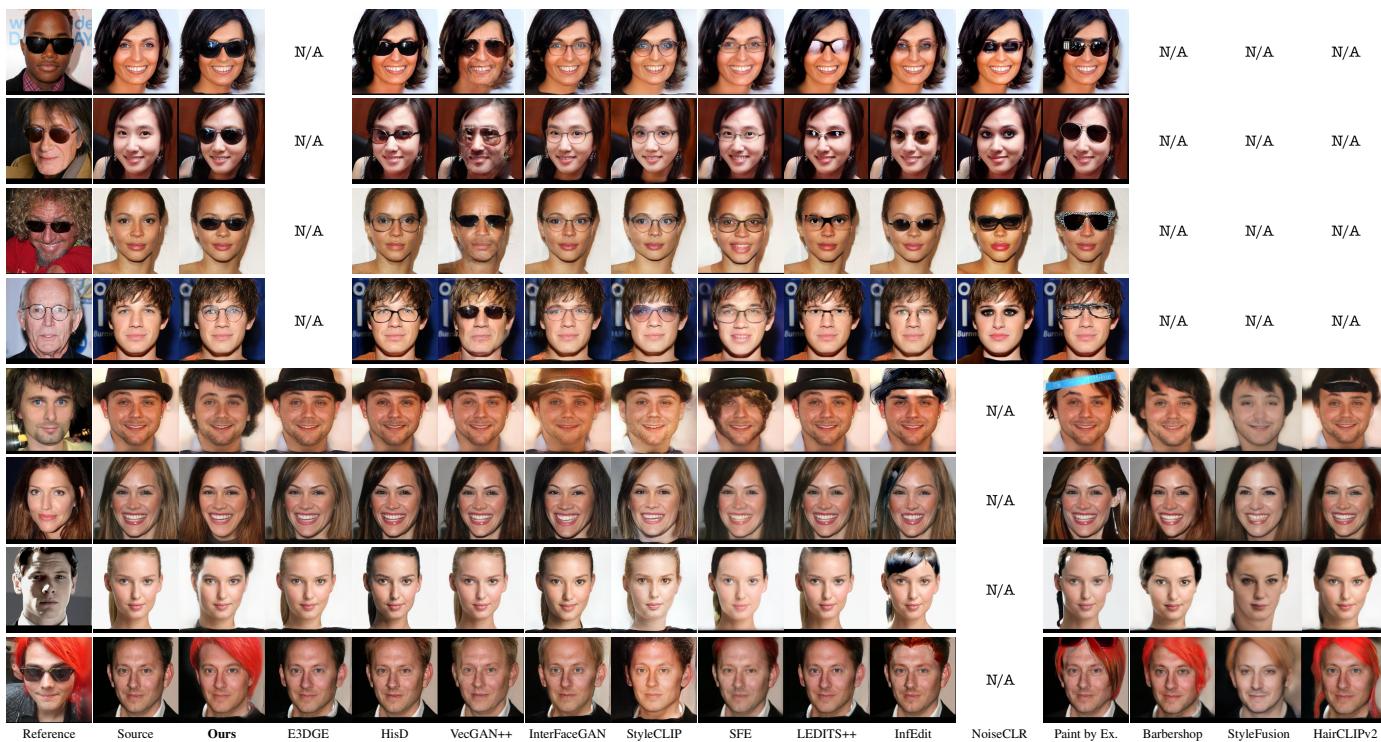
- Row 1 (Glasses): Notice how methods like “Paint by Example” often distort the face or fail to align the glasses. “Ours” places the glasses perfectly on the bridge of the nose.
- Row 8 (Red Hair): Changing hair color and style is notoriously difficult. Other methods either create a helmet-like blurry texture or fail to cover the original hair. The proposed method integrates the red hair naturally with the source face.
Quantitative Success
The researchers backed up these visuals with numbers. They used FID (Fréchet Inception Distance) to measure how “real” the images look, and SSIM (Structural Similarity Index) to measure how well the unedited parts were preserved.
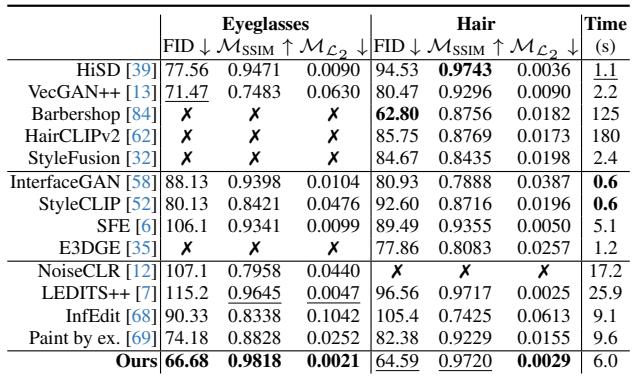
In Table 1, “Ours” achieves the lowest (best) FID scores for both eyeglasses and hair edits (66.68 and 64.59 respectively). It also maintains the highest SSIM, meaning it doesn’t accidentally change the person’s nose when you only wanted to change their hair.
The Importance of Each Step (Ablation)
To prove that every part of their complex pipeline is necessary, the authors performed an ablation study.
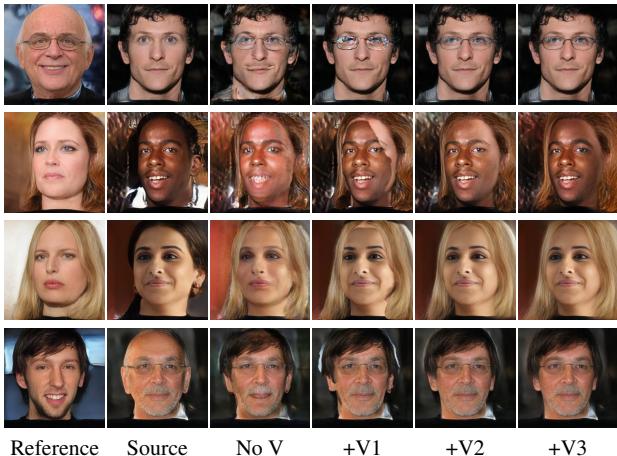
- V1 (Naive): You can see rough edges and color mismatches.
- V2 (Implicit Fusion): The seams disappear, but maybe the skin tone is slightly off or the background shifts.
- V3 (Fine-Tuned): The final result. Sharp details, correct colors, seamless blend.
Beyond Faces
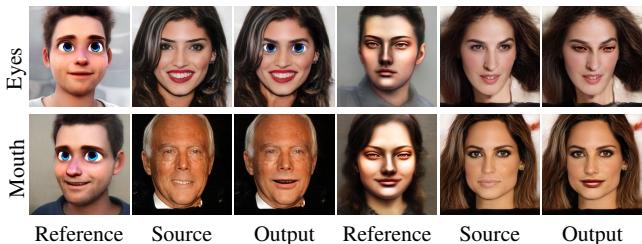
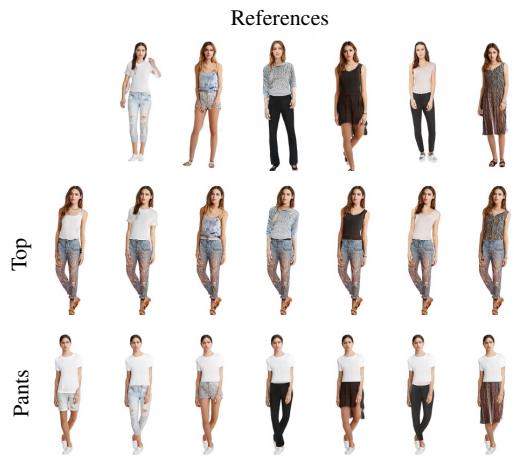
One of the strongest aspects of this method is that it is not limited to human faces. Because it operates on the concept of triplanes (which can represent any 3D volume), it works on:
Stylized/Cartoon Characters:
Fashion and Virtual Try-On:
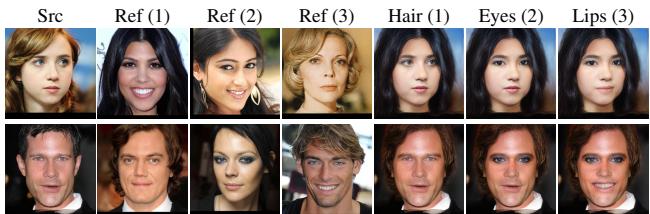
Simultaneous Edits: You can even perform multiple edits at once—changing hair, eyes, and lips simultaneously by combining masks.
Conclusion
The paper “Reference-Based 3D-Aware Image Editing with Triplanes” represents a significant step forward in generative media. It successfully marries the flexibility of reference-based editing (the “Copy-Paste” of the AI world) with the geometric consistency of 3D GANs.
Key Takeaways for Students:
- Triplanes are powerful: They allow us to apply 2D intuition (masking, blending) to 3D problems.
- Gradients as locators: Using backpropagation to find “where” features are in a latent space is a versatile technique used in many areas of deep learning (like DeepDream or Attention maps).
- The Manifold Hypothesis: The “Implicit Fusion” step relies on the idea that the generator’s latent space represents the manifold of “realistic” images. Projecting messy data onto this manifold cleans it up.
Future Directions: The authors note that while this method is great, it relies on the quality of the underlying generator (EG3D, etc.). If the generator is bad at backgrounds, the edit will have bad backgrounds. Future work involves extending this to Large Reconstruction Models (LRMs) and diffusion-based 3D generators, potentially allowing for even higher fidelity edits on full scenes, not just centered objects.
For now, though, the ability to steal a haircut from a photo and slap it onto a rotatable 3D avatar is a reality!