](https://deep-paper.org/en/paper/2404.04904/images/cover.png)
Introduction
Imagine receiving a voice message from a family member asking for help, or hearing a politician declare war on a social media clip. The voice sounds unmistakably authentic—the cadence, the timbre, the breath. But it’s all fake.
We are living in the age of Zero-Shot Text-to-Speech (TTS). Unlike older technologies that required hours of recorded speech to clone a voice, modern models like VALL-E or OpenVoice can clone a specific person’s voice with a single utterance—sometimes as short as three seconds. While this technology has incredible creative potential, it poses severe risks to privacy, security, and social trust.
To combat this, we rely on Audio Deepfake Detection (ADD) models. However, there is a significant problem: the current defense systems are training on outdated data. They are like antivirus software from 2010 trying to catch a virus from 2025. They fail to generalize to the sophisticated, unseen architectures of modern TTS models.
In this post, we are deep-diving into the paper “Cross-Domain Audio Deepfake Detection: Dataset and Analysis,” where researchers from Huawei present a robust solution. They introduce a massive new dataset (CD-ADD), analyze the threats posed by modern neural audio codecs, and propose training strategies that significantly improve our ability to spot these digital impostors.
Background: The Shift to Zero-Shot Synthesis
Before we look at the solution, we must understand the problem. Traditional TTS systems were rigid. To create a synthetic voice for “Alice,” you needed to train a model specifically on Alice’s voice data.
The game changed with Zero-Shot TTS. These models are designed to be generic. They accept two inputs:
- Text: What you want the voice to say.
- Audio Prompt: A short recording of the target speaker.
The model extracts the “speaker identity” (style, tone, accent) from the prompt and applies it to the text. This capability creates a massive challenge for detection systems. Previous datasets (like ASVspoof) are built on older, distinct algorithms. Detection models trained on them often learn to spot specific artifacts of those old algorithms. When faced with a new Zero-Shot model they haven’t seen before, they fail catastrophically.
Furthermore, deepfakes in the wild are rarely clean. They are compressed via WhatsApp, uploaded to YouTube, or subjected to background noise. This paper addresses both the model diversity and the environmental robustness gaps in current research.
Core Method: Constructing the CD-ADD Dataset
The researchers’ primary contribution is the Cross-Domain Audio Deepfake Detection (CD-ADD) dataset. This isn’t just a collection of audio files; it is a carefully engineered benchmark designed to simulate the toughest real-world scenarios.
1. The Generators: Modern TTS Architectures
To ensure diversity, the dataset includes over 300 hours of speech generated by five cutting-edge Zero-Shot TTS models. Understanding how these models work is key to understanding the artifacts they leave behind.
As shown in the figure below, the researchers categorize these models into two main architectures:
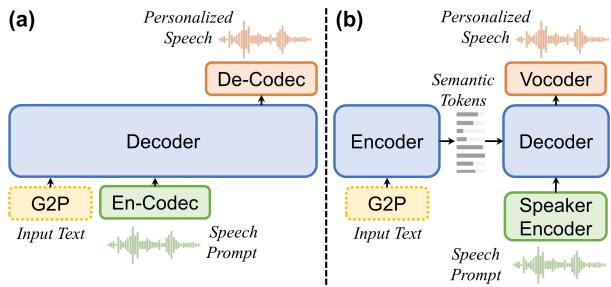
- Decoder-Only (Figure 1a): Models like VALL-E function similarly to Large Language Models (LLMs) like GPT-4. They treat audio as a sequence of discrete codes. They take phonemes and acoustic tokens from a prompt and autoregressively predict the next audio token. This is powerful but can be unstable.
- Encoder-Decoder (Figure 1b): Models like YourTTS, WhisperSpeech, Seamless Expressive, and OpenVoice use this structure. An encoder extracts content (text) and speaker style separately. A decoder then fuses them to generate the spectrogram (visual representation of audio), which a Vocoder turns into sound.
By including both architectures, the dataset forces detection models to learn generalized features rather than over-fitting to one specific type of generation logic.
2. Quality Control via ASR
One of the nuances of generating massive datasets is quality control. Zero-Shot models, particularly autoregressive ones, can “hallucinate”—they might skip words, repeat phrases, or produce gibberish if the audio prompt is noisy.
If a dataset is full of bad deepfakes (audio that sounds obviously robotic), the detection model learns nothing useful. It becomes too easy. To prevent this, the authors implemented an automated filter using Automatic Speech Recognition (ASR).
The process works like this:
- Generate a deepfake.
- Feed the deepfake into an ASR model to transcribe it back to text.
- Compare the transcription with the original text.
- If the Character Error Rate (CER) is too high (meaning the audio is unintelligible), discard it and retry with a new prompt.
This ensures that the detection models are training against high-quality, intelligible, and convincing deepfakes.
3. Simulating Real-World Attacks
In a sterile lab environment, a detection model might look at the raw frequency data of a wav file and easily spot a fake. But in the real world, audio is messy.
The authors identified a critical gap in previous datasets: they largely ignored Deep Neural Network (DNN) based processing. Today, audio is often processed by AI before we hear it—think of Zoom’s background noise suppression or the compression used by streaming services.
The researchers tested nine specific “attacks” or distortions to see if detection models could withstand them.
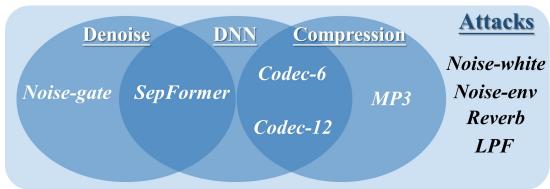
As illustrated in Figure 2, these attacks fall into three overlapping categories:
- Denoise (Noise Reduction): Using algorithms to clean up audio. This includes traditional methods (Noise-gate) and AI models (SepFormer). Paradoxically, removing noise can scrub away the subtle “fingerprints” a deepfake generator leaves behind, making detection harder.
- Compression (Codecs):
- Traditional: MP3 compression.
- Neural Codecs: This is the new frontier. Models like Encodec (used by Meta) compress audio into discrete vector codes at very low bitrates (6kbps or 12kbps). This reconstructs the audio using a neural network, essentially acting as a “resynthesizer.”
- Standard Signal Processing: Adding White Noise, Environmental Noise, Reverberation, or Low-Pass Filters (LPF).
4. The Detection Models
To test their dataset, the researchers fine-tuned two heavy-hitting foundation models:
- Wav2Vec2: A model trained by Meta to learn speech representations from raw audio.
- Whisper: OpenAI’s robust speech recognition model.
They modified these models to act as binary classifiers: input audio \(\rightarrow\) layers of analysis \(\rightarrow\) output probability of “Real” or “Fake.”
Experiments & Results
The experimental setup was rigorous. The researchers utilized the LibriTTS dataset for source audio and compared their CD-ADD dataset against the older ASVSpoof2019 standard. The performance metric used is the Equal Error Rate (EER).
- EER Definition: The point where the rate of false alarms (calling real audio fake) equals the rate of misses (calling fake audio real). Lower is better.
1. The “Cross-Model” Reality Check
The first major finding is that detection models have a massive blind spot.
When a detector is trained and tested on data from the same generator (e.g., trained on VALL-E, tested on VALL-E), it performs almost perfectly, with errors near 0%. However, the moment you test that model on a different generator (e.g., trained on VALL-E, tested on Seamless Expressive), performance collapses.
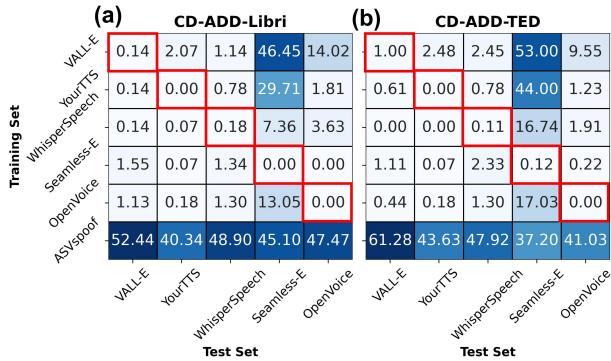
Figure 3 visualizes this failure. Look at the heatmaps:
- The diagonal line represents “In-model” testing (same train/test source). It is dark, indicating high accuracy.
- The off-diagonal cells represent “Cross-model” testing. Notice the lighter squares. For instance, in panel (b), a model trained on ASVspoof (bottom row) fails completely when trying to detect VALL-E deepfakes, resulting in high error rates.
This proves that naive cross-dataset evaluation is insufficient. Artifacts are model-specific. If we want a universal detector, we cannot rely on a single source of training data.
2. The Impact of Attacks and Augmentation
How much damage do those real-world distortions (noise, MP3, Codecs) do to detection accuracy?
The researchers compared a “Baseline” training approach against “Attack-Augmented” training (where the model sees attacked versions of audio during training).
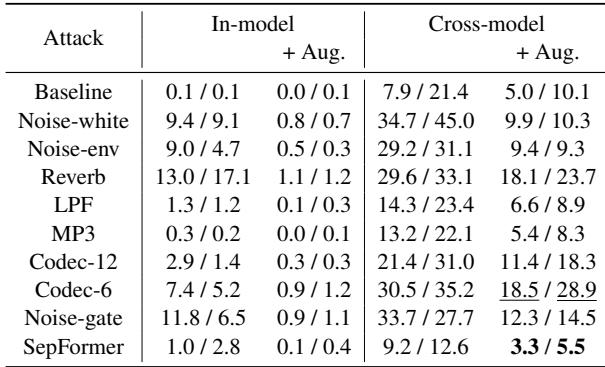
Table 2 offers several critical insights:
- Vulnerability: Without augmentation (the left numbers in the columns), attacks devastate performance. For example, in the Cross-model scenario, applying “Noise-white” jumps the error rate from 7.9% to 34.7%.
- Resilience via Training: When the model is trained with these attacks included (the “In-model + Aug.” and “Cross-model + Aug.” columns), it becomes much more robust.
- The “Friendly” Attacks: Surprisingly, some attacks like MP3 and Low-Pass Filters (LPF) actually helped the model generalize better (lowering EER on the TED set). Why? These attacks remove high-frequency information. This forces the model to stop looking at high-frequency artifacts (which might be specific to one TTS model) and look for deeper, structural anomalies in the low frequencies.
- The Neural Codec Threat: Look at the Codec-6 and Codec-12 rows. Even with augmented training, the error rates remain relatively high (up to 28.9% on the TED set). Neural codecs are essentially “re-imagining” the audio, obliterating the subtle digital traces left by the original deepfake generator. This makes neural codecs one of the biggest current threats to deepfake detection.
3. The Power of Few-Shot Adaptation
The scenario: A new deepfake app is released tomorrow. We don’t have a massive dataset for it yet. We only have one minute of audio collected from a demo video. Can we update our detectors?
The researchers tested a Few-Shot learning scenario. They took a pre-trained detection model and fine-tuned it on very small amounts of data from a new target domain (Seamless Expressive).
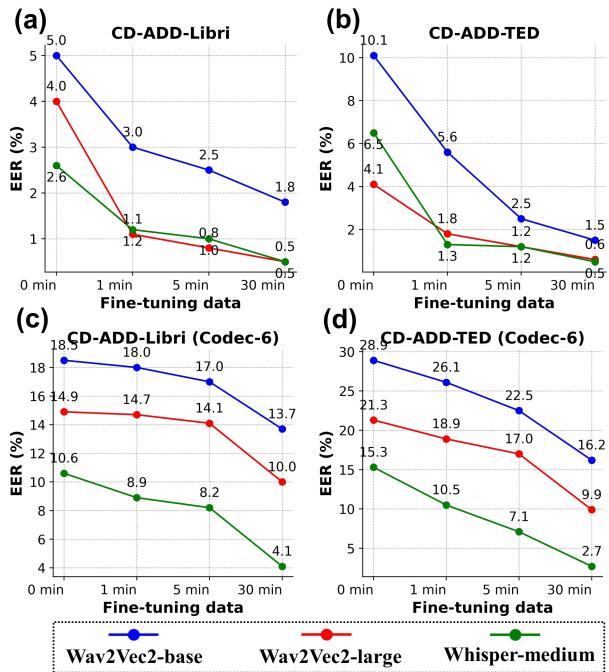
Figure 4 shows the results of fine-tuning duration (x-axis) vs. error rate (y-axis):
- Fast Adaptation: Look at the steep drop in the curves. With just one minute of target data, the error rate plummets. This is fantastic news for defenders. It implies that security systems can be patched almost instantly as new deepfake tools emerge.
- Model Comparison: The Whisper-medium model (green line) and Wav2Vec2-large (red line) consistently outperform the smaller base model. Larger foundation models provide better feature extraction.
- The Codec Barrier: Graphs (c) and (d) show the performance on compressed (Codec-6) audio. While the error rate still drops, it never reaches the near-zero levels of the uncompressed audio in (a) and (b). The neural codec remains a persistent obstacle.
Conclusion & Implications
The paper “Cross-Domain Audio Deepfake Detection” serves as both a warning and a roadmap.
The Warning: We cannot rely on old datasets. The gap between a detector trained on ASVSpoof2019 and a deepfake generated by VALL-E is too wide. Furthermore, the increasing use of neural audio codecs (like those used in modern VoIP and streaming) acts as a natural camouflage for deepfakes, scrubbing the digital fingerprints we usually look for.
The Roadmap:
- Data Diversity: We need datasets like CD-ADD that include varied architectures (Decoder-only vs. Encoder-Decoder) and rigorous quality control.
- Attack Augmentation: Training pipelines must simulate real-world distortions. We cannot assume clean input audio.
- Foundation Models: Utilizing large, pre-trained encoders like Whisper provides a significant advantage in catching anomalies.
- Agility: The success of the few-shot experiments proves that we don’t always need massive retraining. Rapid fine-tuning on small samples of new threats is a viable defense strategy.
As generative AI continues to blur the line between reality and fabrication, the “arms race” between synthesis and detection will accelerate. This research provides the ammunition—data and analysis—needed to keep the defenders one step ahead.
Note: The CD-ADD dataset mentioned in this analysis is publicly available for research purposes, encouraging the community to continue improving detection methods.