](https://deep-paper.org/en/paper/2404.06762/images/cover.png)
Imagine trying to train a new teacher. You wouldn’t want their very first interaction to be with a struggling student who needs delicate, specialized attention. You would want them to practice first. The same logic applies to Intelligent Tutoring Systems (ITS)—AI-driven educational tools designed to provide personalized instruction.
To build truly effective AI tutors, developers need to test them against a wide variety of student behaviors. But recruiting hundreds of real students for pilot studies is slow, expensive, and difficult to scale. Furthermore, testing how an AI handles a frustrated, shy, or over-eager student is challenging when relying solely on available datasets.
This brings us to a fascinating question: Can we use Large Language Models (LLMs) to simulate the students themselves?
In a recent paper titled “Personality-aware Student Simulation for Conversational Intelligent Tutoring Systems,” researchers from Nanyang Technological University and A*STAR in Singapore propose a novel framework. They don’t just ask an AI to “act like a student”; they infuse the simulation with specific cognitive abilities and personality traits. This allows them to create a diverse virtual classroom to train and evaluate AI teachers.
In this post, we will tear down their methodology, explore how they adapted psychological theories for AI, and analyze whether simulated students can actually fool—or at least trigger the right teaching strategies in—an AI tutor.
The Challenge of Personalized Education
The holy grail of education is the “one-on-one” tutoring experience. Human tutors naturally adapt their teaching style. If a student is shy, the teacher might offer more encouragement. If a student is confident but sloppy, the teacher might challenge them to be more precise.
Conversational ITSs aim to replicate this dialogic teaching. However, most current evaluations focus on “post-learning” outcomes (did the student pass the test?) rather than the conversation process itself. To truly evaluate an ITS, we need to see how it handles the nuances of human personality.
The researchers identified a gap: there was no scalable way to simulate students who possess specific, consistent personality profiles (like the “Big Five” traits) within a learning context. Their work fills this gap by proposing a Personality-aware Simulation and Validation Framework.
The Framework: Building a Synthetic Student
The core contribution of this paper is a systematic way to prompt and control LLMs to act as students with distinct profiles. As illustrated in the figure below, the system runs two parallel tracks: the simulation itself and a rigorous validation process to ensure the AI isn’t just hallucinating random behaviors.
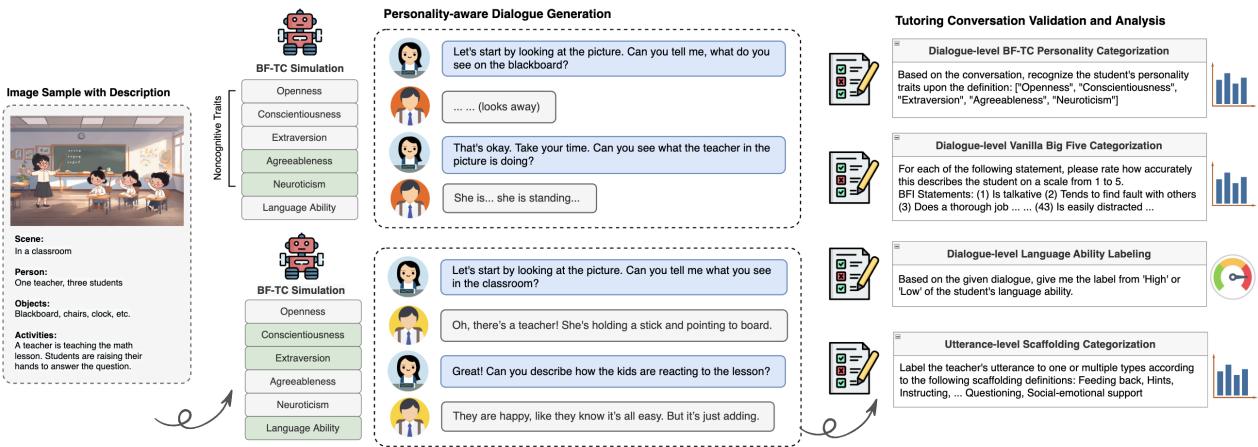
The framework is divided into two main layers of simulation: Cognitive and Non-cognitive.
1. Cognitive Simulation: Language Ability
First, the simulated student needs a skill level. The researchers anchored this in the Narrative Assessment Protocol (NAP), a tool used to assess children’s storytelling abilities.
- High Ability: The simulated student uses complete sentences, correct grammar, and rich vocabulary.
- Low Ability: The simulated student struggles with sentence structure, uses single words, or makes grammatical errors.
2. Non-cognitive Simulation: The “Big Five”
This is where the research gets particularly interesting. Psychology often relies on the Big Five personality traits (Openness, Conscientiousness, Extraversion, Agreeableness, and Neuroticism). However, the general definitions of these traits (e.g., “enjoys parties”) don’t necessarily translate to a classroom setting.
The authors refined these traits into a new scheme called Big Five for Tutoring Conversation (BF-TC). They redefined what each trait looks like when a student is talking to a teacher.
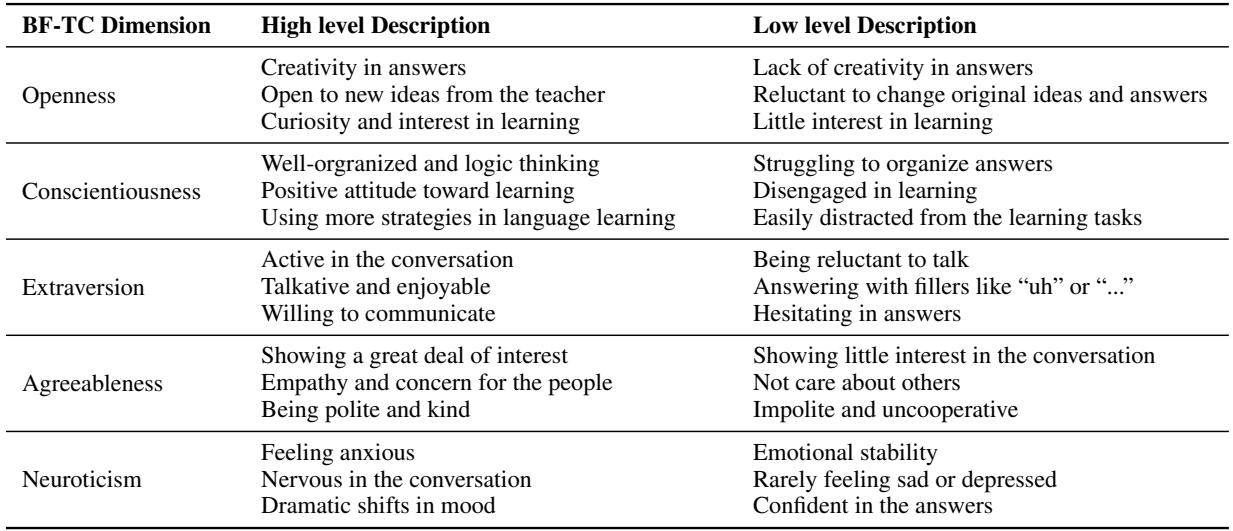
As shown in the table above, the adaptations are specific to learning:
- Openness becomes curiosity and creativity in answers.
- Conscientiousness reflects how organized and logically the student thinks.
- Extraversion dictates how talkative and willing to communicate the student is.
- Neuroticism is mapped to anxiety and confidence regarding their answers.
Seeing the Difference
Does changing these parameters actually change the conversation? Yes. The researchers provide a vivid comparison of two different simulated personalities interacting with a tutor during an image description task.
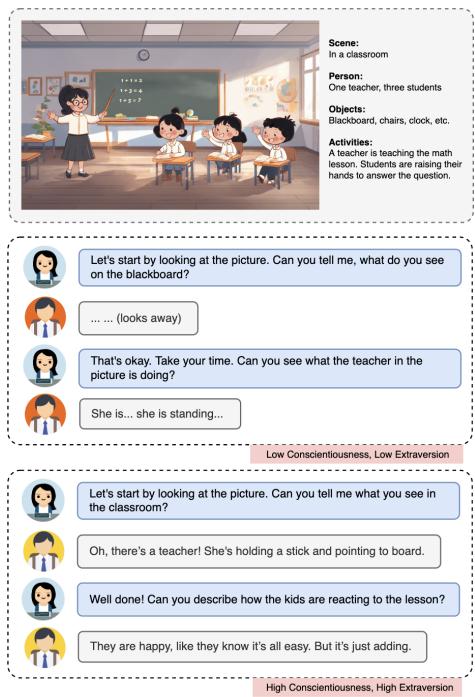
In the image above, notice the stark contrast. The student with Low Conscientiousness and Low Extraversion (top bubble) is disengaged, giving bare-minimum answers like “She is… she is standing…” despite prompts. In contrast, the student with High Conscientiousness and High Extraversion (bottom bubble) is enthusiastic, offering detailed observations like “She’s holding a stick” and inferring emotions (“They are happy”).
The Experiment: Image Description Tasks
To test this framework, the authors set up a role-play scenario involving Image Description. This is a common language learning task for primary school students where they must describe a picture (people, setting, actions) to a teacher.
The Setup:
- The Teacher: An LLM prompted to act as a primary school teacher using “knowledge construction” techniques (scaffolding).
- The Student: An LLM (the simulator) prompted with specific BF-TC traits and language abilities.
- The Models: They tested several models, including Zephyr-7B, Vicuna-13B, GPT-3.5, and GPT-4.
The goal was to generate hundreds of dialogues and then analyze them to see if the “students” stayed in character and if the “teachers” adapted their strategies.
Validation: Did the AI Stay in Character?
It is one thing to tell an LLM “be neurotic,” and another for it to consistently act that way throughout a conversation. The researchers employed a multi-aspect validation approach.
1. Can we detect the personality?
They used an automated evaluator (LLM-as-a-judge) to read the generated logs and guess the personality of the student. If the generator did a good job, the evaluator should be able to easily identify the assigned traits.
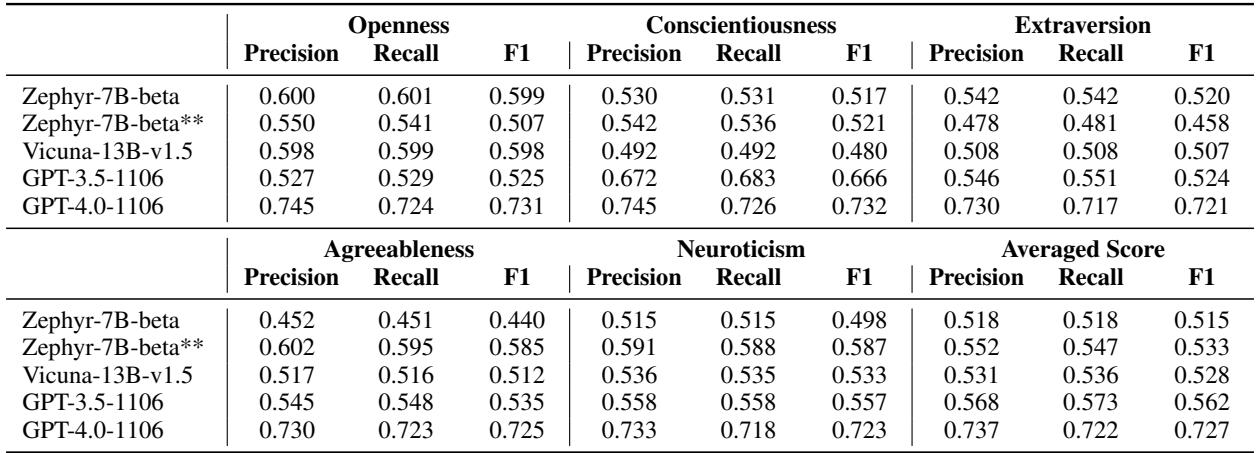
The results (Table 2) show that GPT-4 was significantly better at following the personality instructions than the smaller open-source models (Zephyr and Vicuna) or GPT-3.5. GPT-4 achieved high precision and recall, meaning when it was told to simulate a “Conscientious” student, it produced dialogue that was recognizably conscientious.
2. Psychometric Testing for AI
To double-check the validity, the researchers administered a standard psychometric test—the Big Five Inventory (BFI)—to the simulated students. They essentially asked the AI student, “How much do you agree with the statement: I see myself as someone who is talkative?”

The results were highly consistent. The Cronbach’s alpha (a measure of reliability) was over 0.9 for all traits, which is exceptionally high. This suggests that the BF-TC prompting scheme successfully instilled a coherent personality structure into the LLM.
Furthermore, they checked the consistency between their custom “Tutoring Conversation” traits (BF-TC) and the standard “Vanilla” Big Five traits.
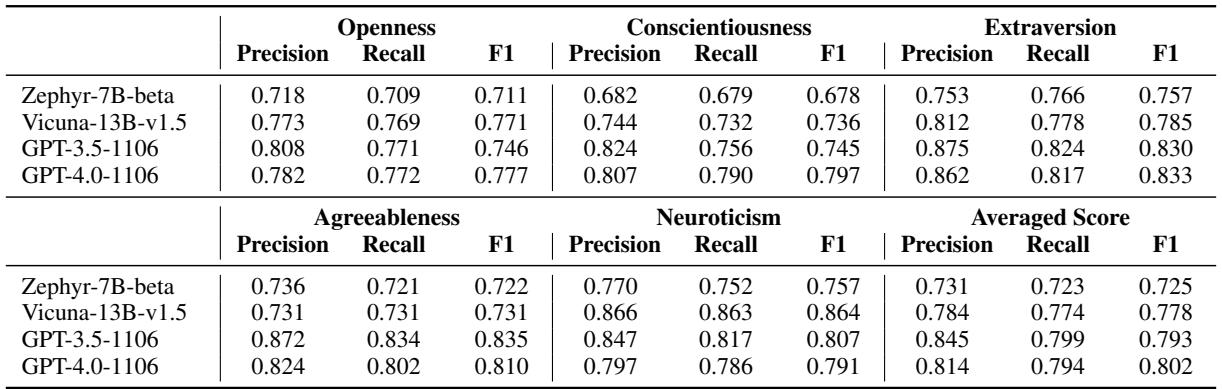
As shown in Table 5, there was a high alignment (F1 scores above 0.8 for GPT-4). This confirms that their specialized classroom personality definitions map correctly onto standard psychological profiles.
3. Visualizing the Differences
To visualize how distinct these personalities really were, the researchers plotted the embeddings (mathematical representations of the text) of the student responses.
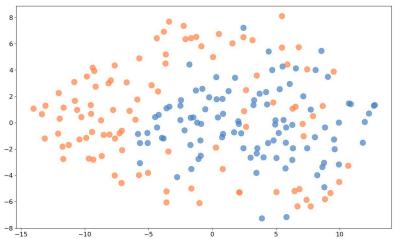
In Figure 3, the orange dots represent simulations with the specific personality instructions, while the blue dots are generic simulations. The orange cluster is distinct, showing that the personality-aware simulation produces a different “flavor” of language compared to the default LLM behavior (which tends to be generically helpful and polite).
The Teacher’s Response: Adaptive Scaffolding
Perhaps the most pedagogical finding of the paper is how the Teacher agent responded to these simulated students. Remember, the teacher agent wasn’t explicitly told “The student is neurotic, so be nice.” It simply reacted to the conversation flow.
The researchers analyzed the teacher’s utterances using Scaffolding Categorization. Scaffolding refers to the support given during the learning process, which is tailored to the student’s needs. Categories included Hints, Questioning, Modeling (demonstrating the answer), and Social-emotional Support.
Adapting to Ability
First, they looked at how the teacher treated High vs. Low ability students.
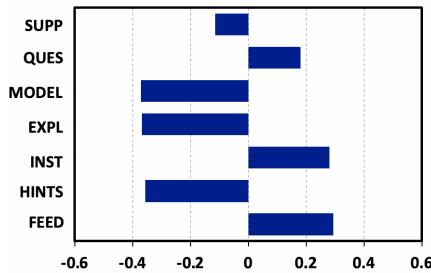
The bar chart above reveals a clear trend:
- Low Ability Students (Negative correlation): The teacher used more Hints, Explaining, and Modeling. Since the student struggled to form sentences, the teacher stepped in to demonstrate or explain how to do it.
- High Ability Students (Positive correlation): The teacher used more Instructing (guiding the next step) and Feeding back (confirming correctness).
Adapting to Personality
The more subtle analysis involved personality traits. Did the teacher treat an “Open” student different from a “Neurotic” one?
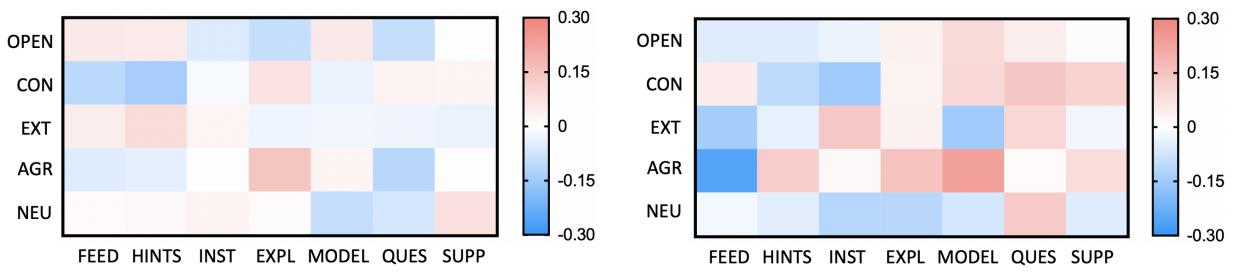
The heatmap above separates students by ability (High on the left, Low on the right). The adaptation is most visible with Low Ability students (Right chart).
- Neuroticism: Look at the bottom row of the right chart. High Neuroticism correlates negatively with almost all instructional strategies (Hints, Modeling, Explaining) but positively with Questioning. This suggests the teacher treaded carefully, avoiding overwhelming a nervous student with heavy instructions, perhaps opting to gently prompt them instead.
- Openness/Extraversion: Students who were low in these traits (shy, incurious) received more Hints (indicated by the negative blue correlation to Openness). If a student didn’t volunteer ideas, the teacher had to provide more clues to keep the lesson moving.
This proves that LLM-based tutors can implicitly adapt their teaching strategies based on the behavioral cues of the student, creating a dynamic feedback loop similar to human interaction.
Conclusion and Future Implications
This research demonstrates that LLMs are not just capable of acting as tutors; they are capable of acting as diverse, complex learners. By modulating the Big Five personality traits and language ability, Liu et al. successfully created a simulator that mimics the variability of a real classroom.
Key Takeaways:
- Feasibility: LLMs (specifically GPT-4) can faithfully simulate specific personality profiles in an educational context.
- Consistency: The “Big Five for Tutoring Conversation” framework aligns well with established psychological theories.
- Adaptability: Simulated interactions trigger genuine adaptive behaviors in AI tutors. “Teachers” naturally shift from direct instruction to emotional support or hinting depending on whether the “student” acts confident, anxious, or struggling.
For the field of EdTech, this is a game-changer. It means developers can stress-test their tutoring bots against thousands of “synthetic students”—ranging from the highly motivated genius to the anxious, struggling learner—before a real student ever logs in. This ensures that when AI tutors finally reach the classroom, they are prepared not just for the curriculum, but for the humans learning it.