](https://deep-paper.org/en/paper/2404.07840/images/cover.png)
The capabilities of Large Language Models (LLMs) like GPT-4, Llama, and Mistral have exploded in recent years. We marvel at their ability to write code, summarize diverse texts, and answer complex questions. Yet, for all their power, the training process remains largely a “black box.”
We know that we feed these models massive datasets—trillions of tokens—and they emerge as intelligent agents. But if a model is particularly good at summarizing legal documents, which specific training examples caused that skill to emerge? Conversely, if a model hallucinates facts about history, which bad data points are to blame?
For students and researchers in NLP, answering these questions is known as Training Data Attribution (TDA). Historically, this has been difficult, computationally expensive, and limited to simple metrics like “loss.”
In this post, we will dive deep into a paper titled “On Training Data Influence of GPT Models” by researchers from Baidu Inc., Sun Yat-sen University, and the University of Copenhagen. They propose GPTfluence, a novel, simulation-based approach that doesn’t just track loss—it predicts how training data impacts complex metrics like BLEU and ROUGE, and crucially, it generalizes to unseen data.
The Problem: Tracing the Source of Intelligence
To optimize training and debug models, we need to understand the relationship between the input (training data) and the output (performance on a specific test case).
Existing methods generally fall into two categories:
- Gradient-Based Methods (e.g., TracIn): These methods look at the gradients (the direction the model updates its weights) during training. If a training example moves the weights in a direction that helps a specific test example, it gets a high influence score. The downside? It requires saving massive amounts of checkpoint data and performing expensive gradient calculations. It usually only predicts “Test Loss,” not actual generation quality.
- Simulation-Based Methods (e.g., Simfluence): These methods try to “simulate” the training run. They learn a function that predicts the test loss at step \(t\) based on the loss at step \(t-1\). However, previous simulators were often tied to specific data indices. If you introduced a new training example the simulator hadn’t seen before, it broke.
The authors of GPTfluence identified a major gap: We need a method that works on Generative metrics (not just loss), handles the scale of GPT models, and generalizes to new, unseen data.
The Solution: GPTfluence
The core innovation of GPTfluence is Featurized Simulation. Instead of treating training examples as anonymous ID numbers, GPTfluence looks at the content of the data (its features).
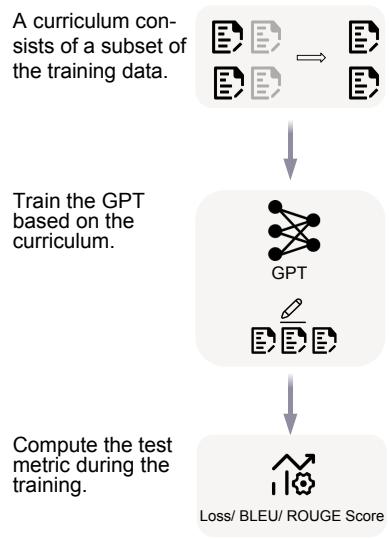
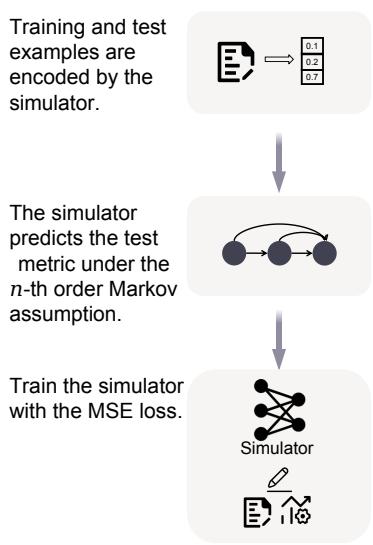
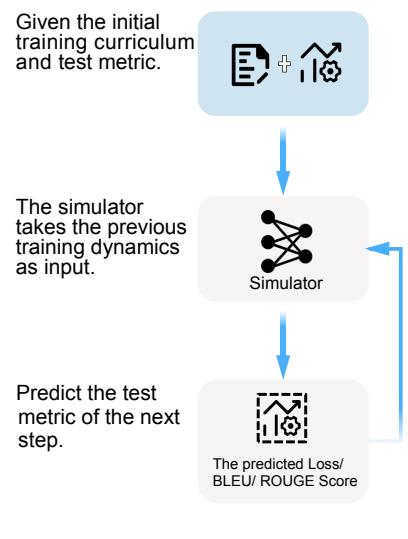
The process is broken down into three distinct steps, as illustrated below.
Step 1: Collecting the Dynamics
First, we need ground truth data. The researchers train actual GPT models (ranging from 14M to 2.8B parameters) on subsets of data. During these training runs, they track the performance of test examples at every step. This collection of training curricula and the resulting performance trajectories is called GPTDynamics.
Step 2: Training the Simulator
Once the data is collected, we don’t look at the GPT model anymore. We train a lightweight Simulator. This simulator takes the current state of a test example and the current batch of training data, and it tries to predict what the test performance will be in the next step.
Step 3: Inference (Simulation)
Once the simulator is trained, you can give it a new curriculum (a new sequence of training data) and a new test example. It will autoregressively predict the performance curve of that test example without ever actually training a massive GPT model again.
The Core Method: Featurized Simulation
Let’s unpack the mathematics and architecture that make this simulator work. The goal is to predict the metric score \(\phi\) (which could be Loss, BLEU, or ROUGE) for a test example \(z'\) at time \(t\).
The n-th Order Markov Process
The authors model the training dynamics as an \(n\)-th order Markov process. This means the performance at the current step depends on the performance at the previous \(n\) steps, plus the influence of the current training data batch.
The update rule is formulated as:
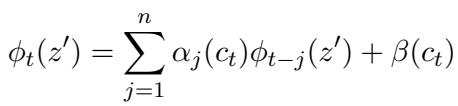
Here:
- \(\phi_t(z')\) is the predicted score at step \(t\).
- \(\alpha_j(c_t)\) is a multiplicative factor (how much the previous state amplifies/dampens).
- \(\beta(c_t)\) is an additive factor (the direct contribution of the current batch).
These factors, \(\alpha\) and \(\beta\), are not random; they are calculated by aggregating the influence of every individual training example in the current batch \(c_t\).

The “Featurized” Innovation
This is the most critical part of the paper. Previous methods (like Simfluence) learned these \(A\) and \(B\) factors for specific training IDs. GPTfluence instead uses features.
It uses a pre-trained encoder (like BERT or a small GPT) to turn both the training example \(z_i\) and the test example \(z'\) into vectors (embeddings).

Because the simulator operates on these vectors (\(h\)), it can understand the semantics of the data. If the simulator learns that “summarization training data” improves “summarization test data,” it can apply that knowledge to new summarization examples it has never seen before, simply because their vector representations are similar.
The influence factors \(A\) (multiplicative) and \(B\) (additive) are computed by looking at the interaction between the training vector and the test vector:
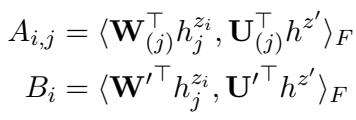
Essentially, the model learns weight matrices (\(W\) and \(U\)) that decide how a specific type of training data interacts with a specific type of test case to change its performance metric.
Experimental Results
The researchers tested GPTfluence on Pythia models ranging from 14M to 2.8B parameters, using datasets like FLAN (which includes RTE, SST-2, BoolQ, etc.). They compared their method against TracIn, Grad-Dot, and the original Simfluence.
1. Estimating Test Loss
The most basic sanity check for TDA methods is predicting the test loss curve. As shown in Table 1 below, GPTfluence achieves significantly lower Mean Squared Error (MSE) and higher correlation (Spearman’s \(\rho\)) than the baselines across various model sizes.
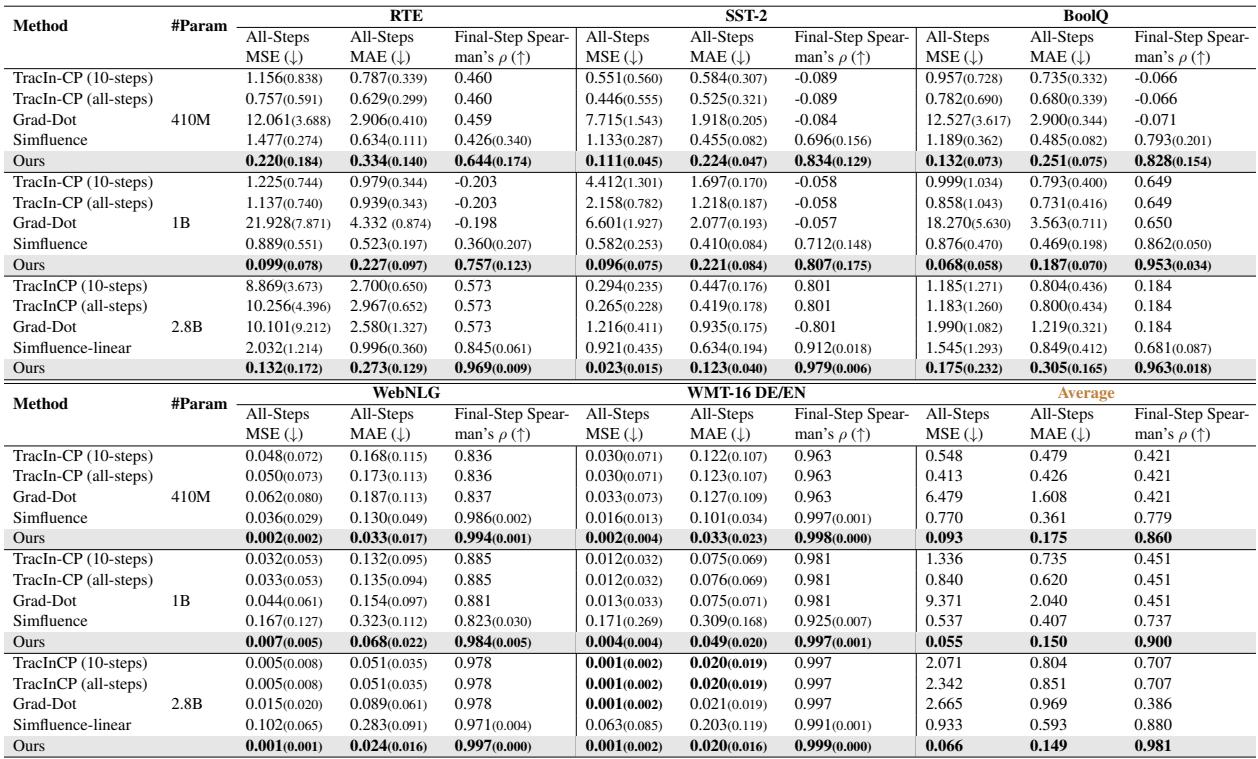
Notice the massive difference in MSE. For the 410M parameter model, GPTfluence achieves an MSE of 0.220 compared to TracIn’s 1.156.
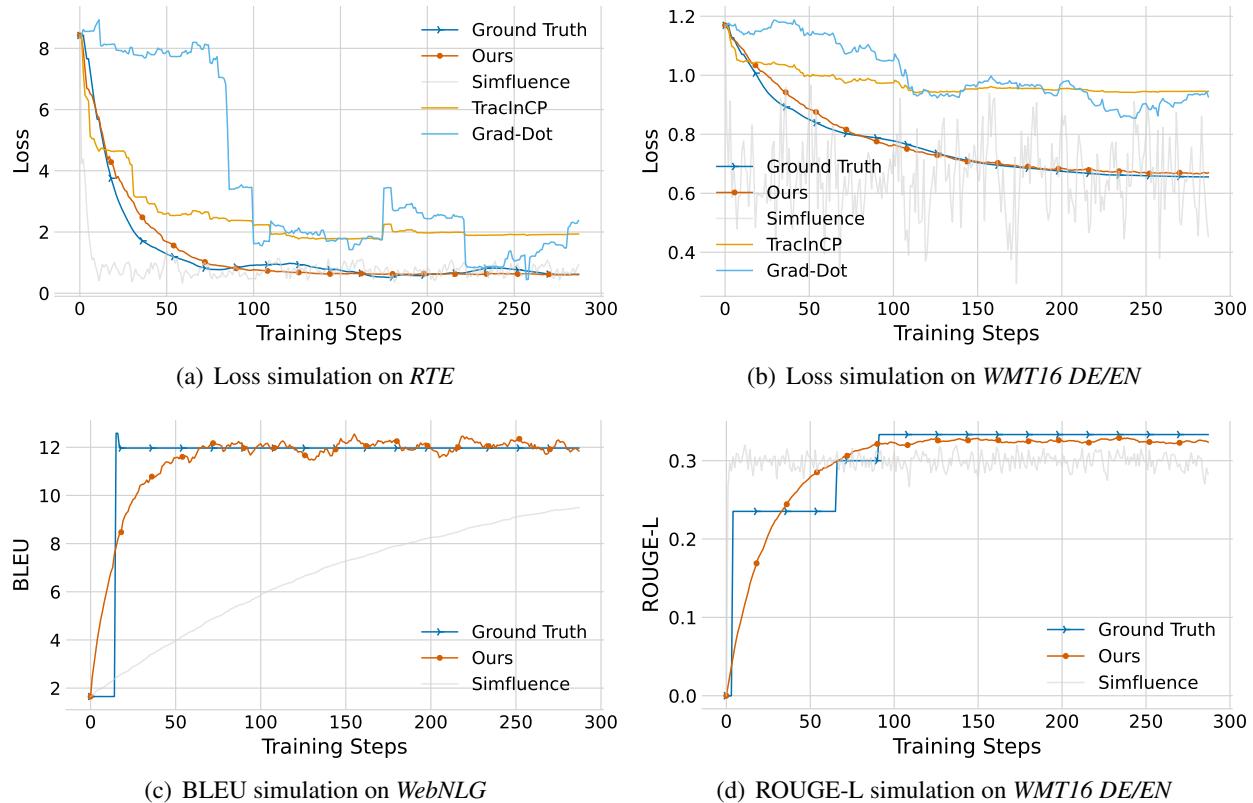
We can visualize this performance in the charts below. The “Ground Truth” (blue line) represents the actual training run. The “Ours” (orange line) tracks it almost perfectly, whereas other methods often diverge or fail to capture the training dynamics.
2. Generalizing to Unseen Data
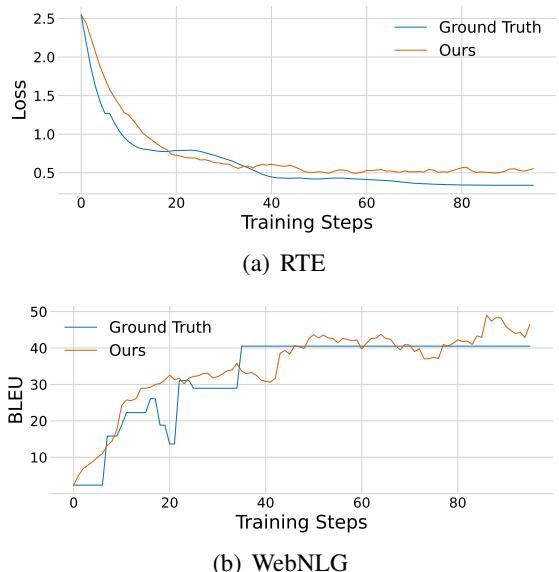
One of the paper’s boldest claims is the ability to handle unseen data. In their experiments, they simulated scenarios where:
- The training curriculum contained new examples.
- The test examples were new.
- Both were new.
As seen in Figure 8 below, GPTfluence (orange) closely follows the Ground Truth (blue) even when the simulator encounters data it wasn’t trained on. This confirms the power of the “featurized” approach—the model learns general principles of data influence rather than memorizing specific examples.
3. Predicting Generative Metrics (BLEU & ROUGE)
Most TDA methods stop at Loss. But Loss doesn’t always correlate perfectly with generation quality. You want to know if a document improves your model’s ability to translate (BLEU) or summarize (ROUGE).
GPTfluence is capable of simulating these metrics directly.
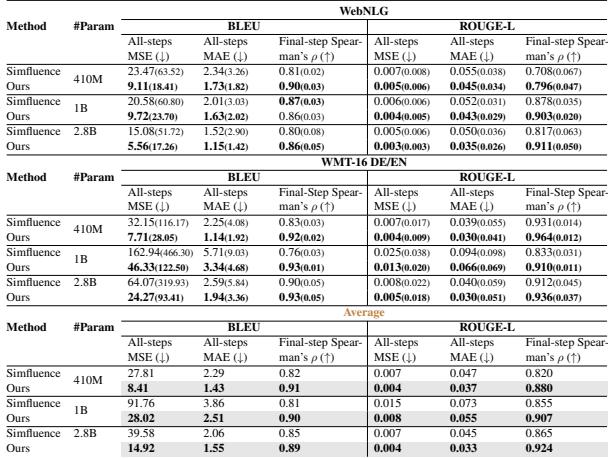
In Table 3, looking at the Pythia-2.8B model on the WebNLG dataset, GPTfluence achieves a BLEU prediction MSE of 5.56, drastically lower than Simfluence’s 15.08. This capability allows researchers to optimize datasets specifically for high-quality generation, not just low perplexity.
4. Robustness Across Scale
Does the method break when the model gets huge? The authors tested this on the Pythia suite up to 2.8B parameters.
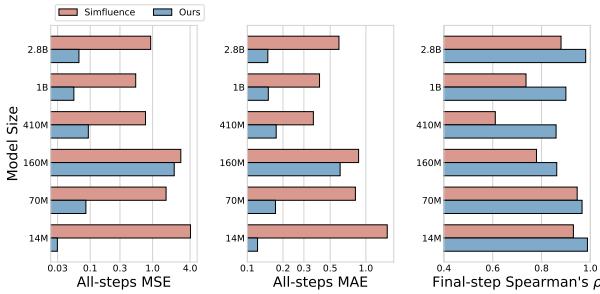
The charts above show that while the task gets harder as models get larger (error rates generally rise), GPTfluence (blue bars) consistently maintains a lower error rate and higher correlation than Simfluence (pink bars) regardless of the model size.
Use Case: Cleaning Mislabeled Data
Why does this matter? Beyond theoretical interest, TDA is a practical tool for data hygiene.
The researchers set up an experiment where they intentionally flipped labels in the SST-2 (sentiment analysis) dataset, corrupting 40% of the data. They then used different methods to identify the “bad” data points.
They calculated the influence of training examples on the model’s loss. Logic dictates that mislabeled data should have a high negative influence (or high contribution to loss).
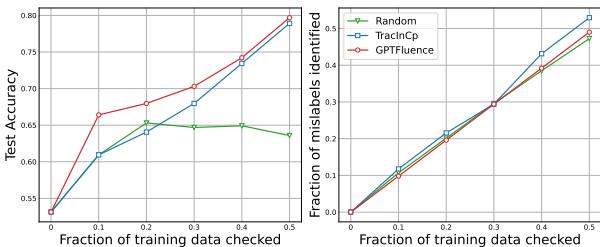
In Figure 7 (Left), look at the Test Accuracy. As they removed data identified by GPTfluence (red line) as “bad,” the model’s accuracy shot up faster than when using TracIn or random selection. This proves that GPTfluence can effectively pinpoint detrimental training data, acting as a filter to clean datasets and improve model performance.
Conclusion
The “black box” of LLM training is slowly opening. GPTfluence represents a significant step forward by moving away from expensive gradient tracking and rigid ID-based simulations.
By using a featurized simulator, the authors have created a tool that:
- Understand Semantics: It treats data as vectors, allowing it to generalize to unseen examples.
- Goes Beyond Loss: It predicts the metrics that actually matter to users, like BLEU and ROUGE.
- Scales: It remains effective even as the target GPT models grow in size.
For students studying this field, this paper highlights the importance of “Metamodeling”—using smaller models (the simulator) to understand the behavior of larger models (the GPT). As LLMs continue to grow, tools like GPTfluence will be essential for curating the massive datasets required to train the next generation of AI.