](https://deep-paper.org/en/paper/2404.07979/images/cover.png)
The Cheat Sheet Strategy: How LLoCO Masters Long Contexts Efficiently
Imagine you are a student preparing for a grueling final exam covering an entire textbook. You have three ways to tackle this.
First, the “Open Book” approach: you bring the entire textbook into the exam hall. You have all the information, but flipping through thousands of pages to find one specific answer takes forever. Second, the “Closed Book” approach: you rely solely on what you memorized. It’s fast, but if the exam asks about specific details from page 342, you’re out of luck.
Now, consider a third option: the “Cheat Sheet” approach. You study beforehand, compressing the textbook’s vast information into a concise, dense set of notes. During the exam, you only bring this cheat sheet. It’s fast to read, easy to manage, and if you studied well, it contains exactly what you need.
In the world of Large Language Models (LLMs), processing long documents—like books, legal contracts, or scientific papers—has historically been an “Open Book” struggle. It is computationally expensive and slow.
Researchers from UC Berkeley have introduced a new method called LLoCO (Learning Long Contexts Offline). This technique essentially teaches LLMs to utilize the “Cheat Sheet” strategy. By compressing long contexts offline and teaching the model how to read these compressed summaries via parameter-efficient finetuning, LLoCO extends a standard 4k token context window to handle up to 128k tokens, runs 30x faster, and achieves state-of-the-art accuracy.
In this post, we will dissect the LLoCO paper, exploring how it turns massive documents into manageable embeddings and why “offline learning” might be the future of long-context processing.
The Bottleneck: Why Long Context is Hard
Before diving into LLoCO, we need to understand why reading long texts is so difficult for standard Transformers.
The core issue lies in the self-attention mechanism. As the length of the input sequence increases, the computational cost and memory usage grow quadratically. If you double the length of the text, the cost doesn’t just double—it quadruples. Furthermore, during generation, the model must store the Key-Value (KV) cache for every token in the history, which eats up massive amounts of GPU memory (VRAM).
Current solutions generally fall into two buckets:
- Context Window Extension: Techniques like RoPE scaling allow models to accept more tokens (e.g., 32k or 128k). However, this doesn’t solve the quadratic cost; it just pushes the limit further out, making inference slow and expensive.
- Retrieval-Augmented Generation (RAG): This breaks documents into chunks and retrieves only the top-k most relevant chunks. While efficient, RAG can miss information that requires reasoning across the whole document or fails when the “answer” depends on subtle context not captured by the retriever.
There is a third, less traveled path: Context Compression. This involves squeezing a long prompt into a smaller set of “summary tokens.” Historically, this has been difficult. If you compress a novel into a paragraph, you lose nuance. LLMs often hallucinate or fail to utilize these compressed representations effectively because they were never trained to interpret such dense information.
This is where LLoCO changes the game.
The LLoCO Architecture
LLoCO stands for Learning Long Contexts Offline. The key insight is that compression alone isn’t enough; the model must be taught how to read the compression.
The architecture is split into two distinct parts: a Context Encoder and an LLM Decoder.
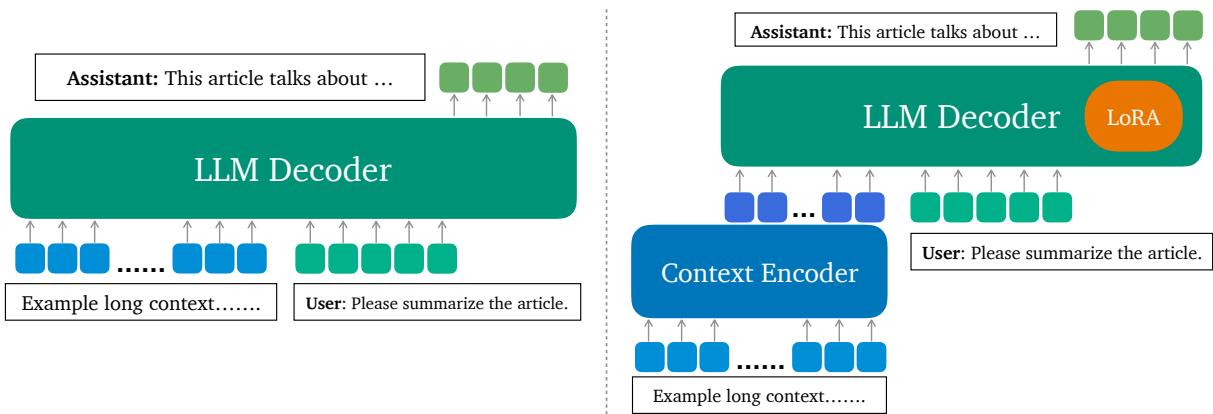
As shown in Figure 1 above, the standard approach (left) forces the LLM to process the entire long document at inference time. LLoCO (right) changes this flow:
- Context Encoder: The long document is processed offline by a separate encoder. This encoder compresses the text into a sequence of concise “summary embeddings.”
- LoRA Finetuning: This is the magic step. The researchers use Low-Rank Adaptation (LoRA) to finetune the LLM. This finetuning aligns the LLM’s understanding with the compressed embeddings, effectively teaching it the “language” of the cheat sheet.
- Inference: When a user asks a question, the LLM only sees the compressed summary embeddings and the user’s question.
Step 1: Compressing the Context (The “Cheat Sheet”)
For the Context Encoder, LLoCO utilizes a model called AutoCompressor. This model is designed to take a long sequence of text and output a significantly smaller set of “summary tokens.”
In the paper’s implementation, the document is split into chunks of 1536 tokens. The AutoCompressor processes each chunk and compresses it into just 50 summary tokens. This results in a compression ratio of roughly 30x.
These summary tokens are not natural language words; they are vector embeddings—pseudo-words that represent the abstract semantic content of the original text. You can think of this as creating a highly dense zip file of the document that only the neural network can read.
Step 2: In-Domain Finetuning (The “Study Session”)
Previous attempts at context compression often failed because they took a “one-size-fits-all” approach. They hoped a standard LLM could magically understand these compressed embeddings. LLoCO argues that the model needs to be specialized.
The researchers treat the LLM like a student who needs to practice using their cheat sheet. They perform Instruction Finetuning using LoRA. They take a specific domain (e.g., academic papers, financial reports) and train a lightweight LoRA adapter to answer questions based only on the compressed summary embeddings.
Mathematically, the goal is to maximize the probability of the correct answer (\(\mathbf{X}_a\)) given the compressed summary embeddings (\(\mathbf{X}_m\)) and the question (\(\mathbf{X}_q\)).
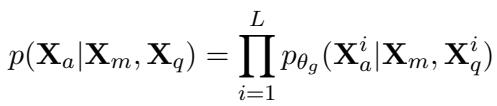
In this equation:
- \(\mathbf{X}_m\) are the summary tokens (the compressed context).
- \(\mathbf{X}_q\) is the question.
- \(\theta_g\) represents the LoRA weights specific to that document group.
By optimizing \(\theta_g\), the model learns to “navigate” the compressed information effectively, reducing hallucinations and improving retrieval accuracy.
Step 3: The Serving Pipeline
How does this look in a real-world application? The authors propose a system design that integrates seamlessly with RAG (Retrieval Augmented Generation) workflows.
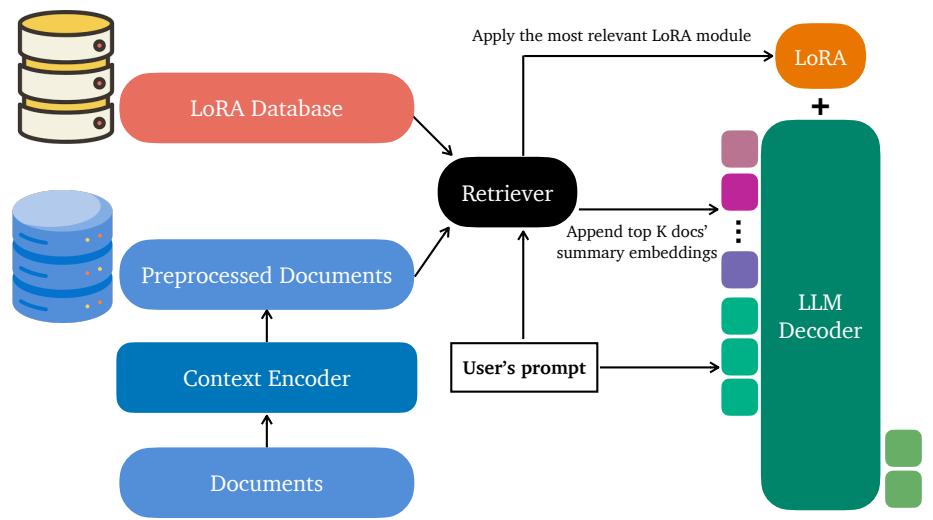
As illustrated in Figure 7 (bottom half of the image above), the pipeline works as follows:
- Preprocessing: Documents are compressed into summary embeddings and stored in a vector database.
- Retrieval: When a user query comes in, a standard retriever finds the relevant compressed document embeddings.
- LoRA Selection: The system identifies which document group the content belongs to and loads the corresponding lightweight LoRA adapter.
- Generation: The LLM generates the answer using the adapter and the compressed context.
This design allows for massive scalability. Since LoRA adapters are tiny, a system can serve thousands of different “specialized” contexts on a single GPU.
Experimental Results: Does It Work?
The researchers evaluated LLoCO on several rigorous long-context benchmarks, including QuALITY, Qasper, NarrativeQA, HotpotQA, and QMSum. They compared LLoCO against standard LLaMA2 models (4k and 32k context windows) and retrieval-based baselines.
Accuracy vs. Compression
The results are striking. Even though LLoCO sees 30x fewer tokens than the full-context baselines, it matches or outperforms them.
In Table 1 (referenced from the paper’s data), LLoCO consistently outperforms the “AutoCompressor” baseline (which lacks the finetuning step), proving that the “study session” (finetuning) is essential. More impressively, it outperforms LLaMA2-32k with retrieval on almost all tasks.
On NarrativeQA, which involves answering questions about entire books (averaging 84k tokens), standard models struggle because the text exceeds their context window. LLoCO compresses these massive texts into a manageable size (~2,600 tokens) and achieves superior performance.
The “Needle in a Haystack” Test
A common stress test for long-context models is “Needle in a Haystack”: placing a specific, random piece of information (the needle) somewhere in a massive text (the haystack) and asking the model to retrieve it.
The researchers tested LLoCO’s ability to retrieve information from different positions within a long context.
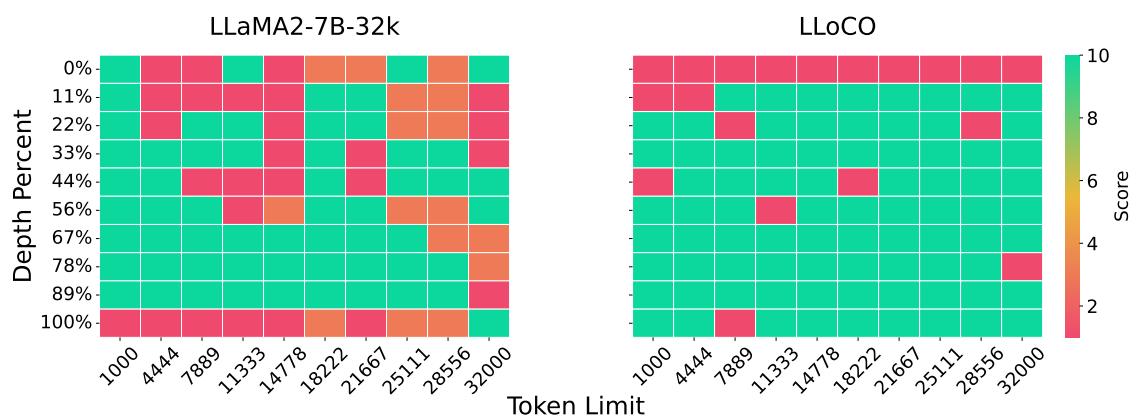
Figure 3 compares a standard LLaMA2-32k model (left) against LLoCO (right).
- The LLaMA2-32k model struggles as the context grows and the needle is placed deeper in the text (indicated by the red/orange zones).
- LLoCO, however, maintains a high success rate (green zones) regardless of where the information is located or how long the context is.
They also tested a harder version with random city-word pairs:
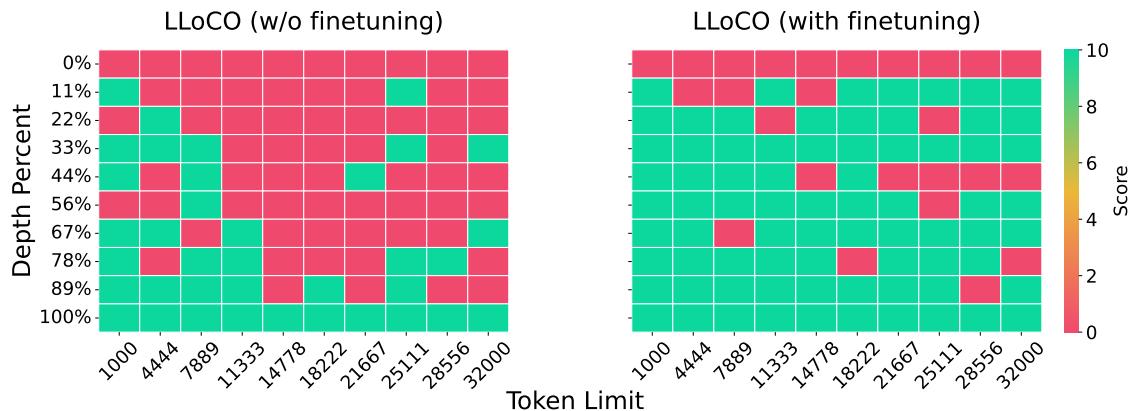
Figure 4 highlights the importance of the finetuning step. Without it (left), the model fails to find the needle in the compressed representations. With finetuning (right), the model becomes highly effective at extraction.
Impact of Compression Ratios
One might wonder: how much can we compress before the “cheat sheet” becomes unreadable? The authors explored compression ratios of 20x, 30x, and 40x.
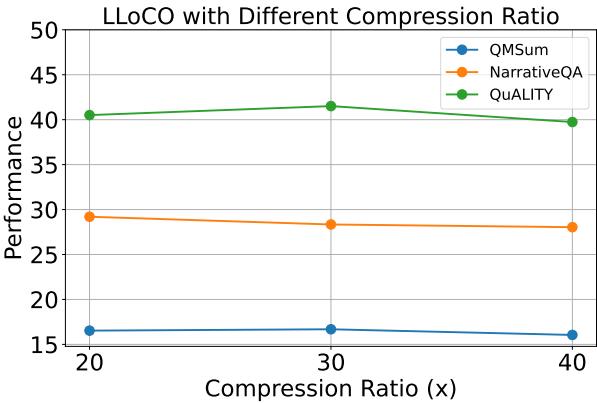
As shown in Figure 2, performance is remarkably stable. The 30x compression ratio (used in the main experiments) sits in a “sweet spot,” offering massive efficiency gains without significant loss in accuracy compared to the 20x setting.
Speed and Efficiency: The Real Payoff
The primary motivation for LLoCO isn’t just accuracy—it’s cost and speed. Processing 100,000 tokens for every single user query is prohibitively expensive. LLoCO changes the economics of long-context serving.
Inference Latency
Because the LLM only has to process the compressed summary tokens (which are 30x shorter than the original text), generation is significantly faster.
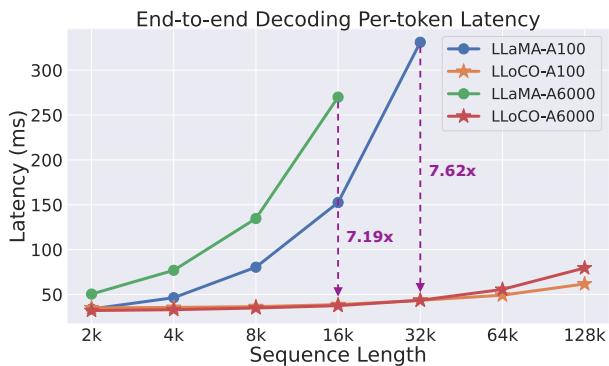
Figure 5 shows the latency per token. The blue line (Standard LLaMA on A100) shoots up exponentially as sequence length increases. The orange line (LLoCO on A100) stays nearly flat.
- At 32k tokens, LLoCO is 7.62x faster than the baseline.
- LLoCO enables a standard LLaMA2-7B model to handle 128k tokens on a single GPU, whereas the standard model runs out of memory (OOM) at much shorter lengths.
Finetuning Throughput
The efficiency gains extend to the training phase as well. If you want to finetune a model on long documents, you typically need massive compute clusters.
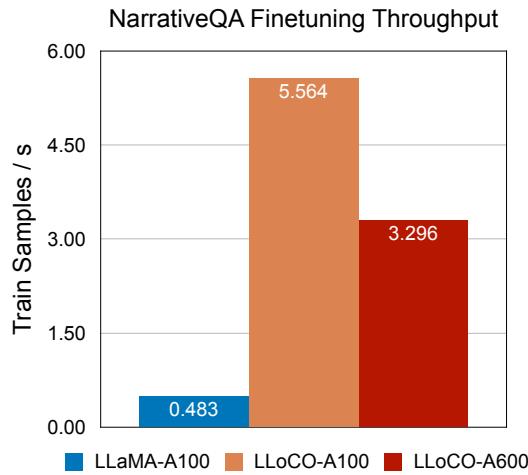
Figure 6 demonstrates that finetuning LLoCO is over 11x faster (in samples per second) than finetuning on the full raw text. This makes it feasible to train custom long-context models on modest hardware.
Conclusion & Implications
LLoCO presents a compelling shift in how we think about Large Language Models and memory. Instead of forcing models to “read” an entire library every time we ask a question, LLoCO proves that we can separate the reading (encoding) from the answering (decoding).
By compressing contexts offline and teaching the model to understand these compressed representations via LoRA, LLoCO achieves the best of both worlds:
- Massive Context: Effectively handling up to 128k tokens.
- High Speed: Inference latency comparable to processing short prompts.
- Low Cost: Significantly reduced VRAM usage and computational overhead.
This “semi-closed-book” approach suggests a future where LLMs act more like experts referencing shorthand notes rather than generalists reading from scratch. As we look toward building AI agents that can digest entire codebases, legal archives, or historical records, techniques like LLoCO will be essential infrastructure for making these interactions fast, accurate, and affordable.